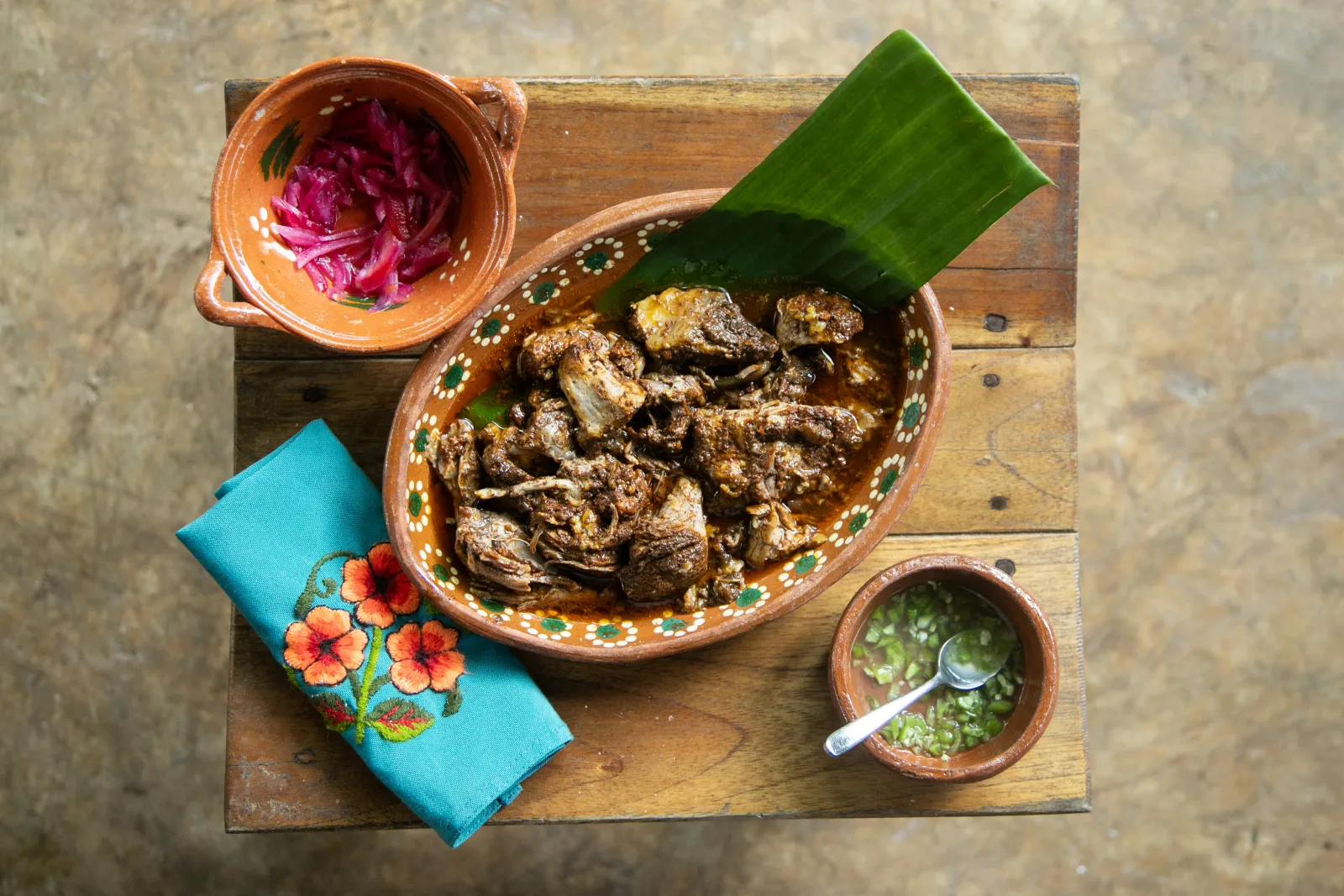

Cochinita pibil (koh-chee-NEE-tah pee-BEEL) is pulled pork from Mexico’s Yucatán Peninsula, and if you know American barbecue, it will surprise you: no smoke, no sugar, no rub. The pork sits overnight in a brick-red paste of ground annatto seed and sour orange juice, gets wrapped in banana leaves and steams in its own juices until it falls apart. It’s piled into corn tortillas under a heap of pink pickled onions with habanero. It was traditionally buried in a pib, a Maya pit oven; at home a 325°F (160°C) oven and a well-sealed pan do the same job.
What cochinita pibil is, and whether it’s worth the overnight wait
How do you make cochinita pibil? Blend 3.5 oz (100 g) of achiote paste with 1 cup (250 ml) of sour orange juice, garlic, cumin, oregano and salt, coat 4.4 lb (2 kg) of chunked pork shoulder and refrigerate 12 hours. Wrap it in banana leaves, seal with foil and bake at 325°F (160°C) for 3½ hours, until it shreds at 195-203°F (90-95°C). Serve in tortillas with habanero pickled onions. 1010 minutes (75 of them hands-on, the rest is marinating and oven time) for 8 servings.
It’s worth it, especially for a crowd. The oven time is identical for 8 people and for 20, and nearly all of it is waiting: about 45 minutes of work on the day, plus half an hour the evening before.
Good for. A taco party, a birthday, a long weekend lunch, or a batch of meat you can eat from all week. It holds well in its covered dish and tastes even better reheated.
Not for. A last-minute dinner, because it needs at least 4 hours of marinating and ideally 12. Anyone who wants a fiery dish should know the pork itself has zero heat; it all lives in the onions.
Honest difficulty, medium. Nothing here is technically hard. It goes wrong when you open the oven, trim the fat off the shoulder, or leave lumps of achiote in the marinade.
Achiote, annatto, onoto. Achiote is the Mexican name for annatto, the seed that colors Red Leicester cheese and many cheddars. Venezuelans call it onoto and use it to tint the dough of Venezuelan hallacas. It tastes earthy and faintly bitter, and it isn’t spicy.
Ingredients, with US and UK swaps
Quantities are in the recipe card: 4.4 lb (2 kg) pork shoulder, a 3.5 oz (100 g) block of achiote, about 1¾ cups (430 ml) of sour orange juice between the marinade and the onions, 2 red onions and 1 habanero for 8. Four of those are hard to find outside Mexico, and here’s what to do about each.
| Ingredient | Where to buy it (US / UK) | Swap | What changes |
|---|---|---|---|
| Sour orange | US Latin grocers; UK Seville oranges, January and February | ½ orange juice + ½ lime juice | a little sweeter, less floral |
| Achiote paste | US Walmart and Latin stores; UK specialist Mexican shops online | homemade recado (below) | more aroma, no additives |
| Banana leaves | frozen, in Latin and Asian grocers in both countries | parchment paper + foil | loses the faint grassy aroma, just as juicy |
| Habanero | most large US supermarkets; UK Caribbean grocers sell Scotch bonnets | Scotch bonnet, or serrano for less heat | serrano is far milder |
| Pork shoulder | ask for Boston butt (US) or pork shoulder (UK) | bone-in shoulder | more flavor, about an hour longer in my oven |
Sour orange, and the Seville orange in your fruit bowl
Sour orange is Citrus aurantium, the same species as the Seville orange British cooks buy for marmalade. UK supermarkets and greengrocers carry them for a short season, roughly late December to mid-February, and they freeze well whole. I squeeze a batch in season and freeze the juice in ice-cube trays, then pull out what I need.
The rest of the year, use equal parts orange juice and lime juice: ½ cup (125 ml) of each for the marinade, 6 tablespoons (90 ml) of each for the onions. It comes out a touch sweeter; I add the zest of half an orange to the marinade to bring back some bitterness. Orange juice alone won’t do it: it isn’t acidic enough to pickle the onions.
Achiote paste, store-bought or homemade
A standard block of achiote paste weighs 3.5 oz (100 g), exactly right for 4.4 lb (2 kg) of pork. In the US, El Yucateco blocks are on Walmart shelves; MexGrocer listed a 3.5 oz block for $4.95. Check the label if you’re cooking for someone who avoids gluten, as some brands add flour.
My homemade version for the same amount of pork: 3 tablespoons annatto seeds, 1 tsp cumin seeds, 1 tsp black peppercorns, 6 allspice berries and 3 cloves, ground in a spice grinder, sieved and ground again, because the seeds are rock-hard. Stir in the marinade’s citrus juice, a teaspoon of oregano and half a dozen crushed garlic cloves. It takes 20 minutes and smells brighter than the block.
The cut, and why the fat stays on
Pork shoulder, every time. It has fat and connective tissue running through it, and when that collagen melts at 195-203°F (90-95°C) it keeps the strands moist. USDA data puts raw shoulder at about 18 g of fat per 100 g. Leg (fresh ham) works but comes out drier; if that’s all you have, dot 1¾ oz (50 g) of lard over the top before sealing. Pork loin is too lean and dries out before it shreds.
Make-ahead plan and a serving-day timeline
Evening before, 30 minutes. Serving day, 260 minutes on the clock and 45 of work.
What you can do ahead. The marinade keeps up to 2 days in the fridge. The pork can sit in it up to 24 hours; longer than that, the acid turns the outside mealy. Or cook the whole thing 1-2 days early and reheat it in its juices, which is how I do it for a party.
How to tell each stage is right.
- Marinade. Thick like tomato sauce, deep red, and no grit when you run a finger through it.
- Banana leaves. Glossy, one shade darker, and they fold without cracking.
- The parcel. The foil stays taut; if your kitchen smells strongly of achiote after an hour, steam is escaping and the edges need crimping.
- Doneness. At 3½ hours the largest chunk falls apart with two forks and reads 195-203°F (90-95°C).
- Onions. After 30 minutes they turn hot pink and soften slightly but still crunch.
Safe is not the same as shreddable
USDA FSIS calls whole cuts of pork safe at 145°F (63°C) with a 3-minute rest, but at that point a shoulder is firm and sliceable, like a roast. To shred, its collagen has to melt into gelatin, which takes hours of moist heat. I pull it when the thickest piece reads between 195 and 203°F (90-95°C); without a thermometer, two forks tell you the same thing.
Oven, Instant Pot or slow cooker
- Oven (recommended) → as written, 325°F (160°C), 3½ hours sealed. The only method that scales to two pans without changing the timing.
- Instant Pot or pressure cooker → the marinated pork with its marinade and ½ cup (120 ml) water, on a piece of banana leaf, 50-60 minutes at high pressure and 15 minutes natural release. Shred, then simmer the juices uncovered for 10 minutes to thicken them.
- Slow cooker → I give it 8 hours on low with leaves lining the crock. It ends up wetter; reduce the juices in a pan.
- Chicken → 4.4 lb (2 kg) skinless thighs, 6 hours of marinating; I bake them covered for 1 hour 15 minutes at 350°F (180°C), and never below 165°F (74°C) inside, the FSIS safe temperature for poultry.
- Vegetarian → canned young green jackfruit, drained, in the same marinade for 2 hours; I give it 45 minutes covered in the oven. It shreds similarly but tastes flatter without the fat.
Scaling up for 20
| 8 people | 20 people | |
|---|---|---|
| Boneless pork shoulder | 4.4 lb (2 kg) | 11 lb (5 kg) |
| Achiote paste | 3.5 oz (100 g) | 9 oz (250 g), 3 blocks |
| Sour orange juice, marinade | 1 cup (250 ml) | 2½ cups (625 ml) |
| Garlic | 4 cloves | 10 cloves |
| Salt, marinade | 2 tsp (12 g) | 5 tsp (30 g) |
| Red onions | 2 large (14 oz / 400 g) | 5 large (2.2 lb / 1 kg) |
| Habaneros | 1 | 2-3 |
| Corn tortillas | 24 | 60 |
| 9 x 13 in baking dishes | 1 | 2 |
| Oven at 325°F (160°C) | 3 h 30 min | 3 h 30 min to 4 h |
For 20, both pans go in together and swap shelves halfway without opening them. A full oven runs a little slower, so I check at 3½ hours and allow an extra half hour. I count 9 oz (250 g) of raw pork per person, which makes 3 generous tacos.
Before you cook, mistakes, heat level, kids and allergens
The mistakes that matter.
- Dry pork → steam escaped, you used leg or loin, or you trimmed the fat. Crimp the foil hard, use shoulder, and skim fat afterwards rather than trimming before.
- Chalky, earthy taste → undissolved achiote. Soak the block in the juice for 5 minutes and blend a full minute.
- Pale inside → under-marinated. Four hours minimum, 12 ideally.
- Mealy outside → more than 24 hours in the acid. If you need to work ahead, cook early and reheat instead.
- Won’t shred → it needs time, it isn’t undercooked in the safety sense. Another 30 minutes, covered.
- Scorched bottom → oven too hot or nothing between meat and dish. Keep it at 325°F (160°C) with leaves or parchment underneath.
Heat level. The pork is 0 out of 5; the onions are about 4. Habaneros measure 100,000-350,000 Scoville units, in the same range as Scotch bonnets, and one is plenty for 14 oz (400 g) of onion. Wear gloves or wash your hands well after chopping it.
Kids. The pork is mild, tangy and usually a hit. Set some onions aside before adding the habanero.
Allergens. No gluten, dairy, egg, nuts or fish in the recipe itself. The one risk is store-bought achiote paste with added flour; read the label or make it from seeds. Corn tortillas are gluten-free when they’re 100% corn.
What it costs to feed 8
At US average prices from the Bureau of Labor Statistics for August 2026, 4.4 lb (2 kg) of pork at $3.737 a pound (the BLS “all other pork” category) comes to $16.48. Add a $4.95 block of achiote, $2.33 of lemons standing in for limes (the BLS doesn’t track limes) and $2.26 of oranges, and the priced ingredients total $26.02, or about $3.25 a serving. Tortillas, onions and banana leaves are on top. For 20 people the same list runs to about $67.50, since nothing but the shopping scales.
Serving, storing, freezing and reheating
How it’s eaten. In Yucatán, in corn tortillas as tacos or stuffed into a crusty roll as a torta, always with the pickled onions and a habanero salsa on the side. Black beans are the classic partner; Venezuelan black beans are close enough, with white rice if you want a plate rather than tacos, and a bowl of authentic Mexican guacamole on the table. If you like achiote-marinated pork, try my tacos al pastor next: same paste, thin slices seared in a skillet instead of hours in the oven. The same wrap-in-banana-leaves, cook-in-its-juices idea works with beef cheeks and dried chiles in my beef barbacoa with consommé. And for a Venezuelan take on slow-roasted, citrus-marinated pork, there’s Venezuelan pernil; Colombia’s whole stuffed pig, lechona, is the party-sized cousin.
Fridge. USDA FSIS guidance: no more than 2 hours at room temperature, then 3-4 days in the fridge at 40°F (4°C) or below. Store the pork in its juices. The pickled onions keep in a closed jar in the fridge; I use them within 4-5 days, after that they go soft.
Freezer. Shredded pork with its juices freezes well for 2-6 months (FSIS) in flat freezer bags. Don’t freeze the onions; make them fresh. Thaw overnight in the fridge.
Reheating. In a covered pan, or a foil-covered dish at 325°F (160°C), with 2-3 tablespoons of water or orange juice per pound (500 g), until it reaches 165°F (74°C) in the middle, the FSIS figure for leftovers. In the microwave, covered, in 1-minute bursts, stirring between them.
Frequently asked questions
What’s the difference between cochinita pibil and carnitas? Both start with pork shoulder, but carnitas are simmered and fried in lard until crisp, while cochinita is marinated in achiote and sour orange and steamed in banana leaves. Cochinita is redder, tangier and softer.
What can I use instead of sour orange? Equal parts orange juice and lime juice, so a cup of sour orange becomes half a cup of each. In the UK, Seville oranges are the real thing, in season around January and February.
Can I make cochinita pibil without banana leaves? Yes. Line the dish with parchment and seal it tightly with foil. The pork is just as juicy; you lose only the faint grassy aroma of the leaf.
How long should cochinita pibil marinate? Overnight is ideal, and four hours is the bare minimum. Past a full day the citrus makes the surface mealy.
How long does cochinita pibil take in the Instant Pot? Under an hour: 50-60 minutes at high pressure, a quarter hour of natural release, then 10 minutes reducing the juices. Add ½ cup of water to the pot so it comes to pressure.
Is cochinita pibil spicy? The pork isn’t; achiote has no heat. The habanero in the pickled onions is very hot, so serve them on the side for kids or anyone heat-shy.
What temperature is cochinita pibil done? It’s safe at 145°F (63°C), but it shreds at 195-203°F (90-95°C). At 325°F (160°C), that takes about 3½ hours for 2½-3 in chunks.
Can you freeze cochinita pibil? Yes, shredded and in its juices; FSIS gives cooked leftovers 2-6 months frozen, and I aim to use mine within three. Reheat to 165°F (74°C) with a splash of water or orange juice.
Nutrition
Per serving (one eighth of the recipe: pork, juices and pickled onions, without tortillas), calculated from USDA FoodData Central (SR Legacy) with the quantities above, the orange-and-lime swap and the 15 g of salt across marinade and onions:
- Calories: 633 kcal
- Protein: 44 g
- Carbohydrates: 11 g
- Fat: 45 g, of which 16 g saturated
- Fiber: 1 g
- Sugars: 5 g
- Sodium: 893 mg
Achiote paste isn’t in SR Legacy, so it’s left out; add the sodium listed on your brand. The fat figure is for raw shoulder, 360 g across the 4.4 lb; some stays in the dish, more if you skim the juices. Tortillas are extra: a 3-taco serving adds about 157 kcal and 32 g of carbohydrates (72 g of corn tortilla).
Growing up in Venezuela, onoto was for hallacas and for coloring rice, so the first time I put it on pork it felt like breaking a rule. What changed my mind was realizing the oven isn’t roasting the meat at all, it’s steaming it, and that the fat has to go in with it. Cochinita is the dish where patience and a tight lid do all the cooking. Josnaisis.