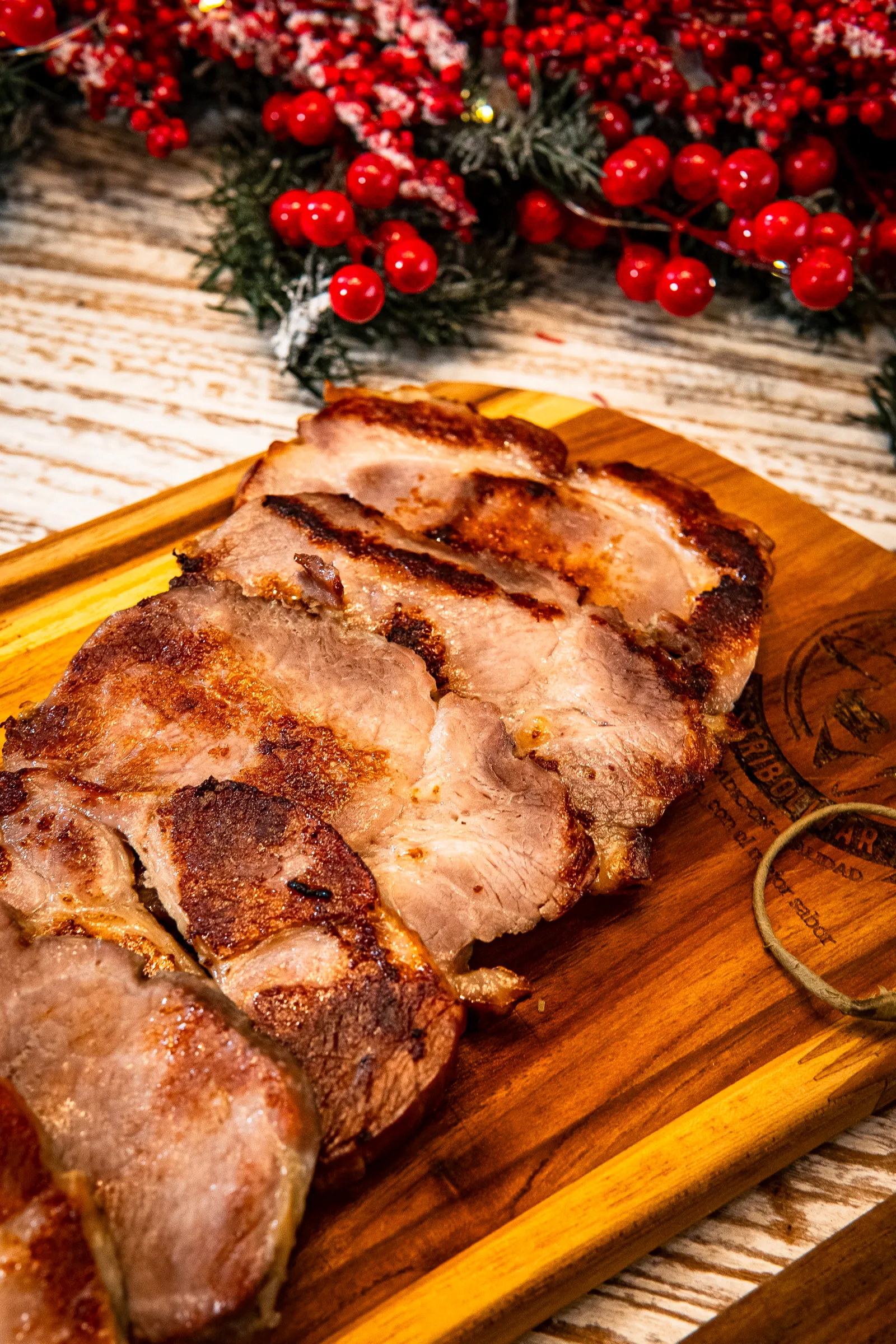

If you have ever had Puerto Rican pernil, the Venezuelan one will feel familiar and taste different: it’s a whole pork leg rubbed with garlic, sweet peppers, orange, wine and Worcestershire, roasted for most of an afternoon and finished with a piloncillo glaze. In Venezuela it shares the Christmas Eve plate with hallacas, ham bread and chicken salad, and it is the dish that feeds the most people per oven. What follows is the version I make for 8, the shopping list for a US or UK butcher, a three-day schedule that leaves Christmas Eve almost free, and the thermometer numbers that decide if it slices cleanly or pulls apart.
What is Venezuelan pernil, and is it worth 3 days?
How do you make Venezuelan pernil? Score the skin of a 7.7 lb (3.5 kg) bone-in fresh ham and rub the meat with a blended marinade of garlic, onion, bell pepper, ají dulce, orange juice, wine, Worcestershire and mustard. Refrigerate 24 hours. Roast covered at 325°F (160°C) for 4 hours 15 minutes, glaze with piloncillo and orange for an hour uncovered, and crisp the skin at 425°F (220°C). 1855 minutes spread over three days for 8 servings.
Pernil (pehr-NEEL) simply means pork leg in Spanish, and in Venezuela it means this roast. It is worth the three days if you are feeding 8 or more and want to cook ahead. Each day asks very little of you: 25 minutes on December 22, 10 on the 23rd and about 20 on Christmas Eve. The rest is fridge and oven time.
When it isn’t worth it. For 4 people (buy a shoulder instead), if your oven can’t take a roasting pan about 14 × 10 in (35 × 25 cm) with 6 in (15 cm) of headroom, or if you don’t own an instant-read thermometer and don’t plan to buy one.
Honest difficulty, medium. Nothing here is technically hard. What goes wrong is the calendar (starting on the 24th) and guessing doneness by the clock.
Buying the right cut in the US or UK
This is where most first attempts fail before they start. In US supermarkets “ham” almost always means cured and smoked; pernil needs fresh ham, the raw, uncured leg, which many stores only carry to order around the holidays. In the UK ask a butcher for a leg of pork joint with the skin on, and walk past the gammon, which is cured.
How much to buy. I count 14 oz (400 g) of bone-in leg per person when there are other dishes on the table, or 10.5 oz (300 g) boneless. That makes 7.7 lb (3.5 kg) for 8, with leftovers for sandwiches, and about 17.5 lb (8 kg) bone-in for 20.
Expect it to shrink by about a third. Comparing raw and roasted pork leg in the USDA nutrient database, protein goes from 17.4 g to 26.8 g per 100 g: the meat loses water, not protein, so roasted leg weighs roughly 35% less than raw.
The marinade, and swaps from a regular supermarket
The marinade does two jobs. The salt, about 1% of the leg’s weight, seasons the meat all the way through in 24 hours. The garlic, peppers and orange give the flavor every Venezuelan recognizes. Worcestershire and mustard add a salty, tangy base.
| Ingredient | What it is | US swap | UK swap | What changes |
|---|---|---|---|---|
| Ají dulce | small sweet pepper, floral, no heat | frozen at Latin grocers, or 2 oz (50 g) more red bell pepper | extra red pepper | loses the floral note; still pernil |
| Piloncillo or papelón | unrefined cane sugar cone | piloncillo in the Mexican aisle, or dark brown sugar | panela online, or dark muscovado | brown sugar glaze is lighter and less deep |
| Bitter orange | sour Seville-type orange | Goya bitter orange marinade, half and half with lime | Seville oranges in January, or orange plus lemon | sharper marinade, same roast |
| Wine | dry white or red | any you’d drink | any you’d drink | without alcohol use ½ cup (120 ml) more orange juice and 1 tbsp vinegar; sweeter |
Salt by weight. 35 g is about 2 level tablespoons of fine sea salt or table salt. Kosher salt is much lighter per spoon, so weigh it.
Equipment. A deep roasting pan (two disposable foil pans nested work), foil, a very sharp knife or box cutter, a blender and an instant-read thermometer. No blender? Mince everything very fine and mash the garlic with the salt.
Make-ahead plan, December 22 to Christmas Eve
Three short sessions, about 55 minutes of work in total. The only parts with no shortcut are the time in the fridge and the time in the oven.
If your leg is frozen. Thaw it in the fridge, never on the counter. The USDA allows roughly one day per 5 lb (2.3 kg), so a 7.7 lb leg needs a day and a half: move it to the fridge on the evening of December 20.
How long can it marinate? USDA guidance allows pork roasts up to 5 days in a fridge marinade. Past 36 hours I don’t taste any gain, and the orange starts making the surface mealy.
Roasting day, hour by hour
Why it takes longer than the USDA chart. At 325°F (163°C), the FoodSafety.gov roasting chart gives 35 to 40 minutes per pound for a 5 to 8 lb bone-in half fresh ham, 22 to 26 for a 12 to 16 lb whole bone-in leg and 24 to 28 for a 10 to 14 lb boneless leg. For 7.7 lb that is about 4½ to 5 hours, but those times stop at 145°F (63°C). Pernil is cooked well past that, until the leg’s connective tissue softens, so the long first stretch is covered: the steam in the pan keeps the outside from drying while the center climbs.
Crackling skin, the four things that make it work
- Score the skin in ¾ in (2 cm) diamonds without reaching the meat.
- Salt only on the skin; the wet marinade steams it instead of browning it.
- 12 hours uncovered in the fridge, skin-up, so it dries.
- 25 to 30 minutes at 425°F (220°C) at the end, with no glaze on the skin: sugar at that heat burns before the skin crackles.
How to tell it’s going right. After 24 hours the surface of the meat looks paler and smells of garlic and orange while the skin stays dry and white. At the end of the covered stretch there is ¾ to 1¼ in (2 to 3 cm) of juice in the pan and the meat gives under a spoon. The glaze should cling, not run; if it runs, simmer it 5 minutes longer. The skin is done when it blisters and sounds hollow.
Temperatures that matter, from safe to pull-apart
Pork is safe at 145°F (63°C) with a 3-minute rest, according to the USDA, which sets that minimum for whole cuts (ground pork is 160°F, 71°C, but a leg isn’t ground meat). Between 145°F and 195°F nothing changes about safety; everything changes about texture.
Mistakes that ruin pernil
- Buying cured ham → it’s already salted and smoked, and 24 hours in a salty marinade makes it inedible. Read the label.
- Raw by the bone → the probe was in the thin end or touching bone. Go into the thickest part, about ¾ in (2 cm) from the bone.
- Dry outside → roasted uncovered from the start or above 350°F (180°C). Covered for the first 4 hours, at 325°F.
- Rubbery skin → it got marinade or never dried. Salt only and a night uncovered.
- Burnt glaze → glaze on the skin at 425°F. Brush the meat only and watch from minute 15.
- Leftovers out all night → the USDA limit is 2 hours at room temperature. Carve and refrigerate before the presents come out.
Spice, kids, allergens. Heat is 0 out of 5; ají dulce is sweet. Kids usually love it (it’s sweet from the glaze), but take the skin off for them and check for bone splinters. Mustard is a declared allergen in the UK and EU, and most Worcestershire sauces contain anchovies, and UK ones often malt vinegar (gluten). No dairy, egg or nuts.
Scaling it, and which version to make
- For 8, as written → 7.7 lb (3.5 kg) bone-in half fresh ham, 5 hours 45 minutes in the oven.
- For 20 → about 17.5 lb (8 kg) bone-in. A whole leg is the classic, but two half legs of about 9 lb (4 kg) in two pans are easier to fit and carve; in my oven they take about 30 minutes longer than one 7.7 lb leg. Multiply the marinade by 2.3: 5 oz (140 g) garlic, 2 large onions (575 g / 1¼ lb), 2 bell peppers (345 g / 12 oz), 14 ají dulce, 2⅓ cups (575 ml) orange juice, 1 cup plus 2 tbsp (275 ml) wine, 7 tbsp Worcestershire, 2.5 oz (70 g) mustard, 80 g (2.8 oz) salt, and 1¼ lb (575 g) piloncillo with 2⅓ cups (575 ml) orange juice for the glaze.
- Short on time → a 5.5 lb (2.5 kg) boneless leg, tied, 12-hour marinade, 3½ hours covered and 45 minutes uncovered. Less flavor than bone-in.
- Small oven or no fresh ham → a 6.5 lb (3 kg) bone-in pork shoulder. Fattier and harder to overcook.
- For sandwiches → take it to 195°F (90°C) and shred it hot with two forks into the strained juices.
- No crackling → the version I grew up with: skin removed before marinating and the whole roast glazed. Quicker and sweeter.
What it costs in the US
The Bureau of Labor Statistics doesn’t track fresh ham, so there is no official price for this exact cut. The closest fresh pork it does price, boneless pork chops, averaged $4.532 per pound in US cities in August 2026, which would put a 7.7 lb leg at about $35. Treat that as an order of magnitude, not a quote: each store sets its own price for bone-in legs. The cured, boneless ham the BLS tracks was $5.382 per pound that month, but that’s a different product.
The rest is cheap. Navel oranges were $1.709 per pound in August 2026, so the 6 oranges for marinade and glaze (about 2.6 lb, 1.2 kg) come to roughly $4.50. Garlic, onion, peppers, wine and a cone of piloncillo add a few dollars more. The meat is almost all of the bill.
Yield. Eight plates of about 6 oz (180 g) of carved meat each, and with other dishes on the table there are usually 1 to 1½ lb (500 to 700 g) left over.
Serving it, and the next-morning sandwich
On the plate. Sliced ½ in (1 cm) thick or in chunks, with the strained pan juices in a jug. In Venezuela it shares the plate with hallacas, a slice of Venezuelan ham bread and Venezuelan chicken and potato salad, with Venezuelan quesillo for dessert. If you’re building a Colombian-Venezuelan December table, it sits well beside Colombian pork tamales, and for a really big party, a Colombian lechona ordered from a specialist; finish with squares of natilla.
Pan con pernil. In my house this was breakfast on the 25th. Shred the cold pernil, warm it in a skillet with 2 or 3 tablespoons of the juices until hot through, and pile it into a split French roll or sub roll with sliced tomato and, if you like, mayonnaise. About 1 lb (500 g) of leftovers makes 5 sandwiches. If you like chile-marinated pork but not almost 6 hours of oven time, tacos al pastor at home use pork shoulder sliced ⅕ in (5 mm) thick and sear in minutes.
Storage. USDA figures for fresh, uncured ham: raw 3 to 5 days in the fridge, cooked 3 to 4 days at 40°F (4°C) or colder, provided it goes in within 2 hours. Freeze cooked pernil 3 to 4 months in bags with some juice, and thaw it in the fridge.
Reheating. Covered, with 3 or 4 tablespoons of juice or stock, in a 325°F (160°C) oven or a skillet over medium heat, to 165°F (74°C) in the center. In the microwave, covered, in 1-minute bursts. Without liquid it dries out in minutes.
Frequently asked questions
How long do you cook pernil per pound? The USDA chart at 325°F gives 35 to 40 minutes per pound for a bone-in half leg to 145°F (63°C). For Venezuelan pernil, cooked to 175 to 195°F, plan on about 45 minutes per pound: 5 hours 45 minutes for 7.7 lb.
What internal temperature should pernil reach? 145°F (63°C) with a 3-minute rest is safe. I take it to 175°F (80°C) to slice and 195°F (90°C) to pull apart.
Is fresh ham the same as ham? No. Fresh ham is the raw, uncured pork leg used for pernil. Regular ham is the same leg cured, and often smoked and cooked; it won’t work here.
Can I use pork shoulder instead of leg? Yes. A bone-in shoulder (Boston butt) is fattier, more forgiving and in every supermarket. The USDA chart lists 45 minutes per pound at 350°F to 145°F.
How long should pernil marinate? At least 24 hours in the fridge, up to 36. The USDA allows pork roasts up to 5 days, but longer doesn’t taste better.
Can I make pernil a day ahead? Yes. Roast it on the 23rd, chill within 2 hours, then reheat covered at 325°F to 165°F (74°C) and give the skin 15 minutes at 425°F.
How is Venezuelan pernil different from Puerto Rican pernil? Both are slow-roasted pork legs or shoulders built on garlic. Puerto Rican pernil leans on oregano and vinegar or bitter orange; the Venezuelan one I make adds sweet peppers, orange, wine and Worcestershire and ends with a piloncillo glaze, so it comes out sweeter.
Nutrition
Per serving: 6 oz (180 g) carved roast leg without bone or skin, plus one-eighth of the glaze, from the USDA FoodData Central database (SR Legacy), using roasted whole pork leg with its fat, brown sugar as a stand-in for piloncillo, and orange juice.
- Calories: 624 kcal
- Protein: 48 g
- Carbohydrates: 34 g, almost all from the glaze
- Fat: 32 g, of which 12 g saturated
- Fiber: 0 g
- Sugars: 33 g
The glaze accounts for 133 of those calories and nearly all the sugar; without it, a serving is 491 kcal. Trim the visible fat and the same 6 oz of lean meat is 380 kcal and 17 g of fat. I don’t give a sodium figure: it depends on how much of the marinade’s salt stays in the meat rather than the pan, and that can’t be measured at home.
For years I started pernil on the morning of the 24th, like my mother did in Venezuela, and spent Christmas Eve watching the oven and serving it pale and soft-skinned. Moving the marinade to the 22nd and leaving the skin to dry overnight changed both. A dry skin and a thermometer do more for pernil than any secret ingredient. Josnaisis.