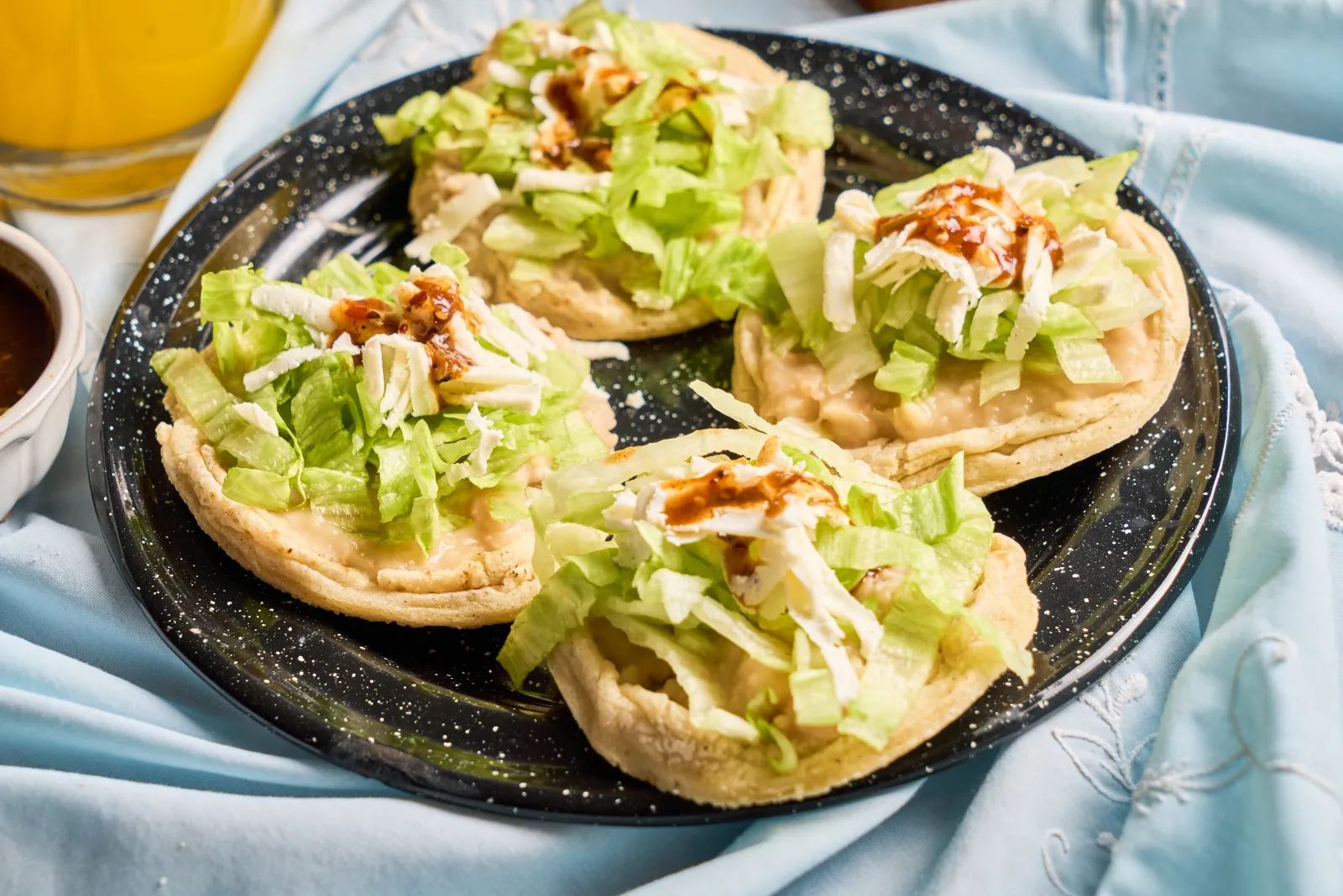

A sope (SOH-peh) is a 3½-inch, thick round of corn masa with a rim pinched up around the edge, so it holds a pile of refried beans, meat, lettuce, crema, cheese and salsa like a little edible plate. It’s one of Mexico’s antojitos, the masa snacks sold on street corners and at market stalls; English Wikipedia places its origin in central and southern Mexico, where it was also called a pellizcada, a “pinched one.” That pinch is the part that goes wrong at home. The rim has to be shaped in the 30 seconds after the disk comes off the griddle, and the dough needs more water than tortilla dough to bend without splitting, which is what this recipe measures.
What is a sope, and is it worth making at home?
How do you make sopes from scratch? Mix 500 g (4⅓ cups) masa harina with 700 ml (3 cups) warm water, divide into 18 balls and press them into 3½-inch disks about 5/16 inch thick. Cook 2 minutes per side on a hot griddle, pinch up a rim while hot, crisp in a little oil, then top with refried beans, shredded chicken, salsa, lettuce, cheese and crema. Ready in 75 minutes for 6 servings.
Yes, if you’re feeding a group. The dough is two ingredients and costs about 6 cents per sope, and the griddled shells keep for days in the fridge or months in the freezer, so a sope night can be mostly done before anyone arrives. What you get is a base that’s crisp outside and tender inside, sturdy enough for a full load of toppings, which is something a taco or a tostada can’t do.
Good for. A build-your-own dinner, a game night, a birthday spread, or using up leftover beans and meat. Three sopes make a full meal.
Maybe not for. A 20-minute weeknight dinner from scratch, since the full recipe takes 75 minutes and most of it is hands-on. It’s not light either, at about 706 kcal for a plate of three, and it isn’t finger food you can eat standing up.
Real time. 75 minutes total, around 60 hands-on. Only the chicken (25 minutes) and the dough’s rest (10 minutes) run on their own. Make the shells and chicken a day ahead and serving day takes 25 minutes.
Honest difficulty, medium. Mixing the dough is easy. Two moments take practice, getting the water right and pinching the rim while it’s hot, and your first couple of sopes will probably be ugly. By the fourth you’ll have it.
Sopes vs gorditas vs huaraches
All three are made from the same masa. The difference is shape and where the filling goes.
- Sope → round, about 3½ inches (9 cm), with a pinched rim; toppings sit on top.
- Gordita → round and thicker, no rim; it’s split open like a pita and stuffed inside.
- Huarache → long and oval, shaped like the sole of a sandal (huarache), flat with no rim; toppings are spread along it.
In Guerrero the same snack is called a picadita, Acapulco makes tiny sopecitos with just beans and salsa, and Oaxaca’s memela is a close cousin with different toppings.
Ingredients, with US and UK swaps
Exact quantities are in the recipe card: 500 g (1.1 lb) masa harina and 700 ml (3 cups) warm water for 18 shells, plus 600 g (1⅓ lb) chicken breast, 450 g (1 lb) refried beans, lettuce, onion, cheese, crema and salsa. Only one ingredient can’t be swapped.
Masa harina, and how much water it needs
Masa harina is flour made from nixtamalized corn, corn cooked and soaked in an alkaline solution and then ground. That process is what lets it form a pliable dough. Maseca, the most common brand, prints a tortilla ratio on the bag of 1¼ cups water to 2 cups flour (1½ cups of water for its yellow corn version). A cup of masa harina weighs 114 g according to the USDA, so the label range is roughly 1.3 to 1.56 ml of water per gram of flour. For sopes I use 700 ml, a little softer than tortilla dough, because the edge has to fold.
Test it with one ball pressed flat to about ⅜ inch (1 cm) between your palms. Cracked edges mean it needs a tablespoon more water. Sticky means it needs a spoonful more flour. Every bag absorbs a bit differently, and the dough keeps drinking during its 10-minute rest, so I hold back the last 50 ml (3 tbsp).
What doesn’t work. Pre-cooked arepa flour (P.A.N., Goya masarepa) is not nixtamalized; it tastes different and the rims split. Cornmeal, polenta, cornstarch and wheat flour won’t make this dough at all. In the UK, look for bags labeled masa harina or harina de maíz nixtamalizada, not plain “maize flour.”
Fresh masa. If there’s a tortilleria near you, about 2.6 lb (1.2 kg) of fresh masa replaces the flour and water together, with a stronger corn flavor.
Where to buy it
- In the US, Maseca is in most supermarkets, in the Hispanic aisle or with the flours, in 4 lb (1.8 kg) bags. Queso fresco, cotija and Mexican crema are in the dairy case.
- In the UK, masa harina is sold online and in Mexican and Latin grocers, and some larger supermarkets carry it in the world foods aisle. Crema is harder to find; sour cream or crème fraîche loosened with 1 tbsp milk per 3 tbsp stands in well.
The toppings, and what each one does
Beans always go first. They glue everything to the base and keep the salsa from soaking in. Thick, spreadable homemade refried beans keep the shell crisp longer than loose canned ones.
- Shredded chicken → the filling in this recipe, poached in salted water and cooled in it so it stays moist.
- Chicken tinga → for chicken that arrives already sauced with chipotle and tomato, use chicken tinga; 1 lb (450 g) covers 18 sopes.
- Steak → leftover carne asada, finely chopped and reheated in the skillet for 2 minutes.
- Chorizo → 250 g (9 oz) Mexican chorizo, fried, drained and stirred into the beans.
- Beans and cheese only → the simplest version, vegetarian with salsa and crema.
For the salsa, a tart tomatillo salsa verde cuts through the beans and crema, while a red taco salsa made with chiles de árbol brings the heat. 180 ml (¾ cup) is plenty for 18 sopes.
Equipment, and what to use without it
A comal or heavy 10-11 inch (26-28 cm) cast-iron skillet, a wide skillet for crisping, a clean kitchen towel and a zip-top bag cut open along the sides. A tortilla press makes even disks; without one, press the ball between the plastic with the bottom of a heavy pan or a flat plate and neaten the edge with your fingers. A nonstick pan works as a griddle, though you’ll get paler spots.
How to plan it, and how to know each stage is right
Start the chicken before anything else. It poaches by itself while you mix the dough, and the dough rests while you chop.
Make-ahead. The shredded chicken, stored in a little of its poaching liquid, and the shells, griddled and pinched but not crisped, wrapped in a towel and then a bag in the fridge. Pati Jinich, the Mexican-born cook behind PBS’s Pati’s Mexican Table, keeps them that way for up to 3 days; after that they turn hard. On the day, crisp them for 2 minutes and top.
How to pinch the rim without cracking it
Three things have to line up.
- Enough water. 3 cups (700 ml) for 4⅓ cups of masa harina. With only 2½ cups (600 ml) the rim cracks no matter how gently you work.
- Heat. Off the griddle, the disk is set outside and raw inside, and that’s when it bends. After a minute or two it stiffens and splits. That’s why I cook only 5 at a time, which is as many as I can pinch before they cool.
- A towel. The disk is hot. Hold it on a folded towel and, with thumb and forefinger, raise a ⅜ inch (1 cm) rim all the way around, pinching up and slightly inward. Close any crack with a wet fingertip.
Then they go back on the griddle for 1 minute per side to cook the center through. If you’re serving them griddle-only, give them 2 minutes per side.
How to tell it’s going right
- Dough → a ball pressed to ⅜ inch has a smooth edge and doesn’t stick to your palm.
- Griddle → a drop of water skitters and vanishes in 1-2 seconds. If it sits and simmers, turn the heat up; if it disappears instantly and smokes, turn it down.
- First flip → at 2 minutes the disk lets go by itself with golden spots underneath. If it sticks, give it 30 more seconds.
- Crisped → the base sounds hollow and crunchy when you tap it with the spatula.
Griddle only, skillet, deep-fried or air fryer
Rick Bayless deep-fries his sopes in 1 inch (2.5 cm) of oil at 360°F (182°C) for about 2 minutes, turning often, and drains them upside down. In the air fryer, I brush the griddled shells with oil and give them 375°F (190°C) for 5-6 minutes; they come out crisp but a little drier than skillet ones.
Before you cook, mistakes, spice level, kids and allergens
Mistakes that ruin sopes.
- The rim cracks → dry dough or a cooled disk. Add water by the tablespoon and pinch straight off the griddle.
- Pasty, raw centers → disks thicker than ⅜ inch (10 mm). Press them to 5/16 inch (7-8 mm).
- Hard as crackers → too little water, too long on the griddle, or left uncovered. Wrap them in a towel as they come off.
- Sticking to the griddle → pan not hot enough, or the dough is too wet. Heat up, and add a spoonful of flour to the dough if needed.
- Soggy by the time they reach the table → too much salsa, or topped too early. Beans first, salsa by the spoonful, serve within 15 minutes.
- Floppy when picked up → they weren’t crisped. Two minutes in the skillet gives the base structure.
Spice, 1 to 4 out of 5. The masa, chicken and beans aren’t spicy, so it all comes down to the salsa. Mild salsa verde keeps it at 1-2; a chile de árbol red salsa takes it to 4. Put the salsa on the table if kids are eating.
Kids. They love them, especially when they build their own. For small hands, make 35 g (1¼ oz) balls and 2½ inch (6 cm) disks.
Allergens. Corn masa is naturally gluten-free, but check the bag for cross-contact warnings if you’re cooking for someone with celiac disease. Milk comes in with the cheese and crema; leave them off and the dish is dairy-free. Canned refried beans sometimes contain lard, so read the label for vegetarians.
Which version should you make?
- Short on time → canned refried beans, a shredded rotisserie chicken and griddle-only shells, about 40 minutes.
- Feeding 4 → 12 sopes: 330 g (2¾ cups) masa harina, 460 ml (2 cups) water, 400 g (14 oz) chicken and 300 g (1⅓ cups) beans.
- Feeding 20 → 3 each is 60 sopes: 1.7 kg (3¾ lb) masa harina and about 2.3 liters (9¾ cups) water, nearly a full 4 lb bag. Make the shells the day before, set out the toppings in bowls, and crisp in two skillets at once.
- Lighter → griddle-only and no crema brings a plate from 706 to about 580 kcal and fat from 26 to about 13 g.
- Vegetarian or vegan → skip the chicken, use about 40 g (1½ oz) beans per sope and add grilled nopales or sautéed mushrooms. With oil instead of lard and no cheese or crema, it’s vegan.
- Northern style → black beans and chorizo instead of the lettuce and chicken.
What sopes cost in the US
The ingredients that have a public price come to about $8.30 for 18 sopes, or $1.40 per serving, before cheese, crema and salsa. Chicken is two thirds of that.
- Boneless chicken breast, 600 g (1.32 lb) → $5.52 at the BLS US city average of $4.173/lb (August 2026).
- Masa harina, 500 g (1.1 lb) → $1.09, from a 4 lb bag of Maseca at $3.98 at Walmart.
- Romaine, 150 g (0.33 lb) → $1.09 at the BLS average of $3.286/lb.
- Dried beans for 1 lb of homemade refried beans, about 160 g (0.35 lb) → $0.58 at $1.630/lb.
- Queso fresco, crema and salsa have no BLS series; add what your store charges.
Yield. 18 sopes, 3 per person for 6 as a main, or 2 each for 9 with other dishes. Each topped sope weighs about 150 g (5¼ oz).
What drives the price. The meat. Beans-and-cheese sopes cost about a third as much. In the UK, imported crema and cotija can cost more than everything else combined, and sour cream and feta do the job.
What to expect, serving and storage
Taste and texture. Toasted corn flavor, a base that crunches under the fork and gives way to a soft middle, creamy beans, cold crisp lettuce, sharp raw onion, salty cheese and crema to round it off.
How they’re served. Freshly topped, on a plate, with salsa and lime wedges on the table. Small ones are eaten by hand, loaded ones with a knife and fork. Add pico de gallo or guacamole on the side.
Fridge. USDA FSIS guidance: nothing cooked sits out more than 2 hours, and leftover chicken and beans keep 3-4 days at 40°F (4°C) or below. Topped sopes don’t store well, because the base goes soft. Keep the shells, chicken and beans separate, and the cut lettuce in a container lined with paper towel.
Freezer. Freeze the shells griddled and pinched, but not crisped or topped. Cool them, layer with parchment and seal in a freezer bag; I use them within 2 months. Shredded chicken freezes well in its liquid. Lettuce, crema and fresh salsa don’t freeze.
Reheating. Frozen shells go straight into the skillet without thawing, over medium-low heat with their oil, 3-4 minutes per side and covered for the first minute so the center heats through. From the fridge, 2 minutes per side. Reheat chicken and beans to 165°F (74°C) with a splash of water. The microwave makes the shells rubbery.
Frequently asked questions
What’s the difference between a sope and a gordita? A sope is open-faced with a pinched rim and toppings on top. A gordita is thicker, has no rim, and is split open and stuffed like a pita.
What’s the water to masa harina ratio for sopes? Roughly 1⅓ cups water per 2 cups masa harina, or 700 ml per 500 g if you weigh. Adjust by the tablespoon until a flattened ball doesn’t crack or stick.
Why do my sopes crack when I pinch them? The dough is too dry or the disk has already cooled. Pinch within 30 seconds of taking it off the griddle and seal cracks with a wet finger.
Are sopes fried? They can be griddle-only, skillet-crisped with ½ tsp oil per side, or deep-fried in 1 inch of oil at about 360°F (182°C). Skillet-crisped is the middle ground.
Can I make sopes ahead and freeze them? Yes. Griddled and pinched but not crisped, they keep 3 days in the fridge and about 2 months frozen. Crisp them from frozen in a skillet.
Can I make sopes with cornmeal or regular flour? No. They need nixtamalized masa harina or fresh masa; cornmeal won’t hold together and wheat flour makes something else entirely.
How many sopes does a 4 lb bag of Maseca make? About 64 sopes of 3½ inches, using roughly 2.5 liters (10½ cups) of water.
Are sopes gluten-free? Corn masa contains no gluten. Check the bag for cross-contact warnings.
How many calories are in a sope? One topped like these, with chicken, beans, cheese and crema, is about 235 kcal. The plain shell is about 100.
Nutrition
Per serving of 3 sopes, calculated ingredient by ingredient from USDA FoodData Central (SR Legacy) with this recipe’s quantities, using canned refried beans, sour cream for the crema and jarred salsa verde:
- Calories: 706 kcal
- Protein: 39 g
- Carbohydrates: 80 g
- Fat: 26 g, of which 9 g saturated
- Fiber: 9 g
- Sugars: 5 g
- Sodium: 1188 mg
The masa alone is 303 kcal of that. Nearly half the sodium comes from canned beans (278 mg) and jarred salsa (272 mg), so those are the first swaps if you’re watching salt.
I grew up making arepas in Venezuela, so I assumed sopes would be the same thing with a different flour. They aren’t. An arepa forgives dry dough and a sope doesn’t, and my first batch cracked at every rim until I learned to pinch them the second they came off the comal. Now I make a double batch and freeze half for busy nights. Josnaisis.