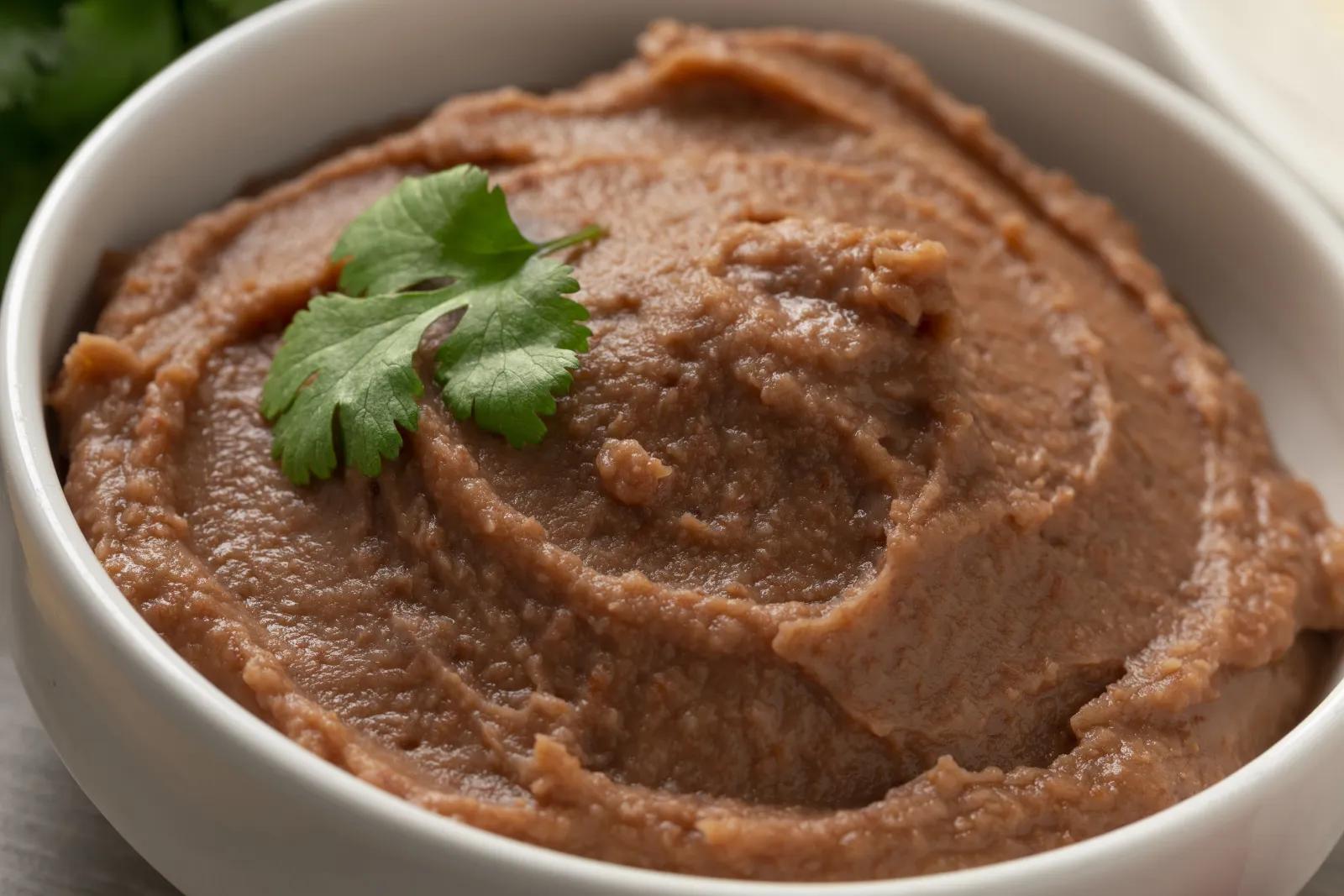

Refried beans go into the pan exactly once, with 2 oz (60 g) of lard for every pound of dried beans. They’re Mexico’s everyday bean dish, pinto or black beans simmered until soft, then mashed into hot lard with fried onion until they turn into a thick, glossy spread; the “re” in refritos means “well fried”, as Rick Bayless puts it, not “fried again”. In Mexico they’re the side on the breakfast plate, the layer under the toppings on a tostada and the filling of a bean-and-cheese torta. What makes them creamy rather than pasty isn’t the lard or the bean. It’s the broth the beans cooked in, and how much of it you add back.
What are refried beans, and are they worth making from scratch?
How do you make refried beans from scratch? Soak dried pinto or black beans overnight, then simmer them in fresh water with onion, garlic and epazote for 60-90 minutes (black) or 90-120 (pinto), saving the liquid. Fry chopped onion in lard, add the beans in batches, mash, and loosen with 1-1½ cups (250-375 ml) of the bean liquid until a spatula leaves a trail. 600 minutes including the soak for 8 servings.
Yes, if you eat them more than once a month. From dried beans they cost a fraction of the canned version, carry less sodium, and the texture is yours to decide. One pound of dried beans, 1.1 lb (500 g) to be exact, gives 8 side servings of ¾ cup or enough for about 50 tostadas.
Make them when you want a side for tacos, rice or enchiladas (they’re the classic partner for creamy baked enchiladas suizas), a base for tostadas and molletes, or a tub in the fridge that turns into breakfast all week. Skip the from-scratch version on a weeknight with no cooked beans on hand: with the soak it’s 10 hours. The canned route below is 25 minutes and much better than beans straight from the tin.
Time. 600 minutes on the clock, about 40 of them hands-on: 480 are the overnight soak, 90 are a pot simmering on its own, and the frying itself is 20.
Difficulty, easy. They go wrong in three ways: too little liquid (dry and grey), too much heat (stuck to the pan) and burnt onion (bitter). None needs skill, only attention in the last 20 minutes.
Not the same as Venezuelan black beans. Venezuelan black beans, caraotas negras, are the same bean served whole in their thick broth with a sweet note of raw cane sugar. They’re never mashed or fried. Leftover caraotas, though, make excellent refried beans the next day, because the long part, cooking the beans, is already done.
Pinto or black beans, lard or oil
These are the two choices that change the result most. My short answer: pinto for the creamy Tex-Mex style, black for depth, and lard unless it has to be vegan.
Pinto beans are the northern Mexican and Tex-Mex standard. They mash into a pinkish-brown, mild, very creamy spread, and every US supermarket stocks them; in the UK they’re in the world-food aisle or online. Black beans taste deeper and earthier and give a glossy black purée, the one I use under eggs, on tostadas and next to chilaquiles. They also cook faster: 60-90 minutes soaked against 90-120 for pinto, per the University of Nebraska–Lincoln Extension. Nutritionally they’re a tie, 132 kcal and 8.7 g fiber per 100 g cooked for black, 143 kcal and 9 g for pinto, per the USDA.
Lard is the traditional fat and tastes like it: it rounds out the beans with a savory depth oil doesn’t have. Calories barely change with oil (902 kcal per 100 g for lard, 884 for soybean oil), but saturated fat does, 39 g per 100 g against 15 g, which takes a serving from 3 g to 1.4 g. Buy rendered pork lard in a block, not vegetable shortening. In the UK, look for it next to the butter; supermarket lard is fine here.
Age matters more than variety. Beans that have sat in a pantry for more than a year can refuse to soften however long you soak them, so buy from a shop with turnover and skip bags with wrinkled or faded beans.
Ingredients, with US and UK swaps
Quantities are in the recipe card: 1.1 lb (500 g) dried beans, 2 oz (60 g) lard, one 5 oz (150 g) white onion split between pot and pan, 3 garlic cloves and 1-1½ cups (250-375 ml) of bean liquid.
| Ingredient | What it does | US | UK | If you can’t find it |
|---|---|---|---|---|
| Epazote | herbal, slightly minty background in black beans | dried, Hispanic aisle | Mexican online grocers | skip it, or a few cilantro stems and a pinch of oregano |
| Mexican avocado leaves | anise-like aroma, toasted 30 seconds first | Latin grocers | sold dried in 10 g packets | 1 bay leaf plus a few anise seeds, Rick Bayless’s swap |
| Lard | savory depth, classic gloss | block lard by the butter | supermarket block lard | bacon fat (smoky) or neutral oil (vegan) |
| White onion | sweetness in the fat | white onion | white or brown onion | any mild onion |
| Bean liquid | creaminess, color | from the pot | from the pot | water plus ½ tsp salt, flatter |
Only Mexican avocado leaves (Persea americana var. drymifolia) carry the aroma; leaves from a Hass tree are close to flavorless. Neither herb is essential. Beans made without either are still very good, just a different flavor.
Salt note. The recipe uses fine table salt, 6 g to the teaspoon. With Diamond Crystal kosher salt, use about twice the volume.
Equipment. A 4-5 quart (4-5 liter) pot, a heavy 11-inch (28 cm) skillet or cast-iron pan, a potato masher and a flat spatula. No masher? A sturdy fork or the bottom of a heavy glass. An immersion blender gives a smooth, restaurant-style purée that sticks more, so stir constantly. A thin pan is what scorches beans; if it’s all you have, use medium-low heat and a little extra liquid.
From dried beans, an Instant Pot or a can
Dried beans, stovetop. The full recipe. Soak overnight (8 hours in cold water) or quick-soak (boil 2-3 minutes, rest 1 hour covered), both methods from the University of Nebraska–Lincoln Extension.
Instant Pot or other electric pressure cooker, no soak. The same source gives 20-30 minutes at high pressure for black beans and 15-20 for pinto, covered with about 6 cups (1.4 liters) of water per pound, plus 20 minutes of natural release. It’s the one to pick when you forgot to soak.
Stovetop pressure cooker. I check the beans 25 minutes after it comes to pressure and give them 5-10 more if needed; every cooker and every bag of beans is different.
Canned beans, done well. A 15-ounce can holds 1¾ cups of drained beans (UNL), so 2 cans make 4 side servings:
- Cook ¼ chopped onion and 1 garlic clove in 1 oz (30 g) lard for 6 minutes.
- Add both cans of whole beans with the liquid from just one (two cans’ worth is too salty) and a toasted avocado leaf or a pinch of dried epazote.
- Mash for 5 minutes, loosening with water or stock until it looks right. Taste before salting: canned beans are already seasoned.
Starting from a can of ready-made refried beans? Warm them in a skillet with 1 tbsp lard and some fried onion, and loosen with 3-4 tablespoons of water per can. “Traditional style” cans may contain lard, so check the label if you’re feeding vegetarians.
Planning the day, and how to tell it’s right
Make ahead. Soak the night before. Cooked beans in their liquid keep 3 to 4 days in the fridge (USDA FSIS) and freeze well, so the 20 minutes of frying can happen any day. I cook 2 lb (1 kg) on Sunday, keep half whole for soup-style beans, and fry the rest when I need it.
How to tell each stage is right.
| Stage | What you should see |
|---|---|
| Cooked beans | one squashes between two fingers, skin as soft as the inside |
| Onion, 6-8 min | translucent, golden at the edges, never dark brown |
| Frying | each batch sizzles as it hits the pan; silence means the heat is too low |
| Done | a spatula through the middle shows the bottom of the pan for a second |
How loose or thick to make them
This is the question that decides the dish. My measure, for the 1.1 lb (500 g) of dried beans in the recipe once cooked:
Refried beans keep setting as they cool, because the bean starch firms up. I always take them off the heat a little looser than I want them at the table, and add 2-3 tablespoons of liquid per cup when I reheat.
Mistakes that ruin refried beans
- Dry, grey beans → too little cooking water, or the liquid went down the drain. Keep all of it and use it instead of water.
- Scorched bottom → high heat, a thin pan or too little fat. Medium heat, a heavy pan, and scrape the bottom every 30 seconds for the last 5 minutes.
- Beans that never soften → old beans, or something acidic (tomato, vinegar) added too early. Acid goes in at the end; old beans just need longer and a blender.
- Bitter → the onion or garlic burnt in the fat. There’s no fixing it; redo that step.
- Lumpy, with skins → under-mashed or under-cooked. A few more minutes with the masher, or a quick pass with an immersion blender.
- Bland → no salt in the pot. Salt can go in from the start; it doesn’t toughen the beans.
Spice, 0 out of 5. Refried beans aren’t hot. Fry a chopped serrano with the onion if you want heat, or put salsa on the table.
Kids. Nearly always a yes: mild, creamy and easy to spread on toast or a tortilla. For small children, make them creamy and go light on salt.
Allergens. Beans, onion, garlic and lard: no gluten, egg, dairy or nuts. Canned refried beans can contain thickeners or traces, so read the label for anyone with celiac disease.
Batch sizes for 4 to 20 people
I count ¾ cup (about 6 oz / 175 g) per person as a side, about 1 oz (25 g) per tostada and 1½ oz (40 g) per mollete half.
| People | Dried beans | Lard | Onion, total | Liquid to spread | Liquid for a side |
|---|---|---|---|---|---|
| 4 | 250 g (9 oz) | 30 g (1 oz) | 75 g (2.5 oz) | ½ cup (125 ml) | ¾ cup (190 ml) |
| 8 | 500 g (1.1 lb) | 60 g (2 oz) | 150 g (5 oz) | 1 cup (250 ml) | 1½ cups (375 ml) |
| 12 | 750 g (1.65 lb) | 90 g (3 oz) | 225 g (8 oz) | 1½ cups (375 ml) | 2¼ cups (560 ml) |
| 20 | 1.25 kg (2.75 lb) | 150 g (5 oz) | 375 g (13 oz) | 2½ cups (625 ml) | 3¾ cups (940 ml) |
An 11-inch (28 cm) skillet comfortably fries about 3.3 lb (1.5 kg) of cooked beans. For 12 or 20, use a wide 16-inch (40 cm) pan or two skillets, a 8-10 quart pot for the beans, and allow 15-20 extra minutes for the bigger pot to finish. For a party, fry them the day before and hold them hot in a slow cooker on warm, above 140°F (60°C), with a splash of liquid.
What it costs in the US
At the US city average price the Bureau of Labor Statistics recorded for August 2026, dried beans of any type cost $1.630 per pound, so the 1.1 lb (500 g) in this recipe come to $1.80, about 23 cents a serving. The BLS doesn’t track lard, canned beans or epazote. Lard is the next biggest cost, and you need only 2 oz (60 g) for 8 servings.
Yield. About 3 lb (1.4 kg) of refried beans: 8 servings of ¾ cup, about 50 tostadas or 35 mollete halves.
How to serve them, and what to cook with them
Taste and texture. A thick, glossy spread that tastes of beans and fried onion, with the savory depth of lard and, if you used it, the herbal note of epazote. Black beans are bolder; pinto, milder and sweeter.
As a side, with crumbled queso fresco or cotija and a few tortilla chips stuck in. As a base, spread thin, about 1 oz (25 g): under shredded chicken tinga on a tostada, on molletes (a split bolillo roll with beans, melted cheese and pico de gallo), in Mexican sopes and tortas. They’re the bed under huevos rancheros and the classic side to a plate of chilaquiles verdes. For a snack, serve them warm with chips, authentic Mexican guacamole and a bowl of Mexican salsa verde, and they go next to any taco, carnitas tacos included.
Storing, freezing and reheating
Fridge. USDA FSIS rules for leftovers: no more than 2 hours out, then 3 to 4 days at 40°F (4°C) or below, in containers under 3 inches (7.5 cm) deep so they cool fast.
Freezer. Refried beans freeze very well. FSIS gives 3 to 4 months for best quality with frozen leftovers. I freeze flat bags of 9 oz (250 g), enough for a breakfast for 4, and thaw them in the fridge overnight.
Reheating. In a skillet over medium-low heat with 2-3 tablespoons of water or bean liquid per cup, scraping the bottom, until steaming hot, 165°F (74°C) in the center. In the microwave, covered, in 1-minute bursts, stirring between them. A teaspoon of lard at the end brings back the shine.
Frequently asked questions
Why are they called refried beans if they’re only fried once? Refrito means “well fried” in Mexican Spanish usage, and the English name is a literal mistranslation. The beans are boiled once and fried once, thoroughly.
Are pinto or black beans better for refried beans? Pinto gives the creamy, light-brown Tex-Mex style; black gives a deeper flavor and cooks faster, 60-90 minutes soaked against 90-120 for pinto.
Can I make refried beans without lard? Yes, with ¼ cup (65 ml) neutral oil. They taste lighter, have less than half the saturated fat, and with water rather than chicken stock they’re vegan.
How do I make canned refried beans taste better? Fry onion and garlic in lard, add the beans with a splash of water, a toasted avocado leaf or a pinch of epazote, and cook 5 minutes, scraping the bottom.
Do I have to soak the beans? No. Soaking shortens the stovetop time and helps them cook evenly; without it, use an electric pressure cooker, 20-30 minutes for black beans plus 20 minutes natural release.
What can I use instead of epazote? There’s no exact substitute. A few cilantro stems and a pinch of oregano in the pot give good beans with a different flavor, or leave it out.
How long do refried beans last, and can I freeze them? 3 to 4 days in the fridge at 40°F (4°C) or below, and 3 to 4 months frozen for best quality. Reheat with a splash of liquid.
Why are my refried beans dry? Not enough liquid, or they were taken off the heat already thick. They set as they cool; finish them looser using the bean cooking liquid.
Nutrition
Per serving, ¾ cup (about 6 oz / 175 g), calculated ingredient by ingredient from the USDA SR Legacy database with the quantities above, using black beans, 60 g (2 oz) of lard and both teaspoons of salt:
- Calories: 290 kcal
- Protein: 14 g
- Carbohydrates: 41 g
- Fat: 8 g, of which 3 g saturated
- Fiber: 10 g
- Sugars: 2 g
- Sodium: 585 mg
Fiber is the headline, 10 g a serving. Oil instead of lard leaves calories unchanged and drops saturated fat to 1.4 g. Almost all the sodium is the salt you add; with one teaspoon instead of two it falls to about 295 mg.
Growing up in Venezuela, beans meant caraotas, whole and swimming in their broth, and the first time I watched someone mash them into a pan of lard I thought it was a waste of good beans. A mollete changed my mind. These days the bean water from my Sunday pot never goes down the sink. Josnaisis.