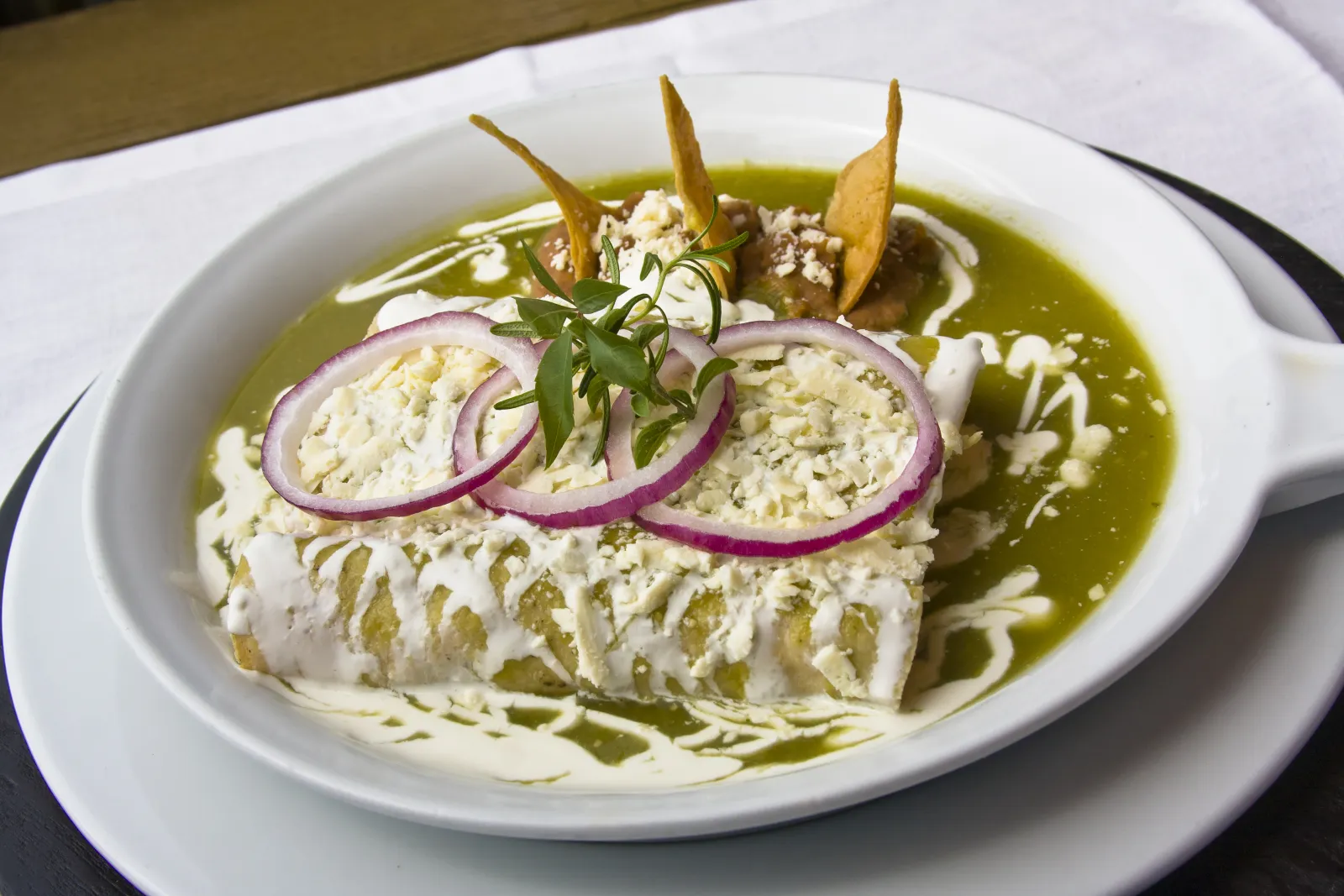

There’s nothing Swiss in enchiladas suizas. The name is usually explained by the cream and the cheese, and the dish is tied to the Sanborns restaurants in Mexico City, though accounts of exactly when and where disagree. What’s on the plate is clear enough: corn tortillas rolled around shredded chicken, covered in a pale green sauce of tomatillos blended with Mexican crema, topped with cheese and baked until it bubbles. For a cook outside Mexico, the two things worth getting right are the cream, which can split into a grainy mess, and the cheese, which needs to melt rather than sweat oil.
What are enchiladas suizas, and how are they different from green enchiladas?
How do you make enchiladas suizas? Poach and shred chicken breast. Simmer tomatillos, serranos and garlic, blend with onion, cilantro and broth, fry the salsa 6 to 8 minutes, then stir in 1 cup (240 ml) of crema over the lowest heat without boiling. Soften corn tortillas in hot oil, fill with chicken and cheese, cover with the creamy salsa and more cheese, and bake 10 to 12 minutes at 400°F (200°C). 65 minutes for 4 servings.
Enchiladas suizas (en-chee-LAH-dahs SWEE-sahs, “Swiss enchiladas”) are the creamy, baked branch of Mexico’s green enchiladas. Plain green chicken enchiladas keep the tomatillo salsa sharp and add crema and crumbled fresh cheese cold, on top, with no oven. Suizas move the cream into the sauce and finish under a layer of melted cheese.
Why make them. They’re a party dish that holds: they come to the table in the dish they baked in and stay good for the ten minutes it takes everyone to sit down. They’re also the green enchilada for people who don’t like heat, since the cream all but cancels the serrano.
Why you might not. A plate of 3 runs about 957 kcal. That’s the crema, cheese and frying oil, and there’s a lighter version further down. And without dairy they stop being suizas.
Time and difficulty. 65 minutes from start to finish, about 45 hands-on. Easy, with two steps that need your attention: the cream and the tortillas.
The ingredients, and what to buy in the US and UK
The recipe card has the exact amounts: 600 g (1⅓ lb) chicken breast, 700 g (1½ lb) tomatillos, 1 cup (240 ml) crema, 200 g (7 oz) cheese and 12 corn tortillas for 4 plates of 3.
Tomatillos are tart green fruits in a papery husk, not unripe tomatoes, and nothing else tastes like them. About 20 medium make 700 g (1½ lb), at 34 g each according to the USDA. The salsa base is a boiled-and-fried Mexican salsa verde made with chicken broth instead of water.
Mexican crema is thick, mild and only slightly tangy. Heavy cream in the US or double cream in the UK are the best stand-ins; a pinch of salt brings them closer. UK crème fraîche works too, since its high fat lets it simmer without splitting.
Cheese. In Mexico it’s Mexican manchego, a mild, melting cow’s-milk cheese that only shares a name with the sheep’s-milk Manchego from Spain, or Chihuahua cheese, also called queso menonita, buttery and smooth when melted. In the US, Monterey Jack does the same job and is in every supermarket. In the UK, low-moisture mozzarella with a handful of mild cheddar. I’d skip aged Spanish Manchego and sharp cheddar: they release fat and their flavor runs over the sauce.
Corn tortillas, 6 inches (15 cm). Flour tortillas go soft under a creamy sauce in the oven. In the UK they’re easiest to find from online Mexican grocers.
Equipment. A blender, a saucepan, an 8-inch (20 cm) skillet, tongs, paper towels and a 9×13-inch (23×33 cm) baking dish, which holds 12 enchiladas in one layer. Two 8-inch (20 cm) square dishes work too.
The creamy salsa verde, how much crema and how to keep it from splitting
My ratio is 1 cup (240 ml) of crema for 1½ lb (700 g) of tomatillos, roughly one part cream to three parts tomatillo by weight. That gives a pale green sauce that still tastes of tomatillo. Published versions range widely: America’s Test Kitchen uses ½ cup per pound of tomatillos, closer to a green enchilada with a creamy edge, while other Mexican recipes go past 3 cups of cream on the same amount of fruit, where it tastes mostly of cream.
Why it splits: milk proteins tighten and clump when heat and acid hit them together, and tomatillo salsa is acidic. Fat protects them. USDA figures put sour cream at about 19% fat against 36% for heavy cream, which is why sour cream turns grainy in a simmering sauce and heavy cream doesn’t.
- Use high-fat cream. Crema, heavy cream or double cream. Not sour cream, not light cream.
- Take the chill off. Leave it out 20 minutes, then whisk in a ladle of hot salsa before it goes into the pan.
- Kill the boil. Lowest heat, wait until the salsa stops bubbling, stir the cream in, and warm it gently for a couple of minutes. It should steam, not bubble.
Already grainy? Blitz it 20 seconds in the blender. It won’t be quite as silky, but the curds disappear.
Game plan for 4, make-ahead and scaling for 12
The chicken poaches on its own for 25 minutes, and the whole sauce, crema included, fits inside that window. The oven goes on once the cream is in, so it’s hot by the time the dish is rolled.
Make ahead. Fry the salsa without the crema and shred the chicken up to 3 to 4 days before; keep them in separate containers in the fridge. On the day, bring the salsa to a boil, drop to low, stir in the crema, soften tortillas, roll and bake: about 35 minutes. You can roll the enchiladas into the dish up to 2 hours ahead, without sauce, and cover them with salsa and cheese right before baking.
Filling. Toss the shredded chicken with 60 ml (¼ cup) of creamy salsa and 50 g (½ cup) of cheese so it stays moist in the oven and holds together when rolled: about 40 g (1½ oz) per tortilla.
Softening the tortillas. 10 to 15 seconds per side in ½ inch (1 cm) of oil that bubbles on contact. In suizas this matters even more than in plain green enchiladas, because the tortillas sit under sauce in the oven for 10 minutes; skip the oil and they fall apart.
| People | Tortillas | Chicken breast | Tomatillos | Serranos | Crema | Cheese | 9×13 in dishes |
|---|---|---|---|---|---|---|---|
| 4 | 12 | 600 g (1⅓ lb) | 700 g (1½ lb) | 2 | 240 ml (1 cup) | 200 g (7 oz) | 1 |
| 6 | 18 | 900 g (2 lb) | 1.05 kg (2⅓ lb) | 3 | 360 ml (1½ cups) | 300 g (10½ oz) | 2 |
| 12 | 36 | 1.8 kg (4 lb) | 2.1 kg (4⅔ lb) | 6 | 720 ml (3 cups) | 600 g (1⅓ lb) | 3 |
For 12, blend the salsa in three batches and fry it in a 5-quart (5-liter) pot. If the three dishes don’t fit on one rack, bake two on separate racks, swap them halfway and give them a few extra minutes, then bake the third.
Oven temperature and time, 400°F (200°C) for 10 to 12 minutes
Everything goes into the oven hot, so the oven’s only job is melting and browning the cheese. At 400°F (200°C) for 10 to 12 minutes on the middle rack, the cheese bubbles and spots gold before the tortilla tips that poke out of the sauce dry out. If you rolled them ahead and they’re cold, give them 15 to 18 minutes at 400°F, America’s Test Kitchen’s time for its make-ahead version. For extra color, a minute or two under the broiler (grill, in the UK) at the end, watching closely.
Mistakes, spice level and allergens
- Grainy, split sauce → it boiled after the cream went in, the cream was fridge-cold, or it was sour cream. Lowest heat, room-temperature high-fat cream.
- Tortillas falling apart → they skipped the oil or baked too long. 10 to 15 seconds a side, 10 to 12 minutes in the oven.
- Dry, hard edges → a slow oven, or tortilla ends not covered with sauce. Sauce to the edges of the dish.
- Greasy top → aged cheese. Chihuahua, Mexican manchego or Monterey Jack.
- Bland, white sauce → more than about 2 cups (450 ml) of crema for 1½ lb tomatillos. Go back to 1 cup.
Spice level, 1 out of 5 with 2 serranos. North Dakota State University Extension puts serranos at 5,000 to 15,000 Scoville heat units, at least double a jalapeño, but the crema and cheese leave little of it on the plate.
Allergens. Dairy, and lots of it. Corn tortillas are naturally gluten-free, but check the label if you’re cooking for someone with celiac disease. No egg, nuts or fish.
A lighter version, and other ways to make them
- Lighter → ½ cup (120 ml) crema loosened with ½ cup (120 ml) of the poaching liquid, half the cheese, 100 g (3½ oz), and tortillas warmed with cooking spray in a 350°F (175°C) oven for 2 to 4 minutes instead of dipped in oil. About 630 kcal a plate. Greek yogurt in place of crema splits in the oven with this acidic sauce, so I don’t use it here.
- Quicker → rotisserie chicken, about 465 g (1 lb) of meat without skin, and canned tomatillos, drained, which skip the simmer. About 35 minutes.
- Vegetarian → fill with Chihuahua cheese and strips of roasted poblano, or diced cooked potato and zucchini.
- Red enchiladas instead → no cream and no tomatillos: a toasted, mild sauce of dried guajillo and ancho chiles, in red enchiladas with homemade red chile sauce.
- Green enchiladas instead → if you want something sharper and lighter with no oven, make plain green enchiladas; they come in about 250 kcal lower per plate.
What enchiladas suizas cost
At the US city average prices the Bureau of Labor Statistics published for August 2026, boneless chicken breast was $4.17 a pound, so the 1⅓ lb (600 g) here is $5.52. BLS doesn’t track Monterey Jack, but cheddar was $5.98 a pound; at that price, 7 oz (200 g) of cheese is $2.64. Chicken and cheese together come to about $8.16, or $2.04 a plate. BLS doesn’t publish prices for crema, corn tortillas or tomatillos, so I’m not adding a guessed total. In Mexico City’s Central de Abasto, the Ministry of Economy’s SNIIM listed tomatillos at 16 pesos a kilo on October 9, 2026, which makes the whole salsa about 15 pesos.
Yield. 12 enchiladas, 4 plates of 3. With rice and beans, 2 each is enough and the recipe feeds 6.
What drives the price. Outside Mexico, the cream and cheese more than the chicken. Poaching a whole chicken gives more meat for the money than breasts and a better broth for the sauce.
Serving, storing and reheating
What to expect. A silky, pale green sauce with tomatillo tang underneath and almost no heat, soft tortillas that hold their shape, and melted cheese with golden spots. They’re best 3 minutes out of the oven.
What to serve with them. Mexican red rice and refried beans made from scratch on the side, and a bowl of authentic Mexican guacamole on the table. Chicken tinga works as a smoky filling in place of plain shredded chicken, and leftover creamy salsa makes a richer batch of chilaquiles verdes the next morning.
Fridge. The USDA Food Safety and Inspection Service guideline for leftovers: 2 hours at most out of the fridge, 3 to 4 days at 40°F (4°C) or below. Baked enchiladas soften with each day; sauce and chicken keep better apart.
Freezer. Freeze the salsa before the crema goes in, and the chicken, in separate containers: FSIS gives 3 to 4 months of best quality. Add the crema when you reheat the salsa. Baked enchiladas can be frozen, but the creamy sauce tends to separate when thawed and the tortillas turn soft.
Reheating. In the dish, covered with foil, 15 to 20 minutes at 350°F (180°C), until the center reaches 165°F (74°C); uncover for the last 3 minutes. In the microwave, one plate at a time on medium power in 1-minute bursts; full power splits the sauce.
Frequently asked questions
Why are they called enchiladas suizas? “Suizas” means Swiss, and the name is generally linked to the cream and cheese. The dish is associated with the Sanborns restaurants in Mexico City, but the story of its origin varies and there’s no reliable date.
What’s the difference between enchiladas suizas and enchiladas verdes? Suizas have 1 cup (240 ml) of crema blended into the salsa verde and are baked under melted cheese. Verdes keep the salsa plain, with crema and fresh cheese added cold on top, and skip the oven.
What is the best cheese for enchiladas suizas? Chihuahua or Mexican manchego. In the US, Monterey Jack; in the UK, low-moisture mozzarella with some mild cheddar. Queso fresco doesn’t melt.
Why did my enchilada sauce curdle? The cream boiled in an acidic sauce, went in fridge-cold, or was sour cream. Use high-fat cream at room temperature and add it over the lowest heat.
Can I use sour cream instead of crema? Not in the sauce. At about 19% fat it splits. Heavy cream or UK double cream, with a pinch of salt, is the better swap.
What temperature do you bake enchiladas suizas at? 400°F (200°C) for 10 to 12 minutes when everything goes in hot; 15 to 18 minutes if they were rolled ahead and are cold.
Can I make enchiladas suizas ahead? Make the salsa without crema and shred the chicken up to four days ahead. Roll the tortillas into the dish up to 2 hours before baking and sauce them at the last minute.
Can you freeze enchiladas suizas? Freeze the salsa before adding crema, plus the chicken, for three or four months. Baked enchiladas freeze, but the creamy sauce separates a little.
Nutrition per serving
Per serving of 3 enchiladas with their sauce and cheese, calculated ingredient by ingredient from the USDA FoodData Central database (SR Legacy) with the quantities above. Crema is counted as heavy cream (36% fat) and the cheese as Monterey Jack, their closest entries in that database. The oil absorbed by the tortillas, about 60 g (4 tbsp) in total, is my own estimate:
- Calories: 957 kcal
- Protein: 54 g
- Carbohydrates: 46 g
- Fat: 63 g, of which 27 g saturated
- Fiber: 8 g
- Sugars: 10 g
- Sodium: 1002 mg
Of the 1,002 mg of sodium, 581 mg comes from the salt in the salsa and 300 mg from the cheese. The lighter version above, with half the crema and cheese and no oil dip, is about 630 kcal.
I make suizas when there are more people than chairs: three dishes in the oven, rice on the stove, and nothing left to do at the table but hand out a spatula. The one step I still won’t rush is the cream, which goes in with the burner nearly off. Josnaisis.