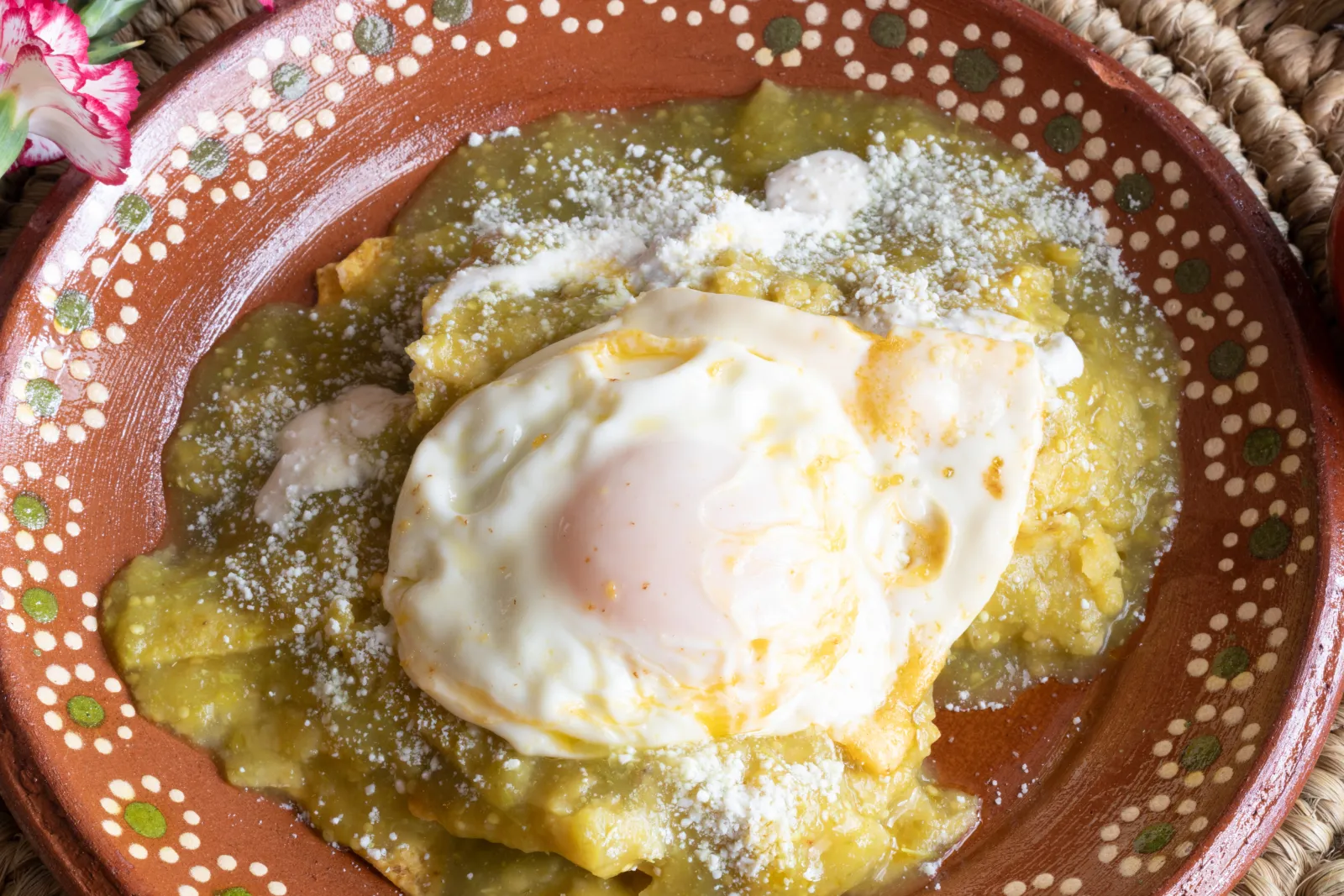

Chilaquiles are fried corn tortilla wedges simmered briefly in salsa and eaten with a fork, the breakfast Mexican home cooks make from yesterday’s tortillas. Verdes means the salsa is green, made from tomatillos, serrano chiles and cilantro, and the plate is finished with crema, crumbled queso fresco, raw onion and usually a fried egg. The catch is time. The good window runs from minute 1 to minute 3 in boiling salsa; leave the chips in until minute 10 and you have mush.
How do you make chilaquiles verdes, and are they worth it?
How do you make chilaquiles verdes? Boil 1.1 lb (500 g) of tomatillos with 2 serranos, onion and garlic for 8-10 minutes, then blend with cilantro. Fry 12 tortillas cut into wedges at 350°F (180°C), reduce the salsa in a tablespoon of oil for 10-12 minutes, and toss the chips in it at a boil for 1 to 3 minutes. Top with crema, queso fresco, onion and a fried egg. Ready in 45 minutes for 4 servings.
They are worth it if you like a savory, sharp breakfast that fills you until mid-afternoon. Think of them as the opposite of nachos: the chips are meant to soak up some sauce, the toppings are cold, and you eat them with a fork.
Best for. A slow weekend breakfast or brunch for 2 to 6, the morning after a party, or a bag of corn tortillas that is drying out in the fridge.
Maybe skip them if you need a 10-minute weekday breakfast (unless the salsa and chips are made ahead), if nobody at the table eats chile, or if you want to assemble everything an hour before guests arrive. Sauced chilaquiles do not wait.
Real time. 45 minutes, nearly all hands-on, since frying 12 tortillas takes 15 minutes on its own. With the chips and salsa made the day before, breakfast is 15 minutes away.
Honest difficulty, easy. Nothing is technical. What goes wrong is a salsa that goes in thin and lukewarm, and a cook who walks away during the last 3 minutes.
Ingredients, with US and UK swaps
The recipe card has exact amounts: 12 tortillas, 1.1 lb (500 g) of tomatillos and 2 serranos for 4 plates, plus 1 egg, 1 oz (30 g) of queso fresco and 2 tbsp (30 ml) of crema per person.
Tomatillos, and what to use outside Mexico
A tomatillo looks like a small green tomato in a papery husk, but it is a different plant: sharper, and when boiled it releases a natural gel that thickens the salsa. Peel the husk, rinse off the sticky film underneath, and pick firm ones that fill their husks. About 15 medium tomatillos weigh 1.1 lb (500 g).
In the US they are in almost any supermarket with a Latin produce section, at a national average advertised price of $0.99 per lb in October 2026, according to the USDA’s weekly retail report. In the UK fresh ones are rare outside summer farm boxes, so the realistic route is a can.
The can you are most likely to find is La Costeña whole green tomatillos, 28 oz (794 g), sold by Latin grocers and online in both countries; in the UK, Mex Trade stocks it along with Clemente Jaques. Drain it, keep the liquid for thinning, and blend without boiling, since the tomatillos are already cooked. One can replaces the fresh weight in this recipe.
Boiled or roasted salsa
For chilaquiles I boil. A boiled salsa is pale green, bright and tart, and thin enough to coat chips; that sourness is what cuts through the crema and cheese. A roasted salsa, with the tomatillos charred under the broiler (grill, in the UK) for 10-12 minutes, is darker, sweeter, smokier and thicker, because the fruit loses water. If you roast, loosen the salsa with about ¾ cup (175 ml) of water before it goes in the pan. My Mexican salsa verde for tacos starts from the same base; for chilaquiles you want it looser and always fried in oil first.
Tortillas, cheese and crema
- Corn tortillas, a day old. A drier tortilla absorbs less oil and survives longer in the salsa. If yours are fresh, leave them spread out on the counter overnight, or dry them for 10 minutes in a 250°F (120°C) oven before cutting. In the UK, buy them from a Mexican grocer and read the label, because some supermarket “corn” tortillas are mostly wheat flour.
- Queso fresco. Mild, salty and crumbly. A mild feta is the easiest swap in both countries; I also like Wensleydale, which crumbles the same way.
- Mexican crema. Thicker than single cream and less sour than sour cream. Crème fraîche is the closest UK match; in the US, sour cream thinned with a tablespoon of milk.
Equipment
A deep 10-inch (24-25 cm) skillet or saucepan for frying, a slotted spoon, a blender and a wide pan for the salsa where the chips fit in one layer. An immersion blender works in the pot if the salsa is warm, not boiling.
How to plan it, and how much to make
45 minutes on the clock. Three things happen at once: the tomatillos boil while you cut and fry, and the salsa reduces while the eggs fry.
Make ahead. The salsa, already fried and reduced, keeps in a jar in the fridge, and the chips stay crisp for 2 to 3 days in an airtight tin at room temperature. Next morning, bring the salsa back to a boil, fry eggs and toss: 15 minutes.
Scaling for a crowd. My ratio is 3 tortillas, 4½ oz (125 g) of tomatillos and 1 egg per person, which gives roughly ⅔ cup (160 ml) of finished salsa per plate.
| People | Tortillas | Tomatillos | Serranos | Eggs | Queso fresco | Crema |
|---|---|---|---|---|---|---|
| 2 | 6 | 250 g (9 oz) | 1 | 2 | 60 g (2 oz) | 60 ml (¼ cup) |
| 4 | 12 | 500 g (1.1 lb) | 2 | 4 | 120 g (4 oz) | 120 ml (½ cup) |
| 8 | 24 | 1 kg (2.2 lb) | 3-4 | 8 | 240 g (8 oz) | 240 ml (1 cup) |
| 12 | 36 | 1.5 kg (3.3 lb) | 5 | 12 | 360 g (12 oz) | 360 ml (1½ cups) |
| 20 | 60 | 2.5 kg (5.5 lb) | 8 | 20 | 600 g (1.3 lb) | 600 ml (2½ cups) |
For a crowd of 8 or more, do not toss everything in one pot. The first plates come out right and the last ones are porridge. Keep the salsa simmering in a pot, line up plates of chips and ladle salsa over each one, or toss in batches of 4 servings. Fry the chips the day before (24 tortillas is 8 batches) and use two skillets for the eggs. Chiles do not scale exactly; start at the lower number and taste.
How to tell each stage is right.
- Tomatillos turn olive green and give when pressed after 8-10 minutes. If they burst, they went too long.
- Oil at 350°F (180°C) makes the tip of a wedge bubble hard at once.
- Chips are golden and clatter; if they come out bendy, the oil was too cool.
- Salsa darkens a shade and coats a spoon after 10-12 minutes. If it runs off like water, give it 3 more.
Before you cook, soggy chips, heat level, kids and allergens
Soggy chilaquiles have two causes, and both are fixable. Thin, lukewarm salsa soaks into the chip; reduced salsa at a full boil coats it and gives you a few minutes of grace. Then it is a matter of counting. In my kitchen, with homemade chips from day-old tortillas, minute 1 gives a soft edge and a crisp center, minute 3 gives soft but whole wedges, and by minute 6 they break when you plate them.
Mistakes that ruin chilaquiles.
- Watery plate → the salsa was not reduced. Fry it 10-12 minutes until it coats a spoon.
- Mush by the time people sit down → you sauced too early. Toss last, and for a crowd, plate by plate.
- Greasy, limp chips → oil below 340°F (170°C) or an overcrowded pan. Fry 3 tortillas’ worth at a time.
- Bagged chips falling apart → thin restaurant-style chips cannot take hot salsa. Buy the thickest, cheapest ones.
- Too salty → salted chips, salty cheese and salted salsa add up. Salt the salsa last, tasting with a crumb of cheese.
Heat level, 2 to 3 out of 5 with 2 serranos. Serranos are clearly hotter than jalapeños. For mild, use 1 jalapeño with seeds and ribs removed; for proper heat, 3 serranos, seeds and all. Crema softens the burn on the tongue but not in the salsa.
For kids, make the salsa with no chile or half a seeded jalapeño, and serve their chips crisp; most children prefer them that way.
Allergens. Milk (crema, cheese) and egg. Pure corn tortillas are gluten-free, but check the label on tortillas and bagged chips for wheat. Leave off the egg, crema and cheese and the dish is vegan.
Which version should you make?
- Short on time → thick bagged chips and salsa made yesterday. You lose the fresh-fried corn flavor and gain salt, but it works on a Tuesday.
- No frying → oven-baked chips: 12 tortillas tossed with 1 tbsp of oil, 12-15 minutes at 350°F (180°C), flipped halfway. In my air fryer they take 6-8 minutes per batch at 350°F (180°C), shaking the basket. Baked chips are more brittle, so give them 1 minute in the salsa, no more.
- With chicken → swap the eggs for 10½ oz (300 g) of cooked shredded chicken breast, warmed in the salsa for a minute before the chips. Protein per plate goes from 18 g to about 35 g.
- Baked, for 8 at once → toss for 1 minute, spread in a baking dish, scatter the cheese and bake 8 minutes at 400°F (200°C). Everyone eats at the same time; the chips end up soft.
- Vegan → no egg, cheese or crema; top with avocado and refried beans.
- Rojos or divorciados → rojos use a red salsa of tomato and dried chiles; divorciados put half green and half red salsa on the same plate. For whole tortillas with the egg on top and a red sauce, you want huevos rancheros with homemade ranchero sauce.
What it costs
The salsa is cheap anywhere. The cheese and crema are what you actually pay for.
Per USDA AMS advertised prices for the week of October 9, 2026 (tomatillos $0.99/lb, white onion $1.22/lb, cilantro $0.97 a bunch) and BLS average egg prices for August 2026 ($2.272 a dozen), the salsa plus eggs for 4 cost about $3.14, under $0.80 a plate. Tortillas, queso fresco and crema have no official price series, so I leave them out rather than guess. In Mexico, the same salsa costs 12.60 pesos at Mexico City’s Central de Abasto wholesale prices published by SNIIM that week.
What to expect, how to serve them and how to store leftovers
Taste and texture. Tart and green-tasting, with heat you notice, chips soft outside and still firm inside if you served them at 1-3 minutes, and cold crema and salty cheese on top. The runny yolk mixes into the salsa on the plate.
How to serve. On a flat plate with any salsa left in the pan spooned over, then crema, queso fresco, onion rings and cilantro, and the egg on top. Refried beans made from scratch go alongside, and avocado or a bowl of authentic Mexican guacamole if you have it. To drink, a cinnamon-spiced Mexican café de olla or, on a cold morning, a thick Mexican champurrado. The same tomatillo salsa fills Mexican green chicken tamales, and leftover salsa from a night of tacos al pastor makes a good start on next morning’s chilaquiles.
Fridge. According to the USDA’s Food Safety and Inspection Service, leftovers should be refrigerated within 2 hours and eaten within 3 to 4 days. Store the salsa in a jar and the chips in a tin, separately. Sauced chilaquiles keep as long, but the texture is gone.
Freezer. The salsa freezes well in portions; use it within 3 to 4 months for best quality. Chips and sauced chilaquiles do not freeze.
Reheating. Bring the salsa to a boil and toss fresh chips. If what you have is sauced chilaquiles, I skip the microwave: into a baking dish with cheese on top, 8-10 minutes at 350°F (180°C), until the center reaches 165°F (74°C). You get baked chilaquiles, which is an honest way to eat them.
Frequently asked questions
What are chilaquiles? A Mexican breakfast of fried corn tortilla wedges simmered briefly in red or green salsa, topped with crema, queso fresco, onion and often a fried egg or shredded chicken.
How do you keep chilaquiles from getting soggy? Serve 1 to 3 minutes after the chips hit the salsa, and make sure that salsa has reduced in oil for 10-12 minutes and is at a full boil. Use thick chips or homemade ones from day-old tortillas.
Can I use store-bought tortilla chips? Yes, if they are thick. Thin chips disintegrate. They add about 156 mg of sodium per plate compared with homemade, so salt the salsa last.
What can I use instead of tomatillos in the UK? Canned whole tomatillos (La Costeña, 28 oz / 794 g), drained and blended without boiling. Jarred salsa verde is a shortcut but saltier and sharper. Green garden tomatoes give a thinner, different-tasting salsa.
Are chilaquiles verdes spicy? Medium with 2 serranos per 1.1 lb (500 g) of tomatillos. One seeded jalapeño makes them mild.
What is the difference between chilaquiles and nachos? Chilaquiles are tossed in hot salsa until partly softened and eaten with a fork. Nachos stay crisp, with toppings piled on top, and are eaten by hand.
Can you make chilaquiles ahead? Make the salsa and chips up to 2-3 days ahead and keep them apart. Toss only when everyone is ready to eat.
Nutrition
Per serving (a quarter of the recipe, with egg, queso fresco, crema and onion), calculated ingredient by ingredient from USDA FoodData Central (SR Legacy). The frying oil the chips absorb, about 30 g in total, is estimated by comparing corn tortillas with fried tortilla chips in the same database.
- Calories: 560 kcal
- Protein: 18 g
- Carbohydrates: 45 g
- Fat: 36 g, of which 10 g saturated
- Fiber: 8 g
- Sugars: 9 g
- Sodium: 924 mg
Toppings account for most of the fat: chips and salsa alone come to 15 g of fat and 307 kcal a plate. The fried egg adds about 102 kcal, 1 oz (30 g) of queso fresco 90 kcal and 225 mg of sodium, and the crema 57 kcal. Swap the egg for chicken and a plate gets 35 g of protein for about 580 kcal.
I didn’t grow up with chilaquiles in Venezuela, so I learned them as an adult, at my own stove, mostly by ruining a few pans of them. The lesson was the clock, not the recipe. My son Dylan likes his crisp and I like mine soft, so I sauce his plate last and he eats first. Josnaisis.