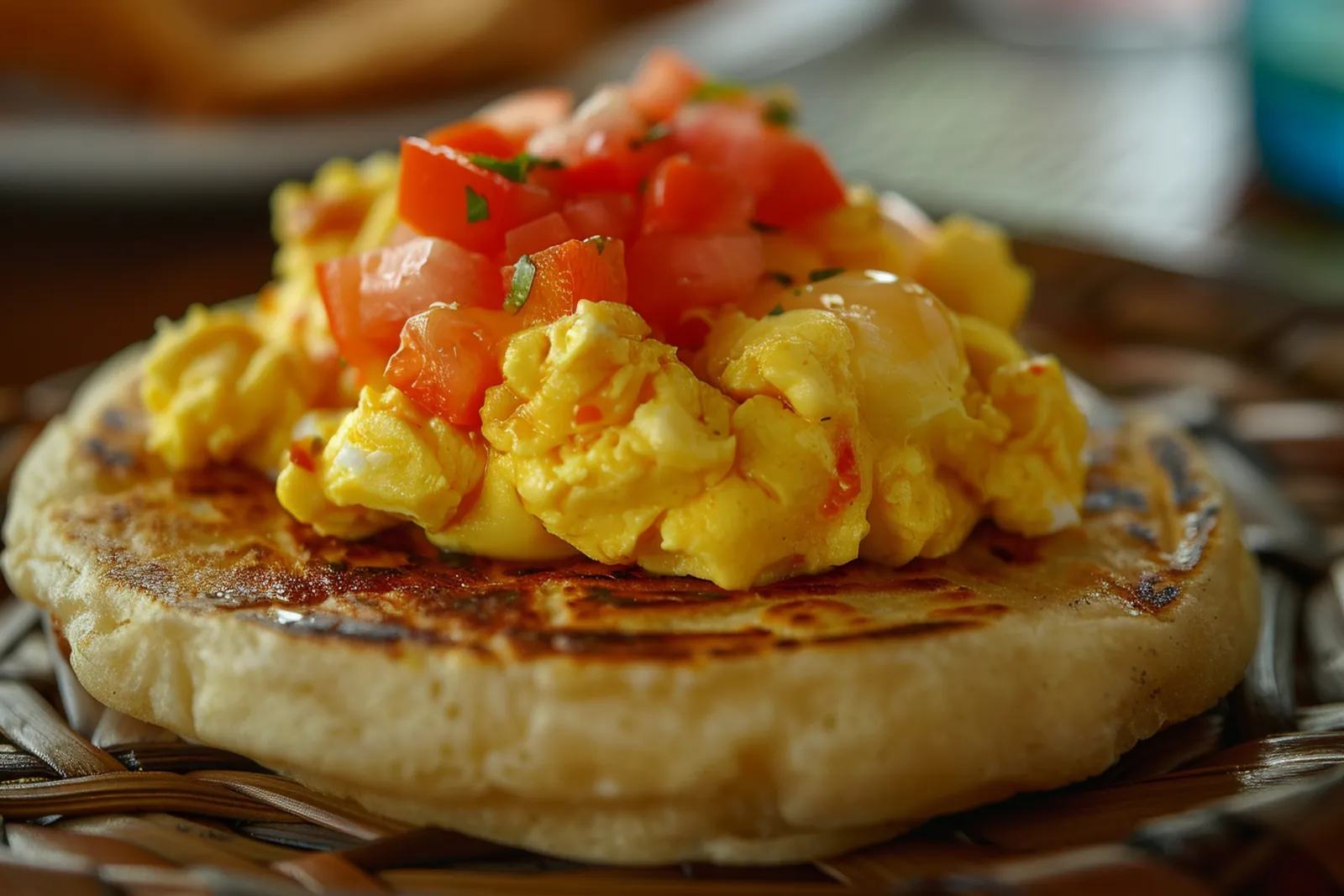

Huevos pericos (WEH-vohs peh-REE-kohs) are what most Colombians mean when they say scrambled eggs: eggs stirred into a two-minute base of scallions and diced tomato, eaten next to a corn arepa with a cup of hot chocolate or coffee. Across the border, Venezuelans make the same thing with white onion and red bell pepper, call it perico, and stuff it inside the arepa. I grew up with the Venezuelan one and learned the Colombian one after moving to Colombia. Both go wrong in the same way, a puddle of pink water on the plate, and both are fixed by the same five minutes of tomato before the eggs go in.
Are huevos pericos worth making, and how long do they take?
How do you make huevos pericos? Soften 60 g (2 oz) of sliced scallion whites in 1 tablespoon of oil for 2 minutes, add 250 g (9 oz) of diced tomato and cook 5 minutes over medium heat until the juice is gone. Pour in 8 beaten eggs, wait 20 seconds, then fold over medium-low heat for 2 minutes, until no liquid egg is left. 15 minutes for 4 servings.
Yes. It’s a weekday breakfast that uses things most kitchens already have, takes no special skill, and gives you about 13 g of protein per two-egg serving before you add the arepa.
Why bother over plain scrambled eggs. The tomato is cooked down just long enough to taste sweet and concentrated, which tints the eggs pink and keeps them moist, and the scallions add a soft, green onion flavor that a bulb onion doesn’t have.
When it fits. A quick breakfast for 2 to 4, an arepa filling to take to work, or a slow Sunday breakfast next to Colombian calentado, the rice-and-beans fry-up Colombians make from last night’s leftovers.
When to make something else. If you want a whole egg with a runny yolk, make huevos rancheros. If you want heat, huevos a la mexicana are the same idea with serrano chile. And if the eggs have to sit on a buffet for half an hour, scrambled eggs of any kind dry out.
Time and difficulty. 15 minutes, 5 to prep and 10 at the stove, nearly all of it hands-on. Easy: the only things to get right are the tomato time and the heat under the eggs.
Ingredients, and what to buy in a US or UK supermarket
The recipe card has everything for 4: 8 large eggs, 250 g (9 oz) of tomatoes and 60 g (2 oz) of scallions. Two eggs each is the norm with an arepa; make it three if the eggs are the whole meal. You won’t need a Latin grocery for any of this, only for the arepas, and toast does fine in a pinch.
The onion, and why scallions are the right call
In Colombia the onion is cebolla larga, a long-stemmed green onion sold in bunches, with almost no bulb. In the pan it behaves like what American stores sell as scallions or green onions and British stores as spring onions, so this is one Latin American recipe where the supermarket version is the authentic one.
Use it in two stages. The whites go into the oil first, for 2 minutes, because they need heat to soften and turn sweet. The greens go on at the end, raw or with the pan’s leftover heat; cooked for 5 minutes they turn khaki and lose their fresh smell.
A white or yellow onion works and is what Venezuelan perico uses. It holds more water, so give it 3 minutes instead of 2, and expect a sweeter, rounder flavor without the green edge.
Tomatoes, and when to seed them
Roma or plum tomatoes in the US, salad or plum tomatoes labeled “ripened on the vine” in the UK: you want firm, fully red fruit with more flesh than juice. Two medium Romas are about 250 g (9 oz). I dice them with the skin and seeds on, because the tomato is meant to show in the finished eggs and 5 minutes in the pan is enough to cook off the juice of a ripe, firm tomato.
Out of season, when supermarket tomatoes are pale and watery, scoop out the seeds and gel with your finger first. You lose about a third of the weight and the pan time drops to 3 or 4 minutes. If they taste of nothing, stir in 1 tablespoon of canned crushed tomato with the fresh.
Eggs, fat and salt
Large eggs, about 50 g (1¾ oz) each out of the shell, beaten only until combined. Over-beaten eggs foam and cook up drier and crumbly.
Oil or butter. Neutral vegetable oil is what I use on weekdays; it holds medium heat without burning. Butter gives a rounder taste and is common in Venezuela, but it browns fast, so drop the heat a notch.
No milk or cream. The tomato is already the liquid. Adding milk is the quickest way to get a watery plate.
Salt goes into the beaten eggs right before they hit the pan: ½ teaspoon for 8 eggs.
About the arepas
An arepa is a round, flat corn cake made from precooked cornmeal, griddled until it has a crust. In the US, look for precooked white cornmeal (often labeled masarepa or by the brand P.A.N.) in the Latin aisle, or frozen ready-made arepas next to the frozen tortillas. In the UK, Latin American online grocers stock both. Don’t use regular cornmeal or Mexican masa harina: neither one holds together as an arepa. If you’d rather start from scratch, Colombian cheese arepas are the friendliest first batch.
Equipment
A 10 in (26 cm) nonstick skillet, which spreads 8 eggs into a layer thin enough to set in 2 minutes, and a silicone spatula to push the curds from the edge. A well-seasoned cast-iron pan works with an extra ½ tablespoon of oil. In stainless steel the eggs stick; if that’s your only pan, use lower heat and don’t touch the eggs until the edge has set.
How to plan it, and what each stage should look like
15 minutes, no waiting. The order is scallion whites, tomatoes, eggs, scallion greens, and each goes in once the one before it is done. The only multitasking is beating the eggs while the tomatoes cook.
| Stage | Time | What you should see |
|---|---|---|
| Scallion whites | 2 min, medium | soft and glossy, no brown edges |
| Tomatoes, start | first 2 min | pink juice covering the bottom of the pan |
| Tomatoes, done | 5 min, medium | dice soft but visible, juice gone, oil shining at the edge |
| Eggs, resting | 20 sec | the edge turns opaque |
| Eggs, folding | about 2 min, medium-low | large soft curds, no liquid egg, still glossy |
| Off the heat | 30 sec more | the pan’s heat finishes the job |
Scaling for a crowd
| People | Eggs | Tomatoes | Scallions | Oil | Salt |
|---|---|---|---|---|---|
| 2 | 4 | 125 g (4½ oz) | 30 g (1 oz), 2-3 | ½ tbsp | ¼ tsp |
| 4 | 8 | 250 g (9 oz) | 60 g (2 oz), 4-5 | 1 tbsp | ½ tsp |
| 6 | 12 | 375 g (13 oz) | 90 g (3 oz) | 1½ tbsp | ¾ tsp |
| 12 | 24 | 750 g (1 lb 10 oz) | 180 g (6 oz) | 3 tbsp | 1½ tsp |
| 20 | 40 | 1.25 kg (2¾ lb) | 300 g (10½ oz) | 5 tbsp | 2½ tsp |
Everything scales except the skillet. A 10 in (26 cm) pan takes 8 eggs at most; any more and the layer is so thick the bottom dries out before the top sets.
Make-ahead plan for 12 to 20
- The night before, cook all the scallion whites and tomatoes in a wide pan until dry, about 10 minutes for 20 people. Cool, cover and refrigerate within 2 hours. The USDA Food Safety and Inspection Service gives leftovers 3 to 4 days at 40°F (4°C) or below.
- In the morning, warm about 75 g (2½ oz) of the tomato base per 8 eggs in the skillet for 1 minute, then scramble the batch. Each batch takes about 4 minutes, so 40 eggs is 5 batches: 20 minutes with one pan, 10 with two.
- Serve each batch as it’s done, greens on top. Scrambled eggs held more than 20 minutes in a dish dry out and weep water.
Before you cook, mistakes, egg safety and allergens
Doneness and safety. The USDA FSIS sets 160°F (71°C) as the safe minimum for egg dishes, and the FDA’s rule of thumb for scrambled eggs is simply that they should not be runny. For young children, older adults, pregnant women and anyone with a weakened immune system, the FDA asks for whites and yolks cooked firm. Pericos meet that once no raw egg is visible, even while the curds still shine.
Mistakes that ruin pericos.
- Watery eggs → the eggs went in while the tomato was still juicy. Five minutes of tomato, and wait for the oil to shine at the edge.
- Water seeping out on the plate after a few minutes → overcooked. Egg proteins tighten and squeeze out moisture. Pull the pan while the curds are glossy.
- Dry, crumbly curds → heat too high, or constant stirring. Medium-low, 20 seconds undisturbed, slow folds.
- Tastes of fried onion → the scallion whites browned. 2 minutes over medium, soft only.
- Grey-green flecks instead of bright green → the greens went in with the tomatoes. They go on at the end.
- Pale and flat → underripe salad tomatoes. Use Romas, or add a spoonful of canned crushed tomato.
Spice level, 0 out of 5. Nothing here is hot. Colombian tables keep ají, a fresh hot sauce, on the side.
Kids. Usually a hit: soft, mild and easy to eat with an arepa in hand. For small children, cook them fully set, as the FDA recommends.
Allergens. Egg. Made with oil there’s no dairy; with butter or cheese, there is. With a corn arepa there’s no wheat; check the cornmeal label if you’re cooking for someone with celiac disease.
Storing raw eggs. In their carton, in the fridge at 40°F (4°C) or below, and used within 3 weeks of purchase, the FDA’s quality window.
Colombian pericos, Venezuelan perico, or something else?
| Version | Onion | Extras | Heat | How it’s eaten |
|---|---|---|---|---|
| Colombian huevos pericos | scallions | tomato only | 0 of 5 | next to the arepa |
| Venezuelan perico | white onion | red bell pepper, sometimes garlic or cilantro | 0 of 5 | stuffed inside the arepa |
| Huevos a la mexicana | white onion | serrano chile | about 2 of 5 | with tortillas and beans |
| Huevos rancheros | in the sauce | blended ranchero sauce | about 2 of 5 | whole fried egg on a tortilla |
- In a hurry → 6 eggs for 3, tomatoes in ¼ in (5 mm) dice: they dry in 3 minutes and breakfast is on the table in 10.
- Venezuelan perico → 60 g (2 oz) white onion and 60 g (2 oz) red bell pepper, finely diced, in oil or butter for 3 minutes, then the tomatoes. Some homes add a garlic clove with the onion and cilantro at the end. Ours always had the pepper.
- For stuffing arepas → cook the tomatoes 2 minutes longer, 7 in all, and set the eggs a little firmer. A juicy filling soaks the arepa from the inside. Venezuela’s other famous filling is the chicken and avocado reina pepiada.
- With cheese → 60 g (2 oz) crumbled queso fresco, or feta in the UK, scattered over the hot eggs on the plate. Stirred in the pan, it melts into strings and turns greasy.
- With bacon → 60 g (2 oz) bacon strips crisped in the dry pan for 4 minutes; use the fat instead of the oil and carry on.
- Lighter → ½ tablespoon of oil instead of 1 in a nonstick pan, which takes off about 15 kcal a serving.
What it costs to make for 4
At the US city average retail prices the Bureau of Labor Statistics published for August 2026, a dozen large grade A eggs cost $2.272 and a pound of tomatoes $1.977. That puts 8 eggs and 250 g (0.55 lb) of tomatoes at about $2.60, or $0.65 a serving, before scallions and oil, which the BLS doesn’t track.
Yield. Four plates of about 150 g (5 oz) of eggs each in my kitchen. With an arepa and a hot drink, a full breakfast; as a side to calentado, it stretches to 6.
What drives the price. Eggs, then tomatoes. In Colombia the picture is the same: at Bogotá wholesale prices for mid-September 2026, eggs were three-quarters of the cost of the dish. The Venezuelan version’s bell pepper is the only extra worth noticing on the receipt.
How to serve, store and reheat huevos pericos
What to expect. Soft, pink-tinged curds in large folds, sweet from the cooked tomato, with a fresh green finish from the scallion tops. They should look glossy when you push a fork in, never compact like an omelet.
How Colombians serve them. On the plate beside a griddled arepa spread with butter or topped with cheese, with a mug of Colombian hot chocolate or milky coffee. In Bogotá, the other egg-and-scallion breakfast is changua, eggs poached in a milk broth, which is worth trying once you’ve made pericos.
How Venezuelans serve them. Split a hot arepa, pack it with perico and a slice of white cheese, and eat it with your hands. At a bakery counter the same eggs come with a couple of ham-filled Venezuelan cachitos and a small coffee.
Fridge. Leftover egg dishes keep 3 to 4 days in the fridge, according to the FDA, as long as they go in within 2 hours of cooking, 1 hour if the kitchen is above 90°F (32°C). Store them in a shallow covered container.
Freezer. I don’t freeze scrambled eggs; they weep water and turn rubbery when thawed. The cooked tomato and scallion base freezes well on its own in 75 g (2½ oz) portions.
Reheating. In a skillet over low heat with 1 tablespoon of water per serving, covered, for 2 to 3 minutes, stirring once, until the center reaches 165°F (74°C), the USDA FSIS reheating temperature. In the microwave, use half power in 30-second bursts and stir in between; full power turns the edges rubbery.
Huevos pericos FAQ
What are huevos pericos? Colombian scrambled eggs cooked into a quick base of diced tomato and scallions, with no chile. They’re a standard breakfast in Colombia, eaten with arepas. Venezuela’s version, perico, uses white onion and often red bell pepper.
What does perico mean, and why are the eggs called that? Perico is Spanish for a small parrot. The name’s origin isn’t documented; the common explanation is that the red, green and yellow of the dish look like a parrot’s feathers, but no source backs it up.
How do I keep scrambled eggs with tomatoes from getting watery? Cook the diced tomato 5 minutes over medium heat before adding the eggs, until the juice has evaporated and the oil shines at the edge of the pan. Skip the milk, and take the eggs off the heat while they’re still glossy.
What’s the difference between huevos pericos and huevos a la mexicana? Chile. Huevos a la mexicana use white onion, tomato and serrano chile and are eaten with tortillas; Colombian pericos use scallions and tomato, aren’t spicy and are eaten with arepas.
Can I use regular onion instead of scallions? Yes. Use 60 g (2 oz) of finely chopped white or yellow onion and sauté it 3 minutes instead of 2. It tastes sweeter and closer to the Venezuelan perico.
What do you eat with huevos pericos? Arepas first, then toast or warm corn tortillas, with hot chocolate or coffee. Avocado slices and crumbled fresh cheese are common on the side.
How many calories are in huevos pericos? About 190 kcal per two-egg serving, without the arepa, with 13 g of protein.
Nutrition per serving
Per serving (2 eggs, no arepa), calculated ingredient by ingredient from USDA FoodData Central (SR Legacy) values per 100 g, using this recipe’s amounts: 400 g (14 oz) eggs, 250 g (9 oz) tomatoes, 60 g (2 oz) scallions, 14 g oil and 3 g salt.
- Calories: 190 kcal
- Protein: 13 g
- Carbohydrates: 4 g
- Fat: 13 g, including 4 g saturated
- Fiber: 1 g
- Sugars: 2 g
- Sodium: 440 mg
Eggs supply about 75 % of the calories and the oil 16 %. Nearly all the sodium comes from the added salt; with ¼ teaspoon it drops to about 290 mg.
My son Dylan learned to eat breakfast on Venezuelan perico packed into an arepa, and when we moved to Colombia he had to get used to eggs served beside the arepa instead of inside it. Now I make both, sometimes on the same morning, and the only real difference between them is two minutes of tomato. Josnaisis.