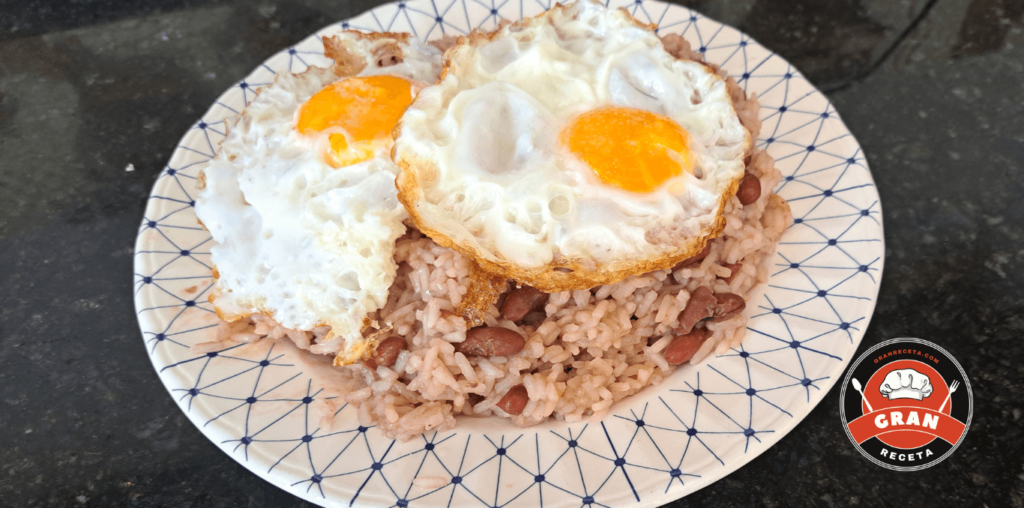
In Antioquia, households cook a bigger pot of beans than they need so that breakfast exists. That is the whole logic of calentado: yesterday’s rice and beans go back into a hot skillet with chorizo, get pressed flat until a crust forms on the bottom, and arrive under a fried egg with an arepa alongside. It is the paisa breakfast of Medellín and the Coffee Region, it takes 20 minutes, and the only real technique in it is knowing how leftovers are stored and reheated safely.
How do you make Colombian calentado? Fry chorizo with scallion, add yesterday’s beans with their liquid and heat until steaming. Stir in the rice, spread it flat and leave it 4 minutes to form a crust. Fry the egg separately and serve it on top with an arepa. 20 minutes for 2 servings.
What calentado is
Calentado means heated up, and the dish is exactly that: whatever was on the table yesterday, brought back in one 10-inch pan. In Antioquia that means red beans and white rice; in Bogotá it often means rice with meat and potato instead.
What turned it from thrift into a proper dish is the pan. Pressed flat and left alone, the rice and bean mixture browns against the metal and forms a crust, and that crust broken through the soft rice is the texture people actually get up for. Plenty of households now cook a bigger pot of beans than they need, specifically so there is calentado the next day.
The safety part, which is the actual technique
Cooked rice is the most demanding leftover in any kitchen. Spores that survive boiling germinate at room temperature, and no amount of reheating undoes what they leave behind, so rice that sat out overnight goes in the bin rather than in the pan.
The numbers are simple. The USDA danger zone runs from 40 to 140 °F, cooked food goes into the fridge within 2 hours, and leftovers are reheated to 165 °F, once. Warm is the worst place to stop, which is why the instruction here is to heat the beans until they steam rather than until they are hot enough to eat.
Storing it properly the night before
Spread rice on a tray or a shallow container rather than leaving it in the pot: a deep pot of rice can sit above 40 °F at its center for hours even inside a fridge. Beans keep in their own liquid, which is also what makes them creamy the next day.
Everything gets the same treatment and the same window of three to four days. The egg is the exception, fried fresh at the last minute, and the arepa reheats on a dry griddle rather than in a microwave, which turns it leathery instead of restoring the crust.
The crust, and how to get one
Once the rice and beans are mixed, spread everything flat and leave it 4 minutes over medium-low heat without stirring. Starch from the rice against hot metal browns into a crust that is then broken up and folded through, and that mixture of crisp and creamy is the difference between calentado and simply reheated food.
Two things stop it forming. Constant stirring, obviously, and an overloaded pan: the layer needs to be ¾ inch deep at most, so for four people it is better to do two rounds than one mountain.
Twenty minutes, in order
Fat first, because the rendered chorizo fat is what carries flavor into everything else. Beans next, since a dense scoop of beans takes longer to reach 165 °F at the center than loose rice does. Rice last, because it needs the least time and dries out with more.
The egg goes in a second pan in the final 5 minutes. Putting it on top rather than stirring it in is not only presentation: the soft yolk works as a sauce once it breaks over the rice.
Who this recipe is for
- If you have no cooked beans → canned red kidney beans, drained and rinsed, work; you lose the bean liquid that makes it creamy
- If the rice is very dry → 2 tbsp of water or bean liquid as it goes in, then cover the pan for a minute
- If you are cooking for 4 → two rounds in the same skillet, since a layer over ¾ inch will not crust
- If you do not eat pork → 1 tbsp of oil and ½ tsp of cumin replace the chorizo without leaving it bland
- If you want it lighter → no chorizo and a boiled egg instead of fried takes the plate from about 550 to about 390 calories
Calentado, gallo pinto and fried rice
Every rice-eating culture has a version of this, because rice keeps badly at room temperature and beautifully in a hot pan. Gallo pinto in Costa Rica and Nicaragua uses black beans and stays loose; Chinese fried rice chases dry, separate grains; this one chases the opposite of dry.
The seasoning tells you where you are, too. Soy sauce in one, Lizano and cilantro in another, and here just scallion and the fat from the chorizo, with hot sauce added at the table by whoever wants it.
What goes wrong
Rice that sat out overnight. Not a flavor problem, a safety one: it gets thrown away.
Reheating twice. Each trip through the danger zone is another opportunity. Heat only what you are going to eat.
Stirring constantly. No 4 quiet minutes, no crust, and without a crust it really is just leftovers.
Stirring the egg in. It scrambles into threads and you lose the soft yolk, which is half the sauce.
An overloaded pan. Over ¾ inch of mixture and the heat never reaches the bottom layer.
Variations
With pork crackling. Chopped leftover chicharrón instead of chorizo, for more fat and more crunch.
With shredded beef. Half a cup of leftover Colombian shredded beef, which turns breakfast into lunch.
With hogao. Two tablespoons stirred in, about 40 calories more, for moisture and color when the rice is dry.
With lentils. A cup of leftover lentils in place of the beans changes the profile and works just as well.
What to serve with it
A Colombian cheese arepa on the side, the fried egg on top, hot sauce, and Colombian hot chocolate or black coffee to drink. At 550 calories a plate, a glass of juice finishes the table.
In practice this is where the leftovers of a Colombian bandeja paisa end up, along with whatever rice is left from a pot of Colombian chicken rice and any chorizo from a fritanga. That is not an accident: the bandeja is a large plate precisely because tomorrow’s breakfast is part of the plan.
Frequently asked questions
Can I use rice from last week? No. Per the USDA, cooked food keeps three to four days refrigerated; after that it goes.
What if the rice was left out overnight? Throw it away. Cooked rice at room temperature is the riskiest thing in a home kitchen.
How do I get the crust? Spread the mixture flat and leave it 4 minutes untouched over medium-low heat, in a layer no deeper than ¾ inch.
Can I use canned beans? Yes, drained and rinsed. You lose the cooking liquid, so add 2 tbsp of water for creaminess.
Can I reheat calentado? Better not. It is already once-reheated food, and a second trip adds risk without improving anything.
Nutrition
Per plate, half the skillet with its egg, calculated with the USDA database for the rice, beans, chorizo and egg:
- Calories: 550 kcal
- Protein: 24 g
- Carbohydrates: 63 g
- Fat: 22 g, of which 6 g saturated
- Fiber: 8 g
- Sodium: 780 mg
The fiber is almost entirely the beans, which according to the USDA carry 9.3 g per 100 g once cooked, and they are why this breakfast holds until lunch. The fat is chorizo and fried egg: leave out the chorizo and boil the egg instead and the same plate lands near 390 calories.
The first time someone served me calentado in Medellín I thought I was being given the leftovers, because in Venezuela yesterday’s food came back as yesterday’s food, with no ceremony. It took me a while to understand that here it was a dish with a name, and that people cook extra beans precisely so it exists. Now I make the pot bigger than I need too. Josnaisis.