
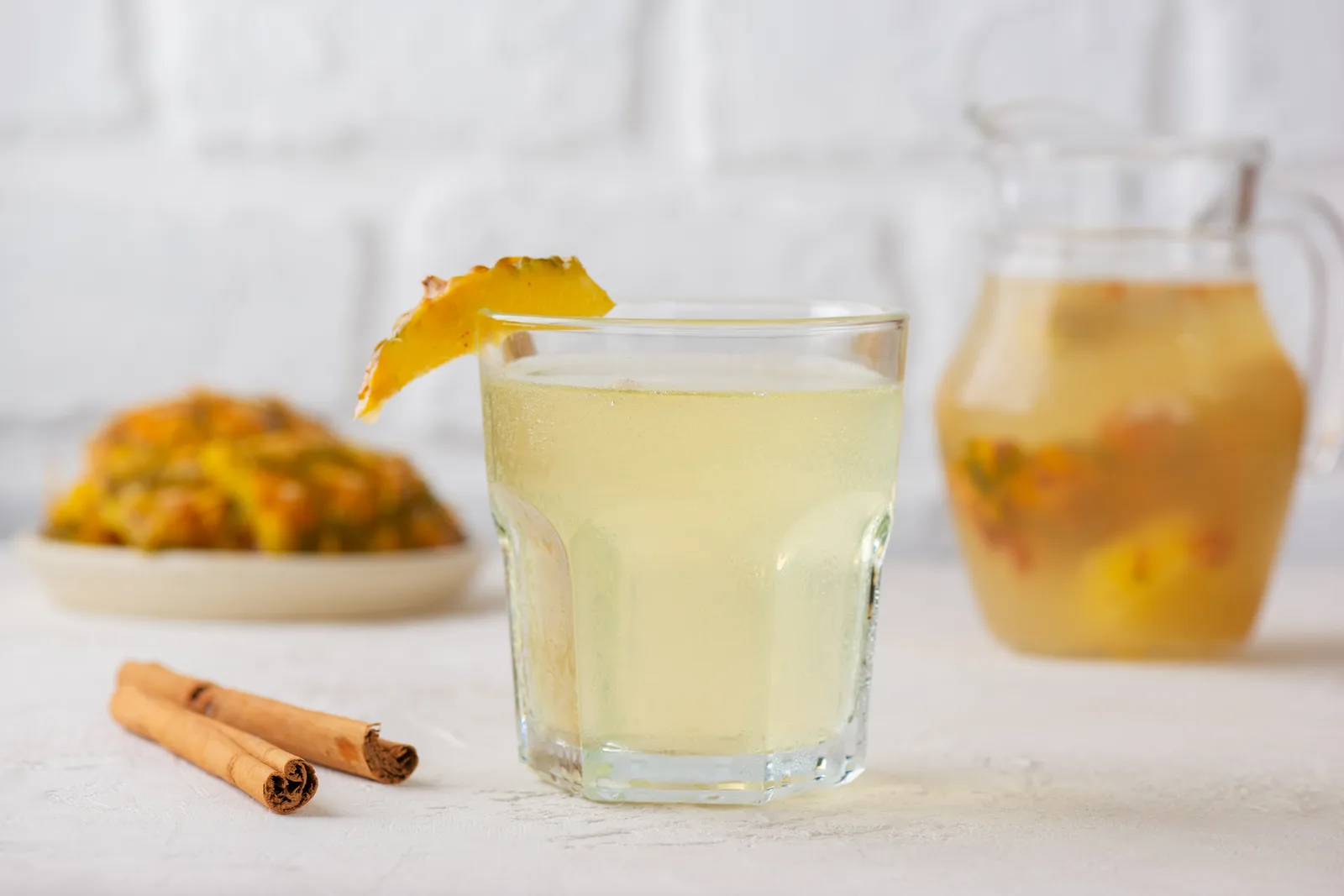

Tepache (teh-PAH-cheh) is a Mexican drink fermented from the part of the pineapple you normally throw away. The peel and core sit in water sweetened with piloncillo, a cone of raw cane sugar, plus a stick of cinnamon, and the wild yeast living on the skin turns it into something amber, lightly fizzy and sweet-tart in a few days. No starter culture, no special equipment beyond a big jar. This is the version I make, with the one thing most people get wrong (the syrup temperature), a day count for your kitchen in °F and °C, and how to tell harmless surface yeast from mold you have to throw out.
What tepache tastes like, and how long it takes
How do you make tepache? Scrub a pineapple, peel it with a little flesh left on and cut out the core. Dissolve 250 g (9 oz) of piloncillo in 1 liter (4¼ cups) of simmering water with a cinnamon stick, add 1 liter of cold water and, once it’s at room temperature, pour it over the pineapple in a 3-liter jar covered with a cloth. Ferment 2 to 4 days until foamy and tart, then strain and chill. Ready in 4350 minutes (about 3 days) for 8 servings.
Think of a soft, low-alcohol pineapple cider with a brown-sugar edge and a little spice. It’s sold cold in Mexican markets and street stalls and goes well with rich or spicy food, like tacos al pastor with grilled pineapple.
- Yield. 2 liters, about 8 glasses of 1 cup (250 ml).
- Hands-on time. About 20 minutes on day one, 5 minutes to strain.
- Waiting. 2 to 7 days depending on your kitchen, about 3 at 72 to 75°F (22 to 24°C).
- Difficulty. Easy. The skill is judging the jar, not cooking.
If you’ve had kombucha or water kefir, tepache sits in the same family but is simpler: there’s no SCOBY or grains to keep alive between batches. Each jar starts from scratch with a new pineapple.
Ingredients, and the US and UK swaps
The pineapple
Use a fresh, ripe pineapple, golden over much of the skin and smelling sweet at the base. The yeast that does the work lives on the peel, so canned pineapple, which is cooked and peeled, won’t start a ferment. Leave a little flesh on the strips for flavor; the rest of the fruit is yours to eat.
Sugar, and what each swap changes
Piloncillo is unrefined cane juice boiled down and set in cones. In Colombia it’s sold as panela and in Venezuela as papelón, and they behave the same here at the same weight. The ratio is 125 g of sugar per liter (about 4½ oz per quart): enough for the yeast to work and for the drink to stay pleasantly sweet.
| What you can find | Where | What changes |
|---|---|---|
| Piloncillo cones | US Latin aisle or Mexican grocers | The reference flavor: deep, molasses-y, toasty |
| Panela | Latin grocers, online in the UK | Same result as piloncillo |
| Dark muscovado sugar | UK supermarkets | Closest UK swap, rich molasses flavor |
| Dark brown sugar | Any US supermarket | Ferments the same, slightly lighter and less complex |
| Jaggery made from cane | South Asian shops | Similar raw-cane flavor; check it’s cane, not palm |
| White sugar | Anywhere | Works, but the drink tastes flat |
Piloncillo cones are rock hard. Wrap one in a towel and tap it with a rolling pin, or drop it whole into the simmering water and stir until it melts.
Equipment
A 3-liter (about 3-quart) glass jar with a wide mouth, a clean cotton cloth and a rubber band to cover it (gas gets out, fruit flies don’t get in), a weight to keep the fruit under (a small plate or a zip-top bag filled with water), a fine strainer, and bottles or a lidded pitcher. If you use a traditional clay pot, make sure it’s lead-free: glazed earthenware of unknown origin can leach lead into acidic liquids.
Step by step, with the day count for your kitchen
Start clean
There’s no added yeast, so whatever lives on the peel and the jar ends up in the drink. Wash the jar, plate and spoon and pour boiling water over them. Scrub the pineapple under the tap with a brush, no soap, before you cut it, and throw away the crown and base, where most of the dirt collects.
Cool the syrup completely
Simmer the sugar and spices in 1 liter (4¼ cups) of water for 5 to 10 minutes, until no lumps remain, then add 1 liter (4¼ cups) of cold water. Wait until it’s at room temperature before it touches the fruit. Hot syrup kills the wild yeast, so along with a cold kitchen it’s one of the first things to suspect when a jar never bubbles.
How many days at your room temperature
Stir once a day with a clean spoon so no peel dries out on top, and put the weight back. A cheap room thermometer near the jar saves a lot of guessing.
What it should look like, day by day
- Day 1. Not much. Maybe a few bubbles clinging to the peel.
- Day 2. Fine bubbles rising by themselves and a pale foam on top. It smells more of pineapple and less of sugar.
- Day 3 at 72 to 75°F (22 to 24°C). Full foam, cloudy amber color, a fruity smell with a sour edge, and on the tongue more tart than sweet with a light prickle. Strain it.
- After a week. Sharp, vinegary and a bit boozier. Left for weeks, it becomes pineapple vinegar.
Strain, chill, and the optional fizz
Strain through a fine sieve, discard the solids and refrigerate. It keeps fermenting in the cold, only very slowly.
For more fizz, bottle it in swing-top bottles made for pressure and leave them at room temperature for 12 to 24 hours, then refrigerate. Open them over the sink, slowly. Pressure builds fast, and thin glass or a reused soda bottle can burst.
Making it for a crowd
It scales in a straight line and the days stay the same: 16 glasses with 2 pineapples, 4 liters (about 1 gallon) of water and 500 g (1 lb 2 oz) of sugar in a 5-liter jar or two 3-liter jars; 24 glasses with everything tripled in three jars. Set the jars up 3 days before the party and strain the day before.
Kahm yeast, mold or vinegar
Three things can show up on the surface, and only one means the whole batch goes in the trash.
Kahm yeast is a flat, white or off-white film, matte, sometimes wrinkled, never fuzzy. It’s common on home ferments and usually harmless. Skim it off with a clean spoon and check that the liquid underneath smells yeasty, not musty. By eye alone it isn’t always easy to tell from early mold, so if you’re not sure it’s a smooth film with no spots or fuzz, discard the batch. If it keeps coming back thick, the tepache is ready or getting past it.
Mold is fuzzy and raised, often in round spots, and can be green, blue, black, pink or cottony white. Throw everything out: liquid, peel and any plastic weight. Skimming doesn’t fix it. The same goes for liquid that turns slimy or stringy, or anything that smells rotten. When in doubt, throw it out.
Vinegar isn’t dangerous, it just isn’t tepache anymore: a sharp acetic smell and a taste that catches in your throat. Use it in salad dressings.
Is tepache alcoholic?
A little. Tepache strained after about 3 days usually stays under 1% alcohol by volume; one batch measured at 72 hours came out at roughly 0.4%, but every home ferment is different and yours may land a little higher or lower. Longer fermentation means more alcohol and more sourness. I haven’t found a measured figure for week-long ferments, so I won’t guess one.
That’s low, but it isn’t zero. During pregnancy no amount of alcohol is known to be safe, so skip it. Skip it too for young children and anyone avoiding alcohol for health, medication or personal reasons. For them, blend the leftover pineapple flesh with the same cooled cinnamon syrup, strain, and serve it the same day as an unfermented pineapple agua fresca. Other same-day Mexican drinks that work for a mixed table are agua de tamarindo and hibiscus agua de jamaica.
Allergens and heat. None of the major allergens, and no chile heat.
Troubleshooting
- No bubbles after 3 days. Warm syrup, a cold kitchen or canned fruit. If it smells fine, move it somewhere warmer and give it 2 more days. Still flat at day 5 and smelling off? Throw it out.
- Still very sweet. It isn’t done. Wait another day.
- Too sour. It went too long or the kitchen was hot. Dilute it with cold water and a splash of dissolved sugar, and next time start tasting at 36 hours.
- Mold on peel that stuck out. It needed a weight. Discard and start again with everything submerged.
- A bottle that erupts. Too long at room temperature after bottling. Refrigerate within 12 to 24 hours.
Variations
- Extra spice. One or two star anise pods with the cinnamon and cloves.
- With beer. Add about 1 cup (240 ml) of light lager per 4 liters (about 1 gallon) of strained tepache and let it sit a few hours. This raises the alcohol, so it’s adults only.
- Drier. Cut the sugar to 200 g (7 oz) and strain as soon as the sweetness fades.
- Faster. At 75 to 84°F (24 to 29°C) it’s ready in 2 days. Don’t push it further by putting the jar in the sun or next to the oven.
Cost is mostly the sugar: the peel comes from a pineapple you were going to eat anyway.
Serving and storage
Serve it very cold, over ice. At a taco night it sits well next to a jug of creamy Mexican horchata for anyone who wants something unfermented. If you like fermented drinks from the same part of the world, Venezuelan chicha andina starts from a very similar pineapple-peel brew and is then thickened with corn and rice, and Colombian masato ferments rice instead of fruit.
- Fridge. Strained and covered, 5 days to 1 week. It gets a little more sour each day; dilute it with cold water if it goes too far.
- Counter. Once strained, don’t keep it out. It keeps fermenting, sours and, in a sealed bottle, builds pressure.
- Freezer. I don’t freeze it. It loses its fizz and tastes flat once thawed.
Tepache FAQ
Is tepache probiotic? Unpasteurized tepache contains live microbes, but which ones varies from batch to batch, because it’s a wild ferment and you don’t control what grows. I don’t drink it as a health remedy; I make it because it tastes good.
Can I make tepache with only the pineapple flesh? The flesh adds flavor, but it’s the peel that starts the fermentation. Without it the jar may never get going. For more pineapple flavor, add flesh to the peel rather than replacing it.
Can I sweeten it after straining? Yes, with a little sugar dissolved in hot water and cooled. Do it by the glass or right before serving. Sweeten a whole bottle and leave it out, and it will start fermenting and building gas again.
Why does my tepache taste boozy? It fermented too long or too warm. Start tasting on day 2 and get it into the fridge as soon as it tastes more tart than sweet.
Nutrition per glass
Per 1 cup (250 ml) glass, with the 250 g (9 oz) of sugar shared across 8 glasses:
- Calories: 119 kcal
- Protein: 0 g
- Carbohydrates: 31 g
- Fat: 0 g
- Fiber: 0 g
- Sugars: 30 g
- Sodium: 9 mg
Treat these as a ceiling. The yeast eats some of the sugar while it ferments, so a well-fermented batch has less. The figures don’t count what the peel releases or the alcohol.
I strain by taste, not by the clock. My kitchen is usually mild, so it’s mostly day three, but I start tasting on day two with a clean spoon. I make it with panela because that’s what’s always in my cupboard, and I peel the pineapple with a finger’s width of flesh left on, because that flesh is where the flavor comes from. Josnaisis.