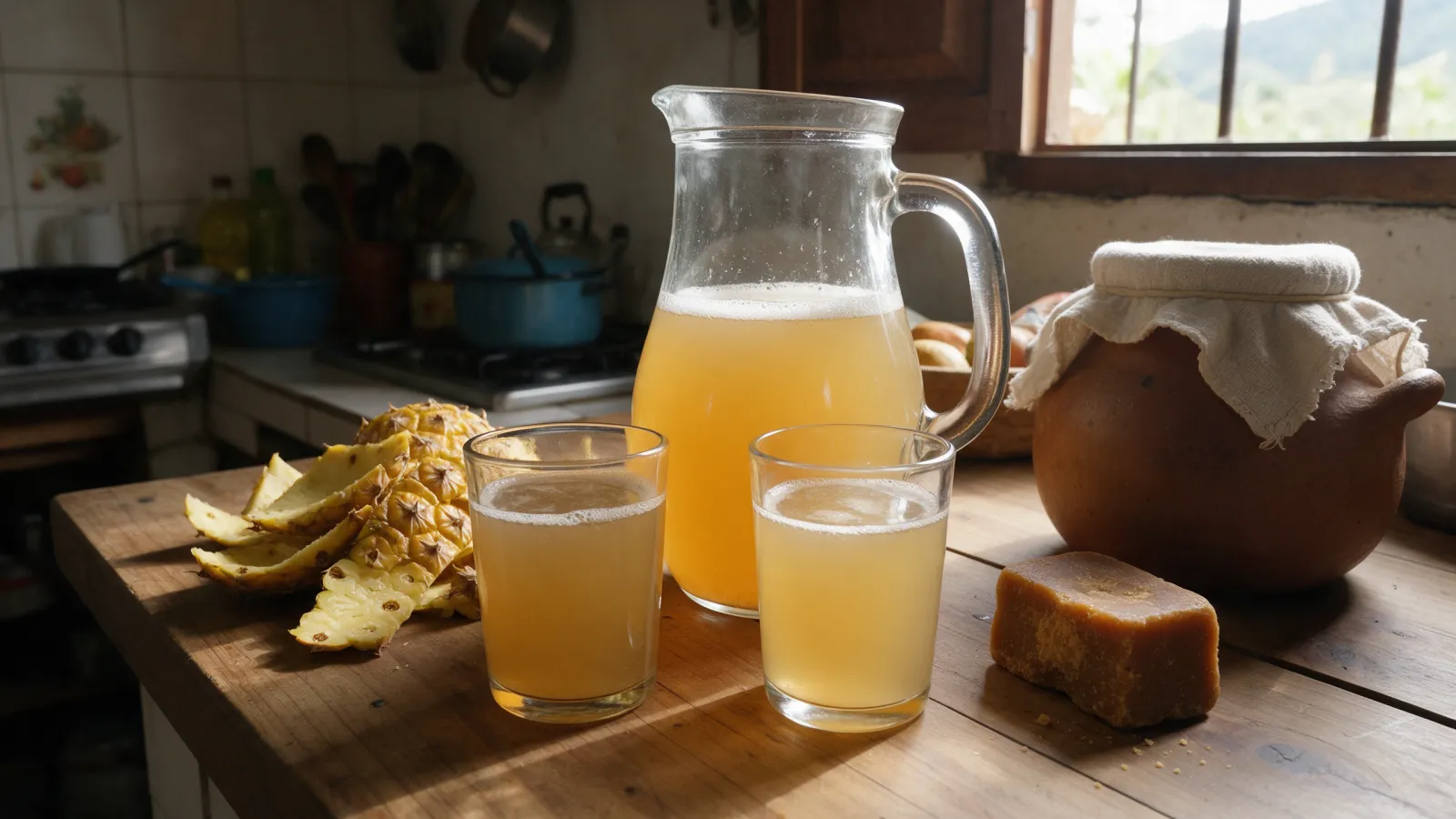

Chicha andina (CHEE-chah ahn-DEE-nah) is the thick, cold drink of the Venezuelan Andes, from the states of Táchira and Mérida. You start it two days ahead by leaving pineapple peels to ferment in water sweetened with papelón, Venezuela’s unrefined cane sugar, until the jar foams. That sour pineapple brew is then cooked with masarepa and rice, spiced with cloves, cinnamon and allspice, blended and chilled. To me it tastes like a cross between Mexican tepache and a spiced rice drink. It contains some alcohol, and how much depends on each brew.
What is chicha andina, and how is it different from tepache?
How do you make chicha andina? Ferment the peel and core of one pineapple in 2 liters (8½ cups) of water with 200 g (7 oz) of papelón for 48 hours. Strain the brew, thicken it with 100 g (3.5 oz) of masarepa for 10 minutes, add 100 g of rice simmered in a spiced papelón syrup, then blend, strain and chill. Ready in 3185 minutes (about 53 hours) for 10 servings.
It is a grain drink built on a fruit ferment. The pineapple part works like tepache, the fermented pineapple-peel drink from Mexico. The grain part, corn and rice cooked until they thicken the liquid, is closer to Colombian masato. Venezuelans also have a completely different drink called chicha, sold from street carts, which is rice blended with milk and condensed milk and never fermented.
Which grain goes in depends on the household. In Táchira a common mix is one cup of corn meal and one of rice flour; others use only corn or only rice, and some use barley. The all-rice version from the Venezuelan Andes is called masato. I use both: corn for body and a pale gold color, rice for a silkier finish.
Is it worth making, and who should skip it?
Make it if you enjoy tart, thick, cold drinks and like the idea of turning pineapple scraps into 10 glasses. The work is under an hour, split across two days; the waiting is the jar’s job.
Skip the fermented version, or make the unfermented one below, for children, anyone pregnant and anyone who avoids alcohol. There is no known safe amount of alcohol during pregnancy. Skip it too if you need a drink today, since the clock runs to about 53 hours.
Difficulty is medium. Nothing here is hard to do, but you need to read the jar: when the brew is ready, and when it has gone wrong.
Ingredients, with US and UK swaps
The recipe card has the exact amounts: the peel of a 1.5 kg (3.3 lb) pineapple, 3 liters (12¾ cups) of water, 400 g (14 oz) of papelón, 100 g (3.5 oz) each of rice and masarepa, and three whole spices.
- Papelón is solid unrefined cane sugar, the same thing as Mexican piloncillo, Colombian panela and the jaggery sold in South Asian shops. In the US, look in the Mexican aisle; in the UK, Latin or South Asian grocers carry it. Dark brown sugar works but gives a lighter, less molasses-heavy drink.
- Masarepa is pre-cooked corn meal, the flour Venezuelans use for arepas. P.A.N. is the common brand in both countries. In a Venezuelan recipe, “harina de maíz” means this flour. Regular cornmeal or polenta needs longer cooking and leaves the drink grainier; if that is all you have, boil it until you cannot feel the grain and strain twice.
- Guayabita is allspice (Pimenta dioica), sold whole in any supermarket spice rack. Seven berries and seven cloves for 3 liters of water is the classic ratio. They add perfume, not heat.
- Rice: any long-grain white rice. Rice flour also works; whisk 100 g (3.5 oz) of it into the cold brew with the masarepa.
- Pineapple: ripe, golden at the base and sweet-smelling. Peels from an underripe fruit ferment slower and taste sharper.
Equipment. A glass jar of 3-4 liters (about 1 gallon), two pots, a blender, a fine sieve, a whisk and a wooden spoon. Ferment in glass, not metal: the brew is acidic. Avoid handmade glazed pottery too. Poorly glazed ceramics can leach lead into whatever is stored in them, and no washing or boiling removes it.
A two-day plan, and how to tell the brew is ready
The pineapple brew needs about 48 hours at 72-79°F (22-26°C). Every household has its own timing: some strain at 24 hours, some at 48, some after 2-3 days, and in a cool kitchen around 68°F (20°C) it can run 4 days or more, until the mixture foams. The yeasts work best at 68-86°F (20-30°C). In a normal kitchen, with 200 g (7 oz) of papelón, I strain mine at 48 hours.
Signs the brew is on track.
- 12-24 hours → fine bubbles along the peels and the rim, and a stronger pineapple smell.
- 48 hours, ready → a layer of foam, bubbles rising on their own, ripe pineapple with a sour edge, and noticeably less sweet.
- 4 days → sharper and fizzier. That is the cool-kitchen timeline, or the strong version.
- No bubbles at all after 4 days → it never started. If it smells clean, the room was too cold; if it smells off, discard it.
Throw the whole jar out if you see mold of any color on the surface, the peels or the rim; a slimy layer or liquid that strings off the spoon; or a smell of rot, strong cheese or nail-polish remover. Scooping the mold off does not fix it.
Why it is a wild ferment, and how to keep it clean. No yeast is added: the peel brings its own microbes. A homemade tepache fermented 4 days at about 72°F (22°C), which works the same way, ends up dominated by Bacillus bacteria and Meyerozyma yeast rather than the lactic acid bacteria you might expect, and wild fermentation makes every batch different. So scrub the pineapple with a brush under running water before peeling, as with any firm produce (no soap needed), scald the jar, and keep every peel under the liquid, since the ones poking out are the ones that grow mold.
Why the masarepa goes into cold brew
Pre-cooked corn meal swells the moment it meets heat, sealing dry flour inside each lump. Whisked first into 500 ml (2 cups) of cold brew, every grain gets wet on its own and thickens evenly later. Once the pot boils, keep stirring the bottom for the full 10 minutes; a scorched patch flavors the whole batch.
Scaling it for 5 or 20 glasses
The recipe scales in a straight line and the times stay the same.
- 5 glasses → peel of half a large pineapple or one small one, 1 liter (4¼ cups) of water and 100 g (3.5 oz) of papelón for the brew; 500 ml (2 cups) of water, 100 g of papelón, 50 g (¼ cup) of rice, 50 g (⅓ cup) of masarepa, half a cinnamon stick, 4 cloves and 4 allspice berries.
- 20 glasses → double everything, with two pineapples fermenting in two 3-liter jars and two pots on day three.
How much alcohol is left after cooking?
I don’t give a figure for chicha andina. It contains some alcohol, and the amount rises the longer the pineapple ferments. The closest comparable drink is commercial Colombian masato, at about 1.5% alcohol by volume, but that is a different recipe and not a stand-in for this one.
What is known is what heat does. The share of alcohol left in a liquid that is simmered is 40 percent after 15 minutes, 25 percent after an hour, 5 percent after two and a half hours. The 10-minute boil here leaves most of what the brew had.
That is why I treat the fermented chicha as a drink with alcohol and do not leave the finished, cooked drink out to “strengthen”, as some Venezuelan households do. It is a cooked starchy drink, and no cooked food should sit more than 2 hours out of the fridge.
Mistakes that ruin chicha andina
- Lumps → masarepa hit hot liquid. Whisk it into cold brew; if lumps formed, blend again and strain twice.
- Burnt taste → the corn stuck to the bottom. Medium heat and a wooden spoon moving for all 10 minutes.
- Too sour → the brew went too long or the kitchen was hot. Stir in a little extra papelón syrup to serve, and strain at 36 hours next time.
- Too thick → it thickens in the fridge. Thin with cold water by the glass.
- Bitter → cloves or allspice got blended. Count 7 and 7 in, count 7 and 7 out.
Which version should you make?
- Alcohol-free, for kids or pregnancy → simmer the peels and core for 1 hour in the 2 liters of water with 200 g (7 oz) of papelón, the way Ecuadorian chicha de piña is made, strain, and carry on from day three. It comes out sweet and spiced, without the tang, and is ready the same day.
- Short on time → a 24-hour brew. Milder and less fizzy.
- Corn only → 200 g (7 oz) of masarepa and no rice. Thicker, more yellow, more corn flavor.
- Rice only → 200 g (1 cup) of rice, or 120 g of rice flour. Paler and smoother.
- Less sweet → 100 g (3.5 oz) of papelón in the syrup instead of 200: about 188 kcal and 29 g of sugar per glass. Leave the brew’s sugar alone, since that is what the yeast eats.
- With milk → some households finish it with a few spoonfuls of milk or a drizzle of condensed milk. It pulls the drink toward the rice-and-milk chicha; I prefer it without, so the pineapple shows.
Cost and yield
Yield: about 2.5 liters (10½ cups), ten 250 ml (1 cup) glasses, or about 16 small 150 ml (5 oz) glasses alongside food.
US cost. At average US prices for August 2026, the 100 g (3.5 oz) of rice costs about 24 cents. Piloncillo, masarepa and pineapple vary a lot by store. If you swap the piloncillo for white sugar, 400 g (14 oz) comes to about 90 cents. The pineapple is the real cost, but you were buying it to eat anyway: the drink uses the part that goes in the bin.
In Colombia, wholesale prices in Cúcuta, the market across the border from Táchira, for September 12-18, 2026, put papelón, rice and masarepa at 2,896 pesos for the batch, about 290 pesos a glass, with papelón at 79 percent of the total. I don’t give a figure for Venezuela, where prices shift week to week.
Serving and storage
What it tastes like. Thick, beige-gold, papelón-sweet first, then clove and allspice, with the brew’s sourness at the end and pineapple in the background rather than the front.
How to serve it. Very cold, stirred, with ground cinnamon on top; some garnish it with a strip of lemon or orange peel. Ice waters it down, so I chill the pitcher instead. It goes with something fried and savory, like Venezuelan pastelitos andinos from the same region, Colombian cheese arepas, or a late weekend breakfast of pisca andina, the Andean milk and potato soup. For the kids at the same table, I pour papelón con limón, which uses the same sugar and no fermentation.
If you want the comparison side by side, the non-fermented cart drink is Venezuelan rice chicha, and the rice ferment is Colombian masato.
Fridge. Once cooked, treat it like any leftover: 3-4 days at 40°F (4°C) or below, in a covered glass pitcher. It thickens each day; add cold water and stir.
Freezer and reheating. I don’t freeze it; I make what will be drunk. It is never reheated, either. If it separates in the fridge, stir or give it 10 seconds in the blender.
Chicha andina FAQ
Is chicha andina alcoholic? Yes, mildly, because the pineapple brew ferments, and how much depends on the brew. Cooking does not remove it: 40 percent of alcohol remains after 15 minutes of simmering.
Is chicha andina made with corn or rice? Either, or both. In Táchira corn meal and rice flour often go together; other households use one. This version uses 100 g (3.5 oz) of each.
How long does the pineapple brew ferment? About 48 hours at 72-79°F (22-26°C), up to 4 days in a 68°F (20°C) kitchen. It is ready when it foams and tastes tart and less sweet.
Can I make it without fermenting? Yes. Simmer the peels with the water and papelón for an hour, strain, and continue with the recipe. That version is for children and pregnancy.
Is chicha andina the same as tepache? No. Tepache is the pineapple ferment on its own, with no grain and no cooking afterwards. Chicha andina cooks that kind of brew with corn and rice into a thick drink.
What can I use instead of papelón? Piloncillo or jaggery, gram for gram. Dark brown sugar works with a little less depth.
How long does it keep? 3-4 days in the fridge at 40°F (4°C) or below, covered. The raw brew does not keep: strain and cook it when it is ready.
Nutrition per glass
Per 250 ml (1 cup) glass, one-tenth of the batch, calculated from this recipe’s amounts: 100 g of degermed white cornmeal standing in for masarepa, 100 g of long-grain white rice and 400 g of brown sugar standing in for papelón.
- Calories: 226 kcal
- Protein: 1 g
- Carbohydrates: 55 g
- Fat: 0 g
- Fiber: 1 g
- Sugars: 39 g, nearly all from the papelón
- Sodium: 12 mg
The figures do not subtract the sugar eaten by the yeast or add calories from alcohol, and they leave out whatever the pineapple peel releases, which is small and hard to pin down. With 100 g of papelón in the syrup instead of 200, a glass drops to about 188 kcal and 29 g of sugar.
At home in Venezuela, chicha meant the rice-and-milk kind, and the Andean one took me a while to like, because I kept waiting for it to taste sweet and it kept answering sour. Now I start the jar with the peels from a weekday pineapple and strain it two days later, once the foam is up. I drink the fermented one; Dylan gets his glass from the pot of boiled peels, which is ready in an hour. Josnaisis.