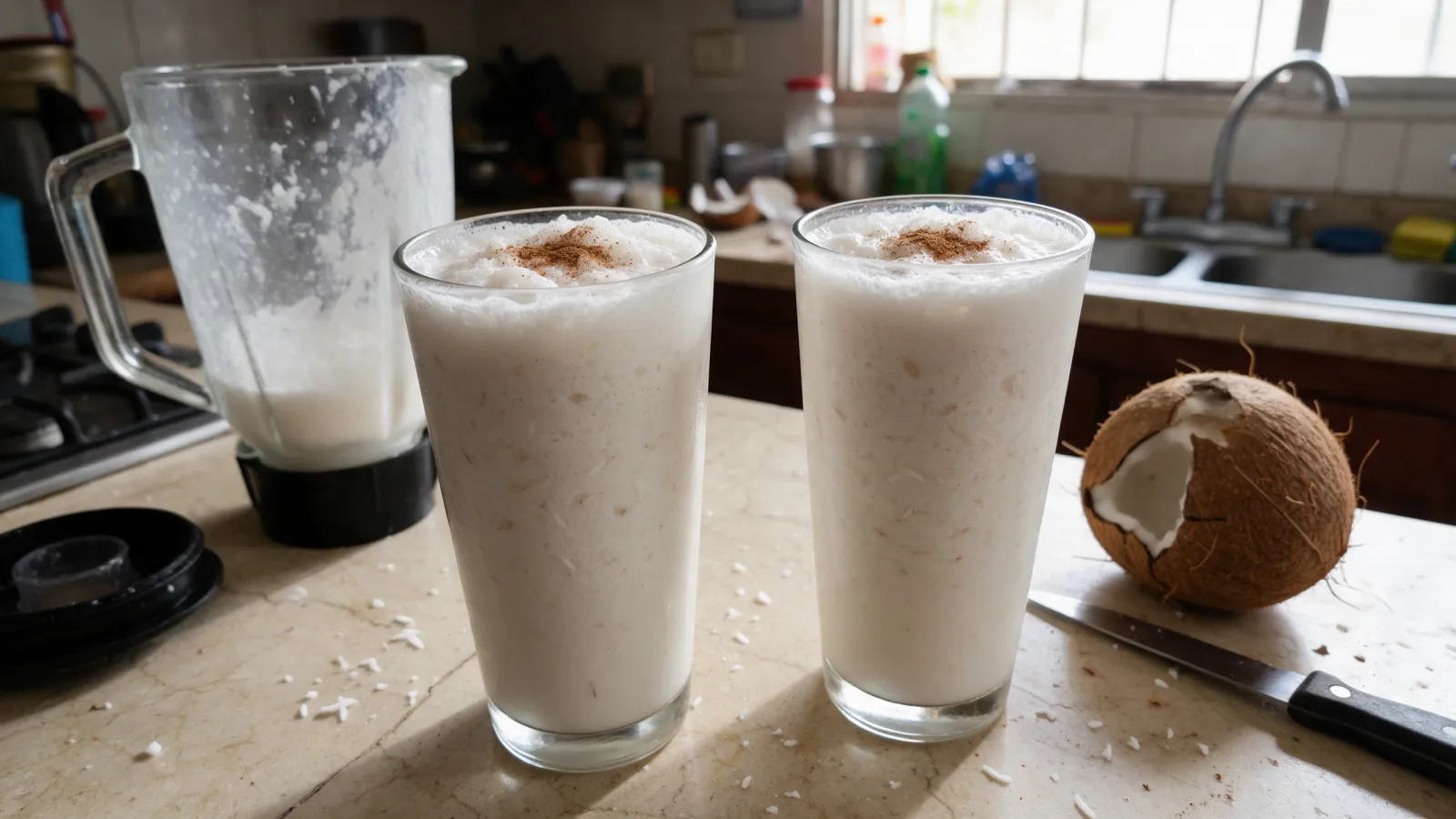

Order a cocada (koh-KAH-dah) in Mexico or Colombia and you get a chewy coconut candy; order one in Venezuela and you get a tall glass. The Venezuelan cocada is a drink: fresh coconut meat blended with its own water, sugar and ice, and in the creamy version most people make at home, with milk and sweetened condensed milk too. Think of a coconut milkshake with no ice cream, slushy rather than smooth, with tiny flecks of real coconut. This recipe uses one brown supermarket coconut for four glasses, and spends most of its words on the part that puts people off: getting into the coconut.
How do you make Venezuelan cocada?
How do you make Venezuelan cocada? Drain a brown coconut through one of its eyes, crack it with a hammer while it’s wrapped in a towel, and pry out 10½ oz (300 g) of meat. Blend it for 90 seconds with 1 cup (250 ml) of coconut water and 1½ cups (360 ml) of cold milk, then add 6 tbsp (120 g) of condensed milk, vanilla and 10½ oz (300 g) of ice and blend 20-30 seconds more. Dust with cinnamon. Ready in 20 minutes for 4 servings.
It’s worth it if you’re fine spending 14 of those 20 minutes on the coconut. The blending is quick. What you get is cold, thick and icy, with a fresh coconut flavor that canned coconut milk alone doesn’t give.
Who it’s for. Hot afternoons, a filling snack, or anyone curious about Venezuelan food beyond arepas. It goes well with something salty, such as Venezuelan empanadas.
Who it isn’t for. Anyone after a light drink. A glass is 432 calories, about twice a Venezuelan merengada, the fruit-and-milk shake, which comes in at 221. For something tart and lighter, try a Colombian coconut lemonade.
Cocada the drink versus cocadas the candy
The word has two meanings. In Venezuela cocada is a refreshing drink made with coconut water and meat and sugar; for Mexico, Colombia, Ecuador and others, a coconut and sugar candy. Venezuelans call that candy conserva de coco, which has its own recipe in Venezuelan coconut conservas. So if a search for “cocada” gives you squares of toasted coconut, that’s the other one. And the baked Venezuelan coconut sweet, a dark spiced drop cookie, is Venezuelan coconut kisses.
That classic definition has no milk in it. The milk-and-condensed-milk version is what I make, and it’s the one most Venezuelan homes make today. The milk-free one, which I call beach-style, is in the versions below.
Buying the coconut in the US or UK
Brown coconut. The hairy, mature one sold in most US and UK supermarkets. A medium coconut gives about 300 g (10½ oz) of meat for a 1½ lb (680 g) coconut. It gives much less water than you’d guess: about 206 g (7 oz) per coconut, and a coconut can hold 684 ml (23 fl oz) at 5-6 months against 332 ml (11 fl oz) once it’s over 12 months old. That’s why the recipe says to top it up to 1 cup (250 ml).
How to pick one. There are three checks: the coconut should feel heavy, you should hear liquid sloshing when you shake it, and all three eyes should be dry, with no mold or damp. A silent coconut is old or cracked. Put it back.
Young Thai coconut. The white, trimmed cylinder wrapped in plastic at Asian grocers and many US supermarkets. Its meat is soft and almost jelly-like and it holds far more water, so the drink comes out smoother. In Venezuela many cooks use this tender coconut.
Frozen grated coconut. The closest substitute for fresh. In the US, Goya sells a 14 oz (397 g) bag in the freezer aisle; Indian and Asian grocers in the UK and US also stock frozen grated coconut. Use 300 g (10½ oz), thawed, with boxed coconut water.
Unsweetened desiccated coconut. It has lost most of its water, so 160 g (5½ oz) replaces the 300 g (10½ oz) of fresh. Soak it in the cold milk in the fridge for an hour before blending. The drink is a little gritty.
Sweetened shredded coconut (the US baking kind) carries about 43 g of sugar per 100 g. With condensed milk on top it’s cloying. Skip it.
Canned coconut milk. One 400 ml (13½ fl oz) can replaces both the coconut meat and the dairy milk. The drink is smooth with no flecks, about 296 calories a glass. Good, but closer to a piña colada without pineapple than to cocada.
How to crack open a coconut safely
The basic method is short: pierce one or more eyes with an ice pick, drain the liquid through a fine sieve, and tap the coconut firmly with a hammer until the shell cracks. A few things I do on top of that:
- Find the soft eye. One of the three gives far more easily than the others. Put the screwdriver tip on it and tap the handle with the hammer. Open a second eye so the water runs out freely.
- Never hold the coconut. Wrap it in a towel and put it on the floor or a heavy board. The towel stops shell from flying and the coconut from rolling.
- Hit the equator, the widest line around it, turning a quarter after each blow. Two or three turns is usually enough.
- Use a butter knife to lever out the meat. A sharp knife skids on the curved shell.
- If the meat won’t let go, heat the drained coconut in a 350°F (175°C) oven for 15-20 minutes before cracking it, and the meat comes away from the shell. Chill the warm meat before blending, or it melts the ice.
Is it good? The water should be sweet and clear, the meat white and firm and smelling of coconut. If the water is sour or fizzy, or the meat is yellowish, gray or smells rancid, throw the whole coconut away.
Ingredients and why the amounts matter
Per glass of about 11 fl oz (330 ml), this recipe uses 75 g (2⅔ oz) of coconut meat and 30 g (1½ tbsp) of condensed milk. Sweeter versions use 57-67 g of condensed milk per glass; I use less because coconut is already sweet, and you can add a spoonful at the end.
- Coconut meat and its water are the flavor. Weigh the meat: by eye it’s easy to use half as much and end up with coconut-scented milk.
- Whole milk gives body. UK semi-skimmed works but the drink is thinner.
- Sweetened condensed milk gives the ivory color and cooked-milk sweetness. It’s in every US and UK supermarket, usually in 14 oz (397 g) cans. Without it, use 60 g (5 tbsp) of sugar.
- Ice, last. Added at the start it melts during the 90 second blend and waters everything down.
You need a blender of at least 1½ quarts (1.5 liters), a hammer, a clean screwdriver or ice pick, a kitchen towel, a fine sieve and a butter knife. Without a blender it doesn’t work: grated coconut stirred into milk with crushed ice is a different drink.
Mistakes that make cocada gritty, watery or cloying
- Tastes of milk, not coconut → too little meat. Weigh 300 g (10½ oz) for four glasses.
- Gritty or lumpy → mature coconut not blended long enough. Give the base the full 90 seconds before the ice.
- Watery → ice went in first. Always last.
- Too sweet → sweetened shredded coconut, or too much condensed milk. Start at 120 g (6 tbsp) and taste.
- Tastes off → an old coconut. Taste the water and smell the meat before blending.
Kids love it, it’s no spicier than a milkshake, and the cinnamon is just aroma. My son Dylan gets half a glass, because at 432 calories it’s a snack rather than a drink.
Allergens. It contains milk, including the condensed milk. In the US, coconut has not been labeled as a tree nut allergen since January 2025, but anyone allergic to coconut obviously can’t have it. No gluten, no egg.
Versions, dairy-free, lighter, boozy and for a crowd
- Dairy-free and vegan → beach-style: 300 g (10½ oz) meat, 250 ml (1 cup) coconut water, 360 ml (1½ cups) cold water, 60 g (5 tbsp) sugar and the ice. Lighter, more coconut-forward, 335 calories a glass.
- Lactose-free → lactose-free milk, and 60 g (5 tbsp) of sugar instead of the condensed milk, which does contain lactose.
- Lighter → 150 g (5¼ oz) of meat, the milk and 30 g (2½ tbsp) of sugar: 232 calories, thinner.
- With rum → 15 ml (1 tbsp) of rum per glass, blended in for the last 5 seconds. Adults only.
- Quickest → frozen grated coconut or meat cracked the day before: 6 minutes.
For a party. One glass per person is plenty. A 1½ quart (1.5 liter) home blender handles one batch of the recipe at a time.
| Guests | Coconuts | Whole milk | Condensed milk | Ice | Batches |
|---|---|---|---|---|---|
| 4 | 1 | 1½ cups (360 ml) | 4¼ oz (120 g) | 10½ oz (300 g) | 1 |
| 12 | 3 | 4½ cups (1.08 L) | 12¾ oz (360 g) | 2 lb (900 g) | 3 |
| 20 | 5 | 7½ cups (1.8 L) | 21 oz (600 g), 1½ cans | 3⅓ lb (1.5 kg) | 5 |
Crack the coconuts the day before and bag the meat in 300 g (10½ oz) portions, so each batch at serving time is one bag, its liquids and its ice.
What cocada costs in the US
With a brown coconut at $2.44 (H-E-B listing, October 2026), a 14 oz can of Great Value condensed milk at $2.47 at Walmart, of which the recipe uses about 30 %, and whole milk at $4.229 a gallon (US average, August 2026), four glasses cost about $3.59, or 90 cents each. Vanilla and cinnamon aren’t counted. The coconut is 68 % of the bill, so a cheaper coconut saves more than skipping the condensed milk. UK coconut prices vary too much, so no pound figure here.
How long cocada keeps, make-ahead and freezing
Out of the fridge. It’s milk and fresh coconut, so the usual rule applies: 2 hours at most, 1 hour above 90°F (32°C). That’s worth remembering at a barbecue.
In the fridge. It separates within 15-20 minutes in my kitchen, with the coconut sinking and the ice melting. Cover leftovers, keep them at 40°F (4°C) or below and drink them the same day: soft coconut meat and coconut milk should be used within a day. Blitz for 10 seconds with a couple of ice cubes before pouring.
Make ahead. Firm coconut meat keeps up to 10 days in the fridge in an airtight container and 8-12 months frozen. I keep the coconut water covered in the fridge and use it the same or next day, or freeze it in an ice cube tray to replace part of the ice. The blended base (meat, coconut water and milk) can be made in the morning for the afternoon; ice and condensed milk go in at serving.
Freezer. Don’t freeze the drink itself. Pour it into ice pop molds instead. Kept at 0°F (−18°C), frozen food stays safe indefinitely; I eat them within a month for flavor.
Venezuelan cocada FAQ
Is cocada a drink or a candy? In Venezuela, a drink. In Mexico, Colombia and much of Central America, cocada is a coconut candy; Venezuelans call that conserva de coco.
What does cocada taste like? Fresh coconut first, then cooked-milk sweetness from the condensed milk, with vanilla and cinnamon. Icy and thick, with fine coconut flecks.
Can I make it without a fresh coconut? Yes. Frozen grated coconut gives almost the same result. Desiccated coconut works if you soak 160 g (5½ oz) in the milk for an hour. Canned coconut milk makes a smoother drink.
Is there a dairy-free coconut milkshake version? Beach-style cocada: coconut meat, coconut water, water, sugar and ice. No dairy, 335 calories a glass.
How do you open a coconut without a hammer? A heavy rolling pin or a clean, heavy stone works the same way: drain it first, wrap it in a towel and hit the equator on a firm surface.
How many calories are in a glass of cocada? About 432 calories for an 11 fl oz (330 ml) glass of this recipe, 335 for the dairy-free one and 232 for the lighter one.
How long does cocada last? Drink it fresh. Leftovers go in the fridge and should be finished that day. Never more than 2 hours out of the fridge.
Nutrition per glass
Per glass of about 11 fl oz (330 ml), based on 300 g coconut meat, 250 ml coconut water, 360 ml whole milk, 120 g sweetened condensed milk, vanilla and cinnamon for four, calculated from those amounts.
- Calories: 432
- Protein: 8 g
- Carbohydrates: 35 g
- Sugars: 27 g, about 16 g of it from the condensed milk
- Fat: 31 g, of which 26 g saturated, nearly all from the coconut
- Fiber: 8 g
- Sodium: 158 mg
It’s rich, mostly because of the coconut fat, and the fiber is there because the meat isn’t strained out. Treat it like a milkshake. A coconut that cooks well also tends to make good Colombian coconut rice, and a rice-based Venezuelan cousin of this drink is chicha.
In Venezuela I never thought of cocada as something you make at home: it was what you bought at the beach. Making it in Colombia taught me to shake every coconut in the shop and taste the water before going any further. A good coconut is most of the recipe. Josnaisis.