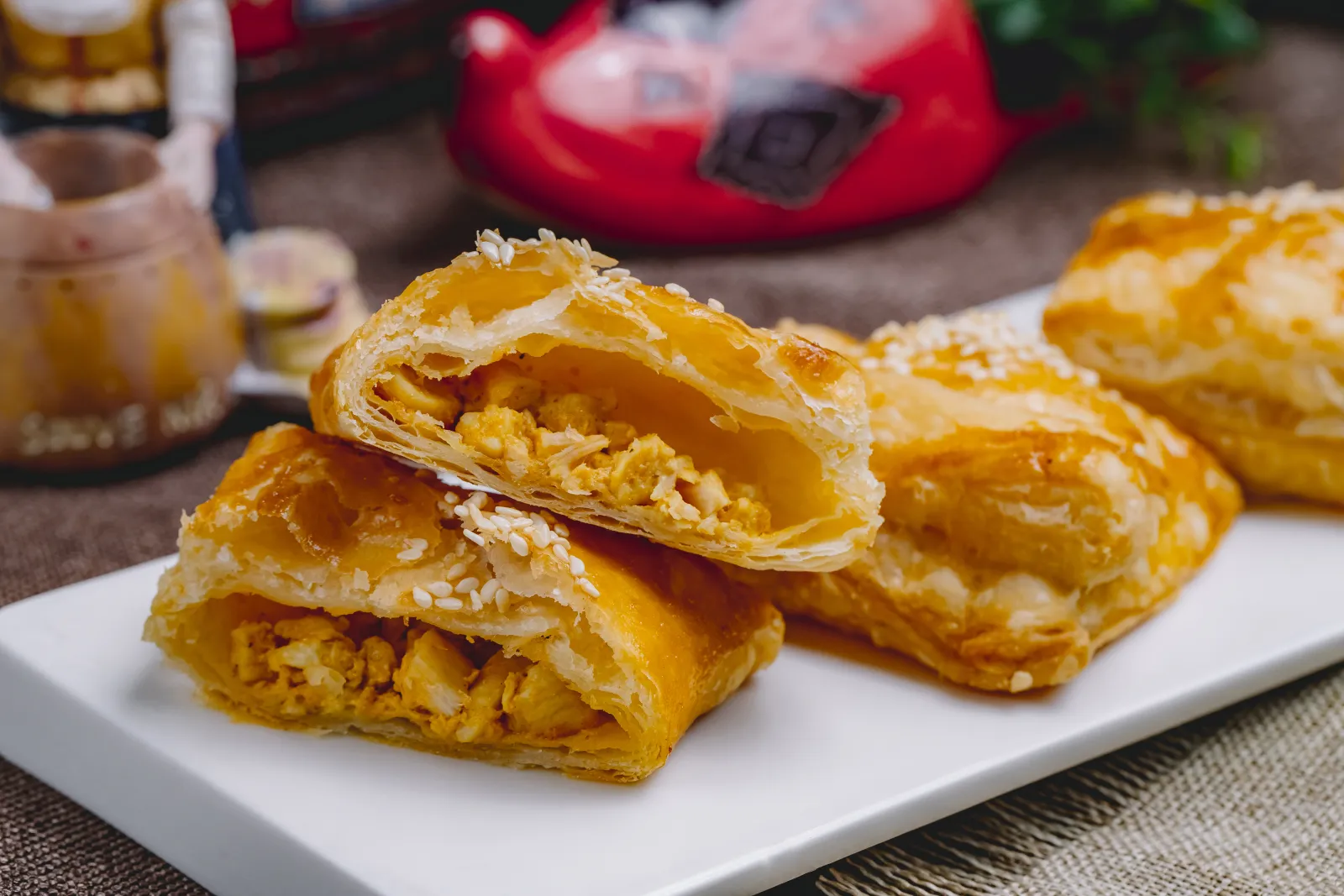

Pasteles de pollo are the puffed, glossy rectangles of a Colombian bakery case: puff pastry wrapped around shredded chicken cooked in hogao, the slow tomato and green onion base of Colombian home cooking. They are a staple of bakeries, school cafeterias and coffee shops, eaten at breakfast or with an afternoon coffee. Think of a hand-held chicken pot pie with no gravy, and a filling dry enough to eat standing up.
What a Colombian pastel de pollo is, and whether it is worth 150 minutes
How do you make Colombian chicken pastries? Poach chicken breast to 165°F (74°C), shred it and cook it with a hogao of green onion and tomato, plus carrot and peas, bound with a tablespoon of flour and reduced until no liquid is left. Chill it, sandwich it between rectangles of puff pastry rolled to ⅛ inch (3 mm), seal with egg, chill 15 minutes and bake at 400°F (200°C) for 22-25 minutes. 150 minutes for 12 servings.
It is worth it if you want a dozen at once, for a brunch, a lunchbox week or a party tray. The clock says 150 minutes, but only about 60 are hands-on with store-bought pastry; the rest is chicken simmering, filling chilling and oven time. Make the filling the night before and baking day takes 75 minutes.
Who will love them: anyone who likes chicken pot pie but wants something portable, and kids, since nothing here is spicy. Who might not: anyone after a light snack, because each pastry is over 450 calories and the pastry supplies most of the fat. The difficulty is medium. The filling is a simple stew; the skill is keeping puff pastry cold while you work.
Pastel, empanada, polvorosa or pot pie
English-speaking readers usually meet chicken in pastry as a pot pie, and Colombian food as empanadas. The pastel sits between them.
The closest cousin on this blog is the Venezuelan polvorosa de pollo, a single large pie with a sweet crust made without water that crumbles instead of rising, around a sweet-and-sour stew. Colombian empanadas share the hand-held idea but use corn masa and go into hot oil. And if you like stuffed breads, Venezuelan ham bread is a yeasted dough rolled around ham, olives and raisins, a completely different technique from laminated pastry.
Ingredients and a US and UK shopping list
For 12 pastries you need 500 g (1.1 lb) of chicken breast, 300 g (10.5 oz) of tomatoes, 100 g (3.5 oz) each of green onion and carrot, and 800 g (1¾ lb) of puff pastry. Nothing is hard to find outside Colombia.
| In a Colombian recipe | Buy this in the US | Buy this in the UK | What changes |
|---|---|---|---|
| Cebolla larga | green onions or scallions | spring onions | nothing you will notice; use white and green parts |
| Tomate chonto | Roma tomatoes | plum tomatoes | nothing |
| Arveja | frozen peas | frozen garden peas | nothing; leave them out if you prefer |
| Hojaldre | frozen puff pastry sheets, Pepperidge Farm is the common brand | chilled ready-rolled puff pastry | all-butter brands taste richer; many standard ones use vegetable fat |
| Ají for serving | any fresh green salsa | any fresh green salsa | see the serving section |
How much pastry to buy. In the US, two 17.3 oz (490 g) boxes of Pepperidge Farm give you 980 g; you need 800 g, so expect a little left over for cheese straws. In the UK, ready-rolled sheets are sold in the chilled aisle; weigh what the label says and buy enough to reach 800 g.
Store-bought puff pastry or rough puff
Store-bought is what I use most weeks, and what I would start with. It rises evenly and takes the longest job out of the plan. A homemade rough puff, the shortcut version also called blitz puff pastry, tastes of butter and costs far less, but it costs you an extra hour and 20 minutes of clock time, a third of it hands-on.
My rough puff for this recipe is a blitz puff scaled to about 780 g (1¾ lb): 300 g (2½ cups) all-purpose flour, 285 g (2½ sticks) very cold unsalted butter in ½-inch cubes, 190 g (¾ cup plus 1 tbsp) ice water and 8 g (1⅓ tsp) fine salt. Toss the butter through the salted flour without breaking it up, add the water and press into a shaggy dough with visible butter. Chill 30 minutes, roll into a rectangle and fold in thirds like a letter, then roll and fold twice more like a book. Chill at least 30 minutes, up to 24 hours. Wrapped, the dough freezes for up to a month.
In my kitchen the homemade dough rises a little less and less evenly than a good store-bought sheet; the butter flavor makes up for it. Nutritionally it trades places: fewer calories per pastry, because there is slightly less dough, but nearly double the saturated fat.
Equipment
Two baking sheets and parchment, a rolling pin (a floured wine bottle works), a sharp knife or pizza wheel, a ruler and a pastry brush. An instant-read thermometer is not essential but settles any doubt about the chicken and about pastries baked from frozen.
The make-ahead plan, and how to know each stage is right
Poach while you chop, shred while the hogao cooks, and heat the oven while the shaped pastries chill. That is the whole choreography.
The day before. Make the filling and keep it covered in the fridge; cooked chicken keeps 3-4 days refrigerated. Move frozen pastry to the fridge the same night. Do not shape the pastries and leave them unbaked in the fridge overnight, because the base soaks up moisture. If you want to shape ahead, freeze them instead.
Signs you are on track.
- Chicken → 165°F (74°C) in the thickest part, no pink, clear juices; it shreds easily with two forks.
- Hogao → no tomato chunks left, the oil looks reddish at the edges and it smells sweet rather than sharp.
- Filling → a spoon leaves a dry track across the pan, and a spoonful holds its shape.
- Pastry → cold and firm when you cut it. If it sticks to the knife or stretches as you lift it, give it 10 minutes in the fridge.
- In the oven → by 10-12 minutes the layers are visibly lifting at the edges.
- Done → deep golden top, open layers at the sides and a golden, not white, base.
Why the filling has to be dry and cold
Puff pastry rises because thin sheets of fat separate thin sheets of dough; in the oven the water in the dough turns to steam and pushes the layers apart. Hot or wet filling melts that fat before the oven can do its job, and the bottom layers glue together. Hence two chills: a quarter of an hour for the shaped pastries, and before that half an hour for the filling, spread thin on a tray. Spreading the filling thin is also the safe way to cool cooked food: into the fridge within 2 hours, in shallow containers.
Sealing, egg wash and a 400°F bake
The egg does two jobs. On the border it is glue: a ⅜-inch (1 cm) edge brushed, pressed and crimped with a fork stays shut. On top it gives the bakery gloss. I thin it with a tablespoon of water so it brushes on evenly. Keep it off the cut edges; in my experience it seals the layers there and that side rises less.
The Pepperidge Farm box says 400°F (200°C), and round pastries are done in about 20 minutes. Some bakers go lower, at 180°C (about 350°F) for 15-20 minutes. With 3½ x 4-inch rectangles and a generous filling, mine take 22-25 minutes. Judge by the base: if it is pale when you lift one, give the tray 3 more minutes on the lowest rack.
Baking for a crowd
| Guests | Pastries | Puff pastry | Chicken breast | Oven |
|---|---|---|---|---|
| 4-6 | 6 | 400 g (14 oz) | 250 g (9 oz) | 1 sheet, 22-25 min |
| 12 | 12 | 800 g (1¾ lb) | 500 g (1.1 lb) | 2 sheets, swapped halfway |
| 24 | 24 | 1.6 kg (3½ lb) | 1 kg (2.2 lb) | 4 sheets in 2 batches, about 50 min of oven time |
For 24, make a double batch of filling in one big pot, but shape in batches and keep the waiting trays in the fridge, never on the counter next to the hot oven. For a party with other food, cut 2½-inch (6 cm) squares instead: you get about 40 bite-size pastries, which take 15-18 minutes in my oven.
Before you start, mistakes, food safety, kids and allergens
The three things that matter are a dry, cold filling, cold pastry and a golden base before they come out.
- Soggy, pale bottom → wet or warm filling. Reduce until the spoon leaves a dry track and chill for 30 minutes.
- Burst open in the oven → no egg on the border, filling on the edge, or edges not pressed. Keep ⅜ inch (1 cm) clean, brush, press and crimp.
- Did not puff → warm dough, or scraps squashed into a ball. Work cold and, if you re-roll scraps, stack them flat on top of each other first so the layers survive.
- Dark top, cold middle → oven too hot or pastry too thick. Stick to 400°F (200°C) and ⅛ inch (3 mm).
- Bland filling → hogao cut short. Cook until the tomato collapses and season before chilling.
Food safety. Chicken is safe at 165°F (74°C), and so is reheated cooked food. The chicken reaches that point before shredding; the oven heats the filling again. For pastries baked from frozen, check the center of one.
Heat level and kids. Zero heat; cumin perfumes, it does not burn. Kids usually love them, just let the full 10-minute rest happen because the filling is very hot.
Allergens. Gluten (pastry and the flour in the filling), egg (the glaze) and dairy if the pastry is all-butter. Without egg, brush with milk; they brown less and do not shine.
Which version should you make?
- Short on time → store-bought pastry and a rotisserie chicken, skin removed and shredded. Skip the 20-minute poach.
- No oven → an air fryer works for a few: mine does two at a time at 350°F (180°C) for 12-15 minutes. Not worth it for 12.
- For a party → 2½-inch (6 cm) squares, 15-18 minutes, or freeze them shaped and bake in batches as guests arrive.
- With potato → 150 g (5 oz) of cooked potato in ⅜-inch (1 cm) dice instead of the peas, closer to chicken-and-potato turnovers.
- Leftover stew → Colombian stewed chicken, shredded, without the potato and cooked down until no sauce runs.
- Vegetarian → mushrooms sautéed until their liquid evaporates, with the same hogao and some crumbled fresh cheese. Same rule: dry filling.
What it costs in the US
With US average prices for August 2026 and puff pastry from Walmart’s website, 12 pastries cost about $16.28, or $1.36 each. The puff pastry is 62.5 % of that.
The math: chicken breast at $4.173/lb × 1.1 lb = $4.60; tomatoes at $1.977/lb × 0.66 lb = $1.31; eggs at $2.272 a dozen, 1 egg = $0.19; Pepperidge Farm puff pastry at $6.24 per 17.3 oz (490 g) box, 800 g used = $10.18. Green onion, carrot, peas, oil and spices are left out.
What drives the price. The pastry. Homemade rough puff with 285 g (0.63 lb) of butter at $4.021/lb ($2.53) and 300 g (0.66 lb) of flour at $0.548/lb ($0.36) costs $2.89, bringing the batch to $8.99, about $0.75 a pastry, in exchange for 80 extra minutes.
Serving, storing, freezing and reheating
Taste and texture. Shattering, flaky pastry on top, a firm golden base, and a soft, juicy chicken filling with sweetness from the carrot and tomato. Not spicy, not sweet-and-sour.
How to serve them. Warm, by hand. In Colombia they go with ají or avocado sauce and coffee or hot chocolate. At my house they come with a bowl of Colombian ají picante and a mug of Colombian hot chocolate. If you want something sweet on the same table, Colombian hojuelas are fried, orange-scented and dusted with sugar.
On the table. No more than 2 hours at room temperature, as with any cooked food. Bring them out in batches.
Fridge. Baked and cooled, in a sealed container, 3-4 days. They lose their crunch in the fridge and get it back in the oven.
Freezing unbaked (the best make-ahead). Shape the pastries without the egg wash, freeze them on the tray for 2 hours, then bag them. I use them within 1 month, the same window as frozen puff dough. Bake straight from frozen: brush with egg and bake at 400°F (200°C) for 32-35 minutes, until the center reads 165°F (74°C). Frozen turnovers usually need 3 to 10 minutes more than the normal time; with this filling, mine need 10.
Freezing baked. Possible, up to 2 months in my experience, though they come back less crisp than ones frozen raw. Food kept at 0°F (-18°C) stays safe indefinitely; what fades is quality.
Reheating. Oven or air fryer at 350°F (180°C), 10-12 minutes from the fridge or 20 from frozen, until the center reaches 165°F (74°C). The microwave heats the filling and turns the pastry soft and chewy.
Any poaching liquid you do not use makes a fine base for the rice in a Colombian chicken and rice the next day.
Frequently asked questions
What is a pastel de pollo? A Colombian bakery pastry: puff pastry filled with shredded chicken cooked in hogao, often with carrot and peas, baked until golden and eaten by hand.
Is a pastel de pollo the same as an empanada? No. The pastel is puff pastry and baked; the Colombian empanada is corn masa and fried.
Can I use store-bought puff pastry? Yes, it is what most home cooks use. All-butter brands taste richer; standard ones rise just as well.
How do I keep puff pastry from getting soggy on the bottom? Cook the filling down until no liquid is left, chill it for 30 minutes, keep the pastry cold and bake until the base is golden.
What temperature do I bake puff pastry hand pies at? 400°F (200°C) for 22-25 minutes for 3½ x 4-inch pastries; 32-35 minutes from frozen.
Can I freeze them unbaked? Yes. Freeze them shaped and unglazed, bag them, and bake from frozen within a month.
Can I make the filling ahead? Yes, and it is easier to portion cold. Made the night before, it is well inside the 3-4 day refrigerator window for cooked chicken.
How many for 24 people? A double batch: 24 pastries, 1.6 kg (3½ lb) of pastry and 1 kg (2.2 lb) of chicken, baked in two rounds.
Nutrition
Per pastry, with peas and store-bought pastry, calculated ingredient by ingredient with the amounts in this recipe:
- Calories: 462 kcal
- Protein: 16 g
- Carbohydrates: 34 g
- Fat: 29 g, of which 7 g saturated
- Fiber: 2 g
- Sugars: 2 g
- Sodium: 400 mg
The pastry accounts for about 367 of the 462 calories and 25 of the 29 g of fat; the filling is mostly protein. Switch to homemade butter rough puff and saturated fat nearly doubles to 13 g per pastry, even though calories fall to about 356 and total fat to 23 g.
The first batch I made at home came out with pale, wet bottoms because I was impatient and filled the pastry with hogao still steaming from the pan. I grew up in Venezuela, where pastel de pollo meant my family’s big polvorosa, so the Colombian bakery version took me a while to get right. Now the filling is always made the night before, Dylan takes two in his lunchbox, and there are always six unbaked ones in my freezer for visitors who call at the last minute. Cold filling, hot oven. Josnaisis.