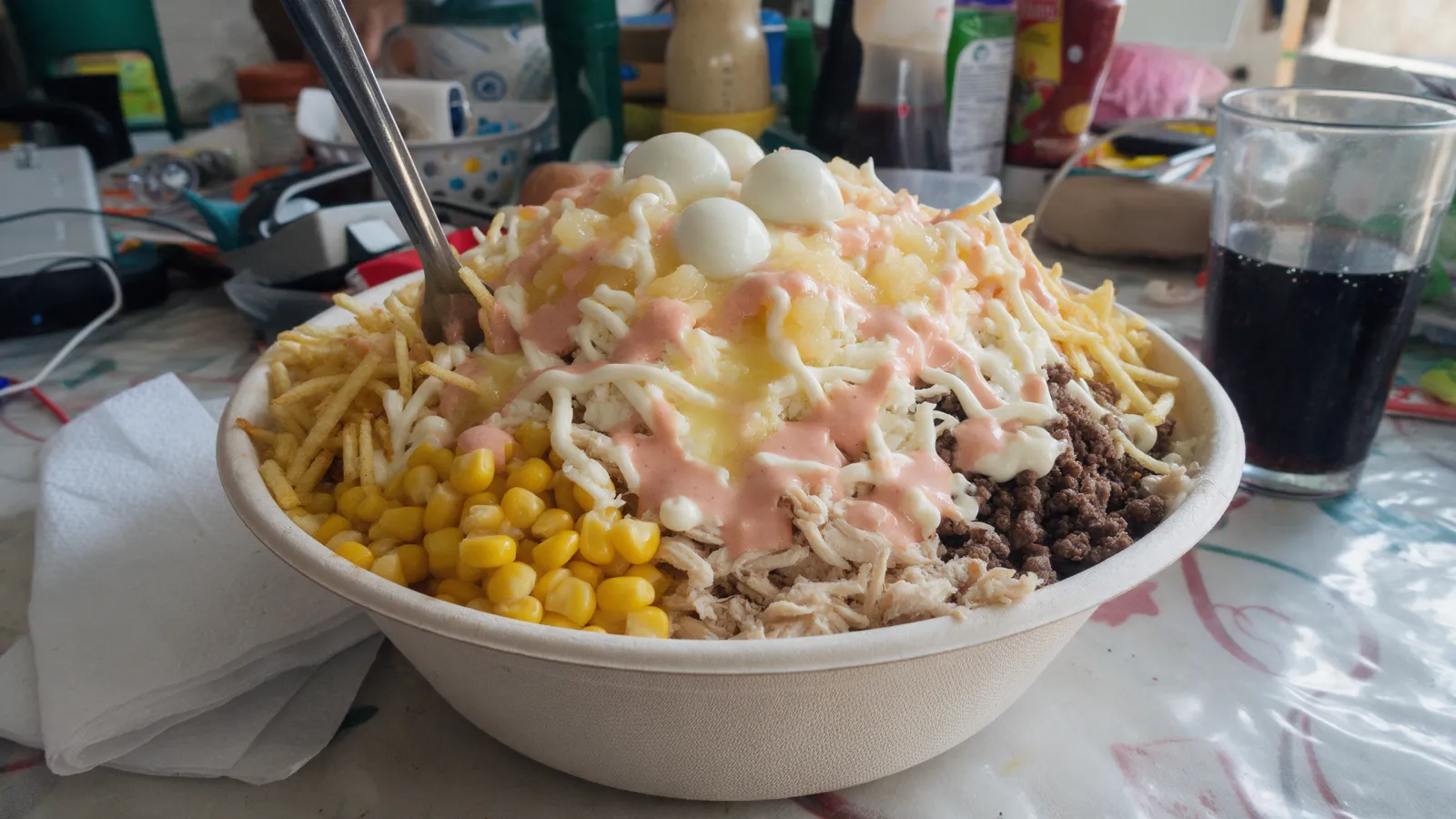

Think of the Mexican street corn you know, swap the cotija and chili powder for three seared meats and a lid of melted cheese, and you’re close to a mazorcada (mah-sor-KAH-dah). It’s Colombian fast food: tender corn kernels cut off the cob, tossed in a skillet with chicken, steak and chorizo, covered in cheese and finished with pink sauce, sweet pineapple sauce and a handful of crunchy potato sticks. Order one with two meats in Bogotá and it’s a mazorcada mixta. Below is how much corn each bowl needs, which supermarket corn and cheese work, both sauces, a party plan for 20 and the real US cost.
What is a Colombian mazorcada, and is it worth making?
How do you make a Colombian mazorcada? Simmer 600 g (4 cups) of corn kernels for 15 minutes and drain them. In a large skillet, brown chorizo, steak and chicken cubes separately, then cook scallions in butter, toast the corn for 5 minutes and return the meats. Cover with shredded cheese until it melts and top with pink sauce, pineapple sauce and potato sticks. 60 minutes for 4 servings.
Mazorca is Spanish for an ear of corn. Nobody can pin down where the dish started; it caught on mostly in Bogotá and Medellín. Its closest relative is Barranquilla’s chuzo desgranado, grilled meats with sweet corn, fried potato bits and cheese. It is not Colombian mazamorra, a similar-sounding cracked-corn dish eaten cold with milk, and it is not esquites, which come in a cup with broth and no meat.
Worth it? Yes, for a game night, a birthday or any table that wants street food at home. One recipe makes 4 bowls of about 450 g (1 lb) each, a full meal. In Colombian shops portions run bigger: one mazorcada festival in 2022 sold 800 g servings.
Not for you if you’re watching calories or salt. A bowl comes to about 1,000 kcal and 1,490 mg of sodium; the lighter version below cuts that to roughly 750 kcal.
Time and effort. 60 minutes, almost all of it at the stove, and the only easy part is waiting for the cheese to melt. The day-before plan cuts serving day to about 25 minutes. Difficulty is easy; what goes wrong is crowding the pan.
Shopping list, with US and UK swaps
For 4 bowls you need 600 g (4 cups) corn kernels, 350 g (12 oz) each of chicken and beef, 2 chorizo links, 200 g (7 oz) cheese, 60 g (2 oz) potato sticks and two sauces. Every Colombian home loads it differently: some use 1 chicken breast, 1 lb of beef and 3 chorizos with 3 ears for 4; others 500 g of corn with 200 g each of steak and chicken and 120 g of sausage, or 4 ears with 200 g of chicken plus chorizo, sausage and bacon. Mine sits in the middle.
Cheese. In Colombia it’s queso doble crema or mozzarella, both stretchy when melted. Low-moisture mozzarella is the match; Oaxaca cheese from a Latin grocery works too. Fresh mozzarella balls release water and make the bowl soggy, and salty crumbly cheeses like cotija or feta won’t melt; save those for the top if you like the salt.
Chorizo. Colombian chorizo is fresh raw pork in a casing, like the one in my homemade Colombian chorizo. The closest US match by texture is fresh Italian sausage; Mexican chorizo is finely ground and crumbles out of its casing, turning the corn red. In the UK, buy cooking chorizo. Cured Spanish chorizo is already cured, drier and smokier, so slice it thin and add it with the corn instead of browning it first.
Potato sticks. Colombians call them papa fosforito, “matchstick potatoes”, or ripio de papa. The canned potato sticks in the US chip aisle are the same thing. In the UK, crushed ready-salted crisps stand in, though they soften faster under the sauce.
Pink sauce. Mayonnaise and ketchup, 2 parts to 1: 80 g (⅓ cup) and 40 g (2½ tbsp) here, with a squeeze of lime. It’s the same ratio I use for Colombian salchipapa with pink and pineapple sauce, where the homemade pineapple sauce recipe lives too. If you want a garlic sauce instead, the Venezuelan garlic sauce is very good on corn.
Equipment. A 30 cm (12 in) skillet with a lid, a 2-liter (2-quart) pot, a serrated knife and a wide bowl for cutting the kernels. No lid? A sheet pan on top works. An instant-read thermometer settles any doubt about the chorizo and chicken.
Fresh, frozen or canned corn
Frozen is the best shortcut; canned is fine if you skip the salt. A large ear of sweet corn yields about 143 g of kernels, so 600 g (4 cups) takes 4 or 5 ears. Fresh sweet corn needs 15 minutes of simmering, the same time I give in the Mexican esquites recipe; frozen kernels 10. Starchy Latin American field corn, choclo, takes 20 to 25 minutes and tastes less sweet.
Canned corn is already cooked, so you just drain it and toast it in the pan. It carries 205 mg of sodium per 100 g drained, against 15 mg for fresh. With 600 g of canned corn each bowl gains about 285 mg of sodium, which is why the recipe’s salt goes. A rinse under the tap trims that by about a fifth, to 163 mg. Two 15-ounce cans give roughly 600 g drained.
Game plan, and what to make the day before
Day before. Cut and cook the corn, drain it and refrigerate it covered. Cube the meats and keep them raw in separate containers; raw chicken keeps 1 to 2 days in the fridge and steaks 3 to 5. Make both sauces: in my Colombian hot dog recipe the pink sauce keeps 3 to 5 days and the pineapple sauce a week. On the day, you only have the skillet work.
Why the meats go in one at a time
Each meat runs on its own clock, and the beef is the fastest at 4 to 5 minutes, ahead of the chicken and then the chorizo. Together, the beef overcooks before the chicken is safe. And a 12-inch skillet fits about 350 g (12 oz) in a single layer; add more and the pan cools, the meat leaks juice and simmers in it. I lift each batch onto a plate and tip the plate juices back in with the corn.
How to tell each stage is right
- Corn → tender to the bite, not mealy; field corn is still firm at 15 minutes.
- Chorizo → browned outside, no pink in the center.
- Beef → a brown crust on 2 or 3 sides of each cube, and no pool of liquid in the pan.
- Chicken → white all the way through the thickest cube.
- Corn in the skillet → a few golden spots after 5 minutes, dry pan.
- Cheese → melted and glossy, not browned underneath.
Safe temperatures, from fridge to bowl
The point people skip is the chorizo: fresh chorizo is ground pork and needs the ground-meat temperature, not the steak one.
Mistakes that ruin a mazorcada
- Watery bowl → crowded meat or wet corn. Batches of 12 oz and corn drained for 2 minutes in the colander.
- Too salty → canned corn plus the recipe’s salt, chorizo and cheese. With canned corn, no salt.
- Chewy beef → cubes too big or cooked too long. 1.5 cm (⅝ in) cubes, 4 to 5 minutes.
- Pink chorizo → the heat was too high and the outside browned first. Medium heat, 8 minutes.
- Soggy potato sticks → they went on before the sauce, or into the pan. Always last, on the plate.
- Scorched cheese → too much heat under the lid. Low heat, 3 to 4 minutes.
Spice level, 0 out of 5. Nothing in it is hot; put Colombian ají on the table for anyone who wants heat. Kids usually love it: it’s sweet from the corn and pineapple and the meat is bite-size. Give little ones less sauce and the potato sticks on the side. Allergens: milk (cheese, butter) and egg (mayonnaise). Check the labels of the chorizo, jarred sauces and potato sticks if you cook for someone with celiac disease.
Versions worth knowing
- Weeknight, 30 minutes → frozen or canned corn and chicken only.
- Sencilla → a single meat, 700 g (1½ lb) of chicken or steak. With chicken only it’s the cheapest.
- With shredded meat → poached chicken and Colombian shredded beef from the day before, folded into the corn for the last 2 minutes. That’s how a lot of Colombian home cooks make it.
- Baked → layer corn, meats and cheese in a baking dish and slide it under the broiler for 5 minutes, like a baked desgranado.
- Coastal style → grated salty queso costeño instead of a melting cheese, butifarra sausage instead of chorizo, and a sauce of blended suero costeño (a tangy cultured cream) with garlic, parsley, lime and pickles.
- On plantains → some cooks serve it with fried green plantains; Colombian patacones make a crunchy base.
- Lighter → no chorizo, 100 g (3½ oz) cheese and half the mayo: about 750 kcal and 1,010 mg of sodium a bowl.
- Vegetarian → 400 g (14 oz) sliced mushrooms seared like the meat, plus cooked red kidney beans. I add extra cheese to keep it filling.
Feeding 20, the mazorcada tray
Multiply by 5: 3 kg (6½ lb) kernels (about 21 large ears, 3 kg frozen or 10 cans), 1.75 kg (3¾ lb) each of chicken and beef, 10 chorizo links, 1 kg (2¼ lb) cheese, 300 g (10½ oz) potato sticks, 400 g (1¾ cups) mayo and 200 g (a generous ¾ cup) ketchup for the pink sauce, and 300 g (1¼ cups) pineapple sauce. Sear the meat in 12-ounce batches with two skillets going.
For a party I build it in two sheet pans, corn and meats with the cheese on top, and give them a few minutes under the broiler until it bubbles. Sauces go in squeeze bottles and the potato sticks in a bowl so they never sit under the sauce. Keep the trays at 140°F (60°C) or above in a low oven or slow cooker, as with any hot buffet food, or clear them within 2 hours.
What it costs in the US
At US average prices, the main ingredients come to 17.33 dollars, about 4.33 a bowl.
The math uses US average prices for August 2026 (round steak, chicken breast, butter, and cheddar and potato chips standing in for mozzarella and potato sticks) and supermarket advertised prices for the week of October 9, 2026 (sweet corn at 41 cents an ear, fresh chorizo, pineapple). Steak is 43 % of the bill; all-chicken saves about 4.26 dollars. In Bogotá, for comparison, the same ingredients cost about 30,700 pesos at wholesale prices in September 2026.
Serving, storing and reheating
What you get. Sweet, juicy kernels with toasted spots, salty seared beef and chorizo, soft chicken, then stretchy cheese, creamy pink sauce, sweet-tart pineapple and the crunch of potato sticks in every spoonful.
How it’s served. In deep bowls or a foil tray to share, sauces zigzagged across and potato sticks on top. Some cooks serve it over shredded lettuce. A cold soda or a fruit juice goes alongside.
Fridge. Store only the corn and meat base, with or without cheese, never with the sauces or potato sticks. Allow no more than 2 hours out, then 3 to 4 days at 40°F (4°C) or below in shallow containers.
Freezer. The base keeps 3 to 4 months for best quality. Melted cheese turns a little grainy after thawing, so freeze it without cheese and add fresh when you reheat.
Reheating. In a skillet over medium heat with 2 tbsp water, covered, stirring, until it reaches 165°F (74°C) in the center, about 6 to 8 minutes; fresh cheese goes on at the end with the lid. In the microwave, 1-minute bursts with a stir between. Sauces and potato sticks always go on fresh.
Colombian mazorcada FAQ
What is mazorcada in English? There’s no standard translation. “Loaded corn bowl” describes it best: corn kernels with mixed meats, melted cheese, sauces and potato sticks.
How is mazorcada different from esquites or elote? Esquites are corn kernels in their broth with mayo, cotija and chili, served in a cup; elote is the whole ear. Mazorcada adds seared meats and melted cheese and eats as a meal.
Can I use canned corn? Yes. Drain two 15-ounce cans (about 600 g), toast them in the pan for 5 minutes and skip the salt, since canned corn has 205 mg of sodium per 100 g.
What’s in Colombian pink sauce? Mayonnaise and ketchup, 2 to 1, with a little lime juice. British Marie Rose sauce is built on the same base.
What can I use instead of chorizo? Fresh Italian sausage is the closest; bacon, crisped first, or more chicken also work. Cured Spanish chorizo works if you slice it thin and add it at the end.
How much should I make per person? About 450 g (1 lb) as a main: 150 g (1 cup) of kernels and about 210 g (7½ oz) of raw meat each. As a party snack, half that.
Is it spicy? No. Heat comes from ají or hot sauce on the side.
How long does it keep? Leftovers keep 3 to 4 days at 40°F (4°C) or below; store it without the sauces and potato sticks and reheat to 165°F (74°C).
Nutrition per bowl
Per bowl (about 450 g, with sauces and potato sticks), calculated ingredient by ingredient at this recipe’s quantities, with whole-milk mozzarella standing in for the melting cheese:
- Calories: 1,000 kcal
- Protein: 60 g
- Carbohydrates: 47 g
- Fat: 66 g, including 24 g saturated
- Fiber: 4 g
- Sugars: 15 g
- Sodium: 1,490 mg
Most of the fat comes from the mayonnaise, cheese, beef and chorizo. Without the chorizo a bowl drops to about 890 kcal and 1,200 mg of sodium. Of the sodium, roughly a third comes from the added salt and a fifth from the chorizo; with canned corn and the salt left in, a bowl climbs to about 1,780 mg.
Where I grew up in Venezuela, corn meant jojoto boiled with butter or ground into cachapas; meat and melted cheese on top of the kernels was something I only met in Colombia. My first one was soupy because I dumped all the meat in at once. Brown it in batches, keep the corn dry, and the bowl takes care of itself. Josnaisis.