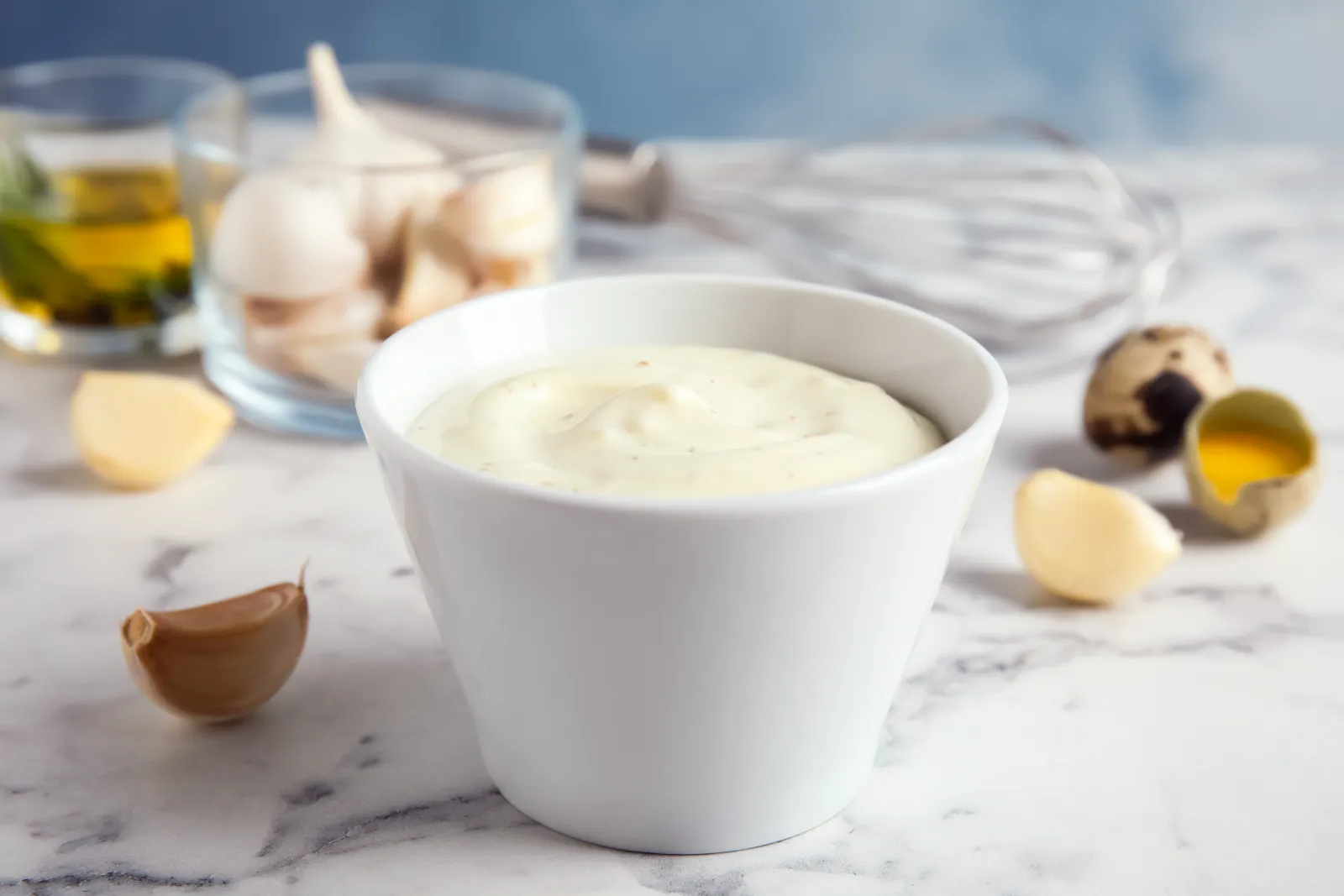

On a Venezuelan hot dog the sauces go on in thin lines from squeeze bottles, and one of them is often white and smells of garlic. That one is salsa de ajo (SAHL-sah deh AH-ho), Venezuelan garlic sauce, and it is simpler than its reputation: mayonnaise, raw garlic, a splash of milk, lime and sometimes cilantro. It goes on cheese sticks, empanadas, hot dogs (including the loaded Colombian hot dog with pineapple sauce) and anything off the grill. The part worth getting right is the amount of garlic, and the part worth taking seriously is how long it keeps.
What is Venezuelan garlic sauce?
How do you make Venezuelan garlic sauce? Purée 15 g (½ oz) of germ-free garlic with ¼ cup (60 ml) of cold milk and 1 tablespoon of lime juice for 30 seconds, then blend in 300 g (1⅓ cups) of mayonnaise for just 10-15 seconds. Pulse in herbs if you like and chill 30 minutes before tasting. Ready in 10 minutes for 12 servings.
It’s a garlic mayonnaise loosened with milk until it pours; garlic makes up about 15 g of every 400 g, or 3.7 % by weight. One batch makes about 400 g (1⅔ cups), twelve 2-tablespoon servings, which covers a cookout for 10 or two rounds of snacks for a family. In Venezuela it shares the grill table with Venezuelan guasacaca, the green avocado-and-vinegar sauce; the two do different jobs, one creamy and rich, the other sharp and fresh.
Is it worth making instead of buying? Yes. Some Venezuelan brands sell it bottled in 12 oz (355 ml) jars at Latin grocers in the US, but at home you choose how much garlic goes in, and it takes 10 minutes.
Who might skip it. Anyone who can’t handle raw garlic (the roasted-garlic version below fixes that), and anyone planning to leave it out all afternoon at a summer barbecue. It holds egg and raw garlic, so it needs the fridge.
Is it the same as toum or aioli?
No, and the difference is mostly method. Lebanese toum is an egg-free emulsion of garlic, neutral oil, lemon and ice water with far more garlic: the PBS SoCal recipe pairs 4 cups of oil with a full cup of peeled cloves, and it turns white and fluffy. Traditional Catalan allioli is garlic, olive oil and salt pounded together in a mortar, also with no egg; the eggy version is a modern shortcut. Venezuelan garlic sauce starts from finished mayonnaise, so it’s milder and creamier than either.
What you need, with US and UK swaps
Exact amounts are in the recipe card: 300 g (1⅓ cups) mayo, 15 g (½ oz) garlic, ¼ cup (60 ml) milk, 1 tablespoon lime juice, and optionally 10 g of cilantro. All of it is regular supermarket stock in both countries.
- Mayonnaise → full-fat. Light mayo is sweeter and thinner, and with the milk it turns watery. Commercial mayonnaise is made with pasteurized egg, which is why this version is the safe default.
- Milk → whole. It loosens the mayo and softens the garlic bite. Water works too, but the sauce tastes flatter and sharper.
- Lime → the small green limes Venezuelans call limón. A lemon is fine and a touch more sour.
- Cilantro → coriander in the UK. Flat-leaf parsley gives a milder, grassier sauce; some cooks use green onions.
Raw, roasted or powdered garlic
Raw is the classic. Crushing garlic triggers the reaction that makes it hot, so blended garlic bites harder than knife-chopped, and the flavor climbs for the first few hours.
Roasted makes a different, sweet sauce with no bite, because oven heat stops that reaction. Cut the top off a whole head, drizzle with oil, wrap in foil and roast at 400°F (200°C) for 40-60 minutes until the cloves are soft and golden. One whole head per 300 g (1⅓ cups) of mayo; it takes more roasted garlic than raw to register.
Garlic powder is a fallback. It tastes flat and toasty and turns gritty if stirred straight into mayo. I soak ½ teaspoon in the lime juice for 10 minutes, mix it in, chill, and add more ¼ teaspoon at a time if needed.
Equipment
A blender or an immersion blender with its tall cup. Without either, grate the garlic on a fine rasp or pound it to a paste with the salt, whisk it into the milk and lime, then stir in the mayo with a fork. Slightly less smooth, just as good.
How much garlic per cup of mayo
The rule in this recipe is 5 g of garlic per 100 g of mayonnaise, which works out to about 11 g, or 3-4 small cloves, per cup (220 g). That’s where the garlic shows up at the end of each bite without burning.
Add three-quarters of the garlic first, chill, taste, then decide. You can add garlic; you can’t take it out.
How to make it, step by step
The whole job is 10 minutes: 3 to peel and de-germ, 1 to purée the garlic in the milk, 1 to blend in the mayo, a few seconds for herbs, then into a jar and the fridge for 30 minutes.
Purée the garlic in the milk first
This is the one step that changes the result. In thick mayonnaise the blade spins and the garlic rides around it in chunks; by the time it’s fine, the mayo has been blending for a minute, warmed up and gone slack. In milk and lime the garlic is gone in 30 seconds, and the mayo only has to be mixed in.
How to tell it’s right
- Garlic purée → the milk is evenly cloudy with no white bits on the bottom of the jar.
- Color → ivory white; with herbs, pale green with darker flecks.
- Texture → it falls off a spoon in a ribbon and the trail disappears in 2-3 seconds. Pours like water, add mayo; doesn’t fall, add milk.
- Taste → after chilling, garlic arrives at the end of the bite. If it burns the throat, stir in more mayo.
Who this recipe is for
- First-timers → the card version with jarred mayo. It cannot split.
- Hot dog and burger nights → thinner, with 5-6 tablespoons (75-90 ml) of milk, in a squeeze bottle.
- Dipping tequeños or empanadas → thicker, with 2 tablespoons (30 ml) of milk so it clings.
- Spreading on sandwiches or arepas → no milk at all.
Is homemade garlic sauce safe? Raw garlic, raw egg and storage
With store-bought mayo, yes, if you treat it as a fresh sauce: fridge at 40°F (4°C) or below, gone after 4 days, never more than 2 hours on the table.
Why 4 days when a jar of mayo lasts 2 months. The raw garlic sets the limit. Garlic can carry Clostridium botulinum spores, and for unacidified raw garlic in oil, Michigan State University Extension says refrigerate at 40°F (4°C) or below and use within 4 days; NC State Extension says 2 to 4. A garlic sauce isn’t garlic sitting under oil, since it contains lime and mayo is acidic, but nobody checks pH at home, so I use the same limit.
Raw egg in homemade mayo. The FDA’s advice for any dish served with raw or undercooked egg is to use pasteurized in-shell eggs or pasteurized egg products, and it names young children, pregnant women, older adults and people with weakened immune systems as the groups most at risk. In the UK, the Food Standards Agency has said since 2017 that eggs stamped with the British Lion mark can be eaten raw by those groups, though not by people who are severely immunocompromised. Homemade-mayo garlic sauce: 3 days.
At the table. USDA FSIS allows 2 hours out of the fridge, 1 hour above 90°F (32°C). At a cookout, put out a small bowl and refill it from the cooler.
Freezing. Don’t. The emulsion breaks as it thaws and turns grainy and oily.
Make ahead and scale for a crowd
Make it the day before. It tastes better once the garlic has settled, and it still has 3 days of fridge life left. Plan on 3 tablespoons a head when the table is full of fried snacks, otherwise 2 tablespoons (about 30 g) per person.
- 4-6 people → 150 g (⅔ cup) mayo, 8 g (2-3 cloves) garlic, 2 tablespoons (30 ml) milk, 1½ teaspoons lime juice. About 200 g (¾ cup).
- 12 people → the recipe as written.
- 20 people → double it: 600 g (2⅔ cups) mayo, 30 g (1 oz, 9-10 cloves) garlic, ½ cup (120 ml) milk, 2 tablespoons lime. About 800 g (3⅓ cups). Blend in two batches if your blender jar is small; overfilled, it won’t purée the garlic.
To scale any amount, use 5 g garlic and 20 ml (4 teaspoons) milk per 100 g (scant ½ cup) of mayo, lime to taste.
Mistakes that ruin garlic sauce
- Bitter aftertaste → the garlic germ was left in, or homemade mayo was made with extra-virgin olive oil. Remove the germ; use a neutral oil.
- Bits of raw garlic → the garlic went in with the mayo. Purée it in the milk first.
- Too runny → too much milk, or blended too long. Stir in mayo 2 tablespoons at a time by hand.
- Overpowering the next day → it was tasted right after blending. Garlic builds; taste after 30 minutes and start with less.
- Homemade mayo split → the oil went in too fast. Put a fresh yolk in a clean jar and blend the broken sauce into it a little at a time.
- Too salty → salt added before tasting. Mayonnaise already has about 635 mg of sodium per 100 g (USDA).
- Left out the whole cookout → past 2 hours in the sun nobody notices. Small bowl out, the rest on ice.
Which version should you make?
- No time → skip the chill. Ten minutes, slightly less garlicky.
- No blender → grated or pounded garlic, whisked by hand.
- Lighter → half mayo, half plain nonfat Greek yogurt, and drop the lime: about 98 kcal and 10 g fat per serving instead of 175 and 19. Tangier.
- Homemade mayo → blend 1 pasteurized egg on low until foamy, drizzle in 300 ml (1¼ cups) neutral oil over 3-5 minutes until thick and white, then add the garlic, milk, lime and ½ teaspoon salt. Thicker, cheaper, about 215 kcal per serving.
- Egg-free, milk-based → the Southern Cone lactonesa method: 120 ml (½ cup) cold whole milk to 240 ml (1 cup) neutral oil, plus garlic and salt, emulsified with an immersion blender from the bottom of the cup. Keeps 3-4 days.
- Vegan → vegan mayo and unsweetened soy milk, or homemade mayo with 1-2 tablespoons of aquafaba (chickpea cooking liquid) per egg.
- Kid-friendly → 2 cloves per 300 g, or the roasted-garlic version.
What it costs
The Bureau of Labor Statistics doesn’t track mayonnaise, so the honest way to price this is by the jar: 300 g is a little over a third of a standard 30 fl oz (887 ml) jar, and that third is nearly the whole cost. Of what BLS does track, the US city average in August 2026 was $2.27 a dozen for large eggs (19 cents an egg, if you make your own mayo), $2.11 a pound for lemons and $4.23 a gallon for whole milk, which makes the ¼ cup of milk about 7 cents. Garlic, cilantro and oil aren’t in the series. Homemade mayo roughly halves the cost: in Colombian wholesale prices it comes out at 2,926 pesos a batch against 5,601 with bought mayo.
What to expect and what to serve it with
Flavor. Cold, creamy, garlicky at the finish with a little lime, lighter than straight mayo thanks to the milk. With cilantro it reads fresher and greener.
How it’s eaten. With Venezuelan tequeños, the cheese sticks wrapped in dough and fried, and with crisp corn-dough Venezuelan empanadas. It’s spread on the bottom shell of a patacón maracucho, the fried-plantain sandwich from Maracaibo, and spooned over grilled meat such as beef skewers. Leftover Venezuelan pernil in a roll with garlic sauce is my favorite way to finish a roast. Outside Venezuela, it’s good with fries, yuca fries and wings, and zigzagged over Colombian salchipapa with fried hot dogs alongside the pink sauce.
Fridge. Clean, dry glass jar, lid on, 40°F (4°C) or below: 4 days with jarred mayo, 3 with homemade. Use a clean spoon each time and put the jar straight back. If it separates a little, stir.
Serving. Never heat it. Serve cold or let it sit out 10 minutes.
Frequently asked questions
What is Venezuelan garlic sauce made of? Mayonnaise and raw garlic, usually loosened with milk or water and sharpened with lime or vinegar; cilantro or parsley is optional. This recipe uses 300 g (1⅓ cups) mayo, 15 g garlic, ¼ cup milk and 1 tablespoon lime.
How much garlic per cup of mayonnaise? A cup (220 g) of mayo takes 3-4 small cloves, about 11 g. For kids, half that.
Is it the same as aioli? No. Traditional allioli is only garlic, olive oil and salt pounded in a mortar, with no egg and much more garlic. Venezuelan garlic sauce starts from mayonnaise and uses neutral oil.
Is it the same as toum? No. Toum is an egg-free emulsion with two to three times as much garlic by weight, white and fluffy. Venezuelan garlic sauce is a milder, creamier mayo sauce.
How long does garlic sauce last in the fridge? 4 days at 40°F (4°C) or below with store-bought mayo, 3 with homemade raw-egg mayo. No more than 2 hours out, 1 hour above 90°F (32°C).
Can you freeze it? No. The emulsion splits when it thaws.
Is it spicy? No chili at all. Raw garlic has a throat-warming bite; roasted garlic has none.
Why does my garlic sauce taste bitter? The garlic germ, or extra-virgin olive oil in homemade mayo. Take out the germ and use a neutral oil.
Can I use garlic powder? In a pinch. Soak ½ teaspoon in the lime juice for 10 minutes first, chill, and adjust.
Can I make it without mayonnaise? Yes. Blend 2 parts neutral oil into 1 part cold milk with the garlic for an egg-free version, or use Greek yogurt, which is tangier and lighter.
How much do I make for 20 people? Double the recipe: 600 g (2⅔ cups) mayo and 30 g (1 oz) garlic, about 800 g of sauce.
Nutrition
Per serving (2 tablespoons, about 33 g), calculated ingredient by ingredient from USDA FoodData Central (SR Legacy) with the quantities in this recipe and no added salt:
- Calories: 175 kcal
- Protein: 1 g
- Carbohydrates: 1 g
- Fat: 19 g, of which 3 g saturated
- Sodium: 162 mg
Nearly all of it is fat from the mayonnaise, which supplies 2,040 of the batch’s 2,105 calories. The homemade-mayo version is about 215 kcal and 24 g of fat per serving with less sodium; the Greek yogurt version, about 98 kcal.
Growing up, garlic sauce was the jar at the back of my family’s fridge that nobody could date. These days I make it the day before a cookout, write the date on the lid, and whatever is left after four days goes. That habit matters more than any recipe. Josnaisis.