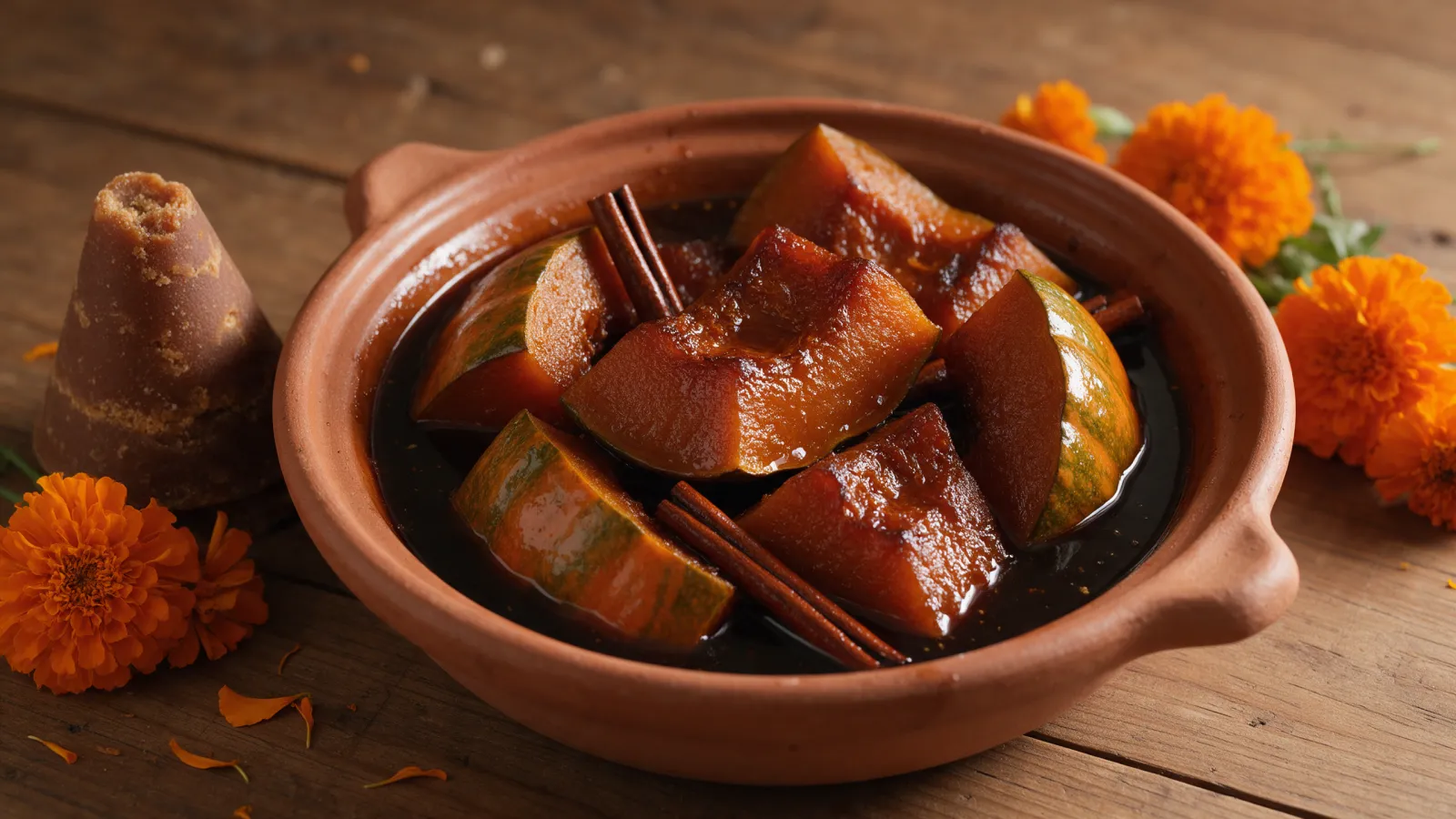

Calabaza en tacha (kah-lah-BAH-sah en TAH-chah) is Mexico’s Day of the Dead pumpkin: wedges of squash, skin and all, simmered for 95 minutes in piloncillo, an unrefined cane sugar, with cinnamon and orange until the flesh turns mahogany and the syrup goes dark and glossy. It is eaten from a bowl with cold milk and set on the ofrenda, the altar for the dead. Outside Mexico, the trick is choosing the right squash and then leaving it alone in the pot. Here is how to do both, in grams and cups, with the syrup stage in °F.
What is calabaza en tacha, and is it worth making?
How do you make calabaza en tacha? Dissolve 1.5 lb (700 g) of piloncillo in 2 cups (500 ml) of water with cinnamon, cloves and orange, then lay in 4.4 lb (2 kg) of pumpkin wedges with the skin on, first layer skin side down. Simmer covered on medium-low for an hour, flipping once at 30 minutes, then uncovered for 35 minutes, basting, until the syrup coats a spoon at 220°F (104°C). 125 minutes for 10 servings.
It is a dessert of candied pumpkin in its own dark syrup, eaten with a spoon. Nothing about it is hard: no oven, no dough, no mixer. You get a soft, jammy wedge that holds its shape, tastes of molasses, cinnamon and a little orange, and turns into something like pumpkin pie filling when you mash it into cold milk.
It is worth making if you want a make-ahead dessert for 10 that costs about $11, or you are setting up an ofrenda, or you have a kabocha on the counter and are tired of soup. It is not for you if you want a lightly sweet dessert: each wedge carries about 2½ oz (70 g) of sugar if you finish the syrup. And you need a wide pot with a lid.
Time and effort. 125 minutes start to finish, about 45 of them hands-on. Difficulty is easy; the hardest job is cutting a hard-skinned squash.
The name refers to the tachos, the copper cauldrons of the old sugar mills where cane juice was boiled down into piloncillo, according to Mexican food researcher Edgar Salgado, interviewed by Uno TV. The UNAM’s nutrition office lists it among the dishes placed on Day of the Dead altars, with guava, tejocote (a small hawthorn fruit), sugarcane or anise depending on the region.
Which pumpkin or squash to buy in the US and UK
In Mexico it is made with calabaza de Castilla, a big winter squash with a hard green or tan rind and deep orange flesh. You will rarely see it outside Latin markets. The best stand-in is kabocha, sometimes sold as Japanese pumpkin: dense, sweet, dry flesh that holds together through a long simmer.
- In the US in October, kabocha is in most large supermarkets and every Asian grocer, and sugar pie pumpkins are everywhere. Either works with the skin on.
- In the UK, butternut squash is in every supermarket and is fine, but its thin skin softens sooner, so check it at 45 minutes. Kabocha and Crown Prince turn up at greengrocers and farm shops in autumn; Crown Prince behaves much like kabocha.
- Skip carving pumpkins, the big ones sold for jack-o’-lanterns. They are watery and stringy, and they fall apart in syrup.
Buy one squash of about 5 lb (2.3 kg); after seeding you will have roughly the 4.4 lb (2 kg) you need.
Ingredients, and the one swap that changes the result
Piloncillo is unrefined cane sugar pressed into cones, the same thing as Colombian panela or Venezuelan papelón. It carries its molasses inside, which is what makes the syrup dark and slightly smoky. In the US it is in the Latin aisle at Walmart and H-E-B in 8 oz (227 g) cones; you need three. In the UK, look in Latin and Mexican online shops, or buy panela from a Colombian grocer, which works the same. Chop it with a serrated knife or grate it so it dissolves in 10 minutes.
No piloncillo? Use the same weight of dark brown sugar, or dark muscovado in the UK, plus 2 tablespoons of molasses or black treacle. 700 g is 3 cups plus 3 tablespoons packed. The syrup comes out a shade lighter and less deep; white sugar alone gives you golden squash, not dark.
How much piloncillo per pound of squash
This recipe uses 5.6 oz per pound (350 g per kg). Across eleven published versions I checked, the ratio runs from 167 g per kg in the University of Illinois Extension recipe to 520 g in the UNAM’s. The Mexican recipes that aim for dark, candied squash (Larousse Cocina, México Desconocido, Pati Jinich, Cocina Delirante) sit between 333 and 375 g per kg. Below about 250 g, as in the Goya and Isabel Eats versions, you get sweet squash in a pale syrup, closer to a compote.
Only 2 cups (500 ml) of water, because the squash releases plenty of its own liquid under the lid.
How to cook it so it doesn’t fall apart
The pumpkin breaks when it is stirred or boiled hard, not because it cooks for 95 minutes. Big wedges, skin on, one gentle flip.
Cutting and scoring
Wedges of about 3 in (8 cm) and 7 oz (200 g), one per person, with the rind on. The rind is the frame that holds the flesh together; it softens enough to eat, though it stays a little firmer than the flesh. Score it in diamonds about 1/16 in (1-2 mm) deep with the tip of the knife so syrup can soak in.
Lid on, then lid off
Covered for 60 minutes so the squash steams and simmers in its own juice before the syrup concentrates; uncovered for 35 minutes to reduce that syrup and glaze the surface. Start uncovered and the syrup thickens before the flesh is cooked, and the rind stays tough. Lay the first layer skin side down, as Pati Jinich does, and flip each wedge once with tongs at the 30-minute mark.
The syrup stage, 220°F (104°C)
Stop when the syrup coats the back of a spoon and still looks loose. On a thermometer at sea level that is 220°F (104°C), the jelly point used by the National Center for Home Food Preservation, 8°F above boiling.
At altitude, measure where water boils in your kitchen and add 8°F. Go much past 230°F (110°C) and the syrup turns chewy in the fridge and glues itself to the cold squash. If that happens, warm it gently with 3 tablespoons of water.
Make-ahead plan for the Day of the Dead and for a crowd
Make it the day before. It gets better overnight in the fridge, darker all the way through.
For an ofrenda, set one wedge with a guava on a small clay or ceramic plate on the altar, separate from what the family will eat. Food on an altar sits out for hours, and USDA FSIS says cooked food should not stay at room temperature longer than 2 hours, so serve your guests from the pot you kept in the fridge.
Scaling.
| Servings | Squash | Piloncillo | Water | Pot |
|---|---|---|---|---|
| 5 | 1 kg (2.2 lb) | 350 g (12 oz) | 250 ml (1 cup) | 4 qt (4 L), same times, check at 45 min |
| 10 | 2 kg (4.4 lb) | 700 g (1.5 lb) | 500 ml (2 cups) | 6-8 qt (6-8 L) |
| 20 | 4 kg (8.8 lb) | 1.4 kg (3 lb) | 1 L (4 cups) | two 6-8 qt pots, same times |
Cooking time depends on the size of the wedge, not on how many there are, which is why the times barely change. For a party buffet next to pan de muerto, cut each wedge in half and 10 servings stretch to 20. If the table needs a second, creamier sweet that can also be made the day before, jericalla, a cinnamon custard from Jalisco, keeps 3-4 days in the fridge.
Mistakes that ruin calabaza en tacha
- It turned to mush → it was stirred, boiled hard, or cut small without the skin. Keep the heat at medium-low and use tongs once.
- It stayed pale → too little piloncillo, too much water, or no uncovered stage. 350 g per kg and 35 minutes of basting fix it.
- The rind is still tough → wedges too thick or a very mature squash. Score the rind and add 10 minutes covered.
- The syrup scorched → it was reduced on high heat with little liquid. Medium heat only; if it smells of dark caramel, pull it and stir in 3½ fl oz (100 ml) of hot water.
- Watery result → a carving pumpkin or a watery squash. Lift out the wedges and reduce the syrup alone for 10 to 15 minutes.
Pickling lime. Some cooks in Mexico soak the pumpkin in lime water (cal, food-grade calcium hydroxide) first so it stays firm, as Mexico News Daily notes. I could not find a tested dose or time for squash, so this recipe skips it, and big skin-on wedges don’t need it. If you try it, use only food-grade pickling lime, wear gloves, don’t breathe the powder, and rinse thoroughly before the syrup.
Variations
- With guava and sugarcane, the UNAM and México Desconocido version: guavas go in at the flip, and 1.3 lb (600 g) of peeled sugarcane sticks from the start.
- Spicier: add 2 star anise and 4 allspice berries; Larousse Cocina uses 3 star anise, 3 cloves and 5 allspice for 3.3 lb (1.5 kg).
- Less sweet: 500 g (1.1 lb) piloncillo, about Goya’s ratio. The syrup is thinner and needs 10 more minutes uncovered.
- Quicker: 2 in (5 cm) chunks of 3½ oz (100 g), 40 minutes covered and 20 uncovered. Less juicy inside.
- Dairy-free: serve with oat or almond milk; the pot itself has no dairy.
What it costs in the US
At October 2026 store prices, the pot for 10 comes to about $11.40, or $1.14 a serving: 4.4 lb of squash at $1.54/lb at Walmart, three H-E-B piloncillo cones at $1.28 each, and an orange at the BLS August average of $1.709/lb. Kabocha at $4.49/lb, the price I found at PriceSmart Foods, pushes the squash to almost $20 on its own. I don’t have a verified UK price for piloncillo or kabocha, so I won’t guess one.
Allergens, kids and spice level, 0 of 5
No gluten, egg, nuts or dairy in the pot; milk comes in only at serving. It is not spicy at all. Kids usually love it, but a full wedge with all its syrup is 74 g of sugar, so give small children half a wedge with a little syrup, and peel the rind for the youngest.
Serving and storing
Serve one wedge per person in a shallow bowl with syrup spooned over and 1 cup (240 ml) of cold milk around it. Warm, right after resting, it is juicier; cold from the fridge it is firmer and sweeter. A mug of café de olla, sweetened with the same piloncillo and cinnamon, is the natural drink alongside, and on a cold November night a thick champurrado or a plain vanilla atole works too. For something bready to dunk in the milk, gorditas de nata, Mexican sweet cream griddle cakes, take about 70 minutes on a dry skillet. The same piloncillo and cinnamon syrup, poured over toasted bread with Cotija and peanuts, becomes Mexican capirotada.
Fridge. USDA FSIS gives cooked leftovers 3 to 4 days at 40°F (4°C) or below, refrigerated within 2 hours. Store the wedges covered in their syrup. Some recipes say a week or longer; I stick to 4 days.
Freezer. The syrup freezes perfectly. The squash can be frozen for 3 to 4 months of best quality (FSIS), but Maricruz Avalos warns it turns watery when thawed, and I agree; eat the squash within 4 days and freeze the extra syrup for oatmeal.
Reheating. Covered, on low, with the syrup and 2 to 3 tablespoons of water, about 10 minutes without stirring, to 165°F (74°C) in the center. In the microwave, covered, in 1-minute bursts.
FAQ
What kind of pumpkin is used for calabaza en tacha? Calabaza de Castilla in Mexico. In the US, kabocha is the closest match, with sugar pie pumpkin a good second; in the UK, kabocha or Crown Prince, or butternut if that’s what you have. Never a carving pumpkin.
Do you eat the skin? Yes. It softens during the long simmer and is edible, a little firmer than the flesh. Scrub it well before cooking, and peel it for small children.
What can I use instead of piloncillo? Panela or papelón, same weight. Otherwise dark brown sugar or dark muscovado with 2 tablespoons of molasses or black treacle; the syrup is a little lighter.
Do you cook it covered or uncovered? Both. One hour covered on medium-low to cook the squash through, then 35 minutes uncovered, basting, to reduce the syrup.
Why did my candied pumpkin fall apart? It was stirred, boiled too hard, or cut small without the skin. Use big wedges, a gentle simmer, and flip once with tongs.
How long does calabaza en tacha last? Up to 4 days in the fridge, covered in syrup, which is the USDA FSIS limit for cooked leftovers. Freeze leftover syrup rather than the squash.
Is it eaten hot or cold? Either. Warm it is juicier; cold, in a bowl of cold milk, is how it is most often served.
Can I make it in the oven or a slow cooker? I make it on the stove because the uncovered stage needs basting and steady evaporation. Mexico News Daily finishes theirs with a short spell in a 400°F (200°C) oven to caramelize the top, which works after the stovetop steps.
Nutrition per serving
Per serving, one 7 oz (200 g) raw wedge with a tenth of the syrup, calculated from USDA FoodData Central (SR Legacy). SR Legacy has no entry for piloncillo, so I used brown sugar, and the rind is counted as flesh:
- Calories: 322 kcal
- Protein: 2 g
- Carbohydrates: 83 g
- Sugars: 74 g
- Fat: 0 g (0 g saturated)
- Fiber: 1 g
- Sodium: 22 mg
Of those 322 kcal, the piloncillo supplies 83% and the squash itself just 52 kcal a wedge. Leave half the syrup in the bowl and a serving drops to about 190 kcal. A cup of whole milk adds 146 kcal, 8 g of protein and 8 g of fat.
I grew up in Venezuela with auyama in soup and never in dessert, so my first pot of this went to mush because I stirred it like I stir green papaya dessert. Now the lid goes on, the spoon stays in the drawer, and the only thing that touches the squash is a pair of tongs. Josnaisis.