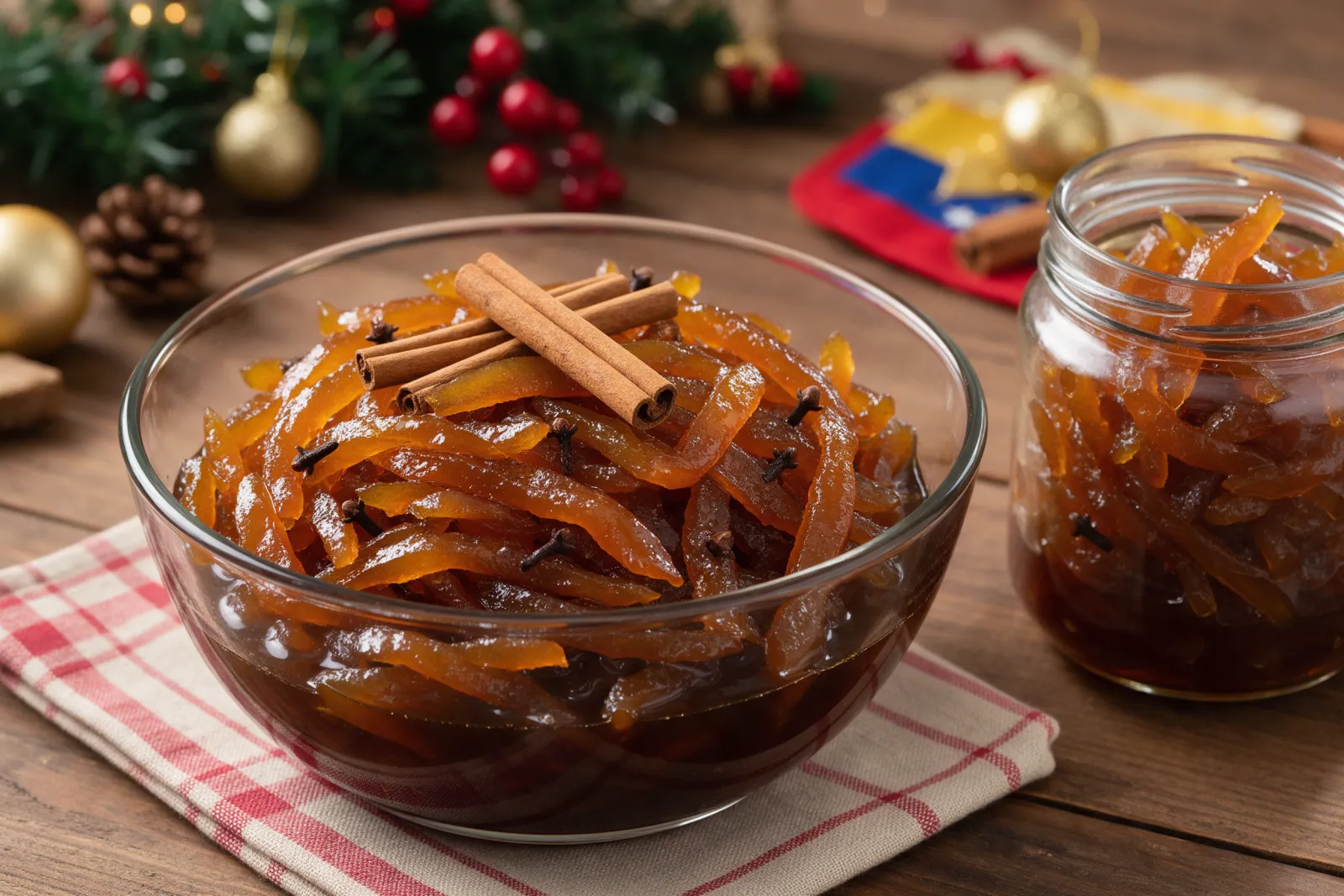

In Venezuela, papaya is called lechosa, and a green one beads with white, milky latex the moment you score the skin. Dulce de lechosa turns that hard, bland, unripe fruit into amber strips in a dark syrup of piloncillo, cloves and cinnamon, and it sits on the Christmas table next to the hallacas and ham bread. The strips should stay whole and a little chewy, and that depends on two things most cooks don’t measure: how green the papaya is, and the exact temperature the syrup comes off the heat.
What is dulce de lechosa?
How do you make dulce de lechosa? Peel a very green papaya, cut it into ⅜-inch (1 cm) strips, rinse off the latex and dry the strips for 60 minutes in a low oven. Simmer them 60 minutes in piloncillo syrup with cinnamon and cloves, then 50 more with white sugar and lime juice, to 223°F (106°C). 210 minutes for 14 servings.
It’s a candied fruit, closer to a fruit preserve than a pudding, eaten cold in small dishes with a spoonful of syrup. Green papaya on its own tastes of almost nothing, a little like cucumber; it brings the texture, and the syrup brings the flavor. The same fruit goes by papaya in most of Latin America and Spain, fruta bomba in Cuba and lechosa in Venezuela and the Dominican Republic.
One batch makes about 1.4 kg (3 lb), 14 servings of roughly 100 g (3½ oz), enough to fill two pint jars and a half-pint.
Picking the papaya, the step that decides everything
The papaya has to be green inside and out. Look for one with no yellow streaks on the skin, as hard as a winter squash when you press it with your thumb, between 1.5 and 2 kg (3½ to 4½ lb). When you cut it open, the flesh should be white or greenish-white and the seeds white or barely gray. If the flesh has gone pink or orange even though the skin is still green, it has started to ripen and will turn to jam in the pot.
Where to buy it. In the US and the UK, the easiest place is an Asian grocery store, because green papaya is the base of Thai som tam salad; it’s often sold already peeled and shredded there, but buy it whole for this recipe so you can cut strips. Many Latin markets carry it too. If all you can find is an unripe “regular” papaya, check the flesh color before buying.
Gloves, please. The latex contains papain, the enzyme sold as meat tenderizer, and it irritates some people’s skin.
Ingredients and US and UK swaps
The ingredient list is short. Besides the papaya, the one thing worth getting right is the sweetener. Papelón is Venezuela’s unrefined cane sugar, sold in cones or blocks, and it’s the same product as Mexican piloncillo and Colombian panela.
White sugar and lime juice go in for the second half of the cooking. The white sugar lightens the syrup slightly, and the acid in the lime converts some of the sucrose into glucose and fructose, which keeps the syrup from crystallizing in the jar.
Cloves and cinnamon stay whole, so the syrup is clear and you can fish them out. Twelve cloves is a noticeable amount; if you’re not sure your family likes clove, use 6.
Equipment. A wide 5-6 quart (5-6 liter) pot, so the strips sit in a few layers, a sheet pan, and an instant-read or candy thermometer. You can do without the thermometer; the cold-plate test below works.
Baking soda or pickling lime, what really firms the strips
Many Venezuelan family recipes soak the strips in baking soda to keep them firm. Chemically, it does the opposite. Baking soda raises the pH, and in hot, alkaline conditions pectin, the glue between plant cells, breaks down through a reaction called beta-elimination; Texas A&M’s food chemistry course notes describe the same effect with beans, which soften faster in baking soda water.
What does firm fruit is calcium. Food-grade pickling lime is calcium hydroxide, the same thing used to nixtamalize corn for tortillas; the calcium binds to pectin and stiffens the cell walls. Illinois and Clemson extension services, repeating USDA-based guidance for lime pickles, insist the excess lime be removed afterwards: drain, rinse and soak for 1 hour in fresh water, three times. Clemson’s pickle recipe uses 1 cup of lime per gallon of water and a 12-to-24-hour soak for cucumber slices; for thin papaya strips I use much less, 2 tablespoons in 2 liters (about 2 quarts), for 1 hour. Don’t breathe the dust when you mix it.
My everyday version uses neither. Very green fruit, an hour in a low oven to drive off surface water, and sugar added in two stages give firm, tender strips. Pickling lime is for when you want crisp edges.
How to make it, step by step
The full method is in the recipe card. Here’s what each stage is doing and how to tell it’s right.
Cutting. Strips of 1 cm by 5-6 cm (⅜ by 2-2½ inches) hold their shape and cook evenly. Thinner ones tend to break when you swirl the pot.
Rinsing. Two changes of cold water take off the sticky latex. Skip it and the syrup can taste faintly bitter.
Drying. After 60 minutes in the oven, the strips feel dry, the edges look slightly darker, and they bend without snapping.
First simmer. Piloncillo syrup only, at the lowest heat, 60 minutes. The edges start to look translucent while the centers stay white.
Second simmer. White sugar and lime go in, another 50 minutes. The strips go amber and translucent all the way through; the bubbles in the syrup get small and slow.
Why the sugar goes in twice
A heavy syrup from the start pulls water out of the fruit faster than sugar can get in, so the outside of each strip shrivels and toughens. A lighter syrup first lets the sugar move in slowly, and the strips turn glassy without shrinking.
The syrup temperature, 223°F (106°C)
At sea level, the syrup comes off at 223°F (106°C). That’s just above the jelly point the National Center for Home Food Preservation uses for jams, 8°F (about 4.5°C) above boiling, and well below thread stage, which the Exploratorium puts at 230°F (110°C). The syrup thickens to a honey consistency as it cools.
At altitude, water boils at a lower temperature and every stage drops with it. The rule that works anywhere: boil some water, read the thermometer, and add 11°F (6°C).
Cold-plate test. Put a small plate in the freezer when the second simmer starts. When you think it’s ready, turn off the heat, drop a little syrup on the plate and wait 30 seconds. If it runs slowly and wrinkles when you push it with a finger, it’s done. If it runs like water, give it 5 more minutes. If it doesn’t move and feels hard, add ½ cup (120 ml) of hot water and boil for 2 minutes.
Who this recipe is for
- If you’re short on time → skip the oven and go straight from rinsing to syrup; the strips come out softer.
- If you want crisp-edged strips → pickling lime, with all three rinses. Do the soaking the night before.
- If your family always used baking soda → 1 teaspoon per quart (1 liter) of cold water, 15 minutes, then rinse. It won’t firm anything, and it won’t ruin the dessert either.
- If you’ve never had it → make half a batch and serve it next to cheese.
A Christmas make-ahead plan
Dulce de lechosa is a make-ahead dessert by nature: it improves after a day or two in the fridge.
- December 21 or 22 (28 or 29 for New Year’s Eve): buy the papaya and cook the whole batch. Cool for 2 hours, then refrigerate.
- December 23 (or 30): portion it into jars or a serving dish. If you’re giving it as gifts, this is the day to jar and label.
- December 24 (or 31): take it out of the fridge only to serve. It’s eaten cold.
For 6 people, half a batch is enough: about 550 g (1¼ lb) of prepared papaya and half of everything else, same times. For 12 to 20, make a batch and a half, 1.65 kg (3⅔ lb) of prepared papaya, in an 8-quart (8-liter) pot or two pots. Allow about 20 minutes more cooking for the extra water.
Mistakes that ruin dulce de lechosa
- Strips fall apart → the papaya had started to ripen inside, or it was stirred with a spoon. White flesh only, and swirl the pot instead.
- The syrup crystallizes in the jar → it went past 223°F (106°C), or sugar crystals on the sides of the pot fell back in. Brush the sides with a wet pastry brush if you see a crust, and don’t skip the lime juice.
- Tough, shrivelled strips → all the sugar went in at once, or the syrup was overcooked. If it’s already too thick, add hot water and boil 2 minutes.
- A soapy or chemical aftertaste → too much baking soda, or lime that wasn’t rinsed out. Stick to the amounts and do the three rinses.
- Scorched syrup → high heat in the second simmer. Lowest burner, small bubbles.
Variations
- Less sweet → 400 g (14 oz) piloncillo and 150 g (¾ cup) white sugar. The syrup is thinner and it keeps for less time, since sugar is what preserves it.
- With pineapple → 300 g (10½ oz) pineapple strips added for the second simmer, for a sharper syrup.
- With fig leaves → 2 or 3 fig leaves in the syrup give a coconut-and-walnut smell. Several Venezuelan recipes list them as optional.
- All white sugar → it works, but the syrup comes out pale gold and tastes simply sweet.
Is it worth making, and what it costs
It’s worth it if you have a free afternoon in mid-December and want a dessert that’s done days before the party: 210 minutes on the clock, about 55 of them hands-on. It’s not for anyone looking for a light dessert, at around 59 g of sugars per serving.
The cost is mostly fruit. The BLS doesn’t track papaya, piloncillo or limes, so I can’t give a verified US total. White sugar averaged $1.024 a pound in August 2026 according to the BLS, so the 1¼ cups (250 g) in this recipe cost under 60 cents. In Colombia, at Bogotá wholesale prices from the DANE’s SIPSA bulletin for September 12-18, 2026, the ingredients come to about 8,600 Colombian pesos, roughly 614 pesos a serving, with the papaya at 62% of the total.
How to serve it
Cold, in small bowls, three or four strips (about 100 g, 3½ oz) with a spoonful of syrup. Fresh white cheese, like queso fresco or a mild farmer’s cheese, is the classic partner: the salt cuts the sugar. At a Venezuelan Christmas dinner it shares the table with Venezuelan hallacas, Venezuelan ham bread and roast pernil, and as dessert it sits next to a Venezuelan quesillo. A small glass of ponche crema, Venezuela’s rum eggnog, is the drink. In Colombia, where I live now, I serve it after a Colombian lechona: something cold and sweet is welcome after that much pork.
Storing it, and gifting it safely
Fridge. There’s no official USDA shelf life for this dessert. The USDA Food Safety and Inspection Service’s general rules apply: no more than 2 hours at room temperature, and a fridge at 40°F (4°C) or below. In clean, covered jars, I eat it within 3 weeks, always with a clean spoon. If you see mold, bubbles or smell fermentation, throw out the whole jar.
Freezer. I freeze it for up to 3 months in airtight containers. FSIS notes that food kept at 0°F (−18°C) stays safe; what time costs you is quality, and the strips come out a little softer once thawed in the fridge.
Gifting. Give it refrigerated, labeled with the date and “keep in the fridge”. Don’t water-bath can it for the pantry. Papaya has a pH of 5.2 to 6.0, according to Clemson Extension’s pH table, above the 4.6 line beyond which USDA guidance requires a pressure canner or a tested acidified recipe, and I couldn’t find a lab-tested dulce de lechosa recipe from the National Center for Home Food Preservation. Sugar doesn’t make up for that. Hand it over cold.
Serving from the fridge. If the syrup has stiffened, 10 minutes on the counter loosens it. If it’s still too thick, warm the open jar in a pan of hot water for 5 minutes.
Frequently asked questions
Can I make dulce de lechosa with ripe papaya? Not really. Ripe papaya collapses in the syrup and you get a jam. With a papaya that’s only just turning, cut thicker strips and use pickling lime.
Why do some recipes use baking soda? Tradition. Many families believe it firms the strips, but alkaline conditions soften pectin when heated. Calcium, from pickling lime, is what firms fruit.
Where can I buy green papaya? Asian grocery stores, where it’s sold for Thai green papaya salad, and many Latin markets. Buy it whole, not shredded.
Is pickling lime safe to use? Food-grade pickling lime is, used in small amounts and rinsed out: drain, rinse and soak 1 hour in fresh water three times, as extension services advise for lime pickles. Don’t use garden or builder’s lime.
How long does dulce de lechosa keep? There’s no official figure. I keep it up to 3 weeks in the fridge at 40°F (4°C) or below, and up to 3 months in the freezer.
Can I can it to give as a gift? Not for the pantry. Papaya’s pH is above 4.6 and there’s no tested canning recipe for this dessert. Gift it chilled, with a “keep refrigerated” label.
What do you eat dulce de lechosa with? On its own, cold, or with fresh white cheese. At Christmas it goes on the table with hallacas and ham bread.
Nutrition
Per serving, about 100 g (3½ oz) with its syrup, calculated from the USDA FoodData Central SR Legacy database using this recipe’s quantities. The database has no entry for green papaya or piloncillo, so I used raw ripe papaya and brown sugar as the closest matches.
- Calories: 239 kcal
- Carbohydrates: 62 g
- Sugars: 59 g
- Fiber: 1 g
- Protein: 0 g
- Fat: 0 g
- Sodium: 17 mg
Nearly all the calories come from the 750 g (about 1⅔ lb) of sugar; the fruit itself adds around 34 kcal per serving. Leave some syrup in the jar and the numbers drop fast.
At home in Venezuela we made this every December with baking soda, and so did I, until my first Christmases in Colombia gave me two batches of soft, broken strips in a row. Dropping the soda and drying the strips in the oven fixed it. The papaya never tastes of much; the patience is what you taste. Josnaisis.