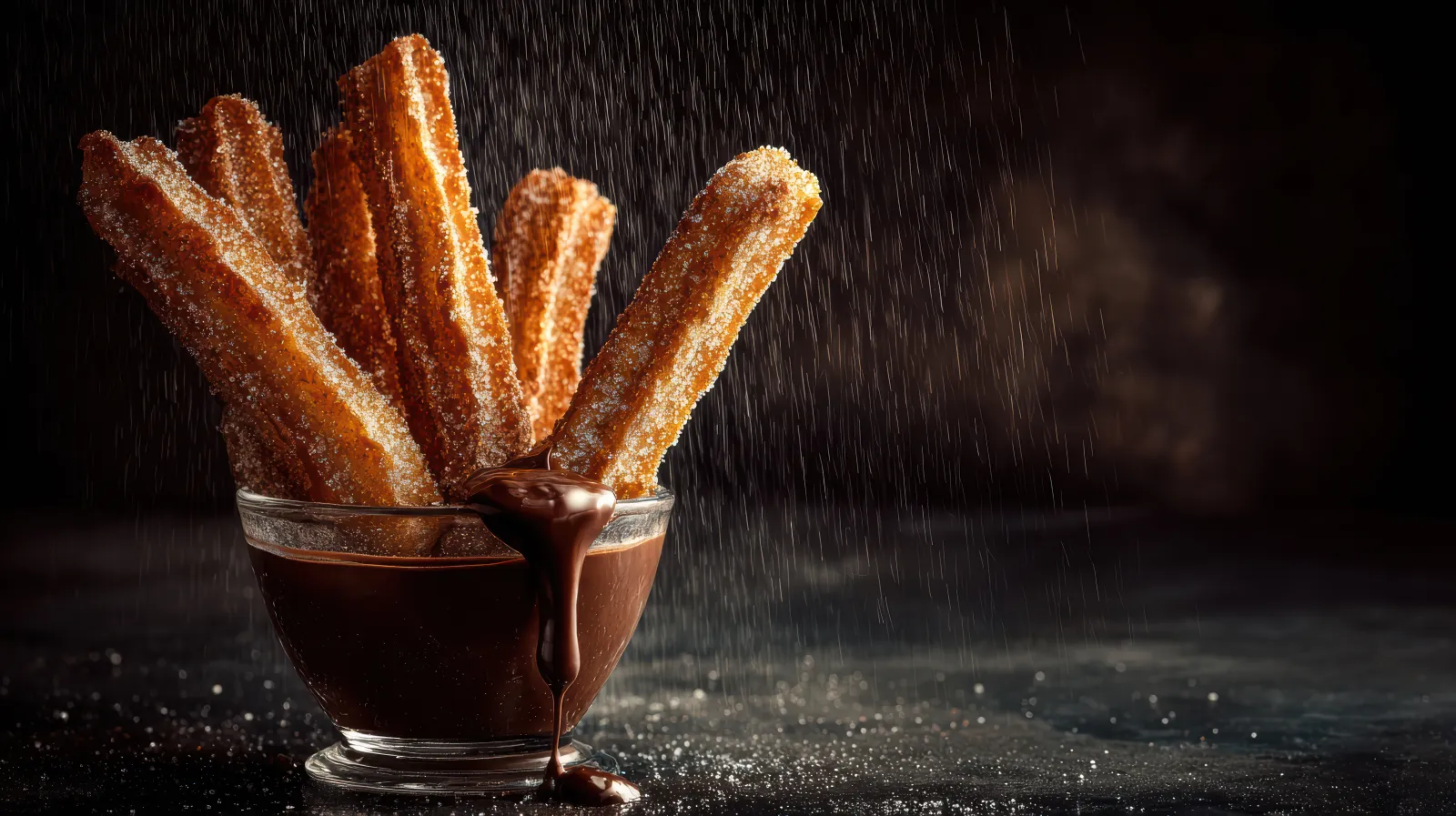

Churros (CHOO-rohs) are ridged sticks of fried dough, crisp outside and soft within, eaten in Spain with a cup of hot chocolate so thick you dip rather than drink it, and across Mexico and Latin America rolled in cinnamon sugar or filled with caramel. The classic Spanish dough has no eggs and no butter, only flour cooked into boiling water, and that one fact explains most of what goes wrong at home. A firm dough holds air if you pipe it carelessly, and air in a stick of dough dropped into 356°F (180°C) oil is how churros spit and burst.
How do you make churros at home?
How do you make homemade churros? Boil 300 ml (1¼ cups) water with salt and a spoonful of oil, beat in 250 g (2 cups) flour off the heat until it forms a ball, and let it cool 10 minutes. Pipe it through an open star tip with no air pockets and fry in batches at 356°F (180°C) for about 4 minutes. Roll in cinnamon sugar and serve with thick hot chocolate set with cornstarch. 45 minutes for 4 servings.
That’s the whole method. The rest of this page is the reasoning behind each number, because churros are a recipe where small changes have big consequences. The ratio decides whether a piping bag survives. The tip shape decides whether they burst. Five degrees of oil decides between crisp and greasy.
Is it worth it? Yes, if you’ll eat them within 15 minutes. That’s how long the crunch lasts, and it’s why homemade beats anything bought. If you don’t want a liter of hot oil on your stove, skip to the oven and air fryer section first: they work, but only with a different dough.
Time and effort. 45 minutes from cold pan to table, about 30 of them hands-on, mostly frying in batches. Medium difficulty: the dough is easy, the oil temperature is the skill.
Spanish churros vs Mexican churros, and which dough to use
Spanish churros are thin, made from water, flour and salt, and dusted with plain sugar or nothing at all; the sweetness comes from the chocolate. Rick Bayless notes that Mexican street churreros use the same kind of simple water and flour dough, firm enough to need a press. The eggy version you see in many US recipes is a choux pastry, the dough of cream puffs: water, butter, flour and eggs. It puffs, goes hollow and tender inside, and pipes easily. Filled churros, with Mexican cajeta or Colombian arequipe, are made from that eggy dough.
Which should you make? The water and flour dough if you’re frying: crisper, less greasy, closer to a churrería. The choux dough if you want to bake, air-fry or fill them.
The water to flour ratio
Published ratios run from 1:1 to 2:1 water to flour by weight. El Español gives 250 g of each; Bayless uses 454 g (2 cups) water to 280 g (2 cups) flour plus 50 g (¼ cup) oil. I settled on 300 ml water to 250 g flour (1.2:1), the firmest dough that still goes through a sturdy piping bag. At 1:1 you need a press; near 2:1 the dough is soft, loses its ridges and fries less crisp.
Measuring by cups? A US cup of all-purpose flour weighs about 125 g, so 2 cups is the 250 g here, spooned and leveled, not scooped. If your dough looks wet and slack, add a tablespoon of flour; if it cracks, a tablespoon of hot water.
What to buy in a US or UK supermarket
| Ingredient | US | UK | Notes |
|---|---|---|---|
| Flour | all-purpose | plain flour | bread flour makes a tougher churro |
| Frying oil | canola, vegetable, peanut | sunflower, vegetable | neutral, high smoke point |
| 70% chocolate | any 70% baking bar | dark cooking chocolate | Mexican table chocolate works but already has sugar and cinnamon |
| Cornstarch | cornstarch | cornflour | the thickener in the chocolate |
| Piping tip | open star, ½-⅝ in | open star, 12-15 mm | not a closed or round tip |
Churro press or piping bag? A press is better for this firm dough: it compacts the dough and pushes out air, the point a professional churro maker made in an interview reported by Infobae, where he said the ridges exist so the air can escape. A piping bag works if it’s a reusable canvas or silicone one (thin disposable bags can split) and you load it in two goes, pushing the dough toward the tip with a spatula.
Why churros explode, and the other things that go wrong
A churro bursts for two reasons. Air pockets in the dough expand suddenly in hot oil. And a smooth round tip makes a continuous skin that seals steam inside until it splits. An open star tip gives thin ridges that set first and let moisture out, so the churro cooks evenly and stays intact. Never let drops of water reach the oil either: at frying temperature water flashes to steam and throws oil.
Getting the oil right
Hong Kong’s Centre for Food Safety recommends frying between 150 and 180°C (300 and 356°F): hotter oil breaks down faster, cooler oil gets absorbed by the food. Bayless and King Arthur Baking fry at 375°F (190°C), which suits the softer egg dough. Churro shops in Spain fry at 200-220°C (390-430°F), according to El Español, in industrial fryers with thin churros; in a home pot at that heat the outside browns before the middle cooks.
No thermometer? Drop in a pea-sized bit of dough. At 356°F (180°C) it rises within 2-3 seconds, ringed with fine bubbles.
Planning ahead, and how many churros per person
The recipe makes about 28 churros of 12-15 cm (5-6 in). I plan 6 or 7 per person with hot chocolate as breakfast or an afternoon treat, and 3 or 4 each as dessert after a meal.
- 4-6 people → the recipe as written; for 6, use 375 g (3 cups) flour and 450 ml (scant 2 cups) water.
- 12 people → 750 g (6 cups) flour and 900 ml (3¾ cups) water, made as two separate batches of dough, because a big batch cools and stiffens before you finish frying. Make the chocolate with 2.25 liters (9½ cups) milk.
- 20 people → 1.25 kg (10 cups) flour in four batches, or pipe and freeze everything the day before.
The freezer method
Pipe the churros onto parchment-lined trays and freeze them 20-30 minutes, until firm enough to lift off the paper, which is King Arthur Baking’s method; then bag them. Fry straight from frozen at 356°F (180°C), about a minute longer than fresh, in small batches because they chill the oil. They come out straight, and nobody holds a piping bag over hot oil, which is the main reason I do it this way when children are around. USDA FSIS notes that food kept at 0°F (−18°C) stays safe indefinitely; for quality, I use them within a month.
Thick Spanish hot chocolate
The model I follow comes from the San Miguel churro shop, published by Noticias de Navarra: 1 liter (4¼ cups) milk, 200 g (7 oz) 70% chocolate, 50 g cocoa, 60 g sugar and 30 g cornstarch for four large cups, cornstarch dissolved in cold milk and cooked 5-7 minutes. I scale it to 750 ml (3 cups) milk, which gives four 190 ml (6½ oz) cups, the right amount for 7 churros each.
Cornstarch is the thickener: about 30 g per liter (1 oz per quart) makes chocolate that clings to the churro. More and it sets like pudding. Without it you have a drinking chocolate, closer to Colombian hot chocolate with cheese, which is a different cup altogether. Make it up to 2 days ahead and reheat with a splash of milk.
Baked and air fryer churros, honestly
With the water and flour dough, baking or air-frying gives a dry, hard stick, more breadstick than churro: without hot oil around it there’s no crisp shell. If you don’t want to fry, switch to the choux dough (King Arthur’s: 227 g / 1 cup water, 113 g / 8 tbsp butter, 150 g / 1¼ cups flour, 4 eggs), pipe, freeze, and brush with oil.
Laylita air-fries her egg-dough churros from frozen at 375°F (190°C) for 10-12 minutes. In the oven I use 400°F (200°C) for 18-20 minutes. Both come out golden and good with plenty of cinnamon sugar, but drier inside than fried.
Variations
Cinnamon sugar → the Latin American way, and the coating in this recipe. For Spanish-style, plain sugar or none.
Filled with dulce de leche or cajeta → use the egg dough, pipe churros 2 cm (¾ in) thick and 15 cm (6 in) long, fry at 340°F (175°C) for 5-6 minutes so the middle cooks, then fill from one end with a thin plain tip, about 15 g (1 tbsp) each. Colombian dulce de leche is the arequipe used in Colombia.
Egg-free and dairy-free → the main dough already is. Make the chocolate with oat milk; cornstarch thickens it the same way.
Porras → the thick Spanish cousin, made from a different dough that usually includes yeast or baking soda, per El Español.
What to serve with churros, 6½ oz of chocolate each
Thick hot chocolate is the Spanish pairing, about 190 ml (6½ oz) per person. A Mexican café de olla with cinnamon and piloncillo, or a thick corn-based champurrado, goes with the cinnamon sugar version. If you like fried sweet doughs, Colombia’s Christmas table has two more worth knowing: buñuelos made with cheese and paper-thin hojuelas with panela syrup. Around Day of the Dead, churros share the table with pan de muerto, the orange blossom bread, a baked yeast dough rather than a fried one.
Cost
With US city-average prices from the BLS for August 2026, the flour costs about $0.30, the sugar $0.21 and the 750 ml of whole milk $0.84. BLS doesn’t track chocolate or frying oil, and the 150 g (5.3 oz) of 70% chocolate is the biggest line in the budget. The same holds in Colombia’s wholesale prices (SIPSA-DANE): chocolate is 83% of the real cost, and the 28 churros alone come to about 52 Colombian pesos each.
Storage and reheating
Fried churros don’t keep well: the fridge makes them soggy. Leftovers sit uncovered at room temperature until the next day, then go into a 400°F (200°C) oven for 4-5 minutes or an air fryer at 356°F (180°C) for 3. The microwave makes them rubbery. The hot chocolate follows USDA FSIS leftovers rules: no more than 2 hours out, 3-4 days in the fridge at 40°F (4°C) or below; reheat over low heat with a splash of milk.
Churro FAQ
Why do my churros explode? Air pockets in the dough and smooth round tips. Pack the bag so no air is left, use an open star tip, and keep water away from the oil.
Are churros Spanish or Mexican? Both are traditions in their own right. Spain eats them thin with thick chocolate; Mexico rolls them in cinnamon sugar and often fills them with cajeta.
Do churros have eggs? Traditional Spanish churros don’t. Many home recipes add eggs and butter, which makes them hollow and softer.
Can I make churros without a piping bag or press? A heavy zip-top freezer bag works with a star-shaped cut in the corner, though the ridges are shallower. A press or a canvas bag with a star tip is better.
Why are my churros raw in the middle? Usually the oil is too hot, so the shell browns before the center sets, or they’re piped too fat. Keep them under ⅝ inch thick and fry at 356°F.
Can you freeze churro dough? Yes, and it’s the best way to do it. Pipe the churros, freeze them on the tray until firm, bag them, and fry from frozen with about a minute added.
What oil is best for churros? A neutral oil with a high smoke point: canola, sunflower, peanut or vegetable.
Nutrition per serving
Per serving (7 churros and a 190 ml / 6½ oz cup of chocolate), calculated from USDA SR Legacy data with this recipe’s amounts. The oil the churros absorb is my estimate, about 75 g (⅓ cup) for the whole batch including the tablespoon in the dough, measured by the drop in the pan. All the coating sugar is counted.
- Calories: 870 kcal
- Protein: 17 g
- Carbohydrates: 109 g
- Fat: 43 g, of which 15 g saturated
- Fiber: 9 g
- Sugars: 43 g
- Sodium: 386 mg
The 7 churros alone are about 443 kcal; the cup of chocolate about 426, with most of the saturated fat. A weekend breakfast, not a daily one.
The churros I got used to in Colombia are sold on the street, cinnamon-sugared and sometimes filled with arequipe. At home I make the plain water and flour kind, freeze them on a tray, and fry them while my son coats them in sugar at the far end of the counter. Fry the first one, break it open, and let it tell you what the oil is doing. Josnaisis.