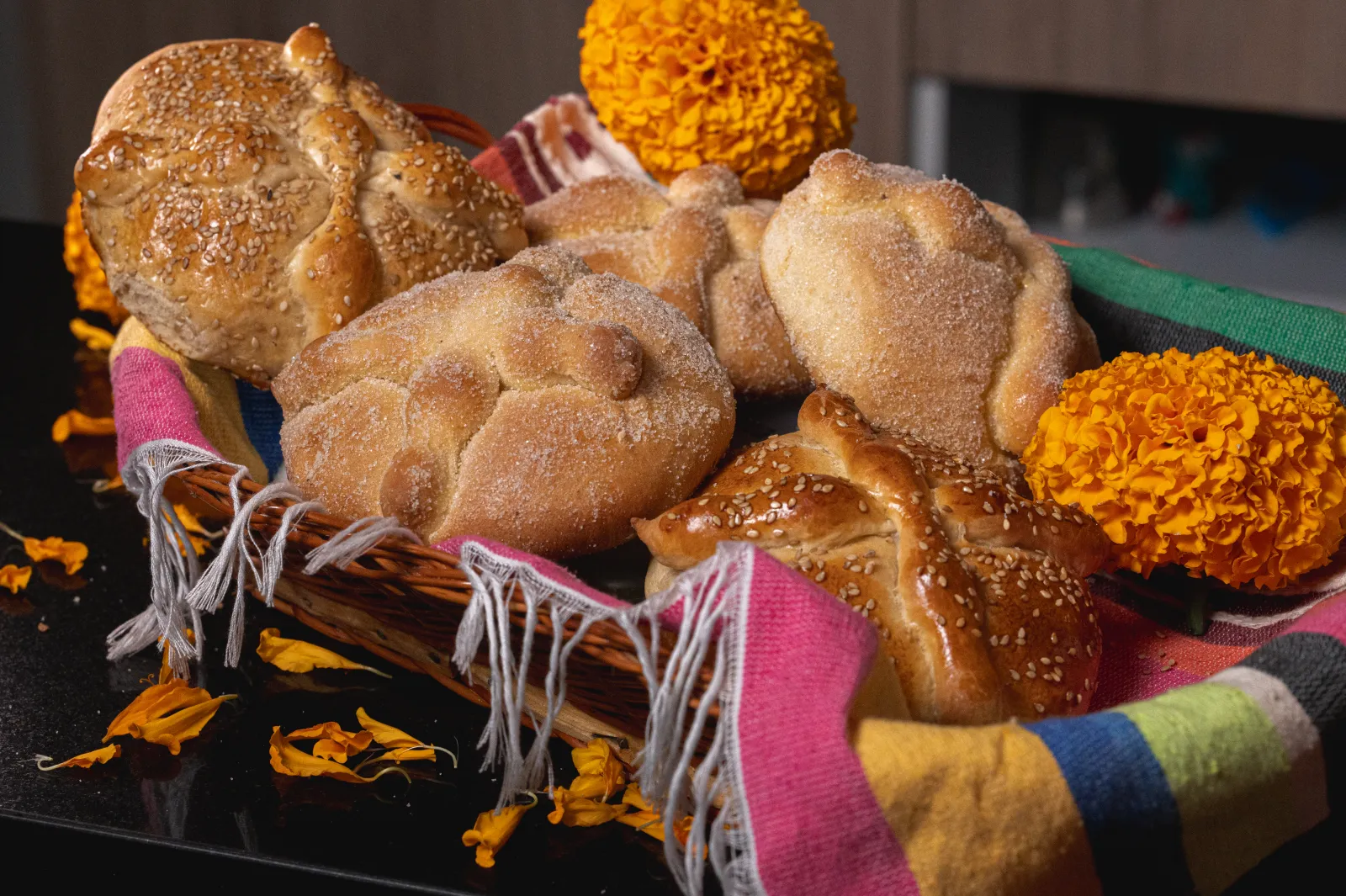

Pan de muerto (pahn deh MWEHR-toh), “bread of the dead”, is the soft, orange-scented sweet bun Mexican families bake or buy for Day of the Dead, set on home altars called ofrendas and eaten over the first two days of November. Each round bun carries a cross of dough “bones” and a small knob on top, and is rolled in sugar while still warm. If you’ve had brioche, you already know the crumb; what you won’t have had is the orange blossom water, which makes the kitchen smell like a florist’s. This version makes 8 buns, works from a dough you mix the night before, and spends most of its words on the part that goes wrong at home: bones that flatten or slide off in the oven.
What is pan de muerto, and is it worth baking at home?
How do you make pan de muerto? Knead 500 g (4 cups) of flour with sugar, yeast, eggs, yolks, warm milk, orange zest and orange blossom water, adding soft butter last. After a 2-hour rise, shape 8 buns topped with crossed dough bones, proof 1 hour, add the small knob and bake at 350°F (180°C) for about 20 minutes. Brush with butter and roll in sugar while warm. 250 minutes for 8 servings.
It’s worth it if you enjoy bread baking or want something homemade for an altar or a Day of the Dead get-together. Fresh, the buns are tender and fragrant; bakery versions from a bag lose the crackle of the sugar crust within a day or two.
When it shines. An altar on November 1, an afternoon with hot chocolate for 6 to 8 people, or a baking project with kids, who tend to love rolling the bones. One batch makes 8 buns of about 135 g (4.75 oz).
When to skip it. If you need it in an hour, since rises alone take over 3. And if you’ve never baked bread and have no stand mixer: hand kneading works, but the dough is sticky and asks for patience.
Real time. 250 minutes start to finish, about 55 hands-on. With overnight dough, serving day is about 140 minutes, as the chart above shows, and only 35 of them need you.
Honest difficulty, medium. The dough behaves if the milk isn’t hot and the butter goes in late. First-timers lose points on decoration, not on the bread.
How it differs from rosca de reyes
If you’ve made the Mexican three kings bread on this site, this dough will feel familiar: butter is 25 % and sugar 20 % of the flour weight in both, and both carry orange and orange blossom. The differences are shape, topping and timing. Rosca is one large ring baked with a sugar-paste crust and fruit paste for January 6. Pan de muerto is individual buns with bones, and the sugar goes on after baking, over melted butter. Neither is a Spanish roscón or a New Orleans king cake.
Ingredients, with US and UK swaps
The full list is in the recipe card. The dough is 500 g (4 cups) flour, 100 g (½ cup) sugar, 3 eggs plus 2 yolks, 125 g (4.4 oz) butter and just 80 ml (⅓ cup) of milk; most of the moisture comes from the eggs, which is why it starts sticky. Don’t add flour to fix that, as kneading and the butter firm it up.
Flour. US all-purpose works. In the UK, strong white bread flour gives taller buns and bones that hold their shape better; plain flour makes flatter buns. Cake flour or self-raising flour won’t work.
Yeast. Instant yeast (fast-action dried yeast in the UK), 7 g, one standard packet or sachet. With active dry yeast, use 9 g (2¾ tsp) and always proof it in the warm milk. Fresh yeast, 20 g.
Oranges. Two oranges for zest, orange part only, as the white pith is bitter. The juice isn’t used, so drink it.
Orange blossom water, where to buy it and what to use instead
Orange blossom water is distilled from the flowers of the bitter orange tree, Citrus aurantium. It’s potent and brands vary, so with a new bottle start with 2 teaspoons, smell the dough, and go up to the full tablespoon if you can barely notice it. Buy the food-grade kind; some pharmacies sell cosmetic orange flower water.
- In the US, look for orange blossom water or orange flower water in Middle Eastern grocery stores, the international aisle of larger supermarkets, or online. Mexican grocery stores sell té de azahar, orange blossom tea bags.
- In the UK, Tesco and Waitrose list Nielsen-Massey orange blossom water in 60 ml bottles, at about £4 when I looked, and Middle Eastern shops carry larger, cheaper bottles.
The tea swap works like this: steep 2 tea bags in 60 ml (¼ cup) of hot water for 10 minutes, then use that infusion plus 20 ml (4 tsp) of milk in place of the 80 ml of milk. Extra zest (3 oranges) gives you a lovely orange bun with no floral note. I don’t use rose water or vanilla.
Equipment
A stand mixer with a dough hook, a large baking sheet with parchment, a pastry brush, a kitchen scale and ideally an instant-read thermometer. The scale matters here: buns of 110 g and bones of 7 g only come out even if you weigh them. No mixer? Knead by hand for 20 minutes or so, using a bench scraper to gather the dough. No thermometer? Tap the base: it should sound hollow, and the sides shouldn’t give when pressed.
A make-ahead plan for November 1 and 2
Mix the dough the night before. Cold dough is easier to shape and gives crisper bone detail, and your morning starts at shaping.
- October 29 or 30. Buy orange blossom water and oranges, check the yeast date. To bake with days to spare, bake now and freeze the buns uncoated.
- Night of October 31. Knead, leave the dough out 30 minutes, then refrigerate it covered for 8 to 14 hours.
- Morning of November 1. Shape cold, proof about 90 minutes, bake 20, coat. For buns on the altar by noon, start shaping at 9:30.
- For fresh bread on November 2 too, mix a second batch on the night of November 1. Don’t push one dough past 14 hours in the fridge.
Scaling for a crowd. Everything scales in proportion, yeast and salt included. Bake one tray at a time and keep the next one in the fridge so it doesn’t over-proof.
| Batch | Buns | Flour | Butter (dough) | Eggs + yolks | Sugar (dough) |
|---|---|---|---|---|---|
| 1× (4-6 people) | 8 | 500 g (4 cups) | 125 g (4.4 oz) | 3 + 2 | 100 g (½ cup) |
| 2× (12-16 people) | 16 | 1 kg (8 cups) | 250 g (8.8 oz) | 6 + 4 | 200 g (1 cup) |
| 2½× (20 people) | 20 | 1.25 kg (10 cups) | 312 g (11 oz) | 7-8 + 5 | 250 g (1¼ cups) |
How to shape bones that don’t fall off
Use firmer dough for the decorations than for the buns. Kneading the reserved 150 g (5.3 oz) with 1 tablespoon of flour and chilling it 15 minutes keeps the knuckles sharp through the oven. Made from the same soft dough as the buns, the bones melt into the top.
- Roll the bones. Strips of 7 g, rolled to 12 cm (4¾ in) with your fingers spread, pressing as you roll. Under each finger the strip thins; between fingers a knuckle forms. They’re longer than the 8 cm (3¼ in) bun on purpose, so the ends can drape down the sides.
- Glue them on the sides. Brush the bun with egg, cross two bones and press the ends into the sides, not just on top. As the bun swells, ends that only sit on top lift off.
- Add the knob last. A 4-5 g ball, placed right before baking, never before the final rise. If it goes on early, the bun rises underneath and pushes it sideways. Dip a finger in egg, make a dent where the bones cross, drop the ball in and press.
Baking, doneness and the sugar coat
Bake 110 g buns at 350°F (180°C), or 160°C fan, for 18-22 minutes on the middle rack. They’re done at 190°F (88°C) in the center, the target I use for egg-and-butter breads. Two large 500 g (1.1 lb) loaves instead of 8 buns need 30-35 minutes; tent with foil at 20 minutes if they brown too fast.
The coating goes on 10 minutes out of the oven: warm enough for the butter to soak into the crust, not so hot that the sugar melts. Brush each bun all over, bones included, and roll it in a shallow bowl of sugar. About 100 g (½ cup) sticks across 8 buns. If the sugar won’t stick, the bun went cold: brush again.
Mistakes, kids and allergens
- It didn’t rise → milk too hot, or a cold kitchen. Check for foam first, and proof somewhere at 75-80°F (24-27°C); an oven with only the light on is often there.
- Dense crumb → butter added at the start, or too little kneading. Look for the thin sheet before the first rise.
- Bones flattened → soft or warm decoration dough. Firm it with flour and chill it.
- Bones slid off → ends resting on top. Press them into the sides with egg.
- The knob rolled away → added before the final rise. It goes on last.
- Dark outside, pale inside → oven too hot or rack too high. 350°F (180°C), middle rack.
Spice level, 0 out of 5. None.
Kids? Almost always a hit: soft, sweet, sugar-coated. At 7 g per strip, small hands can roll the bones.
Allergens. Wheat (gluten), egg and milk. The sesame version adds sesame, a major allergen that must be declared in both the US and the UK.
Versions worth knowing
- Sesame-topped → brush the whole bun with egg before baking, cover with sesame seeds and skip the sugar. Spanish-language Wikipedia lists sesame versions in Oaxaca, and the hojaldra of Puebla pairs orange blossom with sesame.
- Red sugar → tint the coating sugar with a few drops of red food coloring. In the Huasteca of Hidalgo the buns are dusted red; in the Mixteca of Puebla, white sugar goes on children’s altars and red on adults’.
- One big loaf to share → 2 loaves of about 500 g (1.1 lb), four bones each, 30-35 minutes.
- Freezer-first → bake uncoated a week or more ahead, freeze, then reheat and coat on the day.
Central Mexico’s everyday version is the one here, bones and sugar. Oaxaca’s valleys bake a large egg-yolk bread with a small sugar figure pressed in, and Michoacán has pan de hule, round, glossy and dark. Each is its own bread.
What it costs
The tracked ingredients for 8 buns come to $5.52, about 69 cents a bun, at the US city average prices the Bureau of Labor Statistics published for August 2026. Butter is 31 % of that and the two oranges 27 %, because you buy them whole for the zest alone.
Bought in Mexico. In PROFECO’s price survey of October 21-23, 2024, in Mexico City, Guadalajara and Monterrey, a 90-100 g bakery pan de muerto averaged 20.87 pesos, with a range of 15 to 25. The buns here are a little larger.
What pushes the price up. Butter, then orange blossom water, which the BLS doesn’t track: a small bottle can cost more than all the flour, though it lasts for several batches.
Serving and storing
Taste and texture. A yellow, tender crumb that pulls into strands, orange blossom the moment you tear it, a background of orange zest, and a crisp shell of butter and sugar. Each bun has about 26 g of sugar, nearly half of it in the coating.
What to drink with it. In Mexico it’s hot chocolate or atole. A thick Mexican champurrado, the masa-thickened chocolate atole, is the classic dunking drink; a whisked hot chocolate made from a tablet of Mexican table chocolate works too, and so does a pot of spiced café de olla.
More sweet doughs on the site. Venezuelan ham bread is my family’s December loaf, another enriched dough. For something fried and fast, homemade churros take half an hour. For breakfast, Mexican conchas with a vanilla or chocolate topping use a lighter dough with less butter and more milk. If you’re cooking an altar meal for someone who loved Colombian food, a bowl of Colombian ajiaco belongs next to the bread.
At room temperature. Wrapped or in a sealed bag, I keep them 3 days. Uncovered on an altar they dry out in a day or two.
Fridge. Skip it; bread stales faster in the cold than on the counter.
Freezer. Freeze uncoated, wrapped individually. According to the USDA FSIS, food kept at 0°F (-18°C) stays safe indefinitely and only quality declines; I stop at 2 months.
Reheating. Thaw wrapped for 1 hour, warm 5 minutes at 300°F (150°C), then butter and sugar them as if fresh from the oven. In the microwave, 10-15 seconds at most, or the crumb turns chewy as it cools.
Frequently asked questions
What do the bones and the ball on pan de muerto mean? The crossed strips stand for bones and the small ball on top for the skull, while the round shape is associated with the cycle of life and death, according to Spanish-language Wikipedia.
When is pan de muerto eaten? Over the first two days of November, for Day of the Dead, both on altars and at the table. Some Mexican bakeries start selling it weeks earlier.
What can I use instead of orange blossom water? Orange blossom tea is the closest. Extra orange zest makes a good citrus bun without the floral note. There’s no exact substitute.
Where can I buy orange blossom water? In the US, at Middle Eastern grocers, international aisles and online. In the UK, Tesco and Waitrose stock small bottles, and Middle Eastern shops sell larger ones.
Can I make pan de muerto ahead of time? Yes. Refrigerate the dough 8 to 14 hours overnight and shape in the morning, or bake and freeze uncoated for up to 2 months, then reheat and coat on the day.
How do I keep the bones from falling off? Make them from firmer, chilled dough, press their ends into the sides of the bun with egg, and add the top ball only right before baking.
What temperature do I bake pan de muerto at? 350°F (180°C), 160°C fan, for 18-22 minutes for 110 g buns, or 30-35 minutes for 500 g loaves. Done at 190°F (88°C) inside.
Is pan de muerto the same as Mexican sweet bread (pan dulce)? It’s one kind of pan dulce, the one baked for Day of the Dead. Conchas and other everyday sweet breads are different doughs and shapes.
Nutrition
Per bun (one eighth of the batch, about 135 g / 4.75 oz with its coating), calculated ingredient by ingredient from USDA FoodData Central (SR Legacy) with the amounts above, counting half the gluing egg and the 100 g of sugar that sticks:
- Calories: 555 kcal
- Protein: 11 g
- Carbohydrates: 74 g
- Fat: 24 g, of which 14 g saturated
- Fiber: 2 g
- Sugars: 26 g
- Sodium: 333 mg
Butter, in the dough and the coating, supplies 82 % of the fat, and the butter-and-sugar coat alone is a fifth of the calories. Skip it, or go with sesame, and the bun gets noticeably lighter.
Day of the Dead wasn’t part of my Venezuelan childhood, so I came to this bread through the dough, having baked enough three kings rings to know it by feel. What took me longest was the decoration: my first bones melted into the buns like butter. A spoonful of flour and fifteen minutes in the fridge fixed it, and now the bones come out of the oven exactly where I put them. Josnaisis.