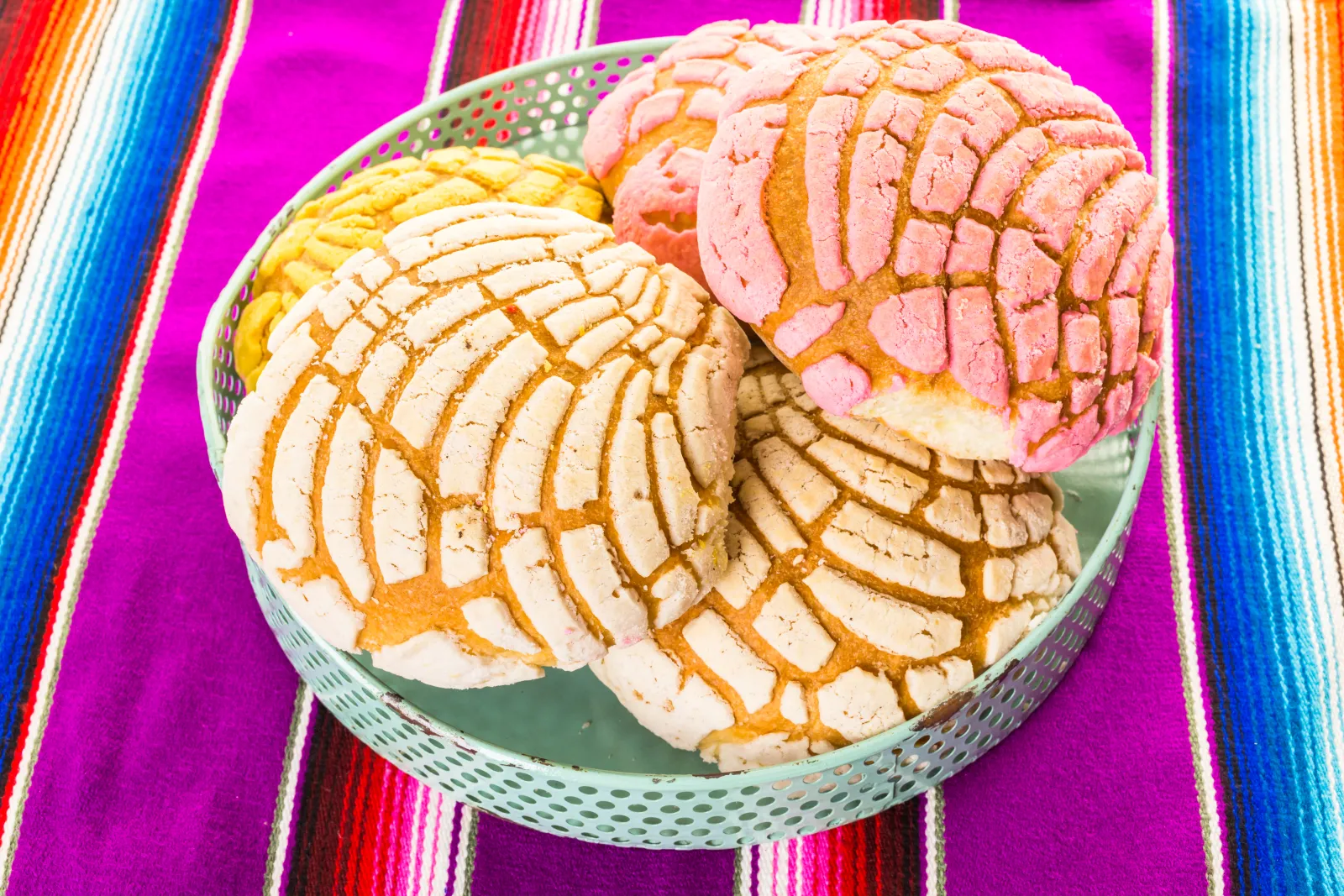

Conchas (KOHN-chahs, “shells”) are the round sweet buns you see stacked in every Mexican bakery case: a soft, vanilla-scented yeast roll under a crisp sugar-cookie topping scored to look like a seashell. In Mexico they’re everyday bread, eaten for breakfast or a late-afternoon snack with coffee or hot chocolate, and in the US they’re the best-known item in any panadería. If you’ve baked dinner rolls, you can bake these. What usually goes wrong at home isn’t the bread at all, it’s the topping, which cracks into slabs or slides off the bun. This batch makes 12, six vanilla and six chocolate, and you can shape them the night before so they go into the oven when you wake up.
What are conchas, and are they worth baking at home?
How do you make Mexican conchas? Knead 500 g (4 cups) of flour with sugar, instant yeast, salt, 2 eggs, 200 ml (¾ cup plus 1½ tbsp) of warm milk and vanilla, adding soft butter last. After a 90-minute rise, shape 12 balls, press on discs of topping made from equal weights of flour, powdered sugar and fat, score them, proof 60 minutes and bake at 350°F (180°C) for about 20 minutes. 205 minutes for 12 servings.
They’re worth it if you like the smell of bread in the morning and have a weekend. A homemade concha is tender and pulls apart in strands, and the topping snaps like shortbread; a store-bought one from a plastic bag usually has a damp, soft top by the next day.
When they shine. A weekend breakfast for 6 to 12, an afternoon with Mexican champurrado, or a baking project with kids, who love scoring the shells. One batch makes 12 conchas of about 100 g (3.5 oz) each, baked.
When to skip them. If you want sweet rolls within the hour: two rises put you past 3 hours. Or if you’re cutting sugar, since each one carries about 17 g.
Real time. 205 minutes total, about 45 hands-on. Make the dough or shape the buns the night before and the morning shrinks to 95-140 minutes, most of it waiting.
Honest difficulty, medium. The dough is friendly. The topping is where bakery conchas and bald buns part ways.
How conchas differ from pan de muerto and brioche
Measured against the flour, this dough has 16 % butter, 18 % sugar, 20 % egg and 41 % milk. That puts it closer to a rich dinner roll than to brioche. The Mexican pan de muerto and three kings bread on this site run 25 % butter, nearly twice the egg and less than half the milk, with orange and orange blossom water; conchas use vanilla instead, and the sugar topping bakes on with the bread rather than going on afterwards.
Ingredients, with US and UK swaps
Everything is in the recipe card. Weigh if you can: a cup of flour scooped straight from the bag packs in noticeably more than a spooned one, and in the topping that difference is the gap between pliable and crumbly.
Flour. US all-purpose is the standard. In the UK, strong white bread flour gives taller, bouncier buns; plain flour works but they spread a little more. Cake flour and self-raising flour don’t.
Yeast. Instant yeast is the US name; fast-action dried yeast is the UK one. With active dry yeast, use 9 g (2¾ tsp) and always proof it in the warm milk first. Fresh yeast, 20 g (0.7 oz).
Sugar. Granulated or caster in the dough; powdered sugar, called icing sugar in the UK, in the topping. Granulated in the topping bakes gritty and spreads.
Milk. Whole milk. Some US recipes use evaporated milk, which makes a slightly richer, more golden crumb; swap it 1 to 1 if that’s what you have.
The topping, butter or shortening
The topping is equal weights of flour, powdered sugar and fat, about 25 g (0.9 oz) per bun. The fat is the real choice.
Vegetable shortening is the bakery classic: Crisco in the US, Trex or Cookeen in the UK. It stays white and soft and copes with a warm kitchen. Butter tastes better, browns a touch at the edges and gets crunchier, but above about 79°F (26°C) it softens while you work. I bake with all butter in winter and half and half in summer.
For chocolate, the recipe swaps 5 g of flour for 8 g (1½ tbsp) of unsweetened cocoa. Cocoa soaks up fat, so the chocolate paste usually needs a teaspoon of milk to feel as soft as the vanilla one.
Equipment, and what to use without it
A stand mixer with a dough hook, two baking sheets, parchment, a kitchen scale and two pieces of plastic for flattening the topping (a split zip-top bag is perfect). A concha cutter, the plastic stamp sold in Mexican groceries and online, is nice to have; a small paring knife does the same job. No mixer? Knead by hand for about 15 minutes, pressing the butter in with the heel of your hand.
Conchas for breakfast, the overnight plan
This is the reason to make conchas at home. There are two ways to get ahead, and the second gets you warm buns at a normal breakfast hour.
- Overnight dough. Knead in the evening, refrigerate the covered dough 8 to 14 hours. Cold dough is easier to shape, but after shaping it needs about 90 minutes to proof. Allow about 140 minutes from fridge to table.
- Overnight shaped conchas. Do everything the night before, topping and scoring included, cover the sheets well without the wrap touching the topping, and refrigerate. In the morning they need about 60 minutes on the counter. Allow about 95 minutes, under 10 of them hands-on.
Don’t rush a cold proof with high heat. The outside warms and rises before the center does, and the topping splits.
Step by step, and how to tell each stage is right
Follow the recipe card for the full method. These are the checkpoints that matter.
Dough. After 13-15 minutes of kneading it should clear the bowl and stretch thin enough to see light through. If it tears, knead 2 more minutes.
First rise. Doubled in about 90 minutes at 75-80°F (24-27°C). A cool kitchen can take 2 hours; an oven with only the light on runs warmer and can get it there in about 60.
Topping on. The disc should cover the top two thirds of the ball, pressed down the sides, not sit on top like a lid. Score only the topping, about 2 mm (1/16 in) deep.
The finger test before baking
Flour a fingertip and press about 1 cm (⅜ in) into the side of a bun, below the topping.
- Springs back right away → underproofed. Check again in 10-15 minutes.
- Springs back slowly, leaving a slight dent → ready. Bake now.
- Stays dented or the dough wrinkles → overproofed. Bake immediately and expect wider cracks.
By then the buns have nearly doubled and the scored lines have started to open on their own.
The temperatures that matter
Six numbers, from the milk to the middle of the baked bun.
In the oven. At 18-20 minutes the bottoms are golden, the sides look like bread and the topping is still pale, just tinged at the tips if you used butter. The center reads 190°F (88°C); without a thermometer, tap the bottom and listen for a hollow sound.
Why concha topping cracks or slides off, and other mistakes
The topping is supposed to split along the scored lines; that’s the shell. These are the failures that aren’t.
- Dry topping, 1 tsp of milk away from fixed. Flour measured by cup makes it crumbly, and it cracks when you flatten it and again in the oven. It should feel like soft modeling clay.
- Melted fat, not soft fat. The topping runs down the sides and leaves the bun bald. Butter should be soft at about 68°F (20°C), and the paste rests 10 minutes in the fridge.
- A lid instead of a cap. A flat disc sitting only on top gets pushed up as the bun grows and falls off once it cools. Press it over two thirds of the ball.
- Overproofing. Stretched dough breaks the topping into plates that flake off. Bake on the finger test, not on size alone.
- An oven running hot. The bun domes fast and the topping tears across the crown. Check 350°F (180°C) with an oven thermometer rather than trusting the dial.
- Moving them hot. Fresh topping is soft and peels away. Give them 10 minutes on the sheet.
Spice level. None.
Kids. A guaranteed hit, chocolate first.
Allergens. Wheat (gluten), egg and milk. No nuts in the recipe, but check cocoa and powdered sugar labels for traces. The egg is fully cooked: the center passes 190°F (88°C), well above the safe minimum for egg dishes, 160°F (71°C) according to the USDA FSIS.
Which version should you make?
- Breakfast → shaped the night before and proofed in the fridge; about 95 minutes in the morning.
- In a hurry → there’s no good shortcut under 3 hours, but a warm proofing spot at 80°F (27°C) brings the total to about 175 minutes.
- Party → two separate batches for 24, half vanilla and half chocolate, plus a pink topping with 2 drops of red food coloring so the flavors are easy to tell apart.
- Lighter → the topping is a third of the calories; 15 g (½ oz) discs instead of 25 g save about 50 kcal a bun and still look right.
- Dairy-free → unsweetened plant milk in the dough and shortening in both dough and topping. The crumb is a little less tender.
- Flavored toppings → 1 tsp instant coffee or ground cinnamon in the vanilla paste. The cinnamon one is my favorite with Mexican café de olla.
- Filled → split and filled with whipped cream or pastry cream, as many bakeries sell them. Fill on the day and keep them chilled.
How many conchas to bake, for 6, 12 or 24
- For 4 to 6 people → half the recipe: 250 g (2 cups) flour, 45 g (3½ tbsp) sugar, 1 egg, 100 ml (7 tbsp) milk, 40 g (3 tbsp) butter, 4 g (1¼ tsp) yeast and 150 g (5.3 oz) of topping. Makes 6.
- For 12 → the recipe as written.
- For 20 or more → one and a half batches (750 g / 6 cups flour) gives 18; for 24, I make two batches back to back rather than one double. A 2 kg (4.4 lb) enriched dough climbs the hook of most home mixers and overheats.
Rise and bake times don’t change when you scale, only the number of sheets.
What homemade conchas cost
At US city average prices from the Bureau of Labor Statistics for August 2026, the ingredients it tracks add up to $3.35 for 12 conchas, about 28 cents each. Butter, split between dough and topping, is 48 % of that.
Yeast, vanilla and cocoa aren’t in the BLS data and aren’t counted; good vanilla can cost more than all the flour, though a bottle lasts many batches. Using shortening in the topping cuts the bill noticeably, since more than half the recipe’s butter is up there.
Serving, storing and freezing conchas
Taste and texture. White, tender, slightly stretchy crumb that smells of vanilla and butter, under a topping that crunches and then melts like a butter cookie. About 17 g of sugar per bun, around 8 g of it in the topping.
How they’re eaten. Whole or split, for breakfast or a snack, dunked in something hot. The Colombian hot chocolate on this site works with Mexican table chocolate too. For a full Mexican-style breakfast, start with huevos a la mexicana and save the conchas for last. For a Venezuelan sweet breakfast bread with salt in it, try golfeados, sticky buns with papelón and white cheese.
Room temperature. In a sealed bag or tin, 2 days at their best. On day three the topping goes soft. Never bag them warm; the steam ruins the crunch.
Fridge. Skip it. Bread stales faster in the cold.
Freezer. Wrap each cooled concha in plastic and bag them. The USDA FSIS notes that food kept at 0°F (-18°C) stays safe indefinitely and only quality drops; I use them within 2 months, after which the topping turns soft on thawing.
Reheating. Thaw wrapped for 1 hour, then warm 5 minutes at 300°F (150°C): the topping crisps again. In the microwave, 10-15 seconds at most, or the topping melts and the crumb turns chewy.
Frequently asked questions
Why does my concha topping fall off? It was resting on top like a lid, the buns overproofed, or they were moved while hot. Press the topping over two thirds of the ball, bake on the finger test and let them sit 10 minutes on the sheet.
Why does the topping crack before baking? It’s too dry, usually from flour measured by cup. It should feel like soft modeling clay; 1 tsp of milk fixes it.
What is concha topping made of? Equal weights of flour, powdered sugar and fat (butter or vegetable shortening), flavored with vanilla or cocoa. About 25 g (0.9 oz) per bun.
What temperature do you bake conchas at? 350°F (180°C), or 320°F (160°C) fan, for 18-20 minutes. Hotter and the topping browns and the crowns split.
Can I make conchas the night before? Yes. Refrigerate the dough 8-14 hours, or shape and top the buns and proof them in the fridge, then bake in the morning after about 60 minutes on the counter.
Can you use butter instead of shortening in the topping? Yes. It tastes better and bakes crunchier and slightly golden, but softens fast in a warm kitchen. Half and half is a good middle ground.
How long do conchas last, and can you freeze them? 2 days at room temperature in a sealed bag. Frozen, wrapped individually, they keep their quality for about 2 months; reheat 5 minutes at 300°F (150°C).
How many calories are in a concha? About 377 kcal for one of these, roughly 100 g (3.5 oz). Without the topping it would be about 254.
Nutrition
Per concha (1/12 of the recipe, about 100 g / 3.5 oz baked, topping included), calculated ingredient by ingredient from USDA FoodData Central (SR Legacy) with this recipe’s amounts, half vanilla and half chocolate:
- Calories: 377 kcal
- Protein: 7 g
- Carbohydrates: 55 g
- Fat: 14 g, of which 8 g saturated
- Fiber: 2 g
- Sugars: 17 g
- Sodium: 281 mg
Butter supplies 86 % of the fat between dough and topping, and the topping alone is a third of the calories. Vanilla and chocolate come out almost identical; 8 g of cocoa changes the color, not the numbers.
Conchas weren’t part of my Venezuelan childhood, and I learned them in Colombia after years of baking holiday breads from a similar dough. My first tray came out with every topping slumped to one side like a crooked hat. Weighing the paste and pressing it down the sides fixed it, and now my son Dylan does the scoring. A good concha is decided on the counter, before the oven door ever opens. Josnaisis.