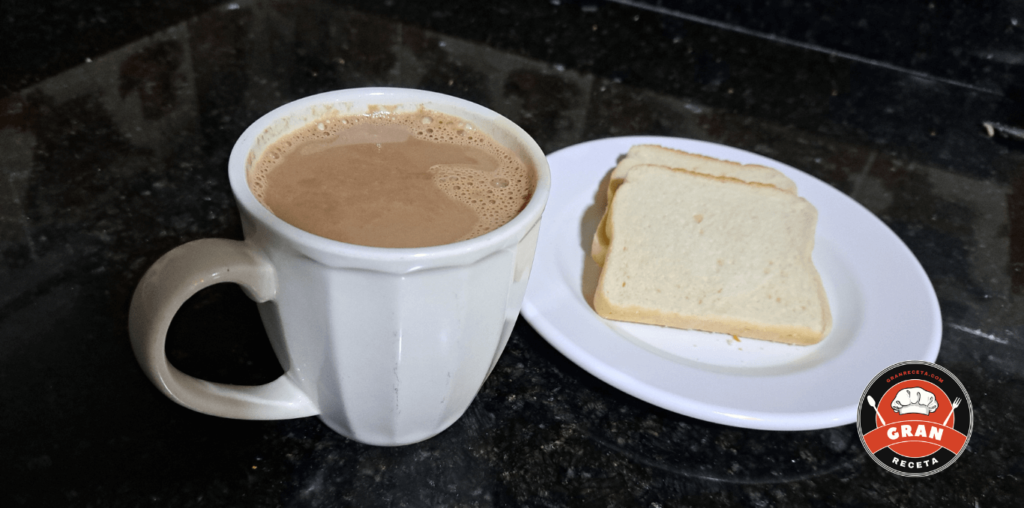
Colombian hot chocolate arrives with 1 oz of fresh cheese sitting in the bottom of the mug, softening as you drink. That sweet-salty combination is what surprises everyone who didn’t grow up with it, and in Bogotá it’s ordinary breakfast. The recipe is short (a tablet of table chocolate, milk, cinnamon, cheese) and has exactly one unbreakable rule: it must not boil. At 175-185 °F the cocoa butter in the tablet melts, the drink thickens and a molinillo raises a foam that holds; once it boils, the fat separates, a skin forms and the foam collapses. Two 8-oz cups in 15 minutes, 373 calories each with milk and cheese.
How do you make Colombian hot chocolate? Heat 2 cups of milk with a cinnamon stick without letting it boil, add 2 oz of table chocolate in pieces and stir 3 to 4 minutes until dissolved. Hold it at 175-185 °F and froth with a molinillo for 1 to 2 minutes. Pour over cubes of fresh cheese set in the bottom of the mug. About 15 minutes for 2 cups.
What to buy
The one ingredient worth sourcing is the chocolate. Colombian table chocolate (Corona and Luker are the household brands) comes as stamped tablets of cocoa already ground with sugar and often cinnamon and clove, so it dissolves into a drink without anything else added. It’s sold in Latin groceries and online, and Mexican table chocolate such as Abuelita or Ibarra is the closest widely available substitute, a little sweeter and more cinnamon-forward.
Dutch-process cocoa powder will make hot chocolate, but a different one: the powder is defatted, at 13.7 g of fat per 100 g per USDA against 52 g in unsweetened baking chocolate, so the drink is thinner, foams less and needs sugar. If it’s what you have, use 2 heaping teaspoons of cocoa and 2 of sugar per cup and froth longer.
Why it must not boil
The foam here isn’t whipped air, it’s an emulsion. The tablet carries its own cocoa butter, which melts into tiny droplets through the milk; the molinillo works air in and the milk proteins hold those bubbles around the fat. All of that works in a narrow band of heat. Under about 160 °F the tablet doesn’t fully melt and you get grit; over 195 °F a skin starts forming, which is coagulated protein; and at a boil the fat separates outright and the foam dies as fast as you can raise it.
Hence the grandmother’s rule that turns out to be physics: you watch hot chocolate, you don’t boil it. The visual cue is steam with bubbles only at the rim of the pot.
The cheese, which softens rather than melts
This is the part to get right, and it comes down to one property. The cheese isn’t supposed to melt: it should soften and stay whole so you can eat it with a spoon at the end. That means a fresh, pressed, low-melt cheese. In Colombia it’s queso doble crema or queso campesino; in a US supermarket, queso fresco is the natural match and a mild feta, rinsed and cubed, works too, bringing the salty edge that makes the contrast.
What doesn’t work is anything designed to melt. Mozzarella stretches into strings and glues itself to the mug; cream cheese dissolves and clouds the drink. And the cheese goes in the mug, never in the pot: in the pot it disintegrates into everyone’s chocolate at once.
Cut 2 oz into ½-inch cubes, set them in the bottom, and pour the hot chocolate over. A minute or two and it’s right: soft outside, whole inside.
How it compares
If you know Mexican hot chocolate, this one is close: same kind of sweetened tablet, same molinillo, same light and foamy result. European drinking chocolate is another drink entirely, thickened with cream until a spoon stands in it, at roughly 450 calories a cup. The Colombian signature is the cheese.
The calories, by version
A cup with milk and 1 oz of cheese is 373 kcal, of which the cheese contributes 93. Made with water instead of milk it drops to 170 and still foams, because the fat comes from the tablet rather than the milk; that’s how it’s drunk on many farms and in coffee country at mid-morning.
Step by step
The molinillo, and what to do without one
The wooden molinillo is rolled between your palms inside the pot, not stirred in circles. The back-and-forth is what drives air in; spinning just mixes. One or two minutes gives a two-finger head of foam.
Without one there are two routes. A blender: half the pot, lid covered with a towel rather than sealed (steam will pop a closed lid), 20 seconds on medium. Or a whisk, which makes less foam but enough if you work it back and forth with the pot tilted.
Who this recipe is for
- If you want it lighter → water instead of milk, 170 kcal a cup, and it foams just the same
- If you can’t find table chocolate → Mexican Abuelita or Ibarra, or 2 tsp cocoa plus 2 tsp sugar per cup
- If you’re making it for kids → skip the cloves and halve the cinnamon; the cloves dominate fast
- If you like it thick → 1½ oz of tablet per cup instead of 1, or swap ½ cup of the milk for cream
- If there’s leftover → it keeps 2 days in the fridge and reheats without boiling; froth it again to bring the foam back
What goes wrong
Letting it boil. The first of these 5 mistakes explains most failed cups: at 212 °F it splits, skins over and the foam dies. Steam yes, bubbles no.
Adding the tablet to cold milk. It takes far longer to dissolve and leaves grit that never goes away. The milk should be hot and steaming first.
Putting the cheese in the pot. It disintegrates and clouds the whole batch. Cheese goes in the mug.
Frothing over high heat. The foam forms and collapses at the same rate. Pull the pot off or drop to the lowest flame, then froth.
Sweetening before tasting. Colombian table chocolate is already sweetened; adding sugar out of habit gives you a cloying cup.
What to drink it with
In Bogotá, chocolate with cheese is breakfast and it’s afternoon onces, an 8-oz cup with bread or an almojábana. At my house it goes with pandebono straight from the oven, with Colombian cheese arepas or with a stuffed boyacense arepa, and in December it’s the drink for buñuelos and natilla. With a Colombian tamal on a Sunday morning it’s the most Colombian breakfast there is.
Questions people ask
Why won’t my chocolate foam? Temperature or the chocolate itself. If it boiled, the fat has separated and won’t emulsify: lower the heat, wait a minute, froth again. If you used cocoa powder, it foams less because it’s defatted.
What cheese goes in Colombian hot chocolate? Queso fresco or a mild feta, in cubes, in the mug. Never a melting cheese like mozzarella, which strings and sticks.
Can I make it with water? Yes, and it’s common outside the cities. It drops to about 170 calories a cup and foams just as well, since the fat comes from the tablet.
How much chocolate per cup? About 1 oz of tablet per 8-oz cup. For a thick cup, 1½ oz.
What is chocolate santafereño? Hot chocolate served with cheese in the cup, the Bogotá version; santafereño refers to Santafé, as the city was once called. It usually comes with bread or an almojábana.
Can I reheat it? Yes, up to 2 days in the fridge, gently and without boiling. Froth it again and the foam comes back.
Nutrition
Per 8-oz cup with whole milk and 1 oz of fresh cheese, from the USDA database: about 373 kcal, 33 g carbohydrate, 21 g fat of which 13 g saturated, 15 g protein, 2 g fiber, 26 g sugar and 260 mg sodium.
Nearly all the sugar comes from the tablet, which is why no sugar is added. Without the cheese it’s 280 kcal, and made with water, 170.
The first time someone put a piece of cheese in my cup of chocolate I assumed the kitchen had made a mistake. I tried it out of politeness and understood it by the third spoonful: warm salty cheese inside sweet chocolate works the same way dulce de leche with cheese works in Venezuela, except here it’s inside the drink. Now it’s what I order when Bogotá turns cold, and what my kids ask for on Sundays. Josnaisis.