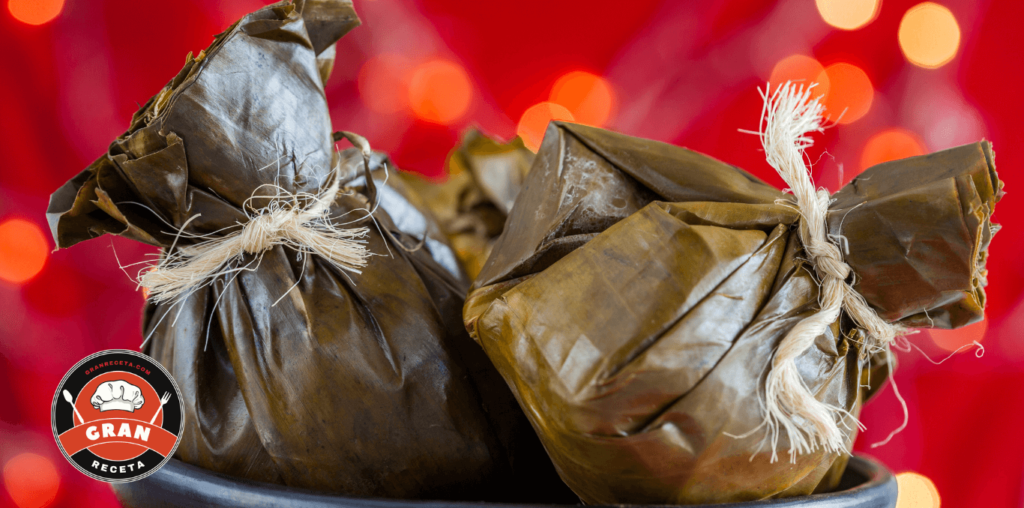
The tamal tolimense is the only Colombian tamal with rice worked into the dough, which makes it denser and more filling than any of the others. What rarely gets mentioned is that it starts three days earlier: the dried white cracked corn needs 72 hours of soaking, water changed daily, before it can be ground, and that clock can’t be sped up. Tamal day itself is six hours and yields 12 parcels of about 520 calories each.
How do you make tamal tolimense? Soak cracked corn 3 days, grind it and mix with al dente rice and cooked split peas. Marinate chicken, pork ribs and pork belly 2 hours, build each tamal on a flamed banana leaf with dough, meats, potato and carrot, tie it with twine and boil upright for 150 minutes. About 370 minutes on tamal day for 12 tamales.
What goes into it
The dough is 1 lb of ground cracked corn with 9 oz of cooked rice and 9 oz of split peas, and that’s its signature: the rice adds starch and a grain you notice in the bite. The filling is three meats (chicken, pork ribs and pork belly) plus potato and carrot, all going in raw or barely cooked and finishing inside the leaf over the two and a half hours of boiling.
The shape identifies it too: the Tolima tamal is tied round with a topknot on top, while the valluno version is a rectangular parcel.
What to buy
Two things need planning. The corn is whole dried cracked corn, sold as maíz trillado or maíz peto in Latin groceries and online; masa harina makes a perfectly good tamal but a smooth one, missing the texture that defines this version. And the banana leaves, which come frozen in 1-lb packs in Latin and Asian markets and work exactly like fresh once thawed and flamed.
For the meats, bone-in chicken thighs beat breast, which dries out over a two-and-a-half-hour boil, and skin-on pork belly is what gives the dough its fat.
The three-day soak
This is the step that decides whether there’s a tamal at all. Cracked corn is a whole dried grain, and grinding it requires water to have reached the center, which takes 72 hours. With one day of soaking the corn is still hard and the mill tears it into pieces rather than turning it into dough; with no soak, it simply won’t grind.
The water gets changed daily, and that isn’t a small detail: soaking corn ferments, and past about five days the dough takes on a sour edge you can taste in the finished tamal. Three days with clean water is the mark.
Tamal day, six hours
Of the six hours, 80 minutes are assembling the twelve, and that’s the part that’s done with company. The rest is grinding, marinating, flaming leaves and waiting on the pot.
One thing I learned the hard way: tamales go into the pot upright, packed against each other, with the water covering them. Lying flat they open under the weight of the water and the dough escapes. And the pot doesn’t get opened mid-boil, because the temperature drops and the centers stay raw.
How it compares
If you know Mexican tamales, almost everything here is different: the wrapper is banana leaf rather than corn husk, the dough is ground whole corn rather than masa harina whipped with lard, the parcel is boiled rather than steamed, and one tamal is twice the size and twice the calories. Colombian Venezuelan hallacas are closer relatives, though a hallaca cooks its filling first and marinates it a full day, while here the meats go in raw.
How to assemble
The leaves and the tie
Pass the banana leaves over a flame for 5 to 10 seconds a side, until the bright green turns dark and matte: that’s when they become flexible and stop cracking. Unflamed, they tear at the first fold.
On the leaf go two big spoonfuls of dough spread into a 6-inch circle, then the meats, potato and carrot, and another spoonful of dough over the top. Fold the sides in, the ends down, reinforce with a second leaf crosswise, and tie with twine, finishing with the topknot.
Assemble loosely: the dough swells as it cooks, and a tight tamal bursts its leaf.
Who this recipe is for
- If you can buy ground corn → you skip the three days; ask for “masa para tamal” at a Latin market and start at the marinade
- If it’s your first time → make six instead of twelve and assemble with help; assembly is what takes the time
- If you can’t find banana leaves → frozen ones work identically; foil is a last resort and costs you the aroma
- If you want it lighter → more rice and less corn, at 12 oz rice to 14 oz corn, gives a looser, lighter dough
- If you’re making 24 → double it and use two pots; packed into one, the tamales in the middle stay raw
What goes wrong
Skipping the soak. The first of these 5 mistakes has no fix: the corn won’t grind and there’s no dough. Three days, water changed.
Not tasting the dough. Once it’s tied there’s no rescuing it. Cook a teaspoon in a pan and taste.
Packing it tight. The dough swells and bursts the leaf. Loose parcel, firm knot.
Boiling them flat. They open and the dough escapes into the pot. Upright and covered with water.
Opening them straight from the pot. The dough is soft and collapses. Twenty minutes of rest.
What to serve it with
In Tolima the tamal is Sunday breakfast, with Colombian hot chocolate and a white corn arepa, and at celebrations it appears beside lechona, the region’s two big dishes. In December it shares the table with natilla and buñuelos. One 520-calorie tamal is a complete breakfast for an adult; half a tamal with a cup of aguapanela is what a child gets.
Storage
Cooked and unopened, tamales keep 4 days in the fridge, within the USDA window for cooked dishes, and should be chilled within 2 hours. Frozen they keep 3 months, always in their leaf, which is the best packaging there is.
To reheat, 20 minutes in boiling water from frozen or 15 from the fridge. In the microwave, 3 minutes with the leaf on and a cup of water beside it. What doesn’t work is reheating them opened: the dough dries and hardens.
Questions people ask
Why does the corn soak for three days? Because it’s a whole dried grain and water needs that long to reach the center so it can be ground. Any less and the mill tears it into pieces instead of making dough.
Can I use masa harina? You’ll get a different tamal. Masa harina gives a smooth, uniform dough; soaked ground corn gives one with body and grain, which is the Tolima texture. If you use it, count on about 1½ lb and less broth.
Why is there rice in it? It’s the Tolima signature, adding starch and a grain you can feel. Tamales from other regions don’t have it.
How long do they boil? Two and a half hours, upright, covered with boiling water. Less than that and the centers stay raw.
How many calories in one? About 520 for a 10-oz tamal, from the USDA database for the corn, rice, split peas and meats.
Can I freeze them raw? Yes, though I prefer freezing them cooked. Raw ones need 3 hours from frozen instead of two and a half.
Nutrition
Per tamal of about 10 oz, from the USDA database: about 520 kcal, 48 g carbohydrate, 20 g fat of which 7 g saturated, 32 g protein, 5 g fiber, 3 g sugar and 720 mg sodium.
It’s a complete meal: corn and rice supply the carbohydrate, the three meats the protein, and the split peas most of the fiber, at 22 g per 100 g dry according to the USDA. That’s why in Tolima a tamal is breakfast in itself and not a side to anything.
Tamales are one of the few dishes that forced me to learn patience. The first time I misjudged it and ground the corn on day two: the dough came out lumpy in a way you could feel in every bite, and I had to explain it at the table. In Venezuela the hallaca has the same assembly-line logic and the same make-many-at-once habit, but it’s another dish: there the filling is cooked first, here the meats cook inside. What holds in both countries is that nobody makes them alone. Josnaisis.