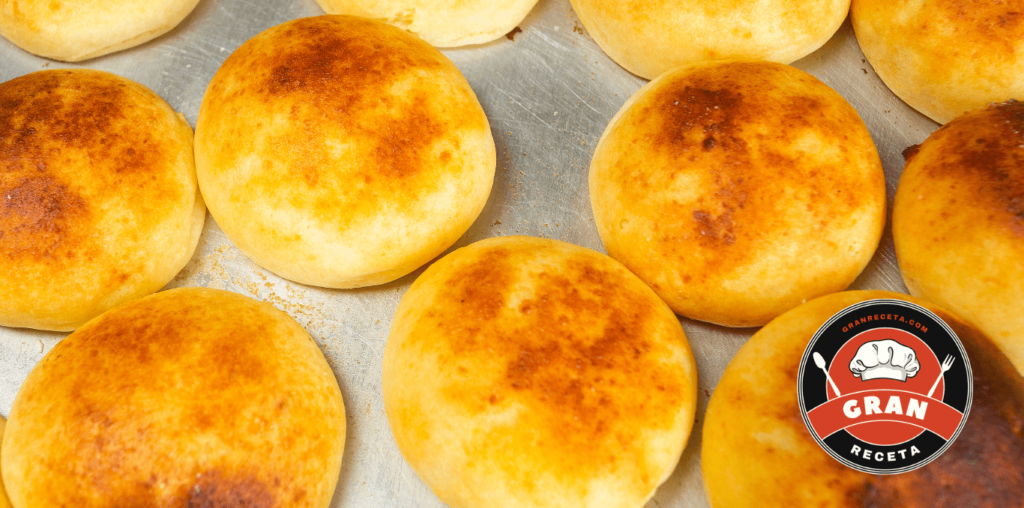
A pandebono has no yeast, no baking powder and no gluten, and 15 minutes in the oven still leaves it puffed to twice the size it went in. What lifts it is sour cassava starch: cassava starch fermented for about a month in tanks of water and then dried in the sun, a process that leaves it able to stretch around steam instead of tearing. Add a lot of salty white cheese, an egg and a splash of milk, and 15 minutes at 425 °F gives you 12 rolls of 1½ oz and 125 calories each. In Colombia they’re breakfast, sold hot from bakery trays all morning in the Valle del Cauca.
How do you make pandebono? Sift 4½ oz of sour cassava starch with 1 oz of cornstarch and a tablespoon of sugar, work in 9 oz of grated salty white cheese and an egg, then add warm milk a spoon at a time until the dough neither sticks nor cracks. Roll 12 balls and bake at 425-445 °F (220-230 °C) for 15 to 18 minutes. About 33 minutes for a dozen pieces.
The bag that decides everything
Sour cassava starch is the one ingredient with no substitute, and the one most likely to go wrong in a US supermarket, because three products sit side by side and look the same: tapioca flour, sweet cassava starch and sour cassava starch. Only the last one works, and it’s usually sold under its Brazilian name, polvilho azedo (azedo means sour). Brazilian and Latin groceries carry it, and so does the internet.
The natural fermentation that makes it runs about 35 days, according to Pedro Vargas Aguilar in the journal Tecnología en Marcha (2010), driven by lactic bacteria that pull the pH of the water down from 6 to about 4, and is considered finished at pH 3.5 to 4. The same paper, citing Dufour and colleagues, notes that the baking potential is acquired during exposure to solar radiation, not from oven drying — which is why an industrially oven-dried starch isn’t the same product even when it’s been fermented. Sunlight is an ingredient here, it just doesn’t appear on the label.
At home the difference is easy to smell: sour starch has a faint acidic whiff, sweet starch smells of nothing.
The cheese, half the flavor and half the cost
Colombian pandebono uses queso costeño: white, firm, very salty, and it doesn’t fully melt in the oven. Those three properties are the job description. It grates without turning to paste, it salts the whole dough so no extra salt is needed, and it leaves pockets of cheese in the crumb instead of disappearing into it.
In the US, feta pressed dry is the closest match on salt and firmness: wrap it in a towel, press it under a plate for 15 minutes, then crumble. A firm queso fresco works with a pinch of salt added. Mozzarella on its own does not: too much water, and it melts completely, so the balls spread instead of rising.
The ratio matters as much as the cheese: 9 oz of cheese to 5½ oz of starch and cornstarch, twice as much cheese as starch. Less cheese and it tastes of plain starch; more and the dough spreads on the sheet.
Oven heat, and why preheating is the recipe
Here’s the mechanism. A gluten-free dough can’t trap gas the way bread dough does, so pandebono doesn’t rise from fermentation. It rises because the water inside it flashes to steam when it hits a very hot oven, and sour starch is elastic enough to stretch around that steam. At 355 °F the water leaves slowly, the crust dries before the inside can push, and you get something closer to a cracker. At 480 °F the outside sets in five minutes and the middle stays gummy.
Between 425 and 445 °F the pandebono grows in the first 6 to 8 minutes and browns in the last few. That’s the whole window, which is why the oven goes on 20 minutes before you start and why the tray goes on a middle rack.
How long it takes
Thirteen minutes of that is dough; the rest is the oven, heating and then baking. It’s the rare recipe where the preheat is the longest step, and skipping it is the most common way to ruin it.
Step by step
The dough, 40 seconds and no more
Sift the sour starch: it cakes in the bag and those lumps don’t break up later. Mix with the cornstarch and sugar, add the cheese and the egg, and work it with your hands until it looks like damp sand. Only then the warm milk, a spoon at a time.
You know the point by folding a piece: if it cracks, it needs milk; if it stays on your fingers, it has too much. And work it briefly, half a minute or so, just enough to bring it together. The longer you knead, the denser the pandebono, because a compacted dough is harder for the steam to stretch.
Shaping and baking
Balls of about 1½ oz, rolled smooth between your palms until there are no cracks on the surface; a crack is where the steam will escape. An inch and a half apart on the sheet. Check at 15 minutes: puffed with a golden dome means done. Leave them to 20 and they’re still pandebonos, but the crumb dries out.
Who this recipe is for
- If all you can find is sweet starch → no ratio fixes it; order polvilho azedo online or ask at a Brazilian grocery
- If it’s your first time → bake two as a test before shaping the rest; 15 minutes will show you how your own oven behaves
- If you want to make them ahead → freeze the raw balls and bake from frozen, 20 minutes instead of 15
- If you have an air fryer → 390 °F for 10-12 minutes in a single layer; slightly less rise, good for a batch of 4 or 6
- If you’re baking for 24 → double it and bake in two trays; a crowded sheet blocks the airflow and they don’t puff the same
What goes wrong
Sweet starch instead of sour. The first of these 5 mistakes is the only one with no fix. The bags look alike; the products don’t. Without fermentation and sun, the starch doesn’t stretch and the dough doesn’t grow.
A tray into an oven that’s still heating. Pandebono doesn’t wait; it puffs in the first minutes or not at all. Twenty minutes of preheat.
Over-kneading. A solid minute of kneading gives you a dense pandebono. This dough is brought together, not worked.
Too much milk. A wet dough spreads on the sheet and you get thick cookies. Add it a spoon at a time and stop as soon as the dough coheres.
Eating them cold. Not a flaw in the recipe but in the starch: as it cools, the starch retrogrades and the crumb tightens. They’re at their best for about half an hour; after that, a few minutes in a hot oven brings them most of the way back.
Pandebono, pão de queijo and a cheese scone
Pandebono and Brazilian pão de queijo come from the same starch and split on the cheese and the liquid: pão de queijo scalds milk and oil into the starch and bakes up hollow, while pandebono carries twice as much cheese as starch and bakes up moist and stretchy. A cheddar scone is a different animal entirely, wheat and baking powder doing what steam does here. If you like this one, the Colombian cheese arepas are the griddle version of the same breakfast idea, and Colombian buñuelos are the fried one. With plain tapioca starch and 1 tsp of baking powder instead of the fermented bag, the same cheese becomes pandeyuca: crisp rings rather than a stretchy ball. And with corn flour, wheat and creamed butter it becomes a garulla, which crumbles instead of stretching.
Make ahead, storage and reheating
Pandebono is a 30-minute food, so the real make-ahead is the dough, not the bread. Shape the balls, freeze them on a tray until hard, bag them, and bake straight from the freezer at 425 °F for 20 minutes instead of 15. They keep 2 months and come out like fresh ones, which is how I always have them ready for breakfast.
Baked ones keep a day in a closed container at room temperature and come back with 3 minutes at 400 °F. A microwave softens them but leaves them chewy, and the fridge is the worst option: cold speeds up the starch retrograding.
Questions people ask
Why did my pandebonos come out flat? The starch or the oven. Sweet starch has nothing to expand. If the starch was sour, the oven most likely wasn’t at 425 °F when the tray went in; the rise happens in the first 6 to 8 minutes.
Is pandebono gluten free? Yes, if the starch and cornstarch are: there’s no wheat in it. Many starches are packed in facilities that also handle wheat, so anyone with celiac disease should check the label.
Can I use tapioca flour? Not in place of the sour starch. Tapioca flour is unfermented cassava starch: it will bind the dough but it won’t puff, and the result is dense.
What cheese works best outside Colombia? Feta pressed dry, for salt and firmness. Firm queso fresco with a pinch of salt is second. Mozzarella alone releases water and flattens the dough.
Can I make them in an air fryer? Yes: 390 °F for 10-12 minutes in a single layer. They rise a little less because the moving air dries the surface sooner, but for a small batch it works well.
How many calories is one pandebono? About 125, for a 1½-oz piece, calculated from the USDA database using queso fresco as the stand-in for queso costeño. Two with coffee is a 250-calorie breakfast.
Nutrition
Per piece, one twelfth of the dough (about 1½ oz / 43 g), from the USDA database with queso fresco standing in for queso costeño: about 125 kcal, 14 g carbohydrate, 6 g fat of which 3 g saturated, 5 g protein, 0 g fiber, 2 g sugar and 165 mg sodium.
Nearly all the protein and fat come from the cheese and nearly all the carbohydrate from the starch. If your cheese is saltier than USDA queso fresco, and real queso costeño usually is, the sodium runs higher; that’s why the recipe adds no salt of its own.
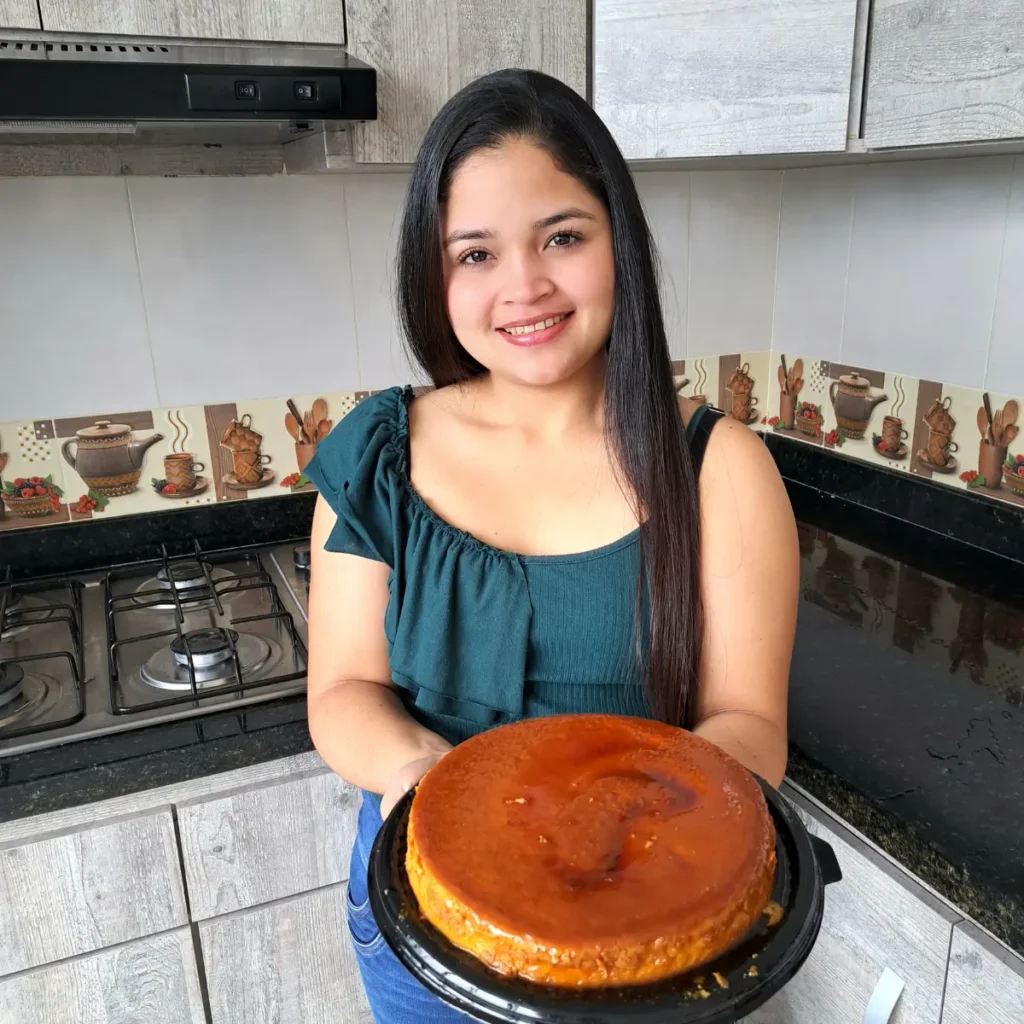
Pandebono was one of the first things I learned to bake after moving to Colombia, and it took three flat batches to work out that the problem wasn’t my hands but the bag of starch I kept buying. We don’t have anything like it in Venezuela; we use cassava starch, but not fermented. Now there are always frozen balls in my freezer and, when someone drops in, they go from freezer to oven while the aguapanela heats up. On a bigger breakfast table they sit with egg arepas from the coast and a bowl of mazamorra to finish. Josnaisis.