
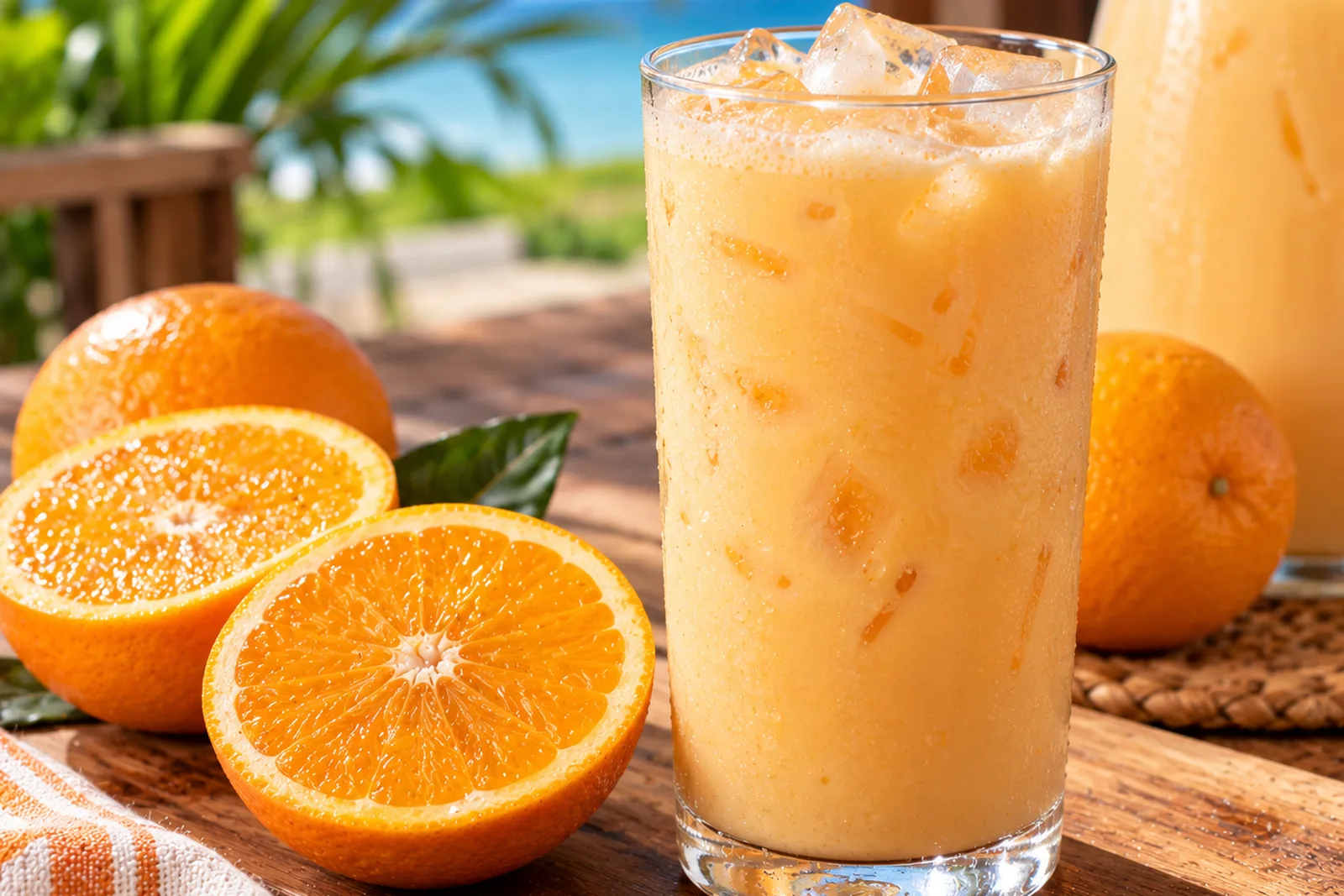

Morir soñando (moh-REER soh-NYAN-doh) works or curdles in the last 30 seconds, when the orange juice meets the milk. Pour it in fast, warm, or the wrong way round (milk into juice) and you get white flecks; pour it cold, in a thin stream and stirring, and the glass stays smooth and creamy. Below you’ll find the ratio for 4 glasses, why it curdles and how to prevent it, which milk to buy, and amounts for a party pitcher.
What morir soñando is and how it tastes
How do you make morir soñando? Stir 2 cups (480 ml) cold whole milk with 5 tbsp (60 g) sugar and vanilla until dissolved, add 2 cups of ice, then pour in 1¼ cups (300 ml) cold strained orange juice in a thin stream while stirring constantly. Serve right away. 10 minutes for 4 servings.
It’s the Dominican drink of milk, orange juice, sugar and ice, with vanilla in many homes. Think of an orange creamsicle you can drink: sweet, cold and fresh, with the tartness of the orange softened by the milk. The name roughly means to die dreaming, and it’s drunk in the Dominican Republic and in Dominican neighborhoods of New York as an afternoon treat or with dinner.
Time: 10 minutes, no stove and no blender. Easy: the only thing that needs care is the order and the cold.
Ingredients and which milk to use
The recipe makes 4 glasses of about 10 fl oz (300 ml) with ice. The ratio is 8 parts milk to 5 parts juice. More juice tastes more of orange, but moves the mix closer to the curdling point.
Whole, evaporated or skim milk
- Whole milk, the one in the recipe. Light and creamy, and it’s already in your fridge.
- Evaporated milk. Many Dominican cooks prefer it. Use one 12 oz (354 ml) can plus ½ cup (120 ml) whole milk instead of the 2 cups. It comes out thick like a milkshake, a little sweeter, with a cooked-milk note. Taste before adding all the sugar.
- Skim milk. Thinner, tastes mostly of orange. The lighter version.
Almond milk. Works for a dairy-free version, and since it doesn’t contain the milk protein that curdles, it won’t form curds. It tastes of almond and is thinner, so it’s really a different drink.
Sweetened condensed milk. Not traditional. If you use it, skip the sugar and thin it with milk or water, or it will be cloying.
The orange juice
- Juice oranges, freshly squeezed and strained. Pulp and seeds leave bits that look like curdled milk; strained, the drink is smooth. A medium orange gives about ⅓ cup (80 ml), so plan on 4 oranges. In the US, Valencia oranges are the classic juicing orange; navels work too.
- Cold. Squeeze fridge-cold oranges or chill the juice first. Cold is half the trick.
- Store-bought juice. Fine if it’s 100% orange juice, chilled and pulp-free; it tastes less fresh. Skip orange “drinks” with added sugar.
- A squeeze of lime or lemon. Some cooks add one for brightness. It’s far more acidic than orange, so keep it small and mix it into the orange juice first.
Evaporated milk is in the baking aisle in the US, next to the sweetened condensed milk; in the UK, look in the tinned dessert aisle.
Equipment. A pitcher of at least 1½ quarts (1.5 liters), a long spoon or whisk, a juicer and a fine sieve.
Why milk curdles with orange juice
Milk curdles from acid. Its main protein, casein, stays evenly dispersed while milk is close to neutral, at pH 6.4 to 6.8. When the mix drops to pH 4.6, casein clumps into white curds. Orange juice sits at 3.3 to 4.2, below that point, and warmth speeds things up.
That gives you three rules:
- Juice into milk, never milk into juice. Pour milk into juice and the first drops land in a very acidic liquid and curdle instantly. With juice going into plenty of milk, each splash is diluted into something that’s still only mildly acidic.
- Very cold. Fridge-cold milk, cold juice, and ice in the milk before the juice goes in. Warm milk or room-temperature juice curdles sooner.
- A thin stream, stirring. A big pour creates pockets with more juice than milk. Stirring dilutes the juice before it can curdle anything.
Sugar doesn’t prevent curdling. It just sweetens.
If it already curdled. You can drink it. It’s milk and juice, and milk curdled by acid is not spoiled milk. The texture turns grainy but the flavor doesn’t change. Next time, check which of the three rules slipped.
How to make morir soñando step by step
Dissolve the sugar in the milk
Sugar goes into the milk before the ice and the juice. It dissolves slowly in cold milk, so stir for 1 minute and scrape the bottom with the spoon. If you still feel grains, keep going. For a completely smooth drink, dissolve the sugar in the milk before chilling it.
Ice before juice
Add 2 cups of ice to the milk and stir for 30 seconds, so the milk is at its coldest right when the juice goes in.
Juice in a thin stream, stirring
Pour the juice in a stream about as thick as a pencil while you stir with the other hand. It takes about 30 seconds to add the 1¼ cups (300 ml). Keep stirring a few seconds longer.
How to tell it’s right. An even pale orange color, a smooth surface and, when you tilt the pitcher, a creamy film running down the glass with no white specks. White flecks or a clear liquid separating at the bottom mean it curdled.
Serve
Right away, in tall glasses with the ice from the pitcher. Morir soñando doesn’t wait: the acid keeps working and the mix separates over time.
Morir soñando for a pitcher or a party
The ratio stays the same when you scale up. For more than 8 glasses, use two pitchers rather than one filled to the brim, because a full pitcher is hard to stir while you pour.
Make ahead. Squeeze and strain the juice and keep it covered in the fridge up to 24 hours ahead. Chill the milk the night before. Mix just before serving: with everything ready it takes 3 minutes.
Morir soñando variations
- With evaporated milk. The creamiest, shake-like version. See the amounts above.
- Passion fruit (chinola). In the Dominican Republic passion fruit is called chinola. For 4 glasses: 1 cup (240 ml) strained passion fruit juice over ice, 1 tsp vanilla, one 12 oz (354 ml) can of evaporated milk and sugar to taste, up to ¼ cup (50 g). Here the milk goes into the very cold juice, in a thin stream, stirring constantly. Passion fruit is more acidic than orange, so it curdles more easily: drink it right away. If you like the fruit on its own, Colombian passion fruit juice is made with water or milk.
- Lighter. Skim milk and half the sugar, about 110 calories a glass.
- No added sugar. Use a sweetener to taste, dissolved in the milk the same way.
- In a blender. Some cooks blend it for a frothy top. Keep the same order, milk, sugar and ice first and juice last, with only a few seconds of blending, because the motor warms the mix.
For other milk and fruit drinks that run into the same acid problem, the Venezuelan merengada explains which fruits curdle milk and which don’t, and the Colombian lemonade with condensed milk is the lime version, blended and strained.
Serving and storing
Serving. Ice cold, in tall glasses, as an afternoon drink or with dinner. It’s good with a sandwich, with fried food like Dominican pica pollo, or with mangú with los tres golpes at a late breakfast.
Fridge. For the best texture, drink it freshly mixed. Leftovers should go straight into the fridge, covered, for up to 1 day; they’ll separate, so stir before pouring, and the texture won’t be as silky. Don’t leave it out of the fridge for more than 2 hours.
Freezer. I don’t freeze it to drink later, because the point is the freshly mixed texture. Leftovers poured into ice pop molds make an orange creamsicle.
Allergens. Contains milk. No gluten and no egg. Kids usually love it.
Frequently asked questions
Is it bad to mix milk and orange juice? No, as long as the milk was fresh. The curds are just milk protein clumped by the acid in the juice: they change the texture, not the safety. What you shouldn’t drink is milk that has gone off on its own, which smells sour before you mix anything.
Can I use store-bought orange juice? Yes, if it’s 100% juice, cold and pulp-free. It tastes less of fresh orange. Start with less sugar, since some juices are already sweet.
How much sugar does it take? The recipe uses 60 g (5 tbsp) for 4 glasses, about 15 g a glass. With very sweet oranges or evaporated milk you can go down to 3 or 4 tbsp. Taste before serving.
Can I make it ahead? The juice and the chilled milk, yes, up to 24 hours ahead. The drink itself, no: mix it when you serve it.
Nutrition
Per glass (a quarter of the recipe, made with whole milk), worked out ingredient by ingredient from the quantities above:
- Calories: 170 kcal
- Protein: 4 g
- Carbohydrates: 29 g
- Fat: 4 g, of which 2 g saturated
- Fiber: 0 g
- Sugars: 28 g
- Sodium: 54 mg
The milk brings about 74 kcal a glass, the sugar about 58 and the juice about 35. The evaporated milk version comes to about 240 calories a glass; with skim milk it drops to about 135.
I always make it in a pitcher, with the ice in the milk before the juice comes anywhere near it, and I adjust the sugar at the end, because oranges vary in sweetness from one bag to the next. If the oranges aren’t cold, I’d rather wait 15 minutes than risk the whole pitcher. Josnaisis.