
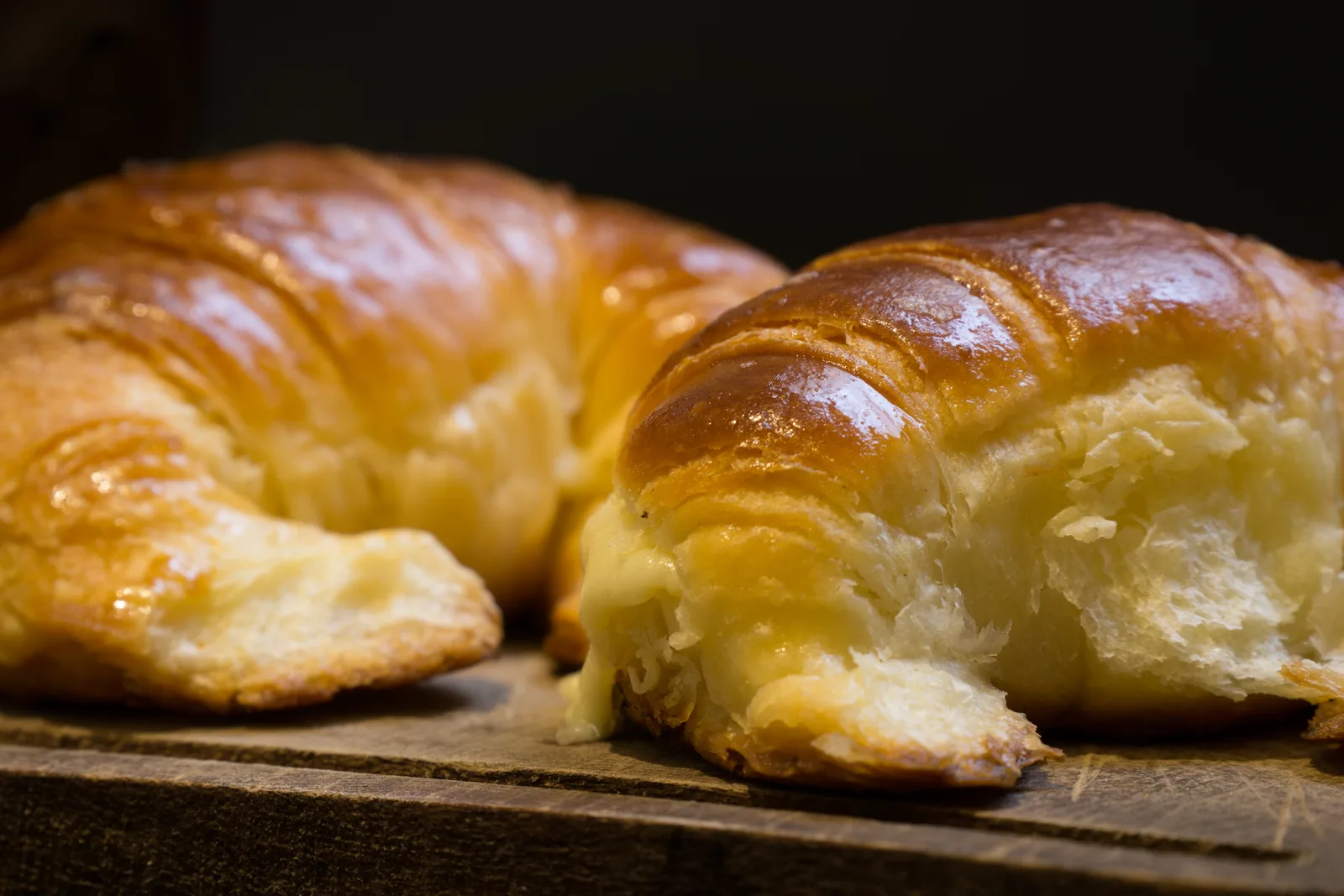

Medialunas (meh-dee-ah-LOO-nahs, “half moons”) are what Argentinians eat with coffee or mate at breakfast: small croissants made from a sweet yeast dough with honey and lemon zest, laminated with butter and brushed with hot sugar syrup the second they leave the oven. That glaze is what makes them shine and stick slightly to your fingers. This recipe makes 24 at home with three letter folds, and lets you split the work over two days so they come out of the oven at breakfast time.
What a medialuna is, compared with a croissant
How do you make Argentinian medialunas? Make a sweet dough with 500 g (4 cups) flour, milk, yeast, sugar, honey and an egg, chill it 1 hour and lock in 200 g (7 oz) cold butter. Give it three letter folds with 30 minutes in the fridge between each, roll to 3/16 in (5 mm), cut triangles with a 4 in (10 cm) base and roll them up. Proof 1 to 1½ hours at 75 to 79°F (24 to 26°C), bake at 375°F (190°C) for 15 to 18 minutes and brush with syrup straight away. 360 minutes (6 hours) for 24 medialunas.
A medialuna is smaller, sweeter and softer than a French croissant. The dough itself carries sugar, honey and citrus, and the syrup adds a thin sticky shine, so the crust is tender rather than shattering. In Argentinian bakeries you’ll also find medialunas de grasa, made with beef fat instead of butter: crisper, less sweet, and longer and more pointed, with less of a curve. This recipe is the butter kind, medialunas de manteca.
Difficulty: hard. The dough is simple. Lamination is where it goes wrong, because the butter has to stay cold yet flexible through every fold. Make your first batch on a cool day.
Ingredients and US/UK shopping notes
The finished dough weighs about 1,180 g (2 lb 10 oz), roughly 49 g (1¾ oz) per medialuna before baking. That’s the medium size you’d get at a café in Buenos Aires.
| Part | What goes in |
|---|---|
| Dough | 500 g (4 cups) flour, 25 g fresh or 8 g (2½ tsp) instant yeast, 225 ml warm milk, 100 g (½ cup) sugar, 15 g (2 tsp) honey, 1 egg, lemon zest, 1 tsp vanilla, 10 g (1¾ tsp) salt, 25 g (2 tbsp) soft butter |
| Butter block | 200 g (7 oz) cold butter and 25 g (3 tbsp) flour |
| Syrup | 100 g (½ cup) sugar and 100 ml water, equal weights |
| To brush | 1 beaten egg |
All told, that’s 225 g (8 oz) butter for 500 g flour, about 45 percent of the flour weight. The sugar in the dough is 20 percent of the flour; the honey is only 15 g and you won’t taste it as honey, but it helps the crust brown evenly.
Flour. Argentinian bakers use type 000 flour. US all-purpose works; bread flour gives a chewier dough that springs back more when you roll it, so give it 5 minutes’ rest if it fights you. In the UK, plain flour or strong white bread flour.
Butter. Use unsalted block butter. A European-style butter with about 82 percent fat (Plugrá or Kerrygold in the US, any block butter in the UK) bends without cracking and holds less water. In Argentina this is “manteca”, which in Spain and Mexico means lard. Don’t let a Spanish-language search send you to the wrong fridge.
Yeast. Fresh yeast sits in the dairy case of some supermarkets and most bakeries. Instant yeast is a third of the weight and goes straight into the flour without dissolving.
Equipment. A rolling pin, a ruler (measurements matter here), a sharp knife or pizza wheel, a pastry brush, parchment, plastic wrap and two baking sheets. A stand mixer with a dough hook helps but isn’t needed.
Your schedule, one day or overnight
Over the six hours, your hands are busy for about 75 minutes. If you want medialunas for breakfast, push part of it to the day before:
- Laminate the night before. Mix, fold three times, wrap the block and refrigerate up to 24 hours. In the morning, roll, cut, shape, proof and bake.
- Shape the night before. Take them all the way to shaped crescents, cover the trays and refrigerate up to 18 hours. They come out cold, so proofing takes about 30 minutes longer.
- Freeze them unbaked. See the storage section. It’s the plan that gets you fresh medialunas on any weekday.
Making the dough and laminating
Mix and chill. The milk should be warm, never above 104°F (40°C). Add salt and soft butter last, then knead 8 minutes until smooth and just tacky. It doesn’t need bread-level stretch; the folds keep working it. Flatten it before it goes into the fridge for 1 hour so it chills evenly.
Butter block. Pound the cold butter and flour between parchment with the rolling pin into a 7 in (17 cm) square under ⅜ in (1 cm) thick. The flour soaks up some of the butter’s water and makes it easier to roll.
Lock in. Roll the dough to 7 × 14 in (17 × 34 cm), put the butter in the middle and fold the ends over to meet on top. Pinch every seam shut, or butter escapes when you roll.
Three letter folds. Roll to roughly 8 × 24 in (20 × 60 cm) and fold in thirds. Three folds give you 27 butter layers, enough to pull apart in flakes while the crumb stays soft.
- Chill 30 minutes between folds, wrapped. After the third, 1 hour.
- Turn the dough 90 degrees before each fold, so the folded edge sits on your left like the spine of a book.
- Roll from the middle outward and don’t run the pin over the edges. Brush off excess flour before folding.
- Good sign: the dough rolls evenly, with no shiny butter patches and no hard lumps catching under the pin.
Shaping, proofing and the syrup glaze
Cut and roll
Halve the dough and keep one half chilled. Roll the other to 12 × 14 in (30 × 35 cm) and 3/16 in (5 mm) thick. Cut two strips 6 in (15 cm) wide, then 6 triangles per strip with a 4 in (10 cm) base, alternating the tips so nothing’s wasted. Press straight down with the knife or wheel; dragging seals the layers at the edges.
Cut a ⅜ in (1 cm) slit in the middle of each base, spread the two corners a little and roll loosely toward the tip, gently stretching the tip with your other hand. Tuck the tip underneath, curve the ends in and leave 1½ in (4 cm) between them. Twelve fit on a sheet.
Proof until they jiggle
Cover loosely and leave 1 to 1½ hours at 75 to 79°F (24 to 26°C). In a cold kitchen it takes longer, so go by these signs rather than the clock:
- About 1½ times their original size, not doubled.
- Layers visible along the sides.
- They jiggle when you nudge the tray.
- A light press on the side springs back slowly.
Never proof them on top of or next to a hot oven. The butter softens inside the dough and runs out during baking.
Bake and glaze
Boil the syrup while they proof: equal weights of sugar and water, 2 to 3 minutes until clear. Keep it thin enough to brush.
Brush with egg, keeping it off the cut edges so the layers can open. Bake at 375°F (190°C) for 15 to 18 minutes, swapping the trays halfway, until golden on top and on the bottom. Brush with the warm syrup immediately: on a hot pastry it soaks in and shines; on a cold one it sits sticky and dull. You’ll have a little syrup left.
Troubleshooting
- Butter pooling on the sheet. Proofed too warm or too long. Stay in the 75 to 79°F range and bake as soon as they jiggle.
- Bready, no layers. The butter got soft during folding and blended into the dough. Respect the 30-minute chills, and if the butter goes shiny mid-roll, wrap and chill 15 minutes.
- Butter shattering into pieces. It was too hard. Let the dough sit out 5 to 10 minutes before rolling.
- Unrolling in the oven. Tip on top, or rolled too tightly. Tip underneath, loose roll.
- Pale bottoms. Oven not fully preheated or tray too high. Swap the trays halfway.
Allergens. Wheat (gluten), milk and egg. No heat at all; children usually love them as they are.
Fillings and bigger batches
- Dulce de leche. A teaspoon of thick baker’s-style dulce de leche on the base before rolling. Runny dulce de leche leaks out in the oven.
- Ham and cheese. Split cooled medialunas and fill with a slice of each.
- Orange instead of lemon. Orange zest gives a softer aroma.
- For 48. Make two separate batches of dough rather than one double block, which won’t fit on a counter or in a fridge shelf. Bake in rounds and keep the second tray proofing somewhere cooler so it doesn’t overproof while the first bakes.
If you like the crescent shape without the lamination, Venezuelan cachitos are rolled from triangles of soft, enriched bread dough and filled with ham. For another syrup-glazed breakfast bread, Venezuelan golfeados are sticky buns rolled with cane sugar, anise and white cheese, then glazed with a dark cane-sugar syrup.
Storing, freezing and reheating
Baked. Best the same day. In a sealed tin or bag they keep 2 to 3 days at room temperature.
Frozen unbaked (the best make-ahead). Freeze the shaped, unproofed medialunas on the tray until hard, about 2 hours, then bag them. They keep 1 month at their best. The night before, set them on lined trays, cover and move them to the fridge; in the morning let them proof at room temperature until they show the signs above (usually 1½ to 2 hours), egg-wash and bake as usual.
Frozen baked. Also fine, in a sealed bag. Reheat straight from frozen in a 325 to 350°F (160 to 180°C) oven for a few minutes, until hot. The microwave makes them soft.
Day-old. A few minutes in a 325°F (160°C) oven, until warm, brings the crust back.
Medialunas FAQ
Can I skip the lamination? You can knead all 225 g (8 oz) of butter into the dough, but you’ll get a sweet crescent-shaped bun with no layers. It’s a quicker home version, not the bakery pastry.
Can I use store-bought puff pastry or crescent roll dough? Puff pastry has no yeast and no sugar, so it bakes up flat, crisp and plain. Canned crescent dough is closer in shape but much softer and blander. Both work as a shortcut if you brush them with the same syrup, but neither tastes like a medialuna.
Why are mine dry the next day? Enriched dough loses moisture quickly. Seal them in a container once cool and warm them briefly in the oven before eating.
What do you serve them with? Coffee with milk or mate in Argentina. For an afternoon spread, add a plate of alfajores, the dulce de leche sandwich cookies, and if you’d rather bake a sweet bread with far less work, Mexican conchas need no folding at all.
Nutrition per medialuna
Per medialuna (24 per batch), calculated from the recipe amounts, counting the egg wash and all of the syrup:
- Calories: 194 kcal
- Protein: 3 g
- Carbohydrates: 26 g
- Fat: 9 g, including 5 g saturated
- Fiber: 1 g
- Sugars: 9 g
- Sodium: 173 mg
Butter accounts for about a third of the calories, roughly 67 per medialuna. Since some syrup always goes unused, the real sugar is a little lower.
I never laminate in one go anymore. The dough and folds happen in the afternoon, the block sleeps in the fridge, and the morning is just rolling, cutting and the wait while they proof. My one rule with the butter is cold hands and as little touching as possible; on a warm day I’d rather add 15 minutes to every chill than lose the layers. And the syrup goes on hot, the moment the tray comes out, even if it means rushing. Josnaisis.