
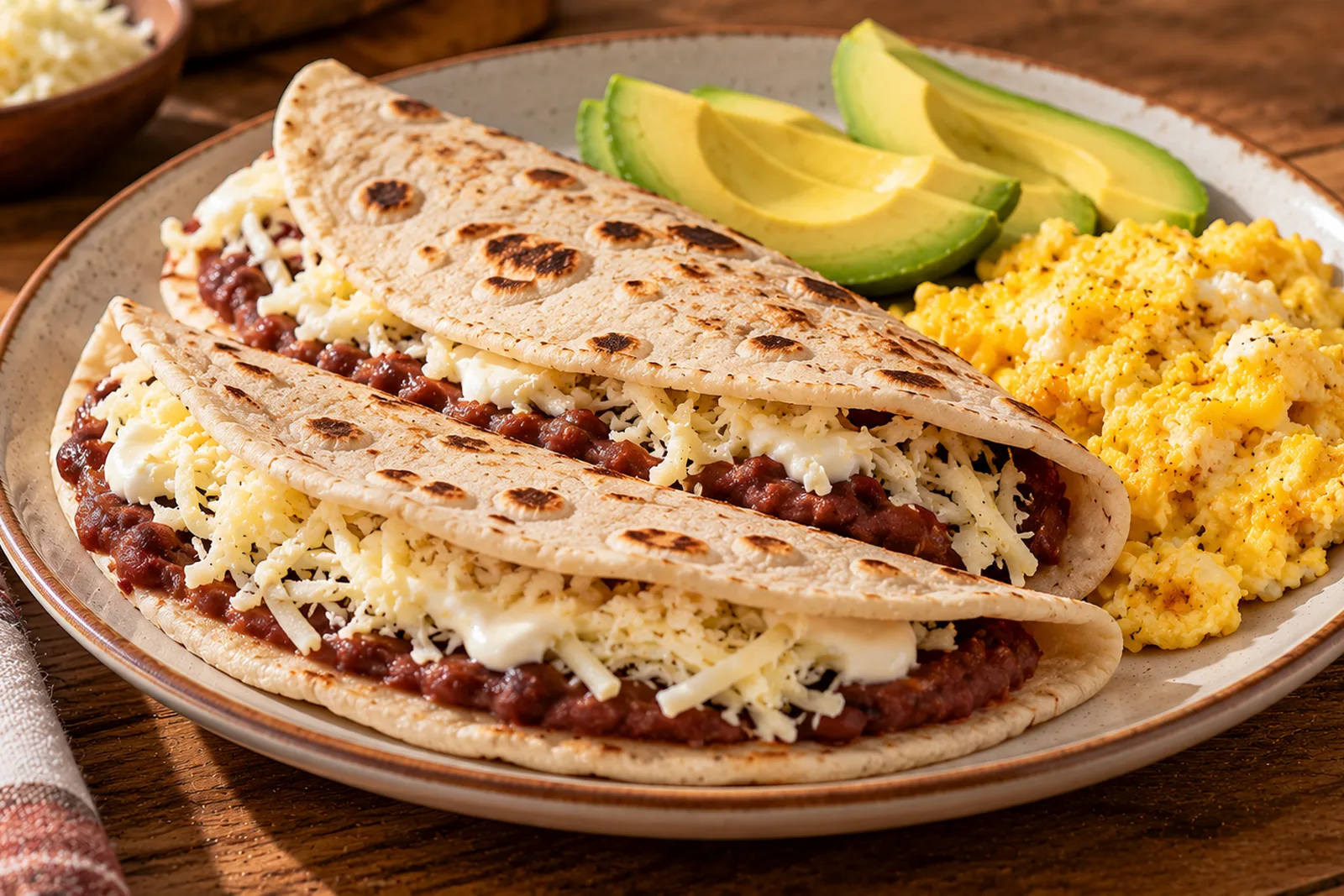

A baleada (bah-leh-AH-dah) is Honduras’s everyday street breakfast: a warm, thick flour tortilla spread with refried red beans, drizzled with a salty, sour cream-like crema, scattered with dry crumbled cheese and folded in half like a book. It looks like a soft taco, but the tortilla is the point. It’s softer and puffier than a Mexican flour tortilla, about ⅛ in (3 mm) thick, because the dough has baking powder in it and is pressed out only so far. Below are the dough weights, how to press tortillas out by hand and know when they’re cooked, what to buy for the crema and cheese in a US or UK supermarket, and how to load one up with eggs and avocado.
What baleadas are, and how long they take
How do you make baleadas? Knead 4 cups (500 g) of flour with 6 tbsp (75 g) of shortening, 1 tsp of baking powder, salt and about 1 cup plus 3 tbsp (280 ml) of warm water, shape 10 balls and rest them 30 minutes. Meanwhile, blend red beans with sautéed onion and garlic and fry until thick. Press each ball to 8 in (20 cm), cook on a dry pan over medium heat for about 2 minutes, then fill with beans, Honduran crema and grated hard cheese and fold. 75 minutes for 10 baleadas.
75 minutes start to finish, about 45 of them hands-on, and the beans cook while the dough rests. Medium difficulty: the fillings are easy and so is the dough. Pressing tortillas round and even, and cooking them through without toasting them, takes a few tries.
A baleada sencilla (plain) is just beans, crema and cheese. Add scrambled egg and it’s often called especial; a baleada con todo (“with everything”) also gets avocado and, depending on the stand, meat, fried sweet plantain or pickled vegetables. They come from Honduras’s north coast, with La Ceiba the city most often named, though El Progreso and San Pedro Sula claim them too. The name means “shot”, and nobody agrees on why.
Baleada tortillas compared with Mexican flour tortillas
If you’ve made homemade flour tortillas in the northern Mexican style, this dough will feel familiar. The differences are what give a baleada its soft, bready bite:
| Baleada tortilla | Mexican flour tortilla | |
|---|---|---|
| Fat per 100 g (3½ oz) flour | 15 g shortening | about 20 g lard |
| Baking powder | yes, 1 tsp per 4 cups | optional |
| Dough ball | about 3 oz (87 g) | about 2 oz (54 g) |
| Thickness | about ⅛ in (3 mm), soft and slightly puffy | about 1/16 in (2 mm), thin and layered |
| How it’s shaped | pressed by hand on an oiled plate, or rolled | rolled |
That thickness is also why it can carry a spoonful of beans and fold without tearing.
Shopping for the crema, cheese and beans
Honduran crema (mantequilla)
In Honduras it’s called mantequilla, which normally means butter, but it’s a salty, tangy cultured cream, runnier than sour cream. Stick butter is a different thing and doesn’t work here.
- US. Latin grocery stores sell Central American crema, labeled Honduran or Salvadoran; it’s the closest match. Mexican crema works too but is milder and less salty, so stir in a pinch of salt.
- No Latin store nearby (US or UK). Stir 160 g (⅔ cup) sour cream (UK soured cream) or crème fraîche with 80 ml (⅓ cup) heavy cream (UK double cream) and ¼ tsp salt. It comes out pourable, tangy and salty. Straight sour cream also works, though it’s thicker and not salty.
- Greek yogurt with salt is too sour and too lean. A last resort.
Queso duro and the cheeses that replace it
Honduran queso duro (“hard cheese”) is dry, firm and quite salty, and it’s grated fine. It doesn’t melt on the hot tortilla; it stays in little grains.
- Cotija. Mexico’s dry, salty aged cheese is the closest swap and easy to find in the US. Central American shops may also carry queso duro or queso seco.
- Feta, well drained and crumbled. Salty and a bit tangier; the easiest option in the UK.
- Parmesan, finely grated, alone or mixed with a mild fresh cheese. Different flavor, but it gives the salt and dry texture a baleada needs.
- Queso fresco. Works, but it’s soft and mild, so the baleada tastes flatter.
Red beans
Honduras cooks with red beans. In US Latin stores look for Central American red beans, sometimes labeled Salvadoran or de seda; otherwise use small red beans or canned red kidney beans. In the UK, tinned red kidney beans are everywhere: two 400 g tins give about 500 g drained. Black beans make a good baleada, but it tastes different.
With canned beans, rinse them, use water instead of the canning liquid, and don’t add salt until you taste. For cooking dried beans from scratch, the method for refried beans from dried works the same with red beans.
Equipment
A large bowl, a cast-iron or heavy nonstick skillet or griddle at least 10 in (25 cm) across, a blender, a clean kitchen towel and a flat plate or foil for pressing. A rolling pin is optional. No blender? Mash the beans in the pan with a potato masher; they’ll be less smooth but spread just as well.
A 75-minute plan, and what to make ahead
Dough first, beans during the rest, griddle last.
- Night before. Oiled dough balls, wrapped, keep up to 24 hours in the fridge. Take them out 30 minutes before pressing.
- Up to 3 to 4 days ahead. The refried beans, in the fridge. Loosen with a splash of water when reheating.
- Hours ahead. Cooked tortillas, wrapped in a towel inside a bag. Rewarm 30 seconds per side.
Making the tortillas
Rub in the fat. 3 to 5 minutes, until no lumps of shortening are left. Leftover lumps turn into hard spots in the tortilla.
Knead. Use warm water, hot to the touch but comfortable to keep your hand in. Knead 8 to 10 minutes. The dough is ready when it’s smooth, soft as an earlobe and doesn’t stick to a clean counter. Press a piece flat between your palms: cracked edges mean it needs more water.
Rest. 30 minutes, oiled and covered. Unrested dough springs back as you press it, and you end up with a small, overly thick tortilla. A longer rest only makes it easier.
Press. The Honduran way is by hand. Flatten the ball with oiled fingertips on an oiled plate or a sheet of foil, pushing from the center out and turning it as you go, to 8 to 8½ in (20 to 22 cm). Some cooks stretch it further by passing it from hand to hand. With a pin, dust lightly with flour and give the dough a quarter turn after each pass. Aim for an even ⅛ in (3 mm): a thick center stays doughy.
Cook. Medium heat, a dry pan preheated for 5 minutes.
- First side, 40 to 60 seconds, until bubbles rise and the underside has golden spots.
- Second side, 40 to 60 seconds, until it puffs, fully or in patches.
- Browning before the minute is up? Turn the heat down. Still pale at 90 seconds? Turn it up a little.
A cooked tortilla is soft, white with golden freckles, and folds without cracking. Stack them in the towel as they come off; the trapped steam keeps them soft.
Refried beans for baleadas
These are blended and fried until spreadable, smoother than mashed refried beans. Fry them with the onion and garlic over medium-low heat, stirring and scraping because they catch on the bottom; in a 10 in (25 cm) skillet that takes 8 to 10 minutes.
When they’re done. Drag a spoon across the pan: you should see the bottom for about a second before the beans close over it. Leave them a little looser than you want them, because they thicken as they cool. Too stiff? Stir in liquid a tablespoon at a time.
You’ll have about 2½ cups, enough for about 4 tbsp per tortilla.
Plain or with everything, how to fill and fold
Fill the tortillas hot; cold ones crack when folded and taste doughy.
Baleada sencilla, per tortilla:
- About 4 tbsp (2 oz / 60 g) of hot beans, spread over the whole tortilla or just half.
- 1½ tbsp crema.
- 2 tbsp grated hard cheese, about 15 g (0.5 oz).
- Fold in half and eat right away.
Baleada con todo. To each plain baleada add 1 scrambled egg and ¼ avocado, sliced. Then, to taste:
- Meat: about 1½ oz (40 g) of chopped carne asada, or shredded beef sautéed with onion and tomato.
- Fried sweet plantain, a few slices fried like Venezuelan fried sweet plantains.
- Pickled vegetables on the side, or chorizo scrambled into the egg.
With this much filling, spread beans over the whole tortilla so everything sticks, and keep the egg and avocado on one half before folding.
How many per person? For breakfast, 2 plain or 1 loaded per adult; 1 plain for a child.
Baleadas, burritos and quesadillas
A burrito is a large, thin tortilla rolled closed around its filling. A quesadilla has melting cheese inside, heated until it goes stringy. A baleada is folded open like a book, on a thick tortilla, with a dry cheese that never melts. Next door in El Salvador, pupusas are corn masa stuffed before they hit the griddle.
What goes wrong
- Hard or crisp tortilla. Cooked too long or too hot. Medium heat, off as soon as it puffs, about 2 minutes in all, then straight into the towel.
- Raw in the middle. Thick center, or heat so high the outside browned first. Press evenly to ⅛ in (3 mm) and lower the heat slightly.
- Shrinks back when pressed. Not rested enough. Give it 5 to 10 more minutes and move on to another ball.
- Cracks when folded. Cold or overcooked. Rewarm 30 seconds per side before filling.
- Soggy baleada. Beans too loose, or too much crema. Fry the beans to the spoon test and stick to 1½ tbsp crema.
- Beans taste canned. Rinse them and give them the full 8 to 10 minutes with the onion; at 2 minutes they still taste of the can.
Allergens. Contains wheat (gluten) and milk; the loaded version adds egg. Not spicy unless the pickles have chile. The plain version is vegetarian as written; for vegan, skip the crema and cheese and lean on avocado and pickles for tang.
Scaling up and shortcuts
- 20 baleadas. Double everything: 1 kg (8 cups) flour, 150 g (¾ cup) shortening, 10 g (2 tsp) baking powder, 16 g salt and 560 ml (2⅓ cups) water; 1 kg (2¼ lb) cooked beans, 480 g (2 cups) crema and 300 g (3 cups) cheese. Two pans and two people: one presses, one cooks.
- Store-bought tortillas. Buy the thickest you can find, homestyle or burrito size, and warm them in a dry pan 30 seconds per side. Thinner and less fluffy than homemade, but baleadas in 15 minutes.
- With milk. Swap the water for the same amount of warm milk. More tender, and it browns faster on the pan, so watch the spots.
- Lard or oil. Lard at the same weight works the same, with a faint pork flavor. With 75 g (⅓ cup) oil the dough is stickier and the tortilla stretchier.
Storing and reheating
Store everything separately and fill at the last minute: an assembled baleada goes soggy from the beans and crema.
- Cooked tortillas. Once cool, in a sealed bag: 2 days at room temperature, or up to 3 months frozen with parchment between them. Reheat in a dry pan over medium heat 30 seconds per side, straight from frozen if needed. In the microwave, wrap in a damp towel and heat in 10-second bursts, but they firm up again as they cool.
- Refried beans. Into the fridge within 2 hours, 3 to 4 days at 40°F (4°C) or below; frozen, 3 to 4 months. Reheat in a pan with 2 to 3 tbsp water per cup, stirring, until steaming hot, 165°F (74°C).
- Crema and cheese. Covered in the fridge until the date on the pack, and no more than 2 hours out of it.
Frequently asked questions
Why are they called baleadas? Baleada means “shot”, as with a gun. There are several stories and none is confirmed: one says the tortillas were sold in bags that looked like bullets, another that a shooting broke out in front of a stand selling them.
Can I make the tortillas without baking powder? Yes, but they come out thinner and less fluffy, closer to a Mexican flour tortilla. For baleadas, keep it in.
How many calories are in a baleada? A plain baleada from this recipe is about 459 kcal. Loaded with an egg and a quarter of an avocado, it’s closer to 600.
Nutrition
Per baleada (a tenth of the batch, with home-cooked beans, the sour cream and heavy cream substitute and cotija), worked out ingredient by ingredient:
- Calories: 459 kcal
- Protein: 13 g
- Carbohydrates: 52 g
- Fat: 22 g, of which 8 g saturated
- Fiber: 5 g
- Sugars: 1 g
- Sodium: 757 mg
The tortilla alone is about 250 kcal, the beans about 92, the crema 59 and the cheese 55. Egg and avocado add about 145 kcal. Canned beans keep sodium about the same if you skip the added salt.
What drew me to baleadas was the bean. In Venezuela we eat black beans, and in Colombia I learned to love red ones, so a thick tortilla spread with red beans felt like home the first time. The heat took longer: I was used to thin tortillas on a very hot pan, and my first batch was scorched outside and raw in the middle. With this dough it’s medium heat and patience, two minutes a tortilla, and they come out soft. Josnaisis.