
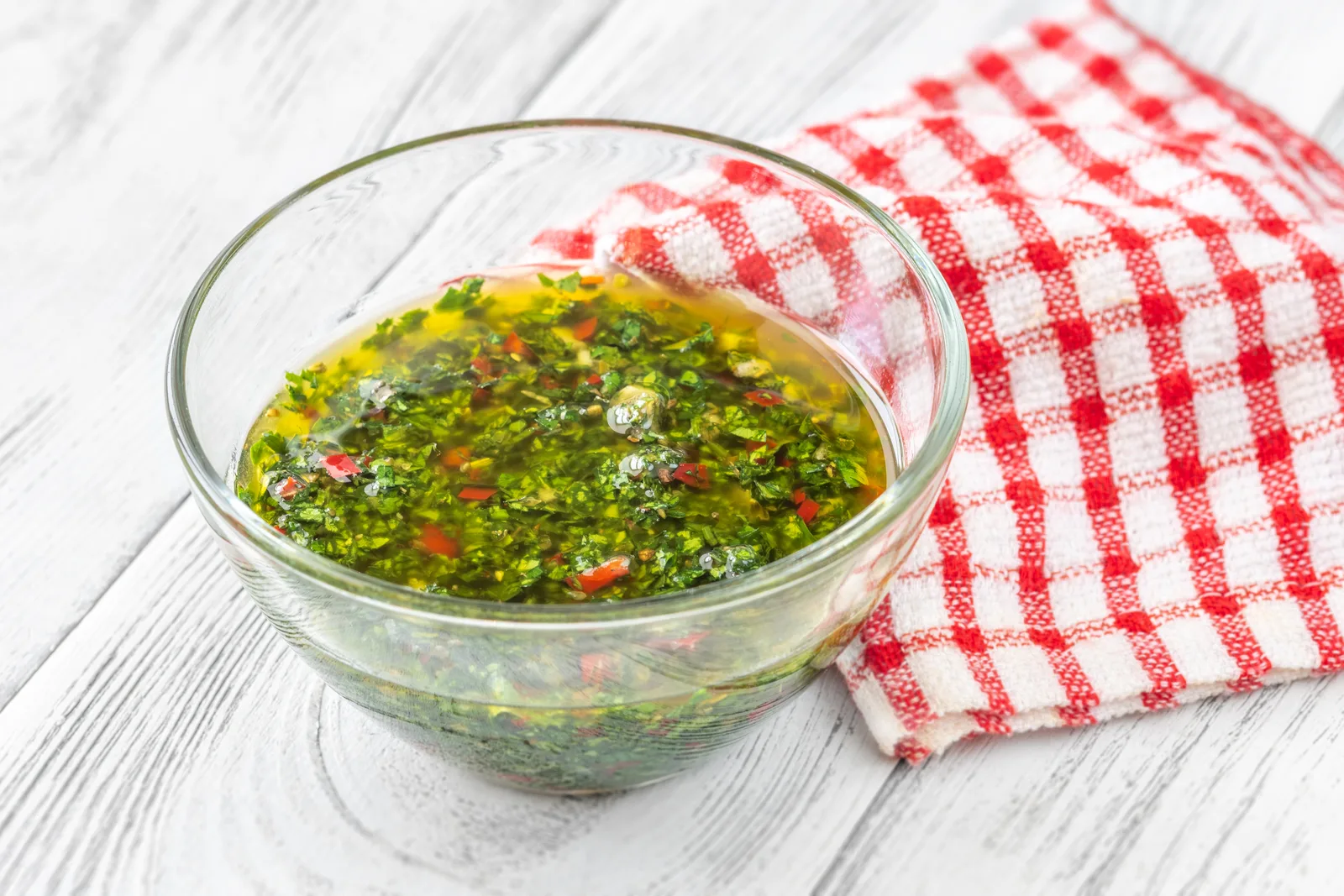

Chimichurri (chee-mee-CHOO-ree) is what Argentines and Uruguayans spoon over meat straight off the grill: parsley, garlic and dried oregano in vinegar and oil, with a pinch of crushed chili. It isn’t blended, so it’s closer to a chopped dressing than to pesto. The step that makes it taste right is easy to skip: the dried oregano, chili and salt sit in a splash of just-boiled water for 10 minutes before any oil goes in. Below is the full recipe for about 1⅔ cups, what to buy in a US or UK supermarket, whether to use a food processor, and the one storage rule you shouldn’t bend.
What chimichurri is, and what it isn’t
How do you make authentic Argentinian chimichurri? Soak 2 tbsp dried oregano, 2 tsp crushed red pepper, paprika, black pepper and 1 tsp salt in ¼ cup (60 ml) of just-boiled water for 10 minutes. Stir in 4 finely chopped garlic cloves and ¼ cup (60 ml) red wine vinegar, then 2 oz (60 g) of hand-chopped parsley and ¾ cup (180 ml) oil, and rest at least 30 minutes. 20 minutes for 12 servings.
The flavor. Sharp and garlicky first, herbal in the middle, with mild heat at the end. The oil carries the oregano and turns faintly red from the chili; the parsley stays in visible flecks.
Does it have cilantro? Not the version on an Argentine or Uruguayan grill table. The herb is parsley. Some home cooks add a little cilantro, and many versions outside the River Plate region do, but it changes the sauce toward something fresher and more citrusy. There’s a cilantro variation below if you like it.
Not to be confused with Venezuelan guasacaca, which shares the vinegar, parsley and garlic but is blended with avocado until pourable, or with Colombian ají, a cilantro, scallion and fresh chili sauce in vinegar and water with almost no oil. Mexican salsa verde is a different thing again: cooked tomatillos and chile. Chile’s pebre, chopped tomato, onion and cilantro, is the salsa spread on Chilean pumpkin sopaipillas.
Time. 20 minutes of work, mostly chopping parsley, plus a 30-minute rest. Easy.
Ingredients and supermarket swaps
The recipe makes roughly 400 ml (1⅔ cups), enough for 12 servings of 2 tbsp, which covers a cookout for 8 to 10 people.
| Ingredient | Amount | US | UK | What a swap changes |
|---|---|---|---|---|
| Flat-leaf parsley | 60 g (2 oz) leaves | ”Italian parsley” | Flat-leaf parsley | Curly works but tastes milder and chews drier |
| Dried oregano | 2 tbsp (6 g) | Any dried oregano | Any dried oregano | Fresh: use 3 tbsp chopped per 1 tbsp dried, no soaking needed |
| Ají molido | 2 tsp (4 g) | Crushed red pepper flakes | Chilli flakes | Jars vary a lot in heat; start with half |
| Sweet paprika | 1 tsp (2 g) | Paprika | Sweet paprika | Optional in green chimichurri |
| Red wine vinegar | 60 ml (¼ cup) | Red wine vinegar | Red wine vinegar | White wine is close; cider is fruitier; distilled white is harsher, use 3 tbsp |
| Oil | 180 ml (¾ cup) | Sunflower, or ⅔ sunflower + ⅓ olive | Sunflower, or a mix | All extra virgin olive oil tastes stronger, can turn bitter and sets in the fridge |
Why sunflower oil, not all extra virgin olive oil
Sunflower or corn oil is common in Argentina for chimichurri. It doesn’t mask the oregano, and it stays liquid in the fridge. Extra virgin olive oil turns cloudy and thick when cold, so you’d have to remember to take the jar out 20 minutes early, and its peppery bite fights the garlic. A third mild olive oil gives a bit more body without those problems.
The ratio is 3 parts oil to 1 part vinegar. Less oil and the vinegar takes over; more and it gets mild and greasy.
Equipment. A sharp chef’s knife, a cutting board and a 500 ml (2 cup) glass jar with a lid. A dull knife bruises parsley instead of cutting it, and the sauce darkens.
How to make chimichurri
1. Soak the dried spices, 10 minutes. Oregano, chili flakes, paprika, black pepper and salt go into the jar with ¼ cup (60 ml) just-boiled water. Salt never dissolves in oil, and the soak softens the oregano so it gives up its aroma to the sauce instead of floating around as dry flakes. It’s ready when the oregano has swelled and the water is red.
2. Garlic and vinegar. Chop the garlic almost to a paste and stir it in with the vinegar once the water has had its 10 minutes, so the heat doesn’t cook it.
3. Parsley, dry and by hand. Wet leaves water down the sauce, cloud it and shorten its life, so spin or towel them dry. Bunch the leaves, slice across, then rock the knife back and forth until the pieces are about ⅛ in (2 to 3 mm). Stop there; parsley chopped to mush turns dark.
4. Oil last. Stir in the parsley, then the oil, until everything sits loose under a thin film of oil. Taste on a piece of bread, not off the spoon.
5. Rest. At least 30 minutes at room temperature. Overnight in the fridge is better: the garlic mellows and the oil picks up more oregano.
Can you make chimichurri in a food processor?
Yes, if you process only the parsley, dry and without oil, in 1-second pulses, checking every two or three, and stop at small flecks. Then stir it into the rest by hand. Run everything together with the oil and you get a smooth green sauce, closer to pesto, that darkens within hours. A blender is a no.
How to tell it’s right
The oil is tinged red, the parsley is still green and separate, and on bread you taste vinegar and garlic first and chili last. Over a few days the green fades to olive; that’s normal.
Troubleshooting
- Bitter. Parsley mashed in a processor, or lots of extra virgin olive oil whizzed hard. Chop by hand and use sunflower or a mix.
- Too sharp. Under 3 parts oil to 1 of vinegar, or distilled white vinegar. Add 2 tbsp oil, wait 10 minutes, taste again.
- Watery or cloudy. The parsley was wet.
- Too salty. Steak seasoned with coarse salt plus chimichurri adds up. Taste it on a bite of meat. If it’s still salty, add more chopped parsley with a little oil and vinegar in the same 3 to 1 ratio.
- Raw garlic too strong. Give it a night in the fridge, or remove the green sprout from each clove before chopping.
- Solid in the fridge. That’s olive oil. Leave it out 20 minutes and stir.
Heat, kids and allergens. At 2 tsp of chili flakes it’s gently warm. For kids, skip the flakes and keep the paprika, and use 2 garlic cloves instead of 4. Free of gluten, dairy, egg and nuts.
How long chimichurri lasts, and the garlic-in-oil rule
4 days in the fridge, in a closed jar with the parsley covered by oil. If you’re not using it within 30 minutes of making it, it goes in the fridge.
The reason is raw garlic and fresh herbs sitting under oil. Oil shuts out air, and that’s the setting in which Clostridium botulinum, whose spores can come in on soil clinging to garlic and herbs, can grow if the mixture spends days unrefrigerated. The vinegar helps by adding acid, but at home you can’t measure whether a particular batch is acidic enough, and the toxin doesn’t change how it looks, smells or tastes. So I treat chimichurri like any homemade garlic-in-oil mixture: always cold, finished in 4 days, frozen if you want it longer.
On the table, no more than 2 hours out of the fridge, or 1 hour above 90°F (32°C), as at a summer cookout in full sun. Serve it in a small bowl with its own spoon and keep the jar cold; whatever sat by the grill all afternoon gets thrown out.
Freezing. Spoon it into an ice cube tray, freeze, then bag the cubes. It keeps for several months; I use mine within 2 or 3, before the aroma fades. Thaw overnight in the fridge, or drop a frozen cube straight onto hot steak. The parsley comes out softer and darker, but the flavor holds.
What to serve chimichurri with
Steak. In Argentina it goes on grilled beef once it’s sliced. The closest US cuts to the classic ones are skirt steak (entraña), flank steak (close to vacío), beef short ribs cut flanken style (tira de asado) and strip steak (bife de chorizo). Skirt is the same cut Mexican cooks call arrachera in carne asada, and chimichurri works on it just as well as pico de gallo does.
Choripán. A grilled fresh sausage split lengthwise in a crusty roll, with 1 tbsp of chimichurri on top; the full method is in this Argentinian choripan recipe. In the US or UK, use a coarse fresh pork sausage that holds its shape on the grill, such as Colombian chorizo. Mexican chorizo won’t work: it’s loose and crumbles as it cooks.
Everything else. Grilled chicken and white fish, roasted or boiled potatoes, grilled vegetables, a slab of grilled provolone, Argentinian beef empanadas in some homes, and slices of Colombian salt-crusted beef tenderloin.
How much. 2 tbsp a person at a cookout; one batch serves 8 to 10. For 20, make two batches rather than one double one, because parsley chops better in small piles.
Using chimichurri as a marinade
Keep it short and in the fridge:
| Meat | Marinating time |
|---|---|
| Chicken breasts or thighs, thin steaks | 30 minutes to 2 hours |
| Skirt or flank steak | Up to 4 hours |
Longer doesn’t add flavor; the vinegar starts to soften the surface and the meat browns less well. Use 2 to 3 tbsp per 1 lb (450 g) of meat, and blot it lightly before grilling, since dripping oil causes flare-ups.
Set aside the serving portion first. Chimichurri that touched raw meat doesn’t go back on the table. Throw it out, or bring it to a boil if you want to use it as a sauce, though it’s no longer the same fresh sauce.
Red chimichurri and other variations
- Red chimichurri. Raise the sweet paprika to 1 tbsp (7 g) in the soak, add ½ red bell pepper (75 g / 2½ oz), very finely chopped, with the garlic, and cut the parsley to 30 g (1 oz). It comes out orange-red, sweeter and less herbal, and is especially good on pork and chicken. Raw pepper releases water, so 4 days in the fridge is still the limit. A teaspoon of smoked paprika gives it a grilled edge.
- With cilantro. Swap 20 g (¾ oz) of the parsley for cilantro (UK coriander). Fresher and more citrusy; lovely with fish, though no longer the Argentine grill version.
- No heat. Leave out the chili flakes and keep the paprika.
- With shallot or roasted garlic. ½ red onion or 1 shallot, minced, adds sweetness and crunch; roasted garlic in place of raw makes it much milder. Same 4-day limit.
- A dry mix to keep on hand. Combine the oregano, chili, paprika and black pepper for several batches in a jar. Without garlic or oil it keeps for months in the pantry. On the day, weigh out 13 g per batch, do the hot-water soak and add the fresh ingredients.
- With dried parsley. About 5 tbsp (⅓ cup) dried parsley stands in for the 60 g fresh; add it to the soak with 2 extra tbsp of hot water, since it soaks up liquid. Darker and less fresh, but it works when the store is out of parsley.
Cost. The oil is the expensive part. Sunflower, or a sunflower and mild olive oil mix, costs well under a jar made entirely with extra virgin olive oil, and tastes better in this sauce.
Chimichurri questions
Is chimichurri served hot or cold? At room temperature. Take it out of the fridge 20 minutes ahead and stir. Cold sauce on hot steak dulls the flavor.
Chimichurri vs pesto, what’s the difference? Pesto is basil pounded or blended with cheese, pine nuts and olive oil into a paste. Chimichurri is parsley, oregano and garlic, chopped and loose, with vinegar for acidity and no cheese or nuts.
Why did my chimichurri turn dark? The parsley was bruised by a blender or a dull knife, or it went in wet. A slow shift from bright green to olive over a few days is normal.
Can I leave chimichurri out overnight? No. Raw garlic and herbs under oil need the fridge, and should be used within 4 days. Freeze anything you won’t get through.
Nutrition per serving
Per 2-tbsp serving (1/12 of the recipe), calculated ingredient by ingredient from the amounts above:
- Calories: 127 kcal
- Protein: 0 g
- Carbohydrates: 1 g
- Fat: 14 g, of which 2 g saturated
- Fiber: 1 g
- Sugar: 0 g
- Sodium: 198 mg
Nearly all the calories come from the oil, about 120 kcal per tablespoon of it. Some of the oil always stays behind in the bowl, so what reaches your plate is usually a little less.
At cookouts here in Colombia chimichurri shares the table with ají, and I like watching people pick by the plate: ají for the potatoes, chimichurri for the beef. I make mine the night before in two jars, one with chili flakes and one without, so Dylan can pile his on without complaining about the heat. Josnaisis.