
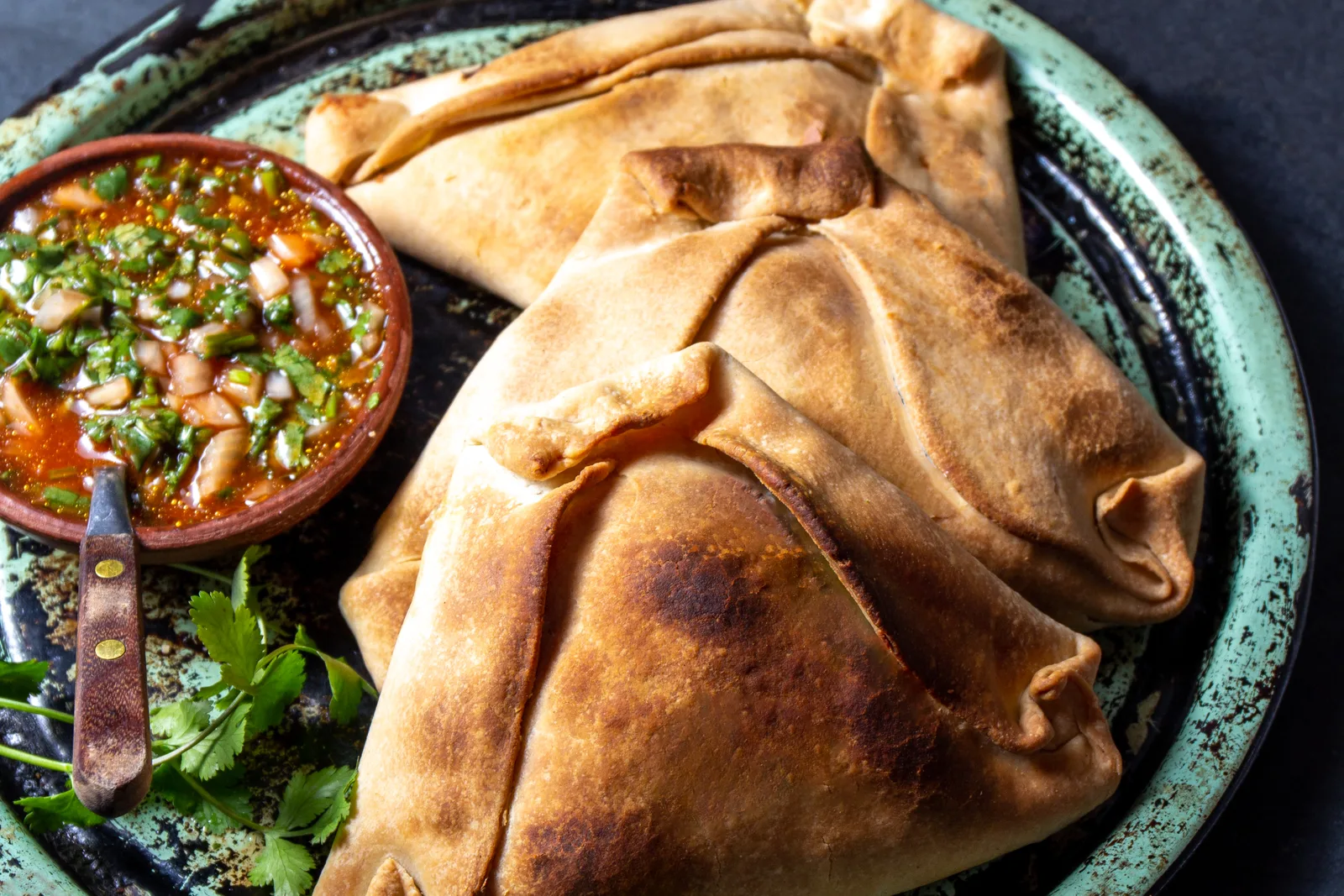

Empanadas de pino (em-pah-NAH-dahs deh PEE-noh) are Chile’s baked beef empanadas, and they are big: an 8 in (20 cm) round of lard pastry folded into a rectangle around half a cup of pino, a filling of beef slow-cooked with even more onion, cumin and sweet paprika. Each one gets a wedge of hard-boiled egg, a black olive and a few raisins tucked in by hand. They’re the food of Fiestas Patrias, Chile’s national holidays around September 18. One with a salad makes a meal.
What empanadas de pino are, and how long they take
How do you make Chilean empanadas de pino? The day before, cook 2¼ lb (1 kg) of beef with 3⅓ lb (1.5 kg) of onions, cumin and paprika and chill the filling overnight. Next day, make a dough of 2¼ lb (1 kg) flour, 1 cup (200 g) melted lard and warm salted water, roll 12 rounds of 8 in (20 cm), fill each with 4¼ oz (120 g) of pino, egg, olive and raisins, fold into rectangles and bake at 400°F (200°C) for 25 to 30 minutes. About 2½ hours of hands-on work for 12 empanadas, plus chilling time for the filling.
Time. About 2½ hours of cooking split over two days, plus at least 4 hours of chilling for the filling: just over an hour the day before for the filling and eggs, and about 2 hours on baking day for the dough, the folding and the oven. Medium difficulty: nothing is technical, but rolling and folding 12 large rounds takes a while, and the first few never look as good as the rest.
What it tastes like. Not spicy at all. The onion cooks down until it’s sweet, the cumin is warm and noticeable, the olive brings salt and the raisins small bursts of sweetness. The crust is firm enough to eat in your hand, slightly flaky, and crisp at the folded corners.
Chilean vs Argentinian empanadas. Argentinian beef empanadas are smaller, about 5½ in (14 cm) across, sealed in a half-moon with a braided edge, and usually filled with green olives and no raisins. The Chilean one is roughly twice the size, folded into a rectangle with no braiding, with a black olive and usually raisins. Venezuelan empanadas and Colombian empanadas are a different thing altogether, made with corn dough and fried.
Ingredients and supermarket swaps
Makes 12 large empanadas.
| Ingredient | Metric | US | Notes and swaps |
|---|---|---|---|
| Beef chuck or bottom round | 1 kg | 2¼ lb | Hand-cut, or 85/15 ground beef |
| Onions | 1.5 kg | 3⅓ lb, 5 large | Yellow or white |
| Lard | 240 g | 8½ oz | 40 g for the filling, 200 g for the dough |
| Sweet paprika | 7 g | 1 tbsp | Stands in for Chilean ají de color |
| Ground cumin | 2 g | 1 tsp | |
| Beef stock | 180 ml | ¾ cup | Low-sodium if from a carton or cube |
| Hard-boiled eggs | 3 | 3 | Quartered, one wedge each |
| Black olives | 12, about 50 g | 12, 1¾ oz | Kalamata are closest |
| Raisins | 20 g | 2 tbsp | Optional |
| All-purpose flour | 1 kg | 2¼ lb, about 8 cups | Not self-rising |
| Warm water + salt | 480 ml + 15 g | 2 cups + 2½ tsp | The brine |
The filling, and the beef to buy
- Beef. Diced by hand into scant ¼ in (5 mm) pieces is the traditional way, and you can feel the little cubes when you bite. In the US, chuck or bottom round; in the UK, braising steak or topside. Ground beef (UK mince) at 85/15 is faster and gives a finer, more even filling. Very lean beef dries the filling out, so add 2 or 3 tbsp more stock.
- Onions, a lot of them. One and a half times the weight of the beef. It looks excessive in the pot, but it cooks down by half and is where the juice and sweetness come from.
- Ají de color is Chile’s mild red pepper powder. Any sweet paprika works; smoked paprika changes the flavor.
- Olives. Chilean cooks use large Azapa olives, often with the pit in. Kalamata olives are the closest in a US or UK supermarket, a little more vinegary. Canned black olives work but taste of less. If you leave the pits in, tell people at the table.
The dough, and if you can’t find lard
- Lard gives a tender, slightly flaky crust that holds up to a heavy filling. In the US it’s sold in tubs in the Hispanic aisle or blocks near the butter; in the UK, blocks of lard sit in the chilled aisle near the butter.
- Vegetable shortening (UK white vegetable fat) works at the same weight and gives an equally tender dough with no pork flavor.
- Butter works at the same weight and tastes richer, but browns faster, and since it’s part water you’ll need a few spoonfuls less brine.
- Flour. Plain all-purpose. Self-rising flour puffs the dough and it cracks around the filling.
Equipment. A wide pot and a skillet for the filling, a rolling pin, two baking sheets and an 8 in (20 cm) plate to trim the rounds neatly if you want them perfect.
The make-ahead plan
- Day before, about 1 hour 10 minutes. Cook the filling, hard-boil the eggs, chill both.
- Baking day, about 2 hours. Dough (20 minutes), rest (30 minutes, while you portion the filling and quarter the eggs), roll and fold (about 40 minutes), bake (25 to 30 minutes).
- Dough a day ahead too. Wrap it and refrigerate overnight; take it out 30 minutes before rolling.
- For 24. Double everything, but make the dough as two separate 1 kg batches. Kneading 4½ lb of dough by hand is hard work and it comes out worse.
Making them, step by step
The filling, the day before
Onions first and slowly, 20 to 25 minutes over medium-low heat, until soft and translucent. If they brown, the filling turns darker and less sweet. The beef goes into a separate hot skillet in two batches for 4 minutes each; dumped all at once into the onions it would release water and stew instead of searing.
With the spices, flour and stock, it simmers uncovered for 15 minutes. It’s right when it’s glossy and juicy but no liquid runs across the bottom when you tilt the pot.
Why overnight. In the fridge the filling sets, the fat turns white and firm, and you can scoop it without it dripping. Cold filling doesn’t soften the dough or wet the edges, and it melts again in the oven. It also tastes better rested. If you’re short of time, give it at least 4 hours. Spread it in a wide dish so it cools fast, and get it into the fridge within 2 hours of turning off the heat.
The dough, with warm brine
The brine is just the warm water with the salt dissolved in it, so the salt spreads evenly through the dough. Warm water also keeps the melted lard from setting into lumps when they meet.
- Rub the warm lard into the flour until it looks like damp sand.
- Add 400 ml (1⅔ cups) of brine and mix. Add the rest a spoonful at a time only if there are dry patches; flours absorb differently.
- Knead 8 to 10 minutes, until smooth and soft. Press a finger in: the dent should stay without cracking. Cracks mean it needs a little more brine.
- Rest 30 minutes, covered. Without the rest it springs back as you roll.
How much filling per empanada
Each ball is about 140 g (5 oz), rolled to 8 to 8½ in (20 to 22 cm) and ⅛ in (3 mm) thick. Thinner tears under the weight of the filling; thicker stays doughy at the folds.
Each empanada takes a heaped ½ cup of filling, about 120 g (4¼ oz), plus an egg wedge, an olive and 3 or 4 raisins, all in the center with about 1½ in (4 cm) of clean dough around it.
Folding the Chilean rectangle
- Wet the whole edge of the round with a damp finger.
- Fold it in half over the filling and press from the filling outward to push out the air.
- Press the curved edge to seal it.
- Fold one point of the half-moon in toward the center, over the filling, then the other. You now have a rectangle with two flaps.
- Press the four corners firmly with your thumb.
Some cooks fold the two sides in first and then bring the top down like an envelope flap. Both seal well. In Chile, the braided crimp is kept for fried empanadas.
Brushing and baking
Brush the tops with the yolk and milk, without letting it drip onto the sheet, and prick each one 2 or 3 times so steam escapes there and not through the folds.
Bake at 400°F (200°C) on the middle rack for 25 to 30 minutes. They’re done when the tops are evenly golden, the bottoms are golden when you lift one with a spatula, and the corners look toasted. Six of these fill a standard sheet; with two sheets in at once, swap them halfway and allow a few extra minutes.
Why empanadas burst, and other problems
- They split or leak in the oven. Warm or wet filling, a greasy edge, or air trapped inside. Cold, well-reduced filling, a clean damp edge, and press out the air as you seal.
- The dough tears when folding. Rolled too thin, too dry, or not rested. Keep it at ⅛ in (3 mm); if it cracks at the fold, it needed more brine.
- Hard, cracker-like crust. Too little fat, too much flour on the counter, or overbaked. Dust the counter lightly.
- Pale bottoms. The sheet was on the top rack. Use the middle, and if your oven only browns on top, move them to the bottom rack for the last 5 minutes.
- Bland filling. The dough doesn’t make up for it. Taste the filling before chilling.
Allergens. Wheat (gluten), egg, and milk in the glaze; brush with yolk and water to leave it out. Not spicy, and most kids like them; take out the olive pits and skip the raisins in theirs if needed.
Serving, storing and freezing
Serving. Straight from the oven after the 5-minute rest. In Chile they come with pebre, a fresh salsa of tomato, onion, cilantro (UK coriander) and chile, the same salsa served with Chilean pumpkin sopaipillas, or with a simple tomato and onion salad. The same pino, without the dough, goes under a sweet corn topping in Chilean pastel de choclo.
How many. One per adult with a salad is a meal; two for big appetites.
Fridge. Cooked filling keeps 3 to 4 days. Baked empanadas the same, refrigerated within 2 hours and covered.
Freezing unbaked, the best option. Fold them without the glaze, freeze them apart on a tray until hard, then bag them. They keep up to 3 months. Bake from frozen at 400°F (200°C), glazed and pricked, for 5 to 10 minutes longer than usual, until golden and 165°F (74°C) in the center. If they brown before the middle is hot, cover loosely with foil.
About the egg. Hard-boiled egg white goes rubbery and watery in the freezer. If that bothers you, freeze them without it and accept a filling with no egg, or bake that batch fresh.
Freezing baked. Cooled and bagged, 2 to 3 months. Reheat from frozen at 350°F (180°C) for about 20 minutes, until 165°F (74°C) in the center.
Reheating. Oven or air fryer at 350°F (180°C), 10 to 12 minutes from the fridge. The microwave heats the filling but leaves the crust soft.
Frequently asked questions
Can I use store-bought empanada discs? Yes. Frozen discs for baking (look for para horno) are in the freezer section of Latin markets and many US supermarkets. They’re smaller than a Chilean round, so you get Argentinian-sized empanadas: use a heaped tablespoon of filling, about 50 g (1¾ oz), fold into a half-moon and seal with a fork. Puff pastry or pie crust makes a richer, flakier pastry that isn’t the same thing.
Are the raisins traditional? The classic empanada de pino has a few, but they’re optional and some cooks leave them out. Skipping them changes nothing else.
Why is there flour in the filling? It binds the onion and beef juices into a creamy filling that doesn’t turn to broth inside the crust. For a gluten-free filling, swap it for cornstarch (UK cornflour); the dough still contains wheat.
Nutrition
Per empanada (one of 12, baked and glazed), worked out ingredient by ingredient from the quantities above:
- Calories: 754 kcal
- Protein: 28 g
- Carbohydrates: 78 g
- Fat: 36 g, of which 14 g saturated
- Fiber: 5 g
- Sugars: 7 g
- Sodium: 1038 mg
The dough accounts for about three fifths of the calories. A little over half the sodium is in the brine; to cut it, use 1 tsp salt in the filling and keep the dough as written, because unsalted dough tastes of nothing.
I always cook the pino the day before, more for the planning than the flavor: on baking day, with the dough resting and the filling already cold in its dish, folding becomes a calm assembly line instead of a race. I go slowly on the first few, checking that each corner is pressed down properly, and by the fourth my hands know what to do. Josnaisis.