
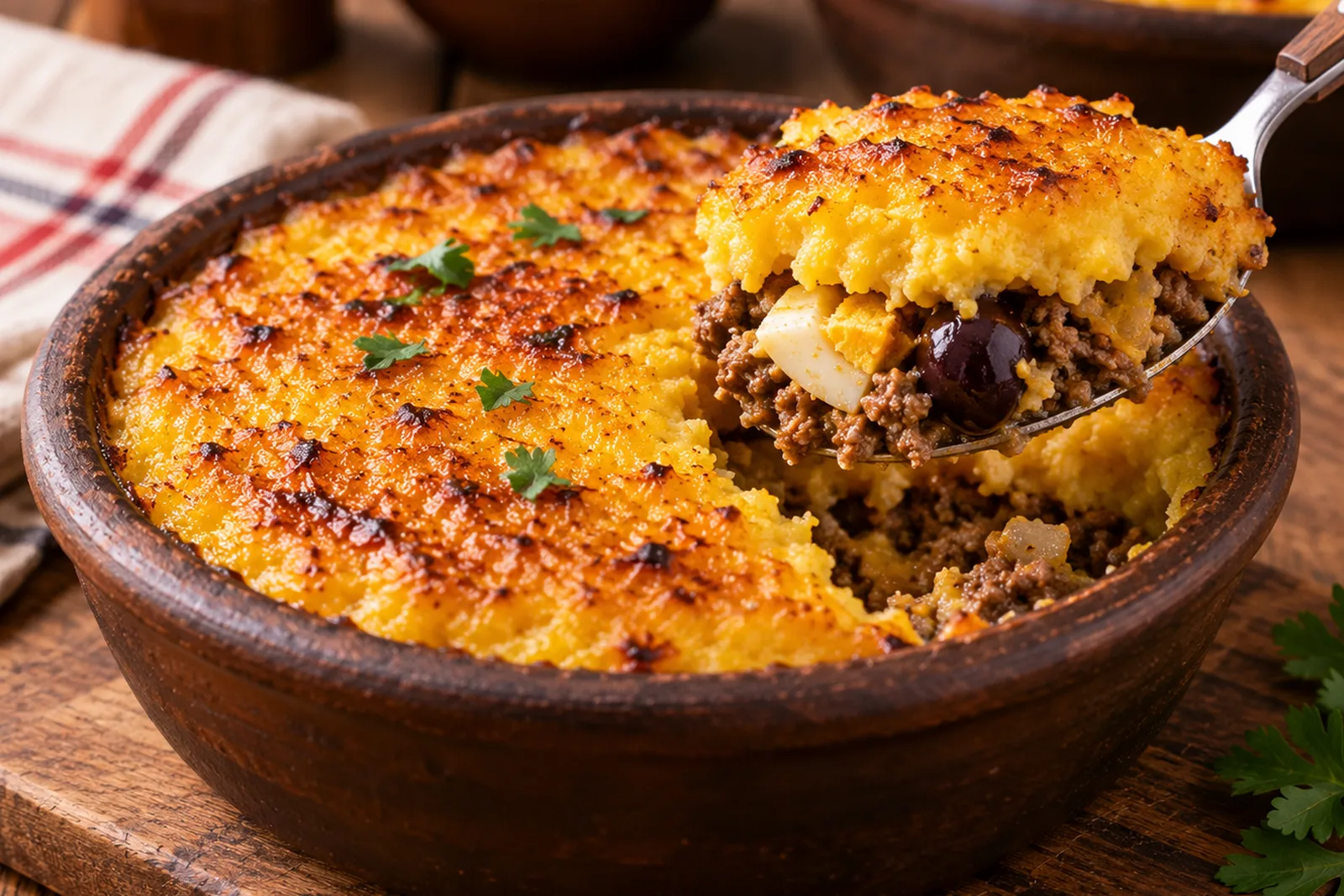

Pastel de choclo (pahs-TEL deh CHOH-kloh) is the dish Chileans make when corn is in season: a beef and onion filling seasoned with cumin and paprika, hidden raisins, olives and hard-boiled egg, and a thick layer of fresh corn blended with basil on top, sprinkled with sugar and baked until it caramelizes. Think shepherd’s pie, but with sweet, soft corn where the mashed potato would be. It takes about 2½ hours, most of them hands-off, and the beef filling is better made a day ahead.
What pastel de choclo is, and how long it takes
How do you make pastel de choclo? Simmer 2.2 lb (1 kg) of ground beef with 3 onions, cumin and paprika for about 40 minutes into a saucy filling and let it cool. Blend 3¼ lb (1.5 kg) of corn with butter, milk and basil and cook it until thick. Layer the beef with egg, olives and raisins, cover with the corn, sprinkle with sugar and bake at 400°F (200°C) for 40 to 45 minutes. 150 minutes for 8 servings.
The name says it: choclo is the Andean word for fresh corn, the same thing Mexicans call elote. In Chile it’s baked and served in a paila de greda, an unglazed clay dish that holds the heat, but any 9 x 13 in casserole works. The flavor is sweet and savory at once, and it isn’t spicy at all: the red color comes from sweet paprika.
Time. 2½ hours in total, including 30 minutes for the filling to cool while you make the corn layer; about 50 minutes of it is active. Skill level, medium: nothing is hard, but there are two components to get right and a layering step.
Ingredients, and what to buy in the US and UK
This fills one 9 x 13 in (23 x 33 cm) dish, or 8 individual baking dishes.
| Ingredient | Metric | US | Notes |
|---|---|---|---|
| Ground beef, 85% lean | 1 kg | 2.2 lb | UK: beef mince around 15% fat |
| Onions | 600 g | 3 large | Yes, that much: they sweeten the filling |
| Sweet paprika | 7 g | 1 tbsp | Stands in for Chilean ají de color; not smoked |
| Frozen sweet corn | 1.5 kg | 3¼ lb, about 10 cups | Or 10 to 11 large ears |
| Whole milk | 120 ml | ½ cup | Up to ¼ cup more if the corn gets stiff |
| Butter | 50 g | 3½ tbsp | |
| Fine cornmeal | 30 g | 3 tbsp | Not coarse polenta or grits |
| Fresh basil | 6 g | 12 large leaves | Sweet or Genovese basil |
Plus 4 eggs, 16 black olives, ⅓ cup raisins, garlic, cumin, oregano, flour, stock and 1 tbsp sugar for the top. Cooked chicken thighs are an optional extra many Chilean families add.
Which corn to use outside Chile
Chileans use a starchy, not-very-sweet corn called choclo humero that thickens on its own when cooked. US and UK supermarket corn is sweet corn, which is sugarier and wetter. Treated the same way, it gives a runny topping that never sets. Here’s how to adjust:
- Frozen sweet corn is the easiest and most consistent choice, in the US and in the UK (frozen sweetcorn). It goes in straight from the bag.
- Fresh corn on the cob, in summer. A large ear gives about 5 oz (140 g) of kernels, so you’ll need 10 or 11. Still sweet corn, so still use the cornmeal.
- Canned corn works but is the wettest: drain it very well, start with half the milk and expect to use all the cornmeal.
- The thickener. Fine yellow cornmeal (UK: fine polenta or fine maize meal). Coarse polenta stays gritty. Cornstarch (UK cornflour) or plain flour will thicken it too but taste less of corn; start with 2 tbsp.
- Sugar on top only. Sweet corn already has plenty; sugar in the mix turns it into dessert.
Other swaps
- Olives. Chileans use black Azapa olives with the pits in. Canned ripe black olives or Kalamatas are fine; if you leave pits in, warn your guests.
- Basil. Avoid Thai basil, whose anise flavor takes over. Dried basil is a weak substitute; 1 tsp if it’s all you have.
- Heat. For a little kick, swap half the paprika for merquén, a smoked Chilean chile, or a pinch of cayenne.
- Gluten-free. Thicken the beef with cornmeal instead of flour.
Equipment. A wide pot for the beef, a heavy-bottomed pot for the corn (a thin one scorches), a stick blender or regular blender, and a 9 x 13 in baking dish.
How to make pastel de choclo
The beef filling (pino)
Onions first, 10 minutes over medium heat until soft and see-through, then the beef for 8 minutes, the spices and the flour. Add the stock and simmer uncovered for 20 minutes.
You want it saucy but not soupy: drag a spoon across the bottom and the path should close slowly. Then let it cool for at least 30 minutes. Cool filling holds up the corn layer; hot, loose filling lets it sink and turns the whole thing into a stew.
The corn layer (pastelera)
Cook the corn in butter for 8 minutes so it softens, add milk, basil and salt for 5 minutes, then blend for about 1 minute, leaving a little texture.
Now the step that matters. Add the cornmeal and keep stirring over medium-low heat for 5 to 8 minutes. It’s ready when it’s thick and glossy, mounds on the spoon, and you can see the bottom of the pot for a second when you drag the spoon through. It spits as it thickens, so use a long-handled spoon.
Layering and baking
- Spread the cool beef in an even layer, about ¾ in (2 cm) deep.
- Scatter the egg quarters, olives, raisins and chicken, pressing them in slightly.
- Dollop the corn all over and join it up with the back of the spoon, without pressing down.
- Score the top with a fork; the ridges brown more.
- Sprinkle the 1 tbsp sugar from a height so it lands evenly.
Bake at 400°F (200°C) on the middle rack for 40 to 45 minutes (individual dishes 25 to 35). Look for bubbling edges and a top that’s golden in patches. If it’s still pale, 2 to 4 minutes under the broiler, standing right there: the sugar goes from golden to burnt very fast. Rest 10 minutes, or the corn layer slumps when you cut it.
Make-ahead plan for a dinner party
| When | What to do |
|---|---|
| Up to 2 days before | Make the beef filling and boil the eggs; refrigerate, covered |
| Up to 2 days before (alternative) | Assemble the whole pie with cold filling and cold corn, without the sugar; cover and refrigerate |
| On the day, about 1½ hours before eating | Make the corn layer (if not done), assemble, bake 40 to 45 minutes, rest 10 |
| Straight from the fridge | Add sugar just before baking and allow about 10 extra minutes |
Freezing. Assemble it unbaked and without sugar in a freezer-safe dish, wrap it well and freeze. For best quality, bake it within 2 to 3 months. Thaw for 24 hours in the fridge, then bake as if it came from the fridge. The corn layer comes out a little softer than fresh. The cooked corn layer on its own also freezes well in flat bags.
For 16 to 20. Double everything and bake two 9 x 13 in dishes on two racks, swapping them halfway. A full oven can take longer, so go by the bubbling and the color. Cook the 6½ lb (3 kg) of corn in two batches; one pot that size is hard to stir and catches.
The beef is what drives the cost. To stretch it, use 1¾ lb (800 g) and 4 onions instead of 3.
Troubleshooting
- The corn sank into the filling. The beef was hot or too wet. Cool it and simmer off loose liquid first.
- The topping is runny. Sweet corn not thickened enough, or taken off the heat too soon. Back in the pot with 1 or 2 tbsp more cornmeal until you can see the bottom.
- The topping is dry or cracked. Over-thickened. Loosen with milk, 2 tbsp at a time, before assembling.
- It tastes like dessert. Sugar went into the corn mix. Only on top.
- The corn scorched in the pot. Thin pot or not enough stirring. Heavy base, medium-low heat, keep stirring.
- No golden crust. Oven too cool or dish too low. Middle rack, and a few minutes under the broiler.
Allergens. Contains milk, egg and wheat (the flour in the filling; use cornmeal instead to make it gluten-free). Not spicy.
Serving, storing and reheating
Serving. Straight from the dish, with a simple tomato and onion salad on the side to cut the sweetness; in Chile that’s ensalada chilena. Some families put a sugar bowl on the table for anyone who wants a sweeter crust. For a South American spread, Argentinian beef empanadas share the beef, onion, egg and olive filling.
Fridge. Refrigerate within 2 hours of baking, covered, for 3 to 4 days at 40°F (4°C) or below.
Freezer. Baked portions keep their quality for 2 to 3 months. Thaw in the fridge.
Reheating. In a 350°F (180°C) oven, covered with foil so the sugar doesn’t burn, until the center reaches 165°F (74°C); uncover for the last few minutes to dry the crust. In the microwave, one portion at medium power in 1-minute bursts; it heats fine, but the crust softens.
Frequently asked questions
Is pastel de choclo the same as a corn casserole or cornbread? No. American corn casserole and Mexican pan de elote are sweet, cake-like bakes with no filling. Pastel de choclo is a main course: the corn is a topping over a savory beef filling. The closest relatives in texture are Venezuelan cachapas, griddled pancakes of blended fresh corn, and the baked Venezuelan corn cake, which is a dessert.
Can I use canned creamed corn? As part of the corn, not all of it. Swap about 14 oz (400 g) of kernels for a can of creamed corn and start with half the milk, since it already has liquid and sugar. Still use the cornmeal and cook until you can see the bottom of the pot.
Why sugar on a savory dish? It caramelizes into the golden crust, and that sweet edge against the salty filling is the point of the dish. Halve it or leave it out if you like; the top just browns less.
What’s a good substitute for the beef? For a ground meat dish with a similar spice profile but no corn and no oven, Mexican picadillo with potato and carrot is ready in 50 minutes. Inside the pie itself, ground beef is what makes it pastel de choclo; extra cooked chicken is the usual addition, not a replacement.
Nutrition
Per serving (one eighth of the dish, without the optional chicken), worked out ingredient by ingredient from the quantities above, using frozen sweet corn:
- Calories: 648 kcal
- Protein: 35 g
- Carbohydrates: 59 g
- Fat: 33 g, of which 12 g saturated
- Fiber: 6 g
- Sugars: 15 g
- Sodium: 851 mg
The beef provides about two fifths of the calories and the corn about a quarter. With 90% lean beef it drops by about 50 kcal a serving; the four optional chicken thighs add about 100.
I always use more onion than seems sensible and assemble it the night before, because a filling that has rested a day tastes better and on the day itself all I do is turn on the oven. If someone at your table won’t eat raisins, make their portion in a small dish of its own instead of picking them out. Josnaisis.