
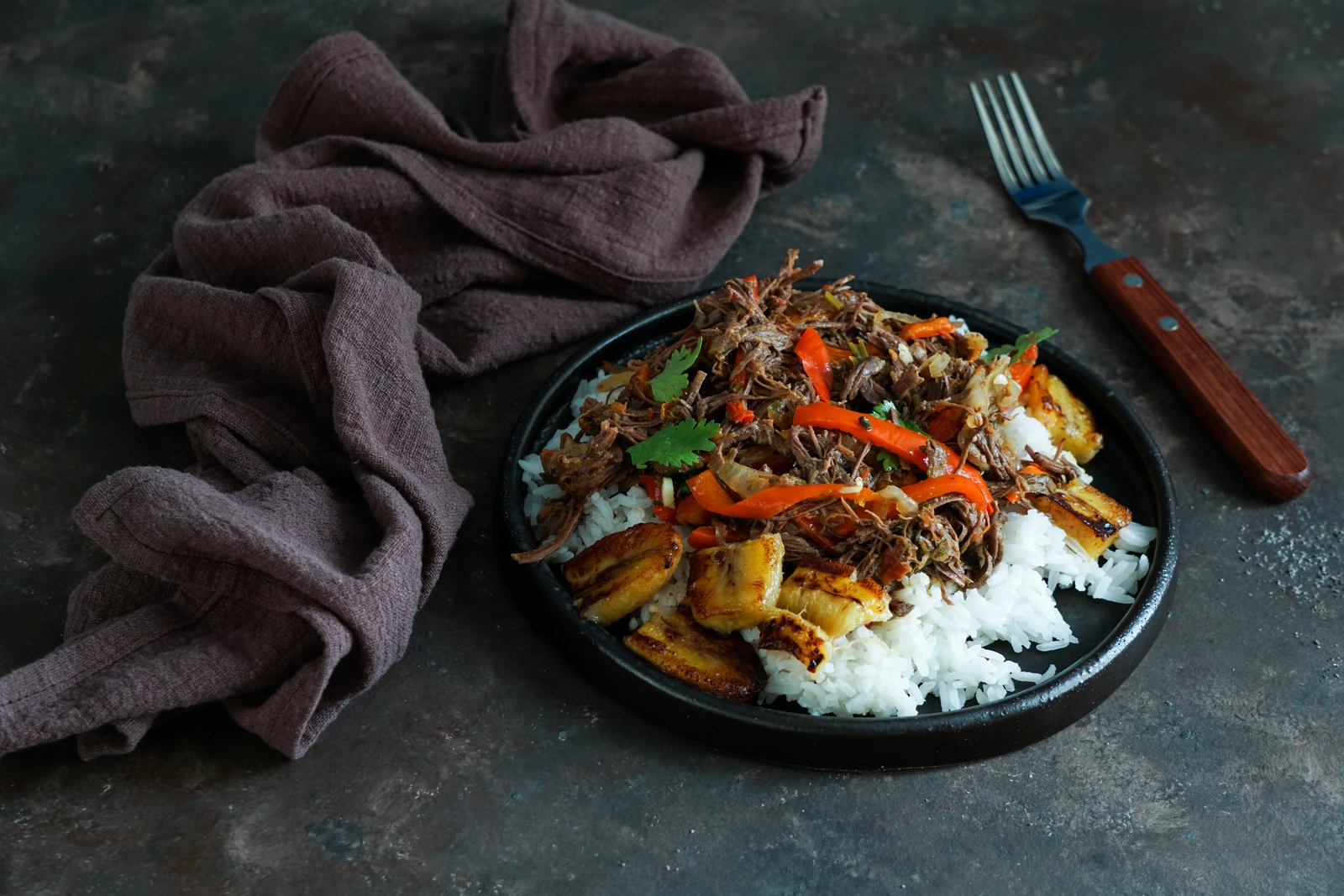

Ropa vieja (ROH-pah vee-AY-hah, “old clothes” in Spanish) is Cuba’s best-known beef dish: flank steak cooked until it falls apart, pulled into long strands, then stewed in a tomato sauce with sliced onion, strips of bell pepper, cumin and a splash of dry cooking wine. The strands look like torn rags, and that’s all the name describes. It isn’t spicy. It’s eaten over white rice with black beans and fried sweet plantains, and it reheats well. Below are the stovetop method, the Instant Pot and slow cooker versions, and what to buy in a US or UK supermarket.
What ropa vieja is, and how long it takes
How do you make Cuban ropa vieja? Simmer 2¼ lb (1 kg) of flank steak in water with onion, garlic and bay leaf for 2 hours, or 45 minutes under pressure, then shred it along the grain while warm. Stew it 15 to 20 minutes in a sofrito of sliced onion and peppers, garlic, cumin, oregano, tomato and ½ cup (120 ml) of dry wine, with 1 cup (240 ml) of the broth, until the sauce thickens. 170 minutes for 6 servings.
Stovetop, 2 hours 50 minutes, of which about 45 are hands-on. Instant Pot, about 2 hours including the time it takes to come up to pressure and release. Slow cooker, 8 hours on low with 30 minutes of work. All three are easy; the one thing to judge is when the beef is really tender.
It’s close to other shredded beef dishes on this site but tastes different. Colombian shredded beef is stewed in a chopped tomato and onion hogao with annatto and no wine, and the shredded beef in Venezuela’s pabellón criollo uses sweet ají peppers and is one part of a four-part plate. Ropa vieja is saucier, the peppers stay in visible strips and you can taste the wine.
Ingredients and what to buy
This makes 6 servings from 2¼ lb (1 kg) of raw beef, which leaves about 1½ lb (650 g) once cooked and shredded: roughly 4 oz (110 g) of beef per person with its sauce, served with rice and beans.
| Ingredient | Amount | US | UK |
|---|---|---|---|
| Flank steak | 1 kg / 2¼ lb | Flank steak, any supermarket | Ask a butcher for flank (often sold as bavette) or use brisket |
| Bell peppers | 1 green + 1 red, 150 g / 5 oz each | Green and red bell peppers | Green and red peppers |
| Crushed tomatoes | 1 cup / 240 g | Canned crushed tomatoes or tomato sauce | Passata |
| Tomato paste | 2 tbsp / 32 g | Tomato paste | Tomato purée |
| Vino seco | ½ cup / 120 ml | Latin aisle, or dry sherry | Fino sherry or dry white wine |
| Green olives | ½ cup / 60 g | Pimento-stuffed manzanilla olives | Pimento-stuffed green olives |
Flank, brisket or chuck
- Flank steak, as written. Lean, with long, clear fibers, which is what gives ropa vieja its long thin strands. Because it’s lean, it dries out if overcooked or reheated without liquid.
- Brisket. More fat and collagen, so it’s more forgiving and juicier, with slightly thicker strands. Give it 30 minutes more.
- Chuck roast. The juiciest and usually cheaper than flank. The shreds come out shorter, more like a stew than classic ropa vieja. Allow 2½ hours on the stove.
Before it goes in the pot, cut the steak across into pieces about 4 in (10 cm) wide. The strands end up as long as the piece, which keeps them manageable on a fork. The beef is what drives the cost here, and brisket or chuck brings it down without hurting the result much.
Vino seco, and what to use instead
Cuban vino seco is a golden cooking wine with salt added. In the US it’s in the Latin aisle of many supermarkets and in Cuban grocery stores. If you use it, taste the sauce before adding the salt in the recipe.
- Dry sherry (fino). Closest in flavor. It has no salt, so salt as written.
- Dry white wine. Lighter, and the easiest to find.
- No alcohol. Use the same amount of broth plus 1 tbsp white vinegar. A little less depth, still ropa vieja.
Olives are optional and salty. Some Cuban cooks add 1 tbsp capers or a handful of raisins; jarred pimientos in strips also appear in older Cuban recipes.
Equipment. A 5-quart (5-liter) pot for the beef, a wide 11 in (28 cm) skillet or braiser for the sauce, and two forks.
Stovetop ropa vieja, step by step
Simmer the beef. Water to cover, onion, garlic, bay leaf and salt, at a gentle simmer with the lid on for 2 hours. Skim the grey foam in the first 10 minutes so the broth stays clean.
How to tell it’s ready. A fork slides in with no resistance, and a piece pressed with the back of a spoon against the side of the pot falls into strands. At 1½ hours flank is cooked through but breaks into chunks instead of shredding, which means it needs another 20 to 30 minutes.
The sofrito. While the beef finishes, onion and peppers go 10 minutes over medium heat. You want them soft but whole and not browned, because the strips stay visible in the finished dish. Then garlic, cumin and oregano for 1 minute, tomato for 5 minutes, and wine for 3 minutes at a simmer, until it stops smelling of alcohol.
Shred along the grain. Rest the beef 10 minutes. Hot, it burns your fingers and crumbles; cold, it firms up. Look at which way the fibers run and pull them apart in that direction. Across the grain you get short chunks.
Stew with the right amount of broth. The beef goes into the sauce with 1 cup (240 ml) of strained broth, uncovered, 15 to 20 minutes over medium-low. It’s done when the strands are glossy with sauce and, when you push the beef aside, there’s no loose liquid at the bottom of the pan. If it dries out before then, add broth ¼ cup at a time.
The leftover broth, about 6 cups, is beef stock. Strain it, cool it and use it within 3 to 4 days for cooking rice or soup, or freeze it.
Instant Pot ropa vieja
The one-pot pressure cooker version builds the sauce first and cooks the beef in it, so there’s no separate broth to manage.
- On Sauté, cook the onion and peppers in the oil for 8 to 10 minutes, then add garlic, cumin, oregano and bay leaf for 1 minute.
- Stir in the tomatoes, tomato paste and wine, scraping the bottom well (stuck bits trigger the burn warning), then add 1 cup (240 ml) beef broth or water and the beef pieces with ½ tsp salt.
- Lock the lid and cook on High Pressure for 45 minutes. Let the pressure drop naturally for 15 minutes, then release the rest.
- Lift out the beef, shred it, and return it to the pot with the olives. On Sauté, simmer 5 to 10 minutes until the sauce thickens and clings.
If the beef still breaks into chunks when you open it, lock the lid and give it 10 more minutes at pressure. Electric cookers run at a slightly lower pressure than stovetop ones, so a thick flank steak sometimes needs that extra time. Stovetop pressure cookers: same 45 minutes from when it comes to pressure, using the plain-water method above with 6 cups (1.5 liters) of water.
Slow cooker ropa vieja
- Make the sofrito in a skillet, through the wine, exactly as in the stovetop method.
- Put the raw beef pieces in the slow cooker, season with ½ tsp salt, and pour the sofrito over. Add no water or broth: it looks dry at first, but after a couple of hours the beef has released plenty of liquid.
- Cook 8 hours on Low or 5 hours on High, until the beef shreds with a fork.
- Shred, stir back in with the olives, and if the sauce is thin, reduce it uncovered in a pan for 10 minutes before mixing.
What goes wrong, and how to fix it
- Chunks instead of strands. Undercooked, or shredded across the grain. Back into the liquid for 20 minutes, then pull along the fibers.
- Dry, stringy beef. Flank overcooked or stewed without liquid. One cup of broth in the stew, and another ¼ cup if needed; take it off the heat while it’s still glossy.
- Soupy. All the broth went in, or the slow cooker released more liquid than usual. Reduce uncovered over medium heat until there’s no loose liquid at the bottom.
- Too salty. Cuban cooking wine and olives both carry salt. Taste before adding the ½ tsp.
- Peppers vanished. Sliced too thin or cooked too long. Keep strips ½ in (1 cm) wide and give them 10 minutes, no more.
Heat, kids and allergens. Not spicy, and a beef stew most kids eat happily, especially without olives. No gluten, dairy or egg; check the label if you use jarred tomato sauce or boxed broth.
Variations
- With potatoes and carrots. 2 medium potatoes and 1 carrot in ¾ in (2 cm) cubes, simmered in the sauce for 20 minutes before the beef goes in. Stretches it to 8 servings.
- From leftover pot roast or soup beef. Use 1½ lb (650 g) cooked beef, skip the first step and stew it with the sofrito and 1 cup of broth.
- For a crowd. Double for 12, triple for 20, cooking the beef in an 8-quart pot. Make it completely the day before and reheat with a splash of broth.
- Vaca frita. Cuban vaca frita, crispy shredded beef, is a different dish from the same cooked, shredded flank: pan-fried with onion and lime until crisp, with no tomato sauce.
What to serve with ropa vieja
The classic plate is fluffy white rice, black beans and fried sweet plantains. For the beans, Venezuelan black beans work well, and for the plantains, fried sweet plantains. If you’d rather have rice and beans cooked together, serve it with Cuban congrí, and crispy tostones can take the place of sweet plantains. Allow about 1 cup of cooked rice per person.
Make ahead, storing and reheating
- Make ahead. Ropa vieja is better the next day. Cook it completely, cool it, and keep it covered in the fridge.
- Fridge. Into a sealed container within 2 hours of cooking, then 3 to 4 days at 40°F (4°C) or below.
- Freezer. 2 to 3 months with its sauce, in flat freezer bags or portion containers. Thaw overnight in the fridge.
- Reheating. Covered skillet over medium-low heat with 2 to 3 tbsp broth or water, 5 to 8 minutes, stirring, until steaming and 165°F (74°C) in the center. In the microwave, covered, at medium power, stirring every minute. Without liquid, flank turns into dry threads.
Frequently asked questions
Is ropa vieja the same as Mexican shredded beef or barbacoa? No. Barbacoa is seasoned with dried chiles and served in tacos. Ropa vieja has no chile heat; its flavor comes from tomato, peppers, cumin and wine, and it’s eaten with rice.
Can I freeze the shredded beef before stewing it? Yes, for up to 3 months. Freeze it shredded, in flat bags, with a little of its broth so it doesn’t dry out. Thaw in the fridge and stew it with the sofrito as in the last step.
Can I use chicken or pork? Cooked, shredded chicken in the same sofrito makes a milder stew. It’s not ropa vieja, but it’s good. For Cuban pork, the dish is lechón asado with mojo.
Nutrition
Per serving (one sixth of the recipe, with olives, no rice or sides), worked out ingredient by ingredient from the quantities above:
- Calories: 395 kcal
- Protein: 37 g
- Carbohydrates: 12 g
- Fat: 21 g, of which 6 g saturated
- Fiber: 3 g
- Sugars: 6 g
- Sodium: 565 mg
Most of the calories come from the beef, about 260 kcal a serving; the olive oil adds roughly 60. Salted Cuban cooking wine pushes the sodium up; leaving out the olives takes off about 155 mg. A cup of cooked white rice adds about 200 kcal.
The Venezuelan shredded beef made in my house uses sweet ají peppers and sits next to the black beans. Ropa vieja taught me to leave the peppers in strips and not be shy with wine in a beef stew. For weeknights I use brisket because it reheats better through the week, and I save flank for when there are guests and I want those long strands. Josnaisis.