
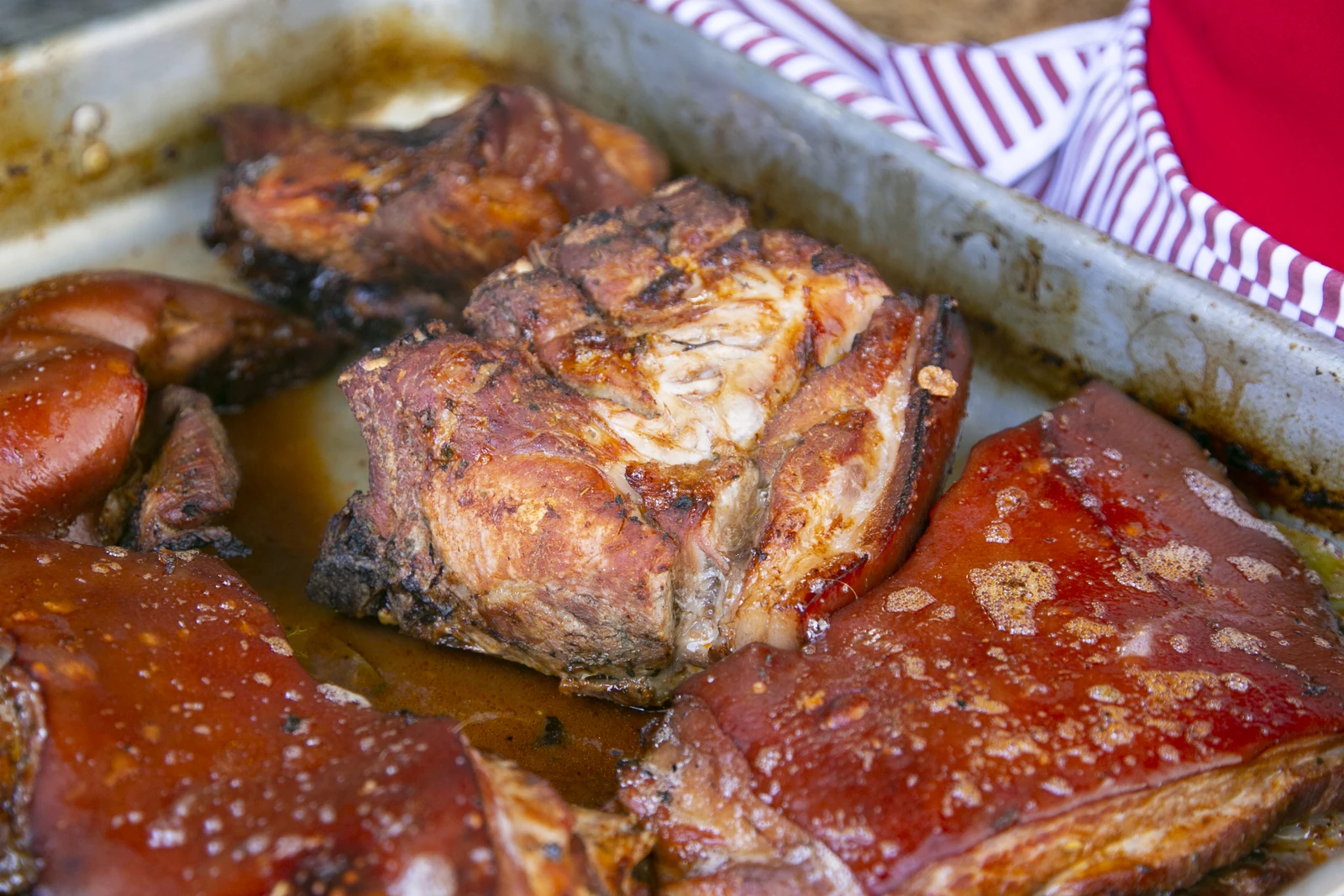

Lechon asado (leh-CHOHN ah-SAH-doh) is Cuban roast pork, the centerpiece of Nochebuena, the Christmas Eve dinner in Cuba and in Cuban American homes. At a big party it’s a whole pig in a caja china, a wooden roasting box. At home it’s a skin-on pork shoulder marinated overnight in mojo, a sharp sauce of sour orange juice, a whole head’s worth of garlic, cumin and oregano, then slow-roasted until the meat is tender and the skin crackles. There’s no sugar and no glaze. Here’s what to buy, how to handle sour orange if you can’t find it, a Christmas Eve timeline, and the one number that matters most: the internal temperature that decides between slices and shreds.
What Cuban roast pork is, and how long it takes
How do you make Cuban roast pork in the oven? Score the skin of a 7¾ lb (3.5 kg) pork shoulder, rub the meat with a mojo of mashed garlic, salt, cumin, oregano, sour orange juice and olive oil, and refrigerate 12 to 24 hours. Roast uncovered at 325°F (160°C) for about 5 hours, to 170°F (77°C) for slicing or 195°F (90°C) for shredding, then blast the skin at 450°F (230°C) for 15 to 25 minutes. 1100 minutes (30 of them hands-on, 12 hours marinating, nearly 6 in the oven and resting) for 8 servings.
At a glance
| Cut | Bone-in, skin-on pork shoulder (picnic) |
| Marinade time | 12 to 24 hours, 4 at the very least |
| Oven | 325°F (160°C) uncovered, then 450°F (230°C) for the skin |
| Time | About 85 to 90 minutes per kg (40 per lb) to 195°F (90°C) |
| Done | 170°F (77°C) to slice, 195°F (90°C) to shred |
| Serves | 8, with some leftovers |
| Difficulty | Medium: it’s planning, not technique |
Lechon asado, pernil, and other Latin roast pork
All of these are slow-roasted pork, but the marinade makes each one a different dish. Venezuelan pernil is a leg in a blended marinade of sweet pepper, wine and Worcestershire, roasted covered and finished with a raw-sugar glaze, so it’s sweet and savory. The Mexican adobo pork leg is skinless and served in a red chile sauce. Colombian lechona is a whole pig’s skin stuffed with seasoned pork and yellow peas. Cuban lechon asado is the plainest of them: garlic, sour orange, cumin and oregano, roasted uncovered. The tang is the point.
Buying the pork
US. Ask for a picnic shoulder, sometimes labeled “pork shoulder picnic” or “picnic roast.” Latin supermarkets usually sell it with the skin on. A Boston butt is the upper shoulder, usually sold without skin: very juicy, but no crackling. A fresh ham (uncured leg) is leaner and slices neatly but dries out faster.
UK. Ask a butcher for a bone-in pork shoulder joint with the rind on, about 3.5 kg. Supermarket rolled shoulder joints are boneless and smaller; they work, but start checking the temperature earlier.
How much per person. I plan on 400 g (14 oz) of raw bone-in, skin-on shoulder per person when there’s rice, beans and yuca on the table, and 450 to 500 g (1 to 1 lb 2 oz) if you want leftovers. Shoulder loses a lot to bone, skin and fat: one pound of raw picnic shoulder gives about 191 g (6¾ oz) of lean roasted meat, plus whatever fat you keep. So a 7¾ lb (3.5 kg) shoulder serves 8 people about 5 oz (150 g) of meat each, usually with a little left over.
| Guests | Bone-in, skin-on shoulder | Sour orange juice for the mojo |
|---|---|---|
| 8 | 3.5 kg (7¾ lb) | 360 ml (1½ cups) |
| 12 | 5 kg (11 lb), one large or two smaller | 520 ml (2¼ cups) |
| 16 to 20 | 7 to 8 kg (15½ to 17½ lb) in two pieces | 720 to 820 ml (3 to 3½ cups) |
Scale the rest of the mojo in the same proportion as the pork.
Sour orange, and what to use instead
Sour orange (naranja agria) is the same fruit as the British Seville orange: as tart as a lime, with a bitter, perfumed peel. It’s what makes mojo taste Cuban.
- US. Fresh sour oranges turn up in Latin and Caribbean grocers, and bottled sour orange juice sits in the Hispanic aisle all year. Bottled sour orange juice usually has no salt. Bottled mojo criollo is a different product, a ready-made marinade that does contain salt: if you use it instead of juice, halve the salt in the marinating mojo and taste.
- UK. Seville oranges are in shops in January and February for marmalade. Juice a few then and freeze it in ice cube trays for Christmas.
- Anywhere, my default: 2 parts orange juice to 1 part lime juice, 1 cup plus ½ cup (240 + 120 ml) for this recipe. Slightly sweeter and less floral than the real thing, with the acidity the mojo needs.
- Half orange, half lime if you like it sharper.
- Orange juice alone isn’t worth it: the pork comes out sweet and flat.
Equipment. A deep roasting pan about 14 × 10 in (35 × 25 cm), with ¾ in (2 cm) of room around the meat; a very sharp knife or a clean box cutter for the skin; a mortar or blender; and an instant-read or probe thermometer, the one thing with no substitute. No container big enough to marinate in? Use a large zip-top bag, then take the pork out at least 8 hours before roasting, pat the skin dry, rub it with the 10 g of salt and let it dry uncovered in the fridge.
Christmas Eve timeline
For a 9 pm dinner on the 24th:
| When | What | Hands-on |
|---|---|---|
| Dec 23, morning or midday | Score the skin, make the mojo, rub the meat, salt the skin | 30 min |
| Dec 23, evening | Spoon the mojo from the bottom over the meat, not the skin | 2 min |
| Dec 24, 2:30 pm | Oven at 325°F (160°C), pork in uncovered with mojo and water | 10 min |
| 6:00 pm | First temperature check | 1 min |
| Around 7:30 pm | Oven up to 450°F (230°C) for the skin; make the serving mojo | 10 min |
| Around 7:50 pm | Rest 20 to 30 minutes, then carve | 15 min |
That leaves half an hour of slack for a slow shoulder or an oven that takes a while to climb to 450°F. If the pork hits its temperature early, take it out, tent loosely with foil without pressing on the skin, and do the 450°F (230°C) blast just before dinner. It stays hot for up to an hour like that. The serving mojo can be made on the 23rd and kept in a jar in the fridge; take it out an hour ahead, as olive oil thickens when cold.
Roasting it
Score properly. Diamonds ¾ in (2 cm) wide, through the skin and fat but not into the meat. Cuts into the meat let juices pool under the skin, and wet skin won’t crackle.
Mojo in the meat, salt on the skin. The garlic paste goes deep into the slits on the meaty side. The skin gets only salt and a night uncovered in the fridge; by morning it should feel dry and taut, like card.
Uncovered at 325°F (160°C). The onion rings lift the pork off the pan and cook down in the mojo. Baste the meat, not the skin, with the pan juices every 90 minutes, and keep about ½ in (1 cm) of liquid in the pan so the garlic doesn’t scorch and turn bitter.
Internal temperature, slices or shreds
At 325°F (160°C), allow roughly 40 minutes per pound (85 to 90 minutes per kg) to reach 195°F (90°C): about 5 hours for this size. Ovens and shoulders vary. Take the first reading at 3½ hours, in the thickest part and not touching bone, then check again every half hour.
| Internal temp | What you get |
|---|---|
| 145°F (63°C) + 3 min rest | Safe, but shoulder is still tough and rubbery |
| 170°F (77°C) | Firm, juicy slices for carving at the table |
| 185°F (85°C) | Comes apart in big chunks with a fork |
| 195°F (90°C) | Falls into shreds and the bone pulls out clean |
For Nochebuena I go to 195°F (90°C) and serve it in chunks and shreds tossed with the pan juices. For thin slices for sandwiches, pull it at 170°F (77°C).
Crackling, and the rescue if it won’t crisp
With dry, salted skin, 15 to 25 minutes at 450°F (230°C) puffs it into golden blisters that sound hollow when tapped. Pull it as soon as it gets there.
If smooth, leathery patches are left after 25 minutes, take the skin off in one piece, lay it fat side down on a lined baking sheet and roast it alone at 450°F (230°C) for 10 to 15 minutes, checking every 5. Keep the meat tented with foil meanwhile. This almost always saves it.
What goes wrong
- Chewy skin → it got wet with mojo, wasn’t dried overnight, or was covered while resting. Crisp it separately.
- Tough meat even though it’s cooked → pulled at 160 to 165°F (71 to 74°C) when you wanted shreds. The connective tissue in shoulder hasn’t softened yet; put it back until 195°F (90°C).
- Dry meat → a lean fresh ham taken to 195°F (90°C), or a dry pan. Leg comes out at 170°F (77°C).
- Bitter or harsh garlic → garlic blitzed too long, or mojo burned in a dry pan.
- Too sour → real sour orange plus extra lime. Pick one.
- Basting with the raw marinade at the end → the mojo that sat with raw pork only goes in the oven at the start, where it cooks for hours. At the table, use the separate serving mojo.
Allergens and heat. No gluten, dairy, eggs or nuts, and no chile heat at all. Kids tend to like the shredded meat with its juices; the serving mojo, with all that raw garlic, is more of a grown-up thing.
Variations and scaling
- Short on time. Marinate at least 4 hours in the fridge. The outside tastes of mojo, the inside less so.
- For 16 to 20. Two 3.5 to 4 kg (7¾ to 9 lb) shoulders in two pans, swapping shelves halfway. Check each one separately; they won’t finish together.
- Boneless or skinless. Same recipe, no skin blast. Start checking a tied 2.5 kg (5½ lb) boneless shoulder at 3 hours.
- Whole leg, 7 to 8 kg (15½ to 17½ lb). Multiply the mojo by 2.2 and follow the oven and day-by-day plan for the Venezuelan pernil, which is the same cut.
- Sour orange and achiote. That’s a different dish: Yucatán cochinita pibil shares the sour orange but is wrapped in banana leaves.
What to serve with it, leftovers and storage
The Nochebuena plate is lechon with Cuban congri, rice cooked with red beans, or moros y cristianos, its black bean twin, or white rice with a pot of Venezuelan-style black beans on the side, boiled yuca with the serving mojo spooned over, and sweet fried ripe plantains (maduros). If you’d rather crisp the yuca, fried yuca takes the mojo just as well. Allow 1 cup of rice and ½ cup of beans per person.
Leftovers. The next morning it’s pan con lechón: Cuban or soft white bread, hot pork with its juices and the onion from the mojo. Sliced pork from a 170°F (77°C) roast is also the base of the Cuban sandwich, with ham, Swiss cheese, pickles and mustard, pressed on a griddle.
Fridge. 3 to 4 days at 40°F (4°C) or below, in shallow containers with some of the juices, as long as it goes in within 2 hours of coming out of the oven. Keep the crackling separate and uncovered, or it goes soft overnight.
Freezer. 3 to 4 months, shredded, in bags with its juices. Thaw overnight in the fridge.
Reheating. Covered, with 3 or 4 tbsp of juices or water, in a 325°F (160°C) oven or a skillet over medium heat, until it reaches 165°F (74°C) in the center. Crackling comes back with about 10 minutes uncovered at 400°F (200°C). The microwave is fine for the meat, not the skin.
Cuban roast pork FAQ
Can I marinate it longer than 24 hours? Two full days in the fridge is safe, but I stop at one. The flavor barely improves, and with that much acid the surface of the meat turns a little mealy.
Can I freeze it in the marinade? Yes. Freeze the raw shoulder in a bag with the mojo and thaw it in the fridge, allowing about 24 hours for every 4 to 5 lb (2 kg). It keeps marinating as it thaws. Dry and salt the skin, then give it a night uncovered before roasting.
Can I roast it the day before? Yes, if you’re shredding it. Roast to 195°F (90°C), shred it into its juices and refrigerate; keep the skin separate and uncovered. On the day, reheat covered at 325°F (160°C) with the juices to 165°F (74°C), checking from 30 minutes, and re-crisp the skin for about 10 minutes at 400°F (200°C).
Is lechon asado the same as pernil? Same idea, different marinade. “Pernil” usually names the cut, a leg or shoulder; Cuban lechon asado is defined by its sour orange and garlic mojo. And in Cuba, Puerto Rico and Colombia, lechón or lechona can also mean the whole pig.
Nutrition per serving
Per serving: 5 oz (150 g) of roasted shoulder with its fat, no skin or bone, plus one-eighth of the serving mojo, worked out from the recipe quantities.
- Calories: 609 kcal
- Protein: 36 g
- Carbohydrates: 3 g
- Fat: 50 g, including 15 g saturated
- Fiber: 0 g
- Sugar: 1 g
The pork accounts for 476 kcal and the olive oil in the serving mojo for about 119. If you trim off the visible fat, a 5 oz serving of lean meat alone comes to 342 kcal with 19 g of fat. I don’t give a sodium figure because it depends on how much of the mojo’s salt stays in the meat and how much ends up in the pan.
My own Christmas pork is the sweet Venezuelan one, glazed with raw cane sugar, so the first time I made this I didn’t expect much from garlic and citrus alone. It needs nothing else. I take it to 195°F, toss it with the strained pan juices and put the serving mojo in a little jug, because my son likes the meat plain and I want mine soaked. Josnaisis.