
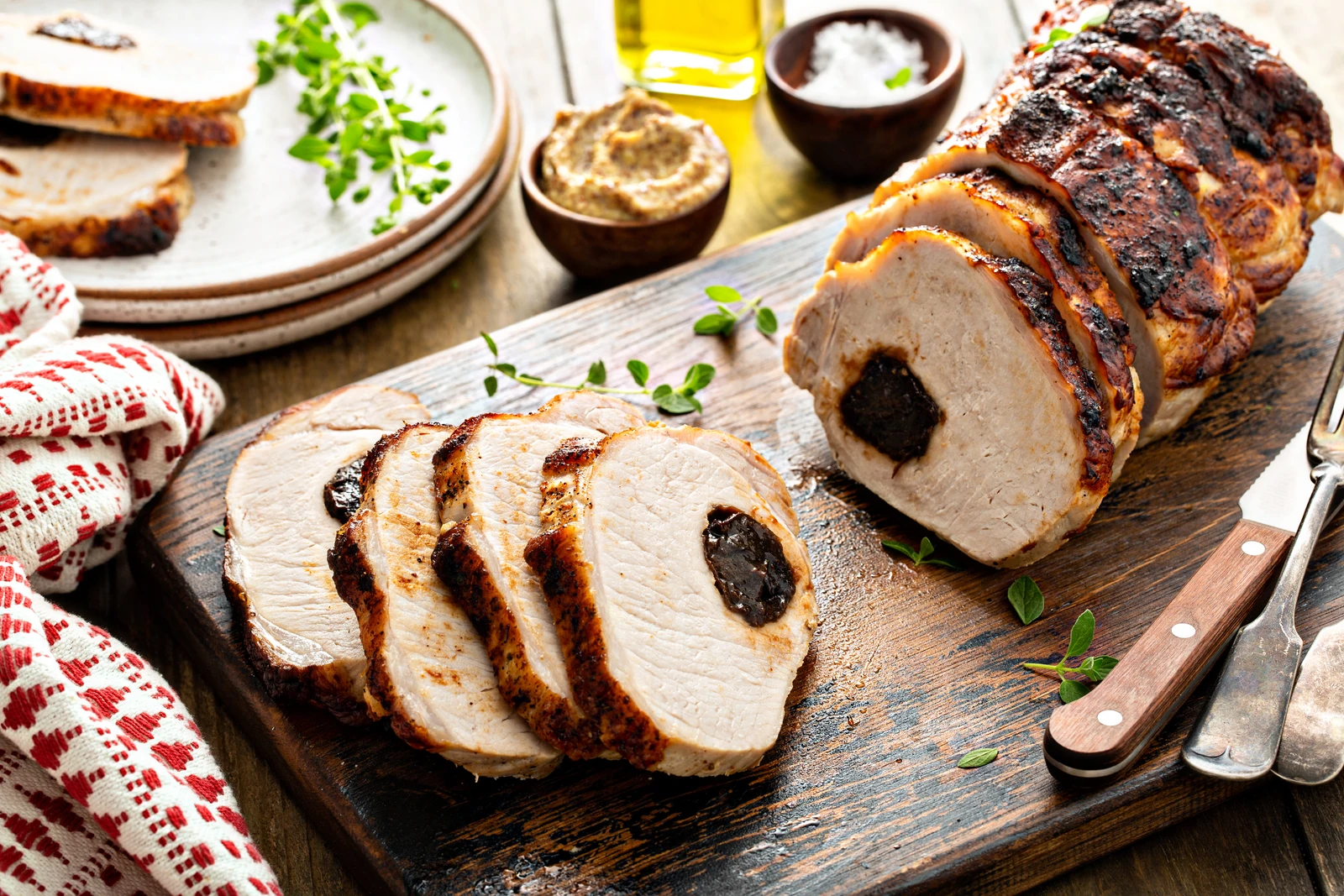

In Colombia, lomo relleno (LOH-moh reh-YEH-noh) is one of the roasts families make at home for the Christmas Eve dinner on December 24, alongside pernil, turkey and lechona. A boneless pork loin is cut open into one flat sheet, layered with bacon, mozzarella, prunes and red pepper, rolled back up, tied and roasted over white wine and onions. Sliced, every round has a spiral of filling, and the pan juices become the sauce. This version serves 8 from a 3.3 lb (1.5 kg) loin, and opening the loin, the step that worries first-timers, is spelled out cut by cut.
What Colombian stuffed pork loin tastes like, and how long it takes
How do you make Colombian stuffed pork loin? Butterfly a 3.3 lb (1.5 kg) boneless pork loin into a ⅝ to ¾ in (1.5 to 2 cm) sheet, season it, layer on bacon, mozzarella, prunes and red pepper, roll it up and tie it every 1¼ in (3 cm). Brown it in a skillet, then roast at 350°F (180°C) over onion, white wine and stock until the center reads 160°F (71°C), 80 to 100 minutes, and rest 15 minutes. 160 minutes for 8 servings.
It tastes like garlic-and-thyme roast pork with salty pockets of bacon, sweet bits of prune and melted cheese, and no chile heat at all, so children usually like it. The sauce is light and glossy rather than a thick gravy.
Time. About 40 minutes of hands-on work (butterflying, filling, tying) and 2 hours of browning, roasting and resting, plus the optional overnight salting. Medium difficulty: if you’ve never butterflied a roast, the first cut is the only new skill.
If you want a pork loin that stays whole and pink in a dark prune and orange sauce, that’s the Mexican pork loin in prune sauce. The Venezuelan Christmas roast is the bone-in pernil, and Colombia’s other famous loin is beef, the salt-crusted tenderloin wrapped in a salt-packed cloth and cooked on coals.
What to buy, with US and UK swaps
Ask for a boneless center-cut pork loin roast about 3 to 3½ in (8 to 9 cm) thick. In the UK it’s a boneless pork loin joint; ask for the rind to be taken off. Many butchers will butterfly it for you if you ask. Don’t use pork tenderloin: at about 1 lb (500 g) it’s far too thin to roll around a filling.
| Colombian ingredient | What to buy | What changes |
|---|---|---|
| Tocineta | US smoked bacon, UK smoked streaky bacon | Nothing; back bacon is too lean to baste the inside |
| Queso doble crema | Low-moisture mozzarella, sliced from a block | Nothing; fresh mozzarella in water turns the filling soggy |
| Ciruelas pasas | Pitted prunes | Same thing |
| Vino blanco | Any dry white, such as Sauvignon Blanc or Pinot Grigio | Sweet wine makes a cloying sauce |
| Fécula de maíz | Cornstarch (UK cornflour) | Same thing |
Equipment. A long sharp knife, cotton kitchen twine (not nylon, which melts), a roasting pan about 12 × 8 in (30 × 20 cm) and an instant-read thermometer. No twine? Soak wooden toothpicks for 10 minutes and pin the seam every 1¼ in (3 cm); it holds less well, so roll tighter and don’t turn the roast.
How to butterfly a pork loin, the roll cut
The goal is to unroll the loin like a carpet without ever cutting all the way through.
- First cut. Loin on the board, fat side down, long side toward you. Rest your flat hand on top and slide the knife in parallel to the board, ⅝ in (1.5 cm) up, along the whole length. Stop ⅝ in (1.5 cm) before the far edge; that uncut strip is the hinge.
- Unfold. Open the flap toward you. You now have a thin strip attached to a thick block.
- Repeat. Make the same cut into the thick block, at the same height, stopping short of the edge again, and unfold. A 3 to 3½ in (8 to 9 cm) loin usually takes two or three cuts to become a sheet about 12 × 12 in (30 × 30 cm).
- Even it out. Cover with plastic wrap and pound the thick areas from the center outward until the whole sheet is ⅝ to ¾ in (1.5 to 2 cm). Even thickness is what makes it cook evenly.
Tying. Roll tightly from the long side, like a jelly roll, until it’s loin-shaped again. Seam side down, slide twine under the roast, knot it firmly on top and cut; repeat every 1¼ in (3 cm), 8 or 9 loops. Finish with one length running end to end, looped under the ties: that’s the one that keeps the filling from sliding out of the ends.
Roasting time and the 165°F rule
A plain pork loin is safe at 145°F (63°C) and slightly pink. A stuffed one is different: when you butterfly it, the outside surface of the meat, the side that touched the board and your hands, ends up on the inside, against the filling. That’s why the center of the roll needs to reach 165°F (74°C), the same as any stuffed meat.
Push the thermometer in from the side to the center of the thickest part. Pull the roast at 160°F (71°C); during a 15-minute rest under loose foil it climbs about 4 to 5°F (2 to 3°C). Check again, and if it hasn’t reached 165°F, give it 10 more minutes. Going past that is what dries it out, because the outer layers are always hotter than the center.
Per pound. At 350°F (180°C), after browning, plan on about 27 minutes per pound (1 hour per kg): 80 to 100 minutes for a 3.3 lb roll. A thick, short roll takes longer than a long, thin one of the same weight, so use the clock only to know when to start checking.
Why brown first. At 350°F alone the outside won’t color before the center is done. Ten to twelve minutes in a skillet fixes that.
The pan sauce. Strain the juices, pressing on the soft onion, and skim the fat. You should have about 1½ cups (360 ml); top up with stock if not. Boil, add the cornstarch slurry and cook 2 minutes. For a thicker sauce, add 1 more tsp cornstarch mixed with water.
Make-ahead plan for Christmas Eve
- December 23, evening. Butterfly the loin and rub it with the seasoning, wrap and refrigerate. Halve the prunes and slice the pepper; refrigerate covered.
- December 24, 3 hours before dinner. Fill, roll and tie (15 minutes), brown, roast and rest.
- While it rests. Make the sauce (5 minutes) and slide the sides into the hot oven.
I don’t fill it the night before: the raw meat would spend the night with the stuffing pressed against the surface that touched the board, and there’s nothing to gain once it’s salted.
Fully cooked the day before. Roast it on the 23rd, chill it whole and slice it cold, which gives the neatest spirals. On the 24th, arrange the slices in a baking dish with the sauce, cover with foil and heat at 325°F (160°C) for 25 to 30 minutes, until the center of the slices reaches 165°F (74°C).
Scaling for 12 or 20 people
The recipe allows about 7 oz (190 g) of raw pork per person, generous when there’s rice, potatoes and a salad on the table.
- 12 people. Two loins of 2.6 lb (1.2 kg) each and 1.6 times the filling (8½ oz / 240 g each of bacon and cheese, 6½ oz / 190 g prunes, 2 peppers). Two thinner rolls fit in one pan and cook faster; start checking at 50 minutes.
- 20 people. 8.4 lb (3.8 kg) in three pieces of about 2.75 lb (1.25 kg), 2½ times the filling, two pans swapped between racks halfway. Check each roll on its own.
If something goes wrong
- Raw in the middle, dry outside. The sheet was too thick or the oven too hot. Slice it and finish the rounds covered in simmering sauce for 3 to 4 minutes.
- It unrolled in the oven. Ties too loose or no end-to-end string. Keep a ¾ in (2 cm) border and don’t overfill.
- Cheese leaked out. Shredded or fresh mozzarella. Use sliced low-moisture.
- Bland inside. Only the outside was seasoned. The salt and garlic go on the face that ends up inside.
- Bitter sauce. The pan ran dry and the juices burned. Add water whenever the bottom shows.
- Slices fall apart. Cut before resting. Give it the full 15 minutes.
Allergens. Contains milk (cheese) and sulfites (wine). Gluten-free if your stock and bacon are; check labels.
Variations
- Ham and vegetable filling. 5 oz (150 g) chopped ham, 1 grated carrot, the red pepper and ½ chopped onion bound with ½ cup fresh breadcrumbs and 1 beaten egg. It slices like a terrine; with egg inside, reaching 165°F (74°C) in the center is a must.
- Without wine. Use 1 cup unsweetened apple juice (sweeter sauce) or more stock (flatter sauce; add 1 tbsp cider vinegar at the end).
- No oven. Brown it in a heavy pot it just fits, add the wine, stock and onion, cover and cook over low heat, turning every 15 minutes. Start checking at 45 minutes, same 160°F (71°C) pull. Softer, no crust.
- Walnuts instead of bacon. 2 oz (50 g) chopped walnuts with the cheese and prunes. Lighter but drier: baste every 20 minutes.
The loin is the main cost, then the bacon and cheese. For a crowd, two medium loins cost less than the same weight in small pieces.
What to serve with it, and leftovers
On the table. Spoon the sauce over creamy mashed potatoes or serve it with Christmas rice with pecans and raisins, a cold ensalada rusa with beets, and Colombian natilla for dessert. If part of your table is Caribbean, Dominican rice and pigeon peas can take the place of the rice and holds the sauce well. For a bigger Colombian spread, lechona is the showpiece pork. Allow 1 cup of rice or potatoes per person with two sides.
Fridge. Refrigerate within 2 hours of serving, in a covered container; it keeps 3 to 4 days. Store the sauce separately.
Freezer. 2 to 3 months, sliced and covered with sauce so it doesn’t dry out. Thaw overnight in the fridge.
Reheating. Covered with sauce at 325°F (160°C) for 20 to 25 minutes for a few slices, or in a covered skillet over low heat with 2 to 3 tbsp stock for 6 to 8 minutes, to 165°F (74°C). In the microwave, use medium power in 1-minute bursts. Cold slices make a great sandwich with mustard on December 25.
Colombian stuffed pork loin FAQ
Can I stuff a pork loin without butterflying it? Yes, by tunneling: push a long thin knife lengthwise through the center, widen the hole with the handle of a wooden spoon and pack in prunes and bacon strips. Skip the cheese, which leaks. You get a circle of filling in each slice instead of a spiral, and the target is the same 165°F (74°C) in the center.
Can I use a frozen pork loin? Thaw it whole in the fridge first; a 3.3 lb (1.5 kg) loin needs about 24 hours. Frozen meat can’t be butterflied and releases water when you brown it.
Is it served with sauce or on its own? Either. The filling already brings fat and flavor, so the pan juices alone are fine. With rice and potatoes on the table, the thickened sauce stretches further and rescues any slice that came out a little dry.
Nutrition per serving
Per serving (⅛ of the recipe, about 7 oz / 190 g raw pork with its filling and sauce, no sides), calculated from the recipe quantities:
- Calories: 612 kcal
- Protein: 45 g
- Carbohydrates: 15 g
- Fat: 38 g, of which 14 g saturated
- Fiber: 2 g
- Sugars: 8 g
- Sodium: 877 mg
The pork accounts for about 371 kcal per serving, the bacon 74 and the cheese 56. The figures count all of the bacon fat and all of the wine; some stays in the pan or cooks off, so the real number is a little lower.
I salt the loin the night before every year, mostly so there’s one less job on the 24th, and I let Dylan lay the prunes in their rows. Crooked rows still make a pretty spiral. In my house the sauce always runs out first, so some years I make it with 1½ cups of stock instead of 1. Josnaisis.