
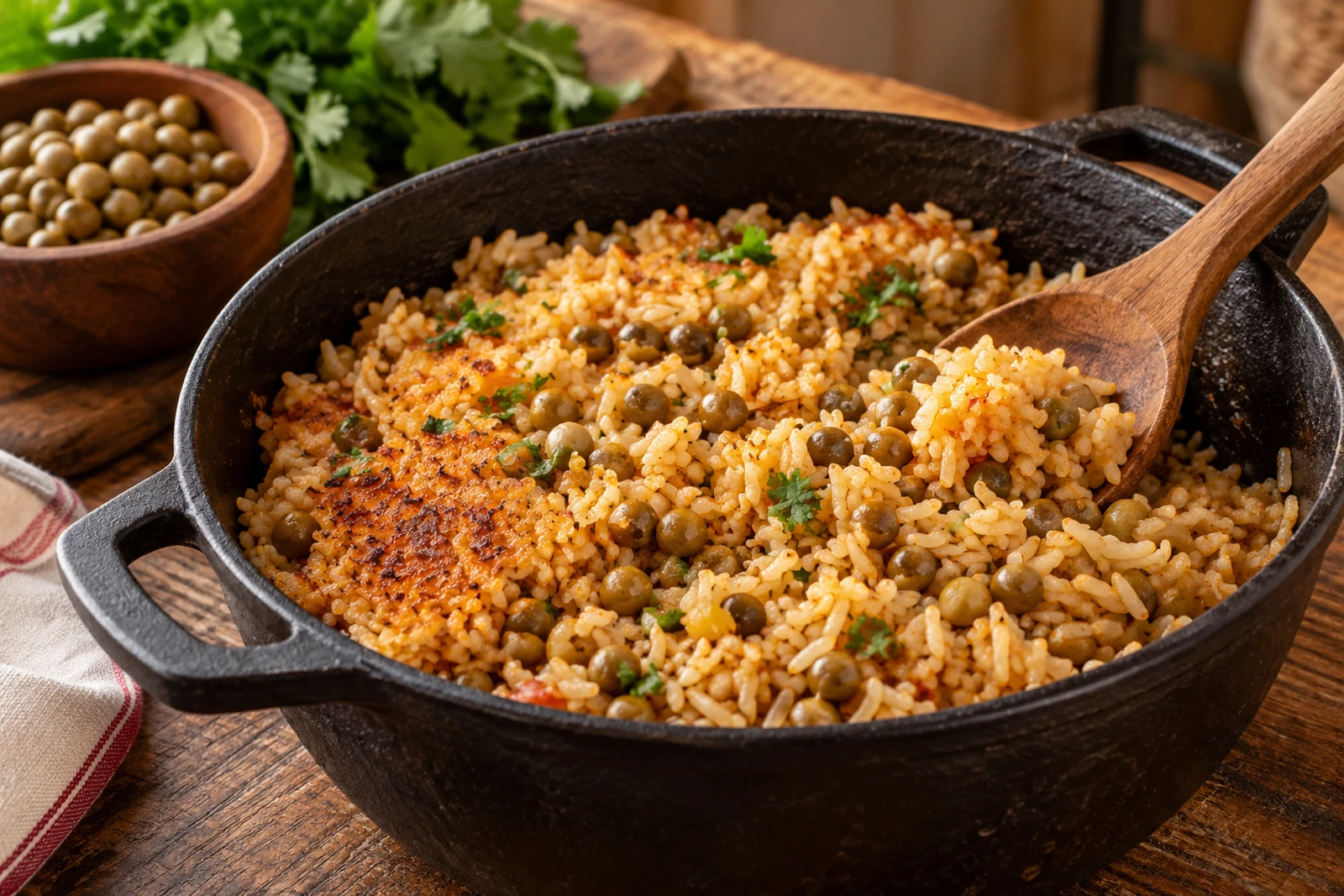

With drained canned pigeon peas and white rice, moro de guandules turns out fluffy when you use 2¾ cups (660 ml) of liquid for every 2 cups (370 g) of rinsed long-grain rice and finish it covered on the lowest heat without touching the bottom. That gives you tender separate grains, whole pigeon peas and a golden crust stuck to the pot, the concón, which gets scraped out and served on its own. Below is the recipe for 6, how canned, frozen and dried pigeon peas change the prep, the coconut milk version, quantities for a crowd of 12 or 20 (each with its own liquid adjustment) and how to reheat it.
What moro de guandules is
How do you make moro de guandules? Soften onion, cubanelle pepper, celery, garlic and cilantro in oil, stir in tomato paste and a drained can of pigeon peas, add 2¾ cups (660 ml) of salted water and bring to a boil. Add 2 cups (370 g) of rinsed rice, cook uncovered until the liquid sinks below the rice, then cover on the lowest heat for 15 minutes, fold and cook 5 to 10 minutes more. 60 minutes for 6 servings.
In the Dominican Republic, moro is rice cooked in the same pot with a legume, and the pigeon pea version is the one for celebrations: it is on the table at the Christmas Eve dinner (Nochebuena), next to roast pork. It is a side dish, not a one-pot meal. Expect light brick-red rice that tastes of sofrito and oregano, with firm, slightly earthy peas.
Is it the same as Puerto Rican arroz con gandules? Close relatives, different seasoning: the Puerto Rican version usually starts with a culantro-based recaíto and sazón with annatto, which turns it yellow-orange, and cooks pork in the pot, while this moro, like many Dominican home versions, has no meat in the rice and comes out redder from the tomato. Cuban congri, rice cooked with red beans in their own liquid, is another one-pot cousin, seasoned with bacon and cumin.
Two related rices on this site, for comparison: Colombian coconut rice reduces coconut milk until it toasts and has no peas, and Mexican Christmas rice with pecans and raisins is the sweet, creamy option for a December table. If you want rice with the meat cooked in, that is Colombian chicken and rice.
Time and difficulty. 60 minutes: 15 to rinse and chop, 45 on the stove, about 25 of them covered and hands-off. Medium difficulty, only because the liquid level and the low heat of the covered stage take one practice run to get right.
Pigeon peas, and where to buy them
Pigeon peas are small, round, beige-to-green legumes with a nutty, earthy taste. Spanish speakers call them guandules (Dominican Republic), gandules (Puerto Rico) or quinchoncho (Venezuela); in Jamaica and in British Caribbean shops they are gungo peas.
- US. Canned, in the Hispanic or international aisle of most supermarkets, labeled green pigeon peas or gandules. Frozen and dried, in Latin and Caribbean grocery stores.
- UK. Canned gungo peas or pigeon peas in the world-food aisle of larger supermarkets and in Caribbean and Asian shops.
- Skip toor dal. It is the same plant, but hulled and split: it collapses into a mush and turns the rice sticky.
- No pigeon peas at all? Canned black-eyed peas are the closest swap in texture, milder in taste. It stops being moro de guandules, but the method is identical.
Canned, frozen or dried
| Pigeon peas | Prep first | Amount | Liquid |
|---|---|---|---|
| Canned, 15 oz (425 g) | Drain and rinse | 1 can | 2¾ cups (660 ml) water |
| Frozen | Boil 10 to 12 minutes in salted water, drain | 1½ cups (250 g / 9 oz) | 2¾ cups (660 ml) |
| Dried | Soak overnight, simmer until tender | ½ cup dried (about 100 g / 3½ oz) gives 1½ cups cooked | 2¾ cups (660 ml), using the cooking water |
- Canned. Drain them, because the can liquid is salty and cloudy. If you would rather use it, measure it and subtract it from the 2¾ cups of water.
- Frozen. Do the pre-boil, or follow your bag. Added raw, they risk staying firm when the rice is done.
- Dried. The cheapest and the most flavorful. After soaking, simmer in unsalted water for 1¼ to 2 hours; old peas can take longer, so start tasting at 1 hour. In a pressure cooker or Instant Pot, 15 to 20 minutes after soaking. Keep the cooking water: it gives the rice a darker color and more pea flavor.
Ingredients and swaps
- Rice. American long-grain white rice, or the long grain rice in UK supermarkets. Medium- and short-grain rice release starch and go sticky. Rinsing until the water runs almost clear is what keeps the grains separate.
- Cubanelle pepper. A long, pale green, mild pepper, sold in most US supermarkets. Half a green bell pepper works and tastes a little more bitter.
- Tomato paste. It gives the color. ¼ cup (60 ml) of canned tomato sauce (UK passata) can replace the 2 tablespoons, for a lighter-colored rice.
- Seasoning packets. Many home cooks add a packet of sazón or half a chicken bouillon cube. If you do, cut the salt to ¾ tsp and taste the liquid before adding the rice.
- Pot. A heavy pot of 3 to 4 quarts (3 to 4 liters) with a tight lid; Dominican cooks use a caldero, a thick cast-aluminum pot, and a Dutch oven is the nearest thing in most kitchens. The cooked rice should not fill more than three-quarters of it. If the lid is loose, put a sheet of foil under it.
How to make it, step by step
The base. Soften the vegetables 3 to 4 minutes over medium heat; if they brown, the rice turns bitter. Cook the tomato paste 1 minute until it darkens and catches a little: the boiling water lifts that layer off the bottom and it becomes color and flavor.
Taste the liquid. When the water boils, taste it. It should be slightly saltier than you want the rice, because the grains absorb the salt. Once the rice is in, there is no way to season it evenly.
Uncovered, until the rice shows. Medium heat, no lid, 8 to 10 minutes, stirring gently every 2 minutes. Cover when the liquid has dropped below the surface and small steam holes appear across the rice. Covering with liquid on top makes it soggy; waiting until it is completely dry burns the bottom.
Covered, on the lowest heat. The burner should be at its lowest setting that still makes steam: the lid should feel hot. 15 minutes without lifting it. Then drizzle the last tablespoon of oil, fold the rice from the sides toward the middle without scraping the bottom, and cover for 5 to 10 minutes more.
Is it done? Taste grains from the top and the bottom: tender but intact, with no chalky center. If they are firm and the pot is dry, sprinkle 2 or 3 tablespoons of hot water, cover and wait 5 minutes. A big splash of water at this point makes it mushy.
The crispy bottom (concón)
Concón is the layer of toasted, crunchy rice left on the bottom of the pot; Puerto Ricans call it pegao. It forms by itself during the covered stage if four things line up:
- A heavy pot. Cast aluminum, cast iron or enameled cast iron. A nonstick pan barely makes any.
- Just enough liquid. Too much and it never toasts; too little and it burns before the rice is cooked.
- No scraping once the lid is on. When you fold, move the rice over that layer.
- Lowest heat with steam, plus the final tablespoon of oil, which is what makes it crisp.
When the rice is ready, move it to a dish right away: left in the pot, the steam softens the crust. Wait 2 minutes with the pot uncovered, then pry the concón off in large pieces. When I want it thicker, I leave the pot 5 extra minutes on the lowest heat before emptying it, and I go by smell: toasty is right; if it smells burnt, leave the bottom in the pot and serve only the rice above it.
The coconut version (moro de guandules con coco)
Swap 1 cup (240 ml) of the water for unsweetened canned coconut milk: 1 cup of coconut milk plus 1¾ cups (420 ml) of water. Nothing else changes. The rice comes out paler and richer, with a sweet coconut note that suits roast pork. For a stronger coconut flavor, use the whole 13.5 oz (400 ml) can and 1 cup plus 1 tablespoon (260 ml) of water, keeping the total at 2¾ cups.
- Shake the can before opening: the fat separates and rises.
- Not cream of coconut. The sweetened kind sold for piña coladas and Puerto Rican coquito makes the rice taste like dessert.
- Canned pigeon peas in coconut milk. If you find them, do not drain them: measure that liquid and top up with water to 2¾ cups.
With 1 cup of coconut milk, each serving goes up to about 425 calories and 16 g of fat.
Troubleshooting
- Mushy or wet. Too much liquid, unrinsed rice, or covered while liquid still sat on top. To rescue it, uncover and leave 5 minutes on the lowest heat to dry out.
- Hard rice, burnt bottom. The covered stage was too hot or steam escaped under the lid. Turn the heat down, seal with foil and use the 2-to-3-tablespoon water trick.
- Broken grains, smashed peas. It was stirred while covered. After the lid goes on, it gets folded once.
- Bland. The liquid was not tasted before the rice went in. Dissolve a little salt in 2 tablespoons of hot water, sprinkle it over and fold.
- Bitter. The garlic or vegetables browned too much. Medium heat, and garlic last.
Allergens and heat. It contains celery, one of the 14 allergens UK labeling requires. It is gluten-free unless your bouillon or seasoning packet contains gluten, and vegan without chicken bouillon. It is not spicy, and kids usually like it.
Scaling it for a holiday crowd
| People | Rice | Pigeon peas | Liquid | Pot |
|---|---|---|---|---|
| 6 | 2 cups (370 g) | 1 can | 2¾ cups (660 ml) | 3 to 4 qt (3 to 4 l) |
| 12 | 4 cups (740 g) | 2 cans | 5 cups (1.2 l) plus ½ cup (120 ml) in reserve | 6 qt (6 l) |
| 18 to 20 | 6 cups, in 2 pots of 3 cups | 3 cans | 4 cups (950 ml) per pot plus ½ cup in reserve | 2 pots of 4 to 5 qt |
A bigger pot loses less liquid per cup of rice, so I do not simply multiply the water: I start with these amounts and keep hot water nearby for the end. For 20, two medium pots beat one huge one, because in an overfilled pot the bottom burns before the top is cooked. Double the sofrito and salt too, and taste the liquid in each pot.
Game plan for a dinner party.
- 2 or 3 days ahead. If using dried peas, cook them and refrigerate them in their water.
- The day before. Chop the onion, pepper, celery and cilantro and refrigerate them together in a sealed container.
- 1 hour before serving. Rinse the rice and start cooking, timing it to be ready as everyone sits down. If it has to wait more than a few minutes, do not leave it covered off the heat: move it to a covered dish in a low oven and check with a thermometer that it stays at 140°F (60°C) or above. Lift the concón out and keep it separate so it stays crisp.
If you must cook it the day before, do not cool it in the pot: spread it in shallow containers, no more than about 2 inches (5 cm) deep, and refrigerate within 2 hours. Reheat as below.
Serving, storing and reheating
Serving. At a Dominican Christmas Eve table it goes with roast pork, such as Cuban lechon asado with garlic mojo, or baked chicken, and often with a Russian-style potato salad. Plan on 1 cup of cooked moro per person. It suits a slow-roasted Venezuelan pernil or a Latin-style Christmas turkey, with ensalada rusa, the beet potato salad, as the cold side. On a weeknight, sliced avocado and twice-fried tostones make it a meal.
Fridge. In a sealed container, refrigerated within 2 hours, it keeps 3 to 4 days. Store the concón separately or it goes soft.
Freezer. Flat, in single portions. I use it within 2 months, as the grains dry out after that. Thaw overnight in the fridge.
Reheating. In a covered pan over low heat with 2 or 3 tablespoons of water per 2 cups of rice, 5 to 8 minutes, folding once, until steaming and 165°F (74°C) in the center. In the microwave, covered, with 1 tablespoon of water per serving, in 1-minute bursts, stirring between them. I reheat the concón on its own in a dry skillet, 1 to 2 minutes per side, and it crisps up again.
Moro de guandules FAQ
Is this the same as Jamaican rice and peas? No. Jamaican rice and peas is usually made with kidney beans or gungo peas, coconut milk, thyme and a whole Scotch bonnet. Moro is built on a tomato and sofrito base, and coconut is optional.
Can I make it in a rice cooker? Yes, without the crispy bottom. Cook the sofrito in a skillet, transfer it to the rice cooker with the peas and rinsed rice, add the amount of salted water your cooker’s manual gives for 2 cups of long-grain white rice, counting any liquid from the sofrito or an undrained can as part of it, and use the regular setting. A rice cooker barely evaporates, so do not use the full 2¾ cups from the stovetop method.
Can I use brown rice? Yes, but the liquid and timing change, and brown rice varies a lot by brand. As a starting point for 2 cups of brown rice: the peas with their can liquid plus 2 cups (480 ml) of water, simmered covered for 40 minutes once boiling, folded, then 10 minutes more. It is done when the grains are tender to the bite with no hard center and no liquid is left at the bottom; if still firm, sprinkle with hot water and cover for 10 to 15 minutes. Soaking the rice for 2 hours shortens the cooking.
Can I add pork? This version does not cook meat in the pot. For that flavor, brown about 3½ oz (100 g) of diced bacon or ham before the vegetables and use 1 tablespoon less oil; the result leans toward the Puerto Rican style.
Nutrition per serving
Per serving (one-sixth of the recipe, without coconut or olives), calculated ingredient by ingredient from the amounts above:
- Calories: 345
- Protein: 8 g
- Carbohydrates: 61 g
- Fat: 8 g, of which 1 g saturated
- Fiber: 3 g
- Sugars: 3 g
- Sodium: 600 mg
The rice provides about 225 calories per serving and the pigeon peas about half the fiber. The coconut version comes to about 425 calories. A bouillon cube or sazón packet raises the sodium considerably.
The hardest part of moro for me was keeping the lid on for those 15 minutes: the habit of peeking at the rice kept ruining my crust. Now I make the coconut version whenever there is pork on the table, and I always save a piece of the bottom for Dylan before I serve. Josnaisis.