
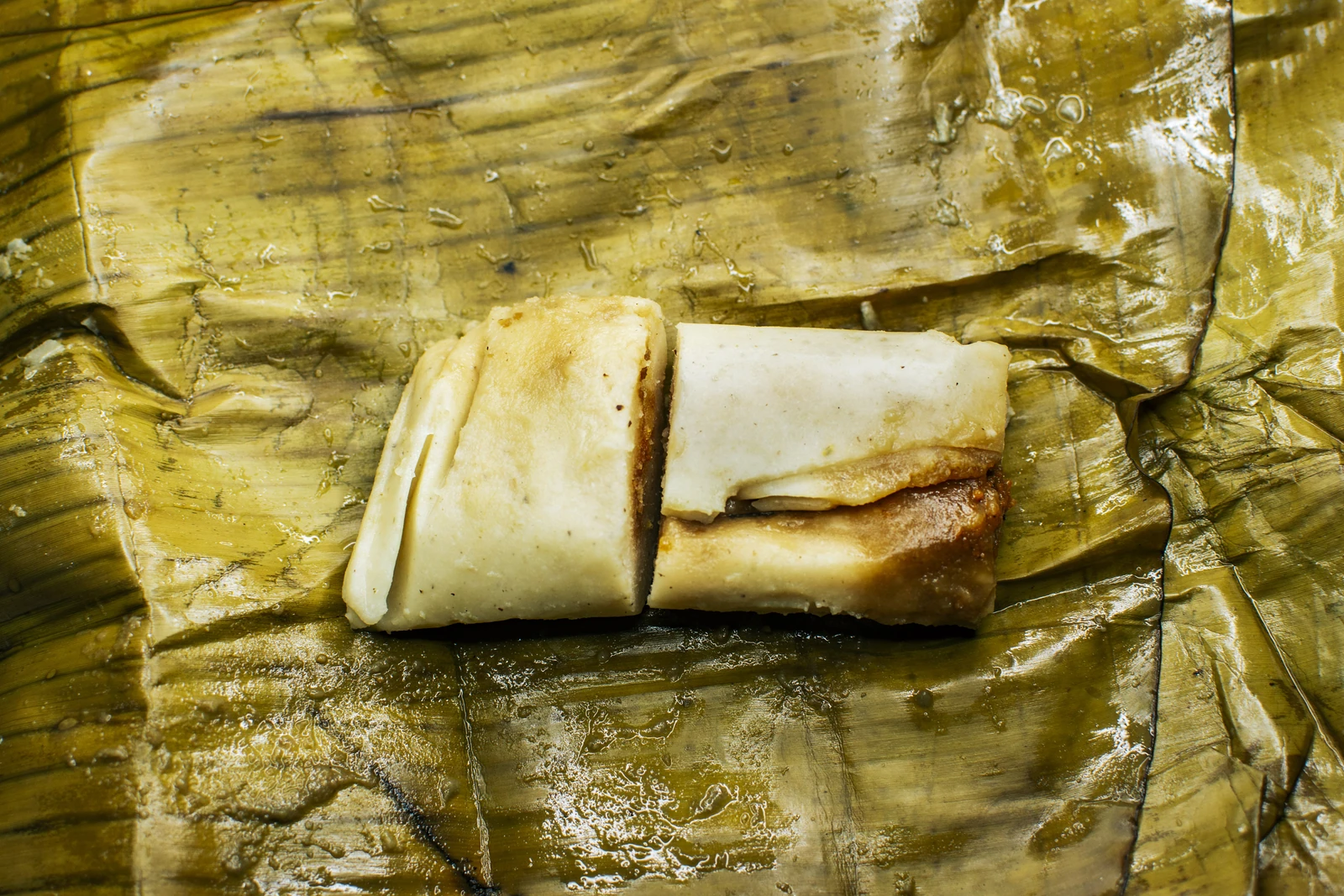

Pasteles (pahs-TEH-lehs) are Puerto Rico’s Christmas parcels: a soft masa of grated green bananas and yautía, a tropical root sold as malanga, colored orange with annatto oil, wrapped around a pork stew in banana leaf and parchment, tied in pairs and boiled. If you know tamales, think of the same idea with a dough made from raw root vegetables instead of corn. This recipe makes 20, with a two-day plan, shopping help for US and UK readers, and how to freeze the batch so you can boil a few whenever you want them.
What Puerto Rican pasteles are, and how long they take
How do you make Puerto Rican pasteles? Stew 2.2 lb (1 kg) of pork with sofrito and chill it. Finely grate 3½ lb (1.6 kg) of yautía and 8 green bananas and mix with milk, cooking liquid and annatto oil. Spread ½ cup of masa on banana leaf over parchment, add filling, fold into a packet, tie in pairs and boil for 1 hour. 270 minutes for 20 pasteles.
A cooked pastel unwraps into a moist, dense, pale-orange block that cuts with a fork. The masa tastes mild and earthy, of green banana and root vegetable; the flavor comes from the pork filling and the hot sauce on the table. On the Christmas table in Puerto Rico they sit next to arroz con gandules (rice with pigeon peas) and roast pork.
Time. About 4½ hours of work over two days: the filling the day before, then peeling, grating, wrapping and boiling. Medium difficulty. Nothing is hard, but grating 5¼ lb (2.4 kg) of roots and wrapping 20 parcels takes a while, and it goes much faster with a second pair of hands.
Shopping list, and where to find it
| Ingredient | Metric | US | Where to find it |
|---|---|---|---|
| Yautía (malanga), peeled weight | 1.6 kg | 3½ lb | US Latin produce section, sold as malanga; UK African and Caribbean grocers, as malanga, tannia or cocoyam. Not the same as taro (eddo, dasheen), which some shops also call malanga |
| Green bananas | 800 g peeled | 8 bananas | Latin and Caribbean grocers; fully green, hard supermarket bananas work |
| Boneless pork shoulder | 1 kg | 2.2 lb | Boston butt in the US; UK pork shoulder |
| Annatto seeds | 2 tbsp | 2 tbsp | Hispanic spice aisle as achiote; UK online or Latin shops |
| Banana leaves | 20 pieces | 20 pieces | Frozen, in Latin and Asian supermarkets |
| Parchment paper | 20 sheets, 30 cm | 20 sheets, 12 in | Any supermarket |
Green bananas are not plantains
The masa uses ordinary bananas picked green and hard, called guineos in Puerto Rico. Plantains are a different, starchier fruit. Buy bananas with no trace of yellow: ones that have started to ripen make a sweet, soft masa that won’t set.
The frozen masa shortcut
Latin supermarkets in the US sell frozen grated pastel masa in the freezer case. It replaces the hardest hour of the job. Thaw it in the fridge and season it with the annatto oil, cooking liquid and salt from this recipe, checking the label first in case it’s already salted.
Swaps, and what they change
- Butternut or kabocha squash, or potato. Replace up to a quarter of the yautía (14 oz / 400 g). It’s a common variation: squash adds color and a little sweetness, potato makes a slightly softer masa.
- Green plantains instead of green bananas. It works, but flavor and texture change; Puerto Ricans call that version pasteles de plátano.
- Cassava (yuca). Some families swap part of the yautía for it. Made all with cassava, you’re making pasteles de yuca, a different masa.
- No annatto seeds. Stir 1 tbsp ground annatto into the ½ cup oil for the color. Without any, the pasteles come out pale and taste the same.
- No culantro. Use twice as much cilantro. Culantro is stronger.
- No ají dulce. These are small, sweet, not-hot peppers. Use more green or red bell pepper.
Grating the masa, box grater or food processor
A box grater on its finest side gives the smoothest masa, but 5¼ lb (2.4 kg) is a long hour of grating and hard on the knuckles. A food processor, first with the shredding disc and then with the S-blade in small batches, gets very close in a fraction of the time. Either way, the goal is a paste with no shreds left.
Peel green bananas with a knife, not your fingers: cut off both ends, slit the skin lengthwise and pry it off. Wear gloves, because the sap stains hands and towels. Keep the peeled pieces in salted water until you grate them, since they darken in the air.
Mixed with the milk, liquid, annatto oil and salt, the masa should look like thick mashed potatoes and fall from a spoon in one mass. Watery masa can drain in a cloth-lined sieve for an hour; stiff masa gets a spoonful of liquid at a time. You don’t need to taste the raw masa: the salt here already allows for the salted boiling water.
A two-day plan
| When | What | Time |
|---|---|---|
| Day 1 | Annatto oil, stew the pork, chill. Clean, soften and cut leaves; cut parchment and twine | 1½ hours |
| Day 2 | Peel and grate, season the masa | About 1 hour |
| Day 2 | Assemble and tie 20 pasteles; start the water halfway through | About 1 hour |
| Day 2 | Boil 3 or 4 pairs (up to 8 pasteles) per 2½ gallon (10 liter) pot; all 20 means three rounds or several pots | 1 hour per round |
Anything you won’t eat that night goes into the freezer, raw and tied, the same day. Assemble on the day you grate the masa, and keep the masa and filling covered in the fridge while you work, taking out only what you’ll use in the next half hour.
For a party. For 40, double everything and set up an assembly line: one person grates, one oils and spreads the masa, one fills, one wraps and ties. Boil in two pots at once.
Making the pork filling
Brown the pork in batches so it sears instead of steaming, about 8 to 10 minutes. Soften the onion, peppers, garlic and culantro for 5 minutes, add the tomato sauce, oregano, bay leaf and water, cover and simmer 45 minutes. It’s ready when a cube falls apart under the back of a spoon. Then 10 minutes uncovered with the chickpeas, olives and capers to cook the liquid down.
Strain off ½ cup of liquid for the masa. The filling itself should be moist but with no liquid pooling at the bottom, and cold from the fridge when you assemble.
How to wrap and tie pasteles
- Lay a sheet of parchment on the table and center a piece of banana leaf on it.
- Brush 1 tsp annatto oil in the middle of the leaf, leaving a 1½ in (4 cm) border bare. The oil is what lets the cooked pastel slide off the leaf.
- Spoon on ½ cup masa and spread it with the back of a spoon into a 6 × 5 in (15 × 12 cm) rectangle, about ¼ in (6 mm) thick.
- Spoon 3 tbsp filling in a line down the center, with a couple of chickpeas and half an olive. Keep it off the edges of the masa.
- Pick up the long edge of leaf and paper nearest you and bring it over to meet the far edge, so the masa folds over and closes on the filling like a book. Press gently through the leaf to seal the masa edges.
- Bring both long edges of leaf and paper together, fold them down twice until the packet is snug against the masa, and tuck both ends underneath. You’ll have a flat parcel about 6 × 3 in (15 × 8 cm).
- Tie in pairs. Put two pasteles together, folded sides facing in, so the water can’t get into the folds. Run the twine once lengthwise and once crosswise, like a parcel, and knot it tight. A loose tie lets water in and the corners go mushy. To tie them singly, use 2 ft (60 cm) of twine each.
No banana leaves? Wrap the masa in two layers of parchment and tie the same way. They boil in the same time and hold together; you only lose the green, tea-like aroma the leaf gives the masa. Foil can go on as an outer layer, not as the only wrap touching the masa.
Boiling pasteles, fresh or frozen
Fill a large pot with enough water to cover the pairs and add 1 tbsp salt per gallon (4 liters). At a rolling boil, add 3 or 4 pairs, wait for the water to come back to a boil, cover and cook 1 hour at a steady boil, turning them halfway. More than 8 pasteles in one pot slows the return to the boil and stretches the cooking, so stick to 8 and count the hour from when it boils again.
From frozen, put them straight into the boiling water without thawing and allow 1½ hours.
To check, lift one out, rest it 5 minutes and open it. Done masa feels firm through the paper, is an even color all the way through, and has no pasty, grayish layer next to the filling. If it does, give the batch 15 minutes more.
What goes wrong
- The packet opened and the filling escaped. Warm or wet filling, a loose tie, or masa spread too thin. Cold, drained filling, ¼ in (6 mm) of masa and a tight knot.
- Grainy or lumpy masa. The roots weren’t grated finely enough. Run the grated mix through the S-blade again before seasoning it.
- Raw in the middle. Too many pasteles for the pot, or water that never came back to a boil. No more than 8 per 2½ gallon (10 liter) pot, count the hour from the return to the boil, and open one before pulling the batch.
- Sweet, soft masa. Bananas that were starting to ripen.
- Stuck to the leaf. Not enough annatto oil on the leaf.
- Pale or bitter. Too little annatto, or oil that got too hot. Keep it on low and take it off as soon as it’s red.
Allergens and heat. The masa contains milk; use all stock to leave it out. Gluten-free if your tomato sauce and stock are. Not spicy at all, since ají dulce is a sweet pepper; heat comes from the hot sauce at the table. The mild masa usually goes down well with kids; leave the olives and capers out of theirs if they’re picky.
Pasteles, tamales and Dominican pasteles en hoja
| Puerto Rican pasteles | Mexican tamales | Dominican pasteles en hoja | |
|---|---|---|---|
| Masa | Raw grated green banana and yautía | Corn masa beaten with fat | Green plantain, yautía and squash |
| Wrapper | Banana leaf and parchment | Corn husk or banana leaf | Banana leaf and paper |
| Cooked by | Boiling, 1 hour | Steaming | Boiling, 30 to 45 minutes |
| Usual filling | Stewed pork with chickpeas and olives | Many | Beef, pork or chicken, often ground |
The Dominican version is also a Christmas dish, eaten on December 24 and 31, and comes to the table with ketchup or hot sauce. To make it with this recipe, use equal weights of green plantain, yautía and squash for the masa, ground meat in the filling, and smaller leaves, about 5 in (13 cm) square, with 2½ tbsp masa, 2 tbsp filling and 2 more tbsp masa on top.
Closer to home on this site, Venezuelan hallacas and Colombian tamales are wrapped in banana leaf too, but both have corn masa. Venezuelan Christmas bollos are the small corn version, boiled for only 30 minutes.
Serving, freezing and reheating
Serving. Unwrap them steaming, straight onto the plate, with pique, Puerto Rican vinegar hot sauce, alongside. For a holiday plate, add rice with pigeon peas, which the Dominican Republic calls moro de guandules, and a roast; the slow-roasted Venezuelan pernil is the same idea of pork shoulder roasted for Christmas, and coquito, Puerto Rico’s coconut eggnog, is the drink that goes with it. For dessert, a Puerto Rican coconut pudding called tembleque can be made the day before and unmolded at the table.
Freezing a batch. Freeze them raw and tied, flat on a tray so they keep their shape, then move them to freezer bags with the date once solid. They keep 4 to 6 months. Raw masa and filling shouldn’t spend more than 2 hours out of the fridge in total, assembly included, so assemble and freeze on the same day.
Cooked leftovers. Into the fridge, still wrapped, within 2 hours of coming out of the pot; they keep 3 to 4 days. Reheat them still wrapped in boiling water for 15 to 20 minutes, until the center reaches 165°F (74°C). In the microwave, unwrap, cover with a plate and heat at medium power in 1-minute bursts; the masa dries out a little more this way.
Frequently asked questions
Do I need to thaw frozen pasteles before boiling? No. Thawed pasteles go soft, the paper gets soggy and they lose their shape when you handle them. Boiling water, straight from the freezer, 1½ hours.
Why did my masa turn gray? Peeled roots oxidize in the air. Peel them into salted water, grate right before seasoning and mix in the annatto oil straight away. If the surface darkens a little while you assemble, stir it and it disappears.
How many pasteles does one person eat? One is a light portion. At a holiday dinner, plan on 2 each next to rice and meat.
Nutrition
Per pastel (about 6⅓ oz / 180 g of masa and filling, no sides), worked out ingredient by ingredient from the quantities above:
- Calories: 348 kcal
- Protein: 12 g
- Carbohydrates: 33 g
- Fat: 20 g, of which 4 g saturated
- Fiber: 4 g
- Sodium: 687 mg
The pork brings about 118 kcal per pastel and the annatto oil about 85, more than half the total. Using half the oil in the masa and only a thin coat on the leaves makes them lighter; they come out less orange and a bit drier, but still release from the leaf.
I come from hallacas, where the masa is corn and you work it with your hands, so my first pasteles taught me to stop kneading and keep grating: the extra minutes in the food processor are what make the masa tender instead of sandy. Now I assemble the whole batch in one go, boil only what we’ll eat that night, and the rest of the pairs are in the freezer before the table is wiped down. Josnaisis.