
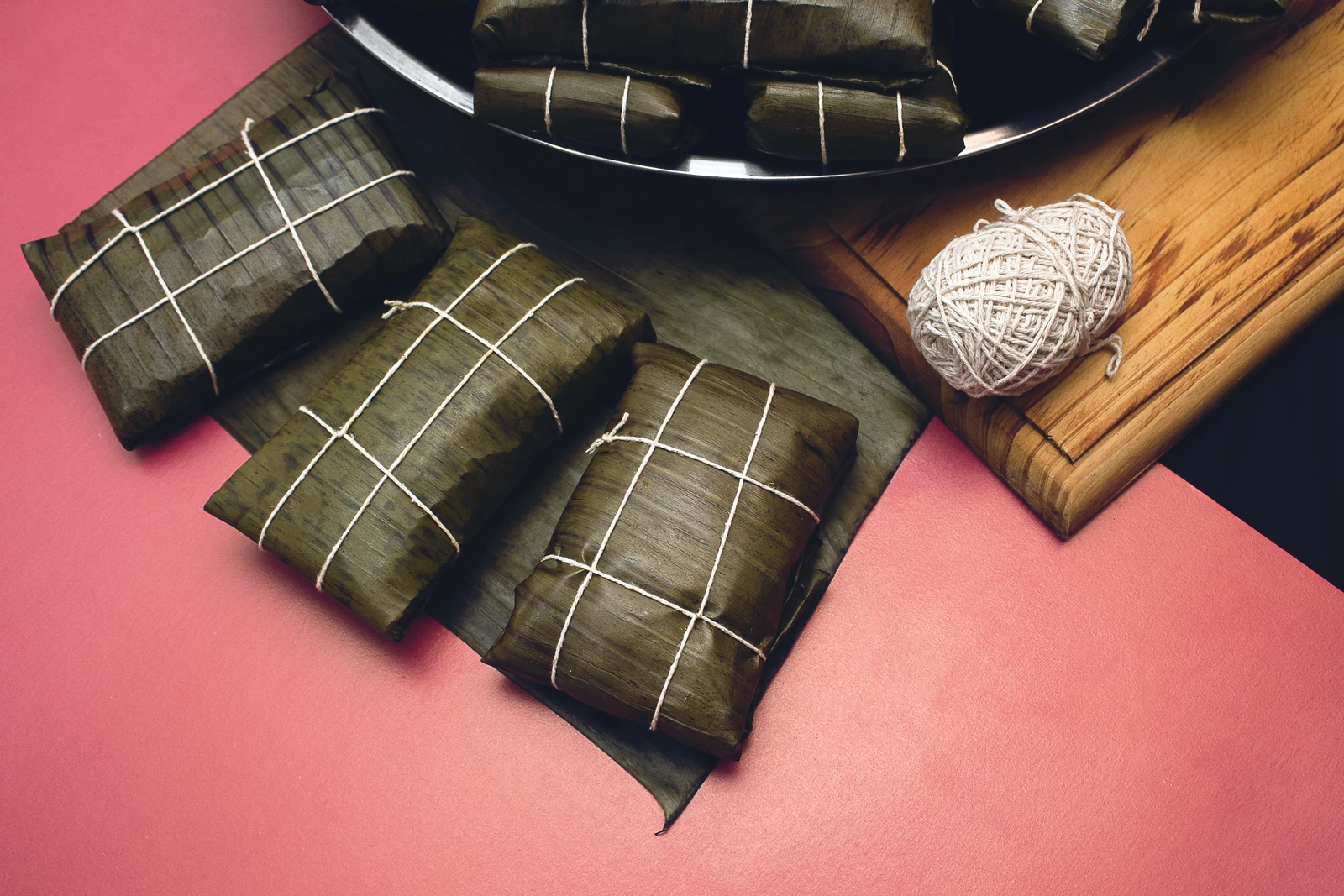

Bollos navideños (BOY-yohs nah-vee-DEH-nyohs) are what Venezuelan families make at the end of a long day of hallacas, the leaf-wrapped Christmas tamales: the dough and filling that didn’t come out even get kneaded together into one orange corn dough, shaped into 4½ oz (130 g) logs, wrapped in banana leaf and boiled for 30 minutes. Hallacas are dinner on Christmas Eve; bollos are breakfast the next morning. Below are the amounts for 12, what to do with just leftover dough or just leftover filling, and how to tie a banana-leaf parcel so water stays out.
How to make Venezuelan Christmas bollos
How do you make Venezuelan Christmas bollos? Knead 3 cups (500 g) of precooked corn flour with 2 cups (500 ml) of warm stock and 3½ tbsp (50 g) of annatto-colored lard, then work in 10½ oz (300 g) of chopped hallaca filling with olives, capers, raisins, bell pepper and onion. Shape 12 logs, wrap each in banana leaf, tie with twine and boil for 30 minutes. 90 minutes for 6 servings.
If you’ve never had one: picture a small tamale with the meat, olives and raisins running all through the dough rather than sitting in a pocket in the middle. The banana leaf isn’t eaten; it perfumes the dough as it boils.
How bollos differ from hallacas. A hallaca is built in layers: dough spread thin on the leaf, filling and garnishes on top, folded into a flat rectangle of about 8 oz (230 g) and boiled 90 minutes. A bollo mixes everything together, weighs about half as much and cooks in a third of the time. You’ll also hear hallaquitas, which depending on the family means a small hallaca, this same bollo, or a plain seasoned corn roll with no filling. And Venezuelan bollitos pelones are a different dish altogether: filled dumplings with no leaf, simmered in tomato sauce. Puerto Rican pasteles look much the same in the pot, but their masa is grated green banana and yautía (malanga) instead of corn.
Time and effort. 90 minutes if the filling is already made: 50 to make the dough, prep the leaves and wrap, 30 in the pot and 10 to rest. The only real skill is tying, and you’ll have it by the third parcel.
What you’ll need, and where to find it in the US and UK
Ingredient shopping guide
| Ingredient | What to buy | What not to use |
|---|---|---|
| Precooked corn flour | Harina P.A.N., Goya masarepa or a store brand, white or yellow, labeled “precooked”. In the US it’s in the Latin aisle at Walmart, Costco, H-E-B and most big chains; in the UK, Latin shops and online | Masa harina (Maseca), which is lime-treated and tastes of tortillas; cornmeal or polenta, which won’t bind; UK “cornflour”, which is cornstarch |
| Banana leaves (also labeled plantain leaves) | Frozen packs of 1-2 lb (450-900 g) in the freezer of Latin and Asian grocers in both countries | Corn husks are too small for this shape and add no aroma; heavy foil works as a last resort |
| Annatto (achiote) | Whole seeds in Latin shops or online, sometimes sold as paste | Paprika gives color but not the flavor |
| Lard | Rendered pork lard from the Latin aisle or the butcher | Butter and oil in equal parts work, with less aroma |
| Twine | Plain cotton kitchen twine | Nylon or plastic string, which softens in boiling water |
How much filling for the dough you have
Leftovers rarely match up, so weigh what’s left.
- Leftover dough and filling. For every 2¼ lb (1 kg) of made dough, about 10½ oz (300 g) of filling and 5 oz (150 g) of chopped garnishes, meaning whatever olives, capers, raisins, pepper and onion are left. That makes about 11 bollos. Past roughly 14 oz (400 g) of filling per 2¼ lb of dough, the dough loses structure and the parcels slump in the pot.
- Leftover filling, no dough. Make the dough in the recipe card. It takes less stock than hallaca dough, which uses 1.2 liters per kilo of flour, because the filling brings its own moisture. If there’s no hallaca filling at all, any dry, well-reduced stew works: Venezuelan pisillo or finely chopped Colombian shredded beef are good, although without the wine and raisins they taste less like Christmas.
- Leftover dough, no filling. I make them with 5 oz (150 g) diced bacon, fried over medium heat for 8 to 10 minutes until crisp and its fat has rendered, then drained and cooled, plus 2 oz (60 g) raisins per 2¼ lb (1 kg) of dough. Salty-sweet, with less meat than the original.
Chop the filling small with a knife and drain off any liquid. Large chunks tear the dough when you roll the logs, and juice in the bowl turns the dough sticky.
Wrapping and tying, step by step
Set everything out before you start: leaves cut and stacked, dough in a bowl, a saucer of orange lard, twine cut to length, and the pot of water heating, since it takes about as long to boil as you’ll take to wrap.
- Grease the leaf. Shiny side up, rub a teaspoon of orange lard in the middle of a 10 × 8 in (25 × 20 cm) rectangle so the dough peels off cleanly later.
- Place the log lengthwise, parallel to the long edge, in the center.
- Fold like an envelope. Bring one long side over the dough, then the other side over that. The leaf should wrap at least one and a half times around.
- Tuck the ends under, so the parcel sits on its folded ends.
- Add the strip crosswise over the seams. It also covers any tear in the main leaf.
- Tie it. Twine twice lengthwise and twice crosswise, pulled until the leaf is taut and the dough can’t shift inside, then a double knot. Leave a 4 in (10 cm) tail to lift it out of the pot.
Twelve take about 20 minutes to tie.
How to tell they’re done
Water at a full boil, enough to cover them; set a plate on top if they float. 30 minutes, covered, over medium heat, counted from when the water comes back to the boil.
The leaves turn olive green. Open a test bollo: the dough should be firm, evenly orange from edge to center, and shouldn’t stick to the knife. Drain them standing up and leave them 10 minutes before unwrapping, because straight out of the pot the dough is still soft and falls apart.
What goes wrong, and the fix
| Problem | Cause | Fix |
|---|---|---|
| Soggy outside | Loose twine or leaf too short, so water got in | Wrap one and a half turns, always add the strip, tie tighter |
| Falls apart when opened | Opened hot, or too much filling | Rest 10 minutes; keep filling under 14 oz per 2¼ lb of dough |
| Cracks when shaping | Dough too dry | Warm stock, 2 tbsp at a time |
| Leaf splits when folding | Not flamed, or flamed too long | 5 to 10 seconds per side, until matte and supple |
| Too salty | Filling, olives and capers are already salted | Taste a pinch of dough before adding the teaspoon of salt |
Heat, kids and allergens. Not spicy. Kids generally like them, though some pick out the raisins and capers, so leave those out of part of the dough. Precooked corn flour is gluten-free; check your stock for coeliac guests. No egg or dairy unless your filling has them.
Making more. The card makes 12 bollos for 6 people, two each at breakfast. Double everything for 24 and use two pots or cook in two batches. The time stays at 30 minutes because it depends on the size of each bollo, not on how many are in the pot, as long as they’re covered and the water returns to the boil. Made from leftovers, they cost no more than the stock and twine.
Make ahead, freezing and reheating
Freeze them raw. This is the big advantage. Tie the bollos, bag them and freeze them uncooked. To cook, drop them straight from the freezer into boiling water for 1 hour, no thawing. I use mine within 2 to 3 months.
Cooked, in the fridge. Whole and still wrapped, 3 to 4 days. Refrigerate them within 2 hours of coming out of the pot. Any raw leftover dough, keep covered in the fridge and use it the next day.
Cooked, in the freezer. Cool, whole and in the leaf, about 3 months.
Reheating. Still wrapped, in boiling water: 10 minutes from the fridge, about 20 minutes from frozen if already cooked. In the microwave, 1½ to 2 minutes in the leaf with a cup of water alongside, though the dough dries out a little. Whichever way, the center needs to reach 165°F (74°C); if it doesn’t, give it 5 more minutes. My favorite second-day trick: unwrap, slice into rounds and fry them in a little oil for 3 minutes per side until crusty.
Serving. Unwrap at the table and eat them as they are, with coffee. On Christmas morning in Venezuela they sit next to the leftovers from the night before: a slice of Venezuelan ham bread, a spoonful of Venezuelan chicken salad and some Venezuelan roast pork.
Questions people ask about bollos
Can I make bollos without banana leaves? Yes, in heavy foil, sealed tight and tied the same way, with the same boiling time. They lose the leaf’s aroma, which is part of the flavor.
Can I fill them instead of mixing everything in? You can: flatten a portion in your palm, add a spoonful of filling, close it into a log and wrap as usual. The result is closer to a mini Venezuelan hallaca, and the boiling time doesn’t change.
My leftover dough went hard in the fridge. Can I still use it? If it was covered and kept cold, yes. Knead it with a splash of warm stock until it’s soft again before adding the filling.
How do I know a frozen raw bollo is cooked through? After the hour, open one. The dough should be firm and the same color all the way through, with no pale, damp patch in the center. If there is one, give the rest 10 more minutes.
Nutrition per serving
Per serving of 2 bollos, about 9 oz (260 g), using the amounts on the card and hallaca filling:
- Calories: 574 kcal
- Protein: 16 g
- Carbohydrates: 75 g
- Fat: 22 g, of which 8 g saturated
- Fiber: 5 g
- Sugars: 7 g (raisins and vegetables)
- Sodium: 840 mg
One bollo is about 287 kcal. The corn dough supplies nearly all the carbs and the lard much of the fat; the filling brings the protein. The bacon-and-raisin version lands at similar calories with less protein.
Growing up, bollos were Christmas morning: hallacas the night before, and the bollos waiting in the fridge, still tied. I still do it that way in Colombia, and I always make two or three without capers for Dylan, tied with a different knot so I can find them in the pot. Josnaisis.