
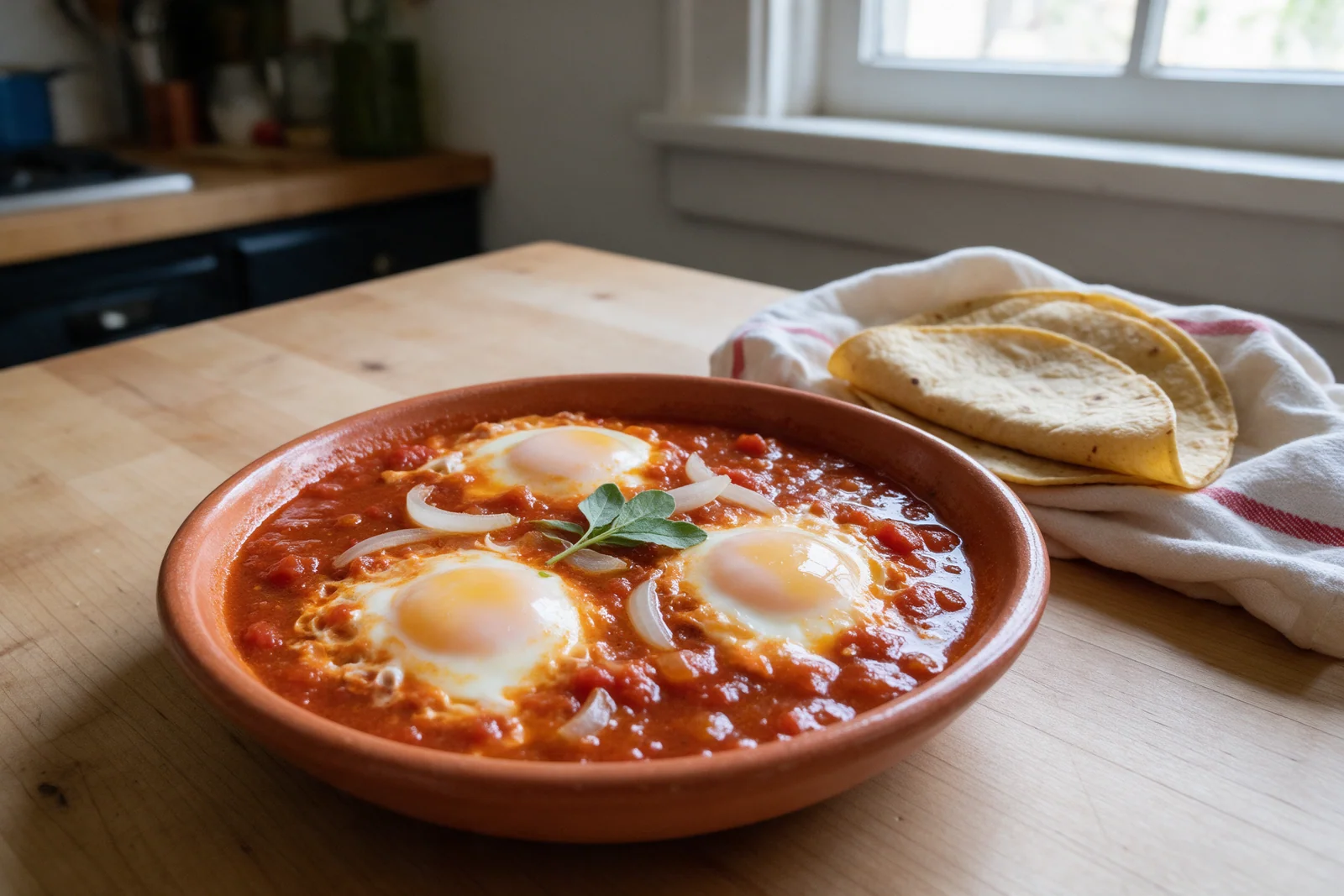

Huevos ahogados (WEH-vohs ah-oh-GAH-dohs) means “drowned eggs,” and that is the whole idea: whole eggs cracked into a pan of thin, gently spicy tomato broth, covered, and left to poach until the whites set. You eat them from a bowl with a spoon, tearing off pieces of corn tortilla to soak up the broth. It is an everyday Mexican breakfast, and with water instead of chicken stock it is meat-free. Below are the broth consistency that makes it work, how to get 8 eggs in without them breaking up, and yolk timings by the minute.
What are huevos ahogados, and how do they compare to shakshuka?
How do you make huevos ahogados? Simmer 600 g (1⅓ lb) of tomatoes with 2 serrano chiles and a garlic clove for 10 minutes, blend with onion and stock, fry the sauce for 4 minutes and thin it with 500 ml (2 cups) of stock in all. Slide in 8 eggs at a gentle simmer, cover and cook 5 to 6 minutes for runny yolks or 9 to 10 for firm. Ready in 40 minutes for 4 servings.
If you’ve made shakshuka, you already know the technique: eggs poached in a tomato sauce in a covered pan. The differences are in the pan and on the table.
| Huevos ahogados | Shakshuka | |
|---|---|---|
| Sauce | Blended smooth and thinned with stock into a pourable broth | Chunky tomatoes and peppers, cooked down thick |
| Flavor | Fresh green chile, onion, garlic, epazote or cilantro | Cumin, paprika and other warm spices |
| Served | In bowls, with plenty of broth | Straight from the skillet |
| Eaten with | Corn tortillas | Bread |
Huevos ahogados also get confused with other Mexican egg breakfasts. Huevos rancheros are fried eggs on oil-softened tortillas with sauce around them, huevos divorciados are two fried eggs split between red and green salsa, and huevos motuleños come from Yucatán, on a fried tortilla with black beans, peas and ham. In ahogados nothing gets fried but the sauce, which makes it the lightest of the lot.
Difficulty: easy. The only thing to watch is the heat under the eggs. Prep takes 10 minutes and cooking 30, most of it hands-off.
Ingredients, with US and UK swaps
| Ingredient | In the US | In the UK | What changes |
|---|---|---|---|
| Roma tomatoes, 600 g (1⅓ lb) | Any supermarket | Plum or vine tomatoes | Out of season, a 400 g (14 oz) can of whole plum tomatoes is better than pale fresh ones; the broth is slightly sweeter |
| Serrano chiles, 2 | Most supermarkets, next to the jalapeños | Rare; use half a fresh green chilli and taste | A jalapeño gives milder heat; bird’s eye chillies are much hotter |
| Epazote, 2 sprigs | Fresh or dried in Latin grocery stores | Dried, from online Mexican food shops | Cilantro (coriander) gives a fresher, different broth, still very good |
| Chicken stock, 500 ml (2 cups) | Cartons, often well salted | Stock pots or cubes, diluted | Water makes a brighter, more tomato-forward broth and keeps it meat-free |
| Queso fresco, 60 g (2 oz) | Mexican-style queso fresco | Mild feta soaked 10 minutes in cold water | Feta is saltier even after soaking |
Why fresh eggs matter. A fresh egg has a thick white that stays wrapped around the yolk; in an older egg the white is runny and spreads into strands in the broth. Taking them out of the fridge 10 minutes early keeps them from chilling the broth when they go in.
Equipment. A deep 28 cm (11 in) skillet or wide pan with a lid fits 8 eggs without touching. With a 24 cm (9½ in) pan, cook 4 eggs at a time. You’ll also need a blender and a small cup for cracking the eggs.
How thick should the broth be?
This is the part that decides the dish. Too thin and the eggs sit in watery soup with no flavor; too thick, like a pasta sauce, and the whites stick to the bottom before the tops set.
Aim for thick tomato juice: it pours off a spoon in a steady stream rather than dropping in blobs, and in a 28 cm (11 in) pan it sits about 2 cm (¾ in) deep, roughly 1 liter (4 cups). If you drag a spoon through and can see the bottom of the pan for a second or two, it’s too thick: add stock or water 50 ml (3 tbsp) at a time. If it looks like tinted water, simmer it 3 to 4 minutes more before adding the eggs.
Frying the blended sauce for 4 minutes before thinning it is what takes away the raw tomato taste. Don’t skip it.
Poaching the eggs without breaking them
- Gentle simmer. Small bubbles at the edge of the pan only, nothing rolling in the middle; about 185 to 195°F (85 to 90°C) if you have a thermometer.
- One egg per cup. You can check the yolk is whole, and slide it in from just above the surface instead of dropping it.
- Make a gap. Push the broth aside with a spoon and slide the egg into the space, so the white sets against the pan and doesn’t spread.
- Space them out, about 2 cm (¾ in) apart, and cover. Don’t move or stir for the first 2 minutes.
- Baste. Then spoon broth over the exposed whites, keeping clear of the yolks, and cover again.
Yolk timing
Counting from when the last egg goes in, covered, at a gentle simmer:
| Time | Result | How to tell |
|---|---|---|
| 5 to 6 minutes | Set whites, runny yolk | White opaque right up to the yolk; yolk glossy and wobbles when you nudge the pan |
| 7 to 8 minutes | Jammy yolk | Edge of the yolk turns opaque, center still soft |
| 9 to 10 minutes | Firm yolk | Yolk looks matte and doesn’t give when pressed with the back of a spoon |
When in doubt, lift one out and cut it open.
Young children, pregnant women, older adults and anyone with a weakened immune system should have eggs with both white and yolk firm: the 9 to 10 minutes, or pasteurized in-shell eggs, which are sold in US supermarkets labeled as such.
What goes wrong, and how to fix it
- Whites break into strands → the broth was boiling hard or the eggs weren’t fresh. Lower to a gentle simmer first.
- Whites stick to the bottom and stay raw on top → broth too thick or too shallow. Thin it to 2 cm (¾ in) deep and baste at the 2-minute mark.
- Yolks overcook while you serve → the hot broth keeps cooking them. Take them out a minute before your target and turn off the heat.
- Bland broth → the sauce wasn’t fried, or it was made with unsalted water. Taste and salt before the eggs go in, because you can’t stir afterwards.
- Too spicy → seeds and veins left in the serranos. Add stock or one more blended tomato and simmer 3 minutes.
Variations
- Salsa verde. Swap the tomatoes for 500 g (1 lb 2 oz) tomatillos, husked and rinsed, and simmer them with the chiles and garlic 8 to 10 minutes, until they turn from bright green to olive. Blend with the onion, a handful of cilantro and the stock, then carry on as above. It’s essentially Mexican salsa verde thinned with stock. In the UK, canned tomatillos are the realistic option. If it tastes very sharp, I add a pinch of sugar.
- With nopales. Add 250 g (9 oz) cooked cactus paddles, cut in strips, with the second batch of stock. Cook and rinse them first, as in the Mexican nopales salad, so they don’t make the broth slimy. Jarred nopales work too, well rinsed.
- With dried chile. Use guajillo chiles instead of serranos; I use 3, seeded and soaked in hot water for 10 minutes, blended with the tomatoes. Darker, milder and toasty.
- With chorizo. Brown crumbled Mexican chorizo in the pan before frying the sauce (I use 100 g / 3½ oz for this amount).
Making ahead and feeding a crowd
The broth, made up to step 4, keeps 3 to 4 days in the fridge, covered. On the morning, bring it back to a boil and poach the eggs. The eggs themselves are always cooked to order: once poached, the yolks keep cooking in the hot broth.
- For 8 → double the broth (1.2 kg / 2⅔ lb tomatoes, 1 liter / 4 cups stock) and use 16 eggs. Two 28 cm (11 in) pans side by side, each with half the broth and 8 eggs, is the easiest way.
- For 12 → triple it (1.8 kg / 4 lb tomatoes, 1.5 liters / 6⅓ cups stock) and use 24 eggs. Keep the broth hot in a large pot, ladle 1 liter (4 cups) into the skillet for each batch of 8 eggs, and serve each batch as it’s ready. Allow about 10 minutes per batch.
- For 2 → halve everything and use a 24 cm (9½ in) pan.
Serving and storage
Serving. Two eggs per shallow bowl with their broth, crumbled queso fresco and a few cilantro or epazote leaves. Warm homemade corn tortillas are the classic way to mop it up; a crusty roll works too. For a bigger breakfast, add a side of frijoles de la olla or Mexican red rice.
Fridge. The broth alone, 3 to 4 days. Leftover eggs in their broth, also 3 to 4 days, covered, refrigerated within 2 hours of cooking.
Freezer. The broth without eggs, 2 to 3 months. Not the cooked eggs: the whites turn rubbery.
Reheating. The broth, until it boils. Leftover eggs, in their broth over low heat, covered, until piping hot; the yolks will end up firm.
Huevos ahogados FAQ
Are huevos ahogados the same as poached eggs? Same technique, different finish. A classic poached egg is cooked in plain water and lifted out; huevos ahogados are poached in the seasoned tomato or tomatillo broth and served in it.
Can I use jarred salsa or tomato sauce? A plain tomato sauce or a simple jarred salsa works if you thin it with stock to that thick-tomato-juice consistency. Pasta sauces with oregano, basil or sugar change the dish completely.
How many eggs per person? Two, with tortillas and beans, makes a full breakfast at about 262 kcal before the tortillas. One is enough as part of a bigger lunch.
Can I make it in a saucepan? Only a wide one. The eggs need room not to touch and about 2 cm (¾ in) of broth; in a narrow, deep pan the whites spread up the sides and stick.
Nutrition
Per serving (2 eggs, a quarter of the broth and 15 g / ½ oz queso fresco), worked out from the weights above with store-bought chicken stock and no added salt. Tortillas not included.
- Calories: 262 kcal
- Protein: 18 g
- Carbohydrates: 10 g
- Fat: 17 g, of which 5 g saturated
- Fiber: 2 g
- Sugars: 6 g
- Sodium: 730 mg
Made with water and ½ tsp salt instead of stock, sodium drops to about 555 mg per serving. Contains egg and milk (the cheese); gluten-free with corn tortillas.
The only egg in broth I knew before was the beaten kind, stirred into Colombian egg soup. Whole eggs in tomato broth took me some practice, and the hardest part was leaving the pan alone for those first 2 minutes. These days I make the broth on Sunday and have breakfast on the table in about 15 minutes on a weekday. Josnaisis.