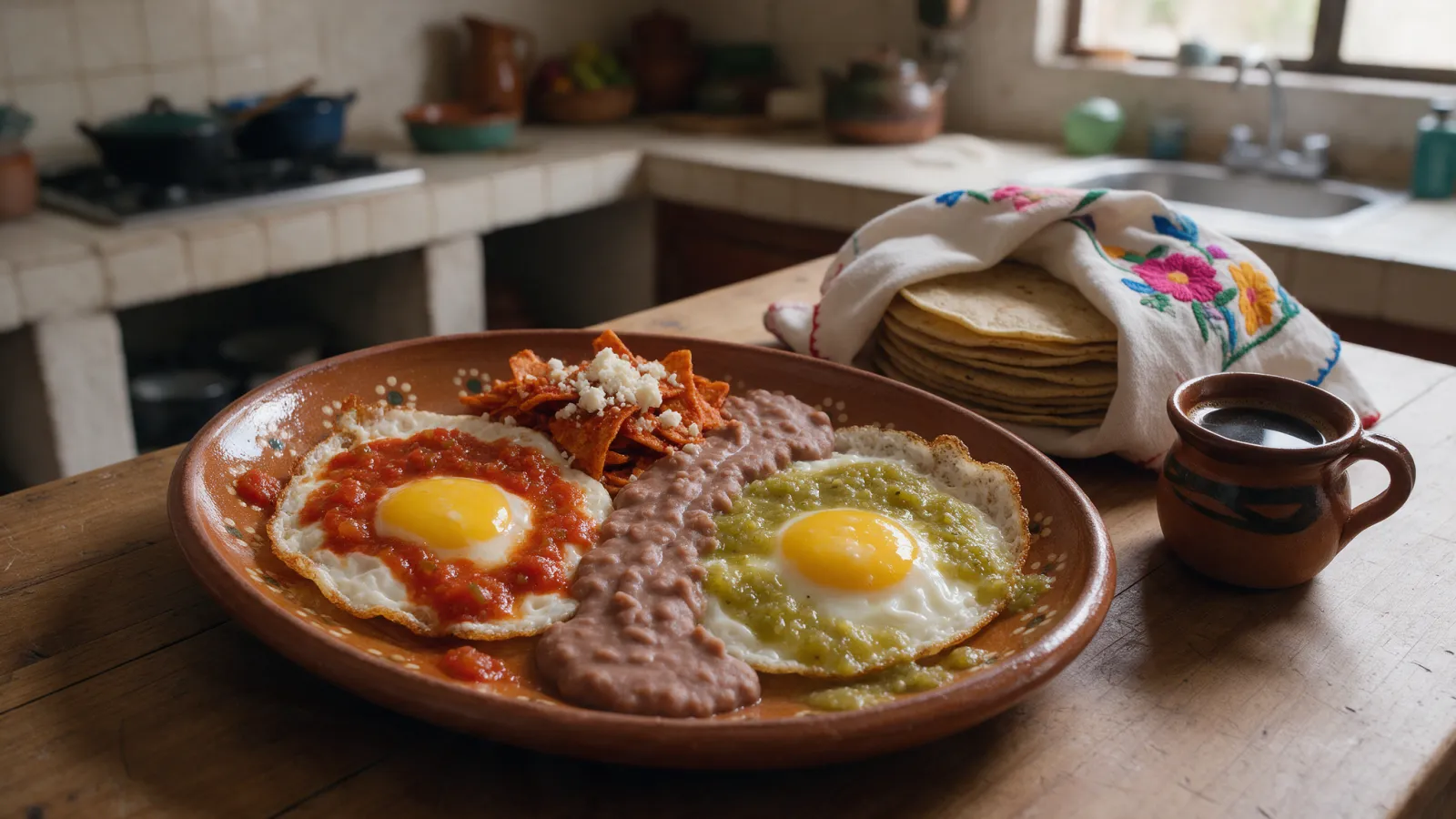

Two fried eggs, two salsas and a strip of refried beans keeping them apart: that’s huevos divorciados (WAY-vohs dee-vor-see-AH-dohs), “divorced eggs”, a Mexican breakfast built for a household that can’t agree on salsa. The eggs share a plate of oil-softened corn tortillas, one under a green tomatillo salsa and the other under a red tomato one, with the beans as the fence. That separation is the whole joke of the name; where the dish started isn’t documented, and even the Mexican restaurant chain Sanborns, which has it on its menu, says there’s no precise historical record. What puts most people off is making two salsas before breakfast. The fix is one pot of water, with the tomatillos out at 8 minutes and the tomatoes at 10.
What are huevos divorciados, and how do you make them?
How do you make huevos divorciados? Simmer 300 g (⅔ lb) tomatoes and 250 g (just over ½ lb) tomatillos in one pot with a serrano and a garlic clove for each salsa, pulling the tomatillos at 8 minutes and the tomatoes at 10. Blend each salsa and fry it for 6 minutes. Dip 8 corn tortillas in hot oil, fry 8 eggs with crisp edges, and plate each with beans in the middle, one egg in red salsa and one in green. Ready in 40 minutes for 4 servings.
Think of it as huevos rancheros with a second sauce. That second sauce matters more than it sounds: the green is bright and sour, the red mellow and a little sweet, and a runny yolk ties the two halves together. It’s worth the extra 10 minutes over rancheros when you want something that looks like an occasion without much more work, or when half the table wants green and half wants red.
Time and effort. 40 minutes, about 30 of them hands-on, because the salsas need stirring. With both salsas made the day before, the morning takes about 20 minutes. Difficulty, easy. The usual failures are overcooked tomatillos, tortillas that crack, and a runny salsa that drifts into the other one.
Ingredients, and what to buy in the US or UK
The recipe card covers four people, each getting a pair of eggs and a pair of tortillas. Five items might send you to a second store, and the table shows what to grab in each country and what you lose with the swap.
Tomatillos (Physalis philadelphica) look like small green tomatoes inside a papery husk, and they’re what gives the green salsa its tart, almost citrusy edge. US supermarkets sell them fresh near the chiles. In the UK, buy canned whole tomatillos from a Mexican grocer or online; drain about 250 g (½ lb), skip the simmering because they’re already cooked, and go lighter on the salt. Green tomatoes from a greengrocer are unripe ordinary tomatoes: with a squeeze of lime they make a decent green sauce, but a different, watery one. Cape gooseberries share the husk and are sweet, so they’re no use here.
Queso fresco is a mild, salty, crumbly fresh cheese, sold in most US stores. In the UK, soak mild feta in cold water for 10 minutes to pull out some salt.
Corn tortillas. In the US they’re in the bread aisle or the chilled Latin section; in the UK, Mission makes corn ones, but many “soft taco” packs are wheat, so read the label.
Equipment. A medium pot, a slotted spoon, a blender, two small saucepans so both salsas fry at once, a 20 cm (8 in) skillet for the tortilla oil and a 26 cm (10 in) nonstick skillet, with a lid if you want covered eggs. With only one saucepan, fry the green salsa first, tip it into a bowl and fry the red: 7 minutes more.
Two salsas, one pot
For 8 eggs you need about 250 ml (1 cup) of each salsa, 60 ml (¼ cup) per egg: enough to ring the yolk without drowning the tortilla. Half a batch of each of the blog’s salsas gives exactly that.
Tomatillos and tomatoes cook the same way, simmered with chile and garlic; only the timing differs. Tomatillos are done when they shift from grass green to olive green, around 8 minutes. Leave them longer and they split, fill with water and give a thin salsa. Tomatoes need 10 minutes, until the skins crack. A slotted spoon and a timer save you a second pot.
Both then get fried in oil for 6 minutes. It’s the step that turns blended vegetables into a sauce: it drives off water, deepens the color and makes the salsa cling to the egg instead of running across the plate and into its neighbor.
- Already have a jar of green? The boiled tomatillo salsa verde makes about 630 g (22 oz); a quarter of a liter of it covers these 4 plates. Fry it for 3 or 4 minutes in ½ tbsp oil before serving so it thickens.
- Why not the taco salsa for the red? The chile de árbol red taco salsa takes 12 dried chiles and is thin by design, made to drip over a taco. Here it would bury the egg in heat. I put it on the table for anyone who wants more fire.
Golden-edged eggs, and who should eat them firm
Crisp, lacy, golden edges come from very hot oil, not from more time. In my kitchen, a large egg in a 26 cm (10 in) nonstick pan with 1½ tbsp of oil over medium-high heat sits untouched for 1 minute, then gets basted for 1½ to 2 minutes: tilt the pan so the oil pools and spoon it over the white around the yolk. The top of the white sets from the hot oil, the yolk stays runny. If you prefer a soft, even white with no browning, use ½ tbsp oil over medium heat with the lid on for 3 minutes.
On runny yolks. The safe-handling statement USDA FSIS requires on US egg cartons says to keep eggs refrigerated and cook them until the yolks are firm, and FSIS lists infants, young children, older adults, pregnant women and people with weakened immune systems as the groups most at risk; the FDA gives the same advice. For them, cover the pan for 5 to 6 minutes, or use pasteurized shell eggs, which FSIS says can be eaten without full cooking and which US stores sell labeled as such. Keep raw eggs in their carton in a fridge at 40°F (4°C) or below and use them within 3 weeks, the FDA’s quality guide.
Planning it, from 2 people to 20
The plan works because beans and tortillas fit inside the minutes the salsas spend reducing.
| People | Eggs | Tortillas | Tomatoes | Tomatillos | Serranos | Onion | Refried beans | Queso fresco |
|---|---|---|---|---|---|---|---|---|
| 2 | 4 | 4 | 150 g (5 oz) | 125 g (4½ oz) | 1 | 30 g (1 oz) | 120 g (½ cup) | 30 g (1 oz) |
| 4 | 8 | 8 | 300 g (⅔ lb) | 250 g (½ lb) | 2 | 60 g (2 oz) | 240 g (1 cup) | 60 g (2 oz) |
| 8 | 16 | 16 | 600 g (1⅓ lb) | 500 g (1.1 lb) | 4 | 120 g (4 oz) | 480 g (2 cups) | 120 g (4 oz) |
| 12 | 24 | 24 | 900 g (2 lb) | 750 g (1⅔ lb) | 6 | 180 g (6 oz) | 720 g (3 cups) | 180 g (6 oz) |
| 20 | 40 | 40 | 1.5 kg (3⅓ lb) | 1.25 kg (2¾ lb) | 10 | 300 g (10 oz) | 1.2 kg (5 cups) | 300 g (10 oz) |
Cooking for 2? Make the salsas for 4 anyway. 125 g of tomatillos barely covers the bottom of a saucepan and scorches, and the leftovers are a second breakfast later in the week. Everything else scales in proportion, except the tortilla oil: it stays an 80 ml (⅓ cup) bath, topped up when it drops below about 5 mm (¼ in).
Make-ahead and freezer
Make both salsas the day before and get them into the fridge within 2 hours. USDA FSIS figures for leftovers: 3 to 4 days at 40°F (4°C), and 3 to 4 months frozen for best quality. I freeze them in 250 ml (1 cup) tubs, one red and one green per four people. The green sets slightly in the fridge thanks to the tomatillos’ pectin; reheat each until it bubbles, which takes it past the 165°F (74°C) FSIS asks for, with 2 or 3 tablespoons of water if needed.
A brunch for 8 to 20
- The night before, make double salsa: poaching eggs takes more sauce, 1 liter (4 cups) of each for 8 people.
- 20 minutes before serving, dip all the tortillas, wrap them in foil and hold them in the oven on its lowest setting; they stay warm and soft for half an hour.
- Poach the eggs in the salsas. Simmer the red salsa in one 30 cm (12 in) deep skillet and the green in another, make 8 wells in each, crack in the eggs, cover and cook over medium-low for about 6 minutes for runny yolks, 9 for firm, the same times as the drowned eggs in the rancheros recipe. Each plate gets one egg from each pan, with its salsa, beans in the middle. For 12 or 20, repeat the batches.
Mistakes, heat level, kids and allergens
- Thin green salsa → the tomatillos split in the water. Pull them as soon as they turn olive green, even before 8 minutes.
- Red and green run together → under-reduced salsa or no bean line. Fry each for the full 6 minutes and keep the beans thick.
- Cracked tortillas → warmed dry or left to brown. 10 seconds a side in oil, out while floppy.
- No golden edge → the oil wasn’t hot enough or there wasn’t enough of it. It should shimmer before the egg goes in.
- Yolk clouds over → hot oil landed on it. Baste the white only.
Heat level. With one serrano per salsa, I’d put the red at 2 out of 5 and the green at 3 out of 5, the same ratios as the blog’s rancheros and salsa verde. Seeding the chiles drops each a point. Kids: blend each salsa first without its serrano, set aside a few spoonfuls, then blend in the chile; and per the FSIS advice above, firm yolks for them. Allergens: egg and milk (cheese). Corn tortillas contain no wheat; for a coeliac guest, check the pack says corn only and use oil that hasn’t fried anything breaded. Traditional canned refried beans can contain lard, so check the label for vegetarians.
Which version should you make?
- Short on time → salsas from the day before, or a jar of green salsa fried for 3 or 4 minutes plus a 400 g (14 oz) can of whole tomatoes, blended and fried for 10 minutes for the red. That can makes enough red for 8 plates. About 20 minutes.
- Only one sauce → that’s huevos rancheros: 30 minutes for 4, one pot.
- For a crowd → eggs poached in two pans of salsa, as in the brunch plan.
- Chilaquiles divorciados → fried tortilla chips, half tossed in green salsa and half in red on the same plate, with a fried egg on top. The method is the one in chilaquiles verdes that stay crisp: chips in boiling salsa for 1 minute, with the red in a second pan.
- Scrambled → two small mounds of scrambled egg, each with its own salsa. If you’d rather have the tomato and chile cooked into the eggs, that’s another dish, huevos a la mexicana, in 20 minutes.
- Roasted red salsa → char the tomatoes, chile, onion and garlic in a dry cast-iron pan until blistered black in spots, instead of simmering them. Darker and smokier; the tomatoes no longer share the pot.
- Lighter → warm the tortillas in a dry pan and cook the eggs covered with ½ tbsp oil per batch: about 115 kcal less per plate, though the tortillas tear more easily.
What it costs
At US prices, the ingredients that can be priced come to about $3.95 for 4 plates, $0.99 each. Eggs are the biggest line; both salsas together cost about $2.14.
The egg, tomato and dried bean prices are Bureau of Labor Statistics averages for August ($2.272 a dozen large eggs, $1.977 a pound of tomatoes, $1.630 a pound of dried beans). The beans are counted dry, because the blog’s refried beans recipe turns 500 g (1.1 lb) of dried beans into 6 cups; 1 cup takes about 83 g (3 oz). Tomatillos ($0.99 a pound), onion, garlic and chile come from the USDA AMS weekly retail report of October 9, with jalapeño standing in for serrano, which isn’t listed. Neither source tracks corn tortillas, queso fresco or cilantro, so I haven’t guessed at them. In Mexico, at Mexico City wholesale prices from the government’s SNIIM service, the same plate comes to about 9.20 pesos, with the eggs again close to half.
Serving and storing
Two overlapping tortillas per plate, beans in a line down the center, one egg on each side with its salsa, crumbled cheese on top, and avocado slices if you have them. A mug of café de olla, coffee simmered with cinnamon and piloncillo, is what I’d pour alongside.
Only the salsas and beans keep: 3 to 4 days in the fridge, 3 to 4 months frozen. Fried eggs reheated turn rubbery with chalky yolks, and dipped tortillas harden. The FDA rule for cooked egg dishes is no more than 2 hours out of the fridge, or 1 hour above 90°F (32°C).
Frequently asked questions
What are huevos divorciados? “Divorced eggs”: a Mexican breakfast of two fried eggs on corn tortillas, one with red salsa and one with green, separated by refried beans. About 40 minutes for 4.
Why are they called divorced eggs? Because the two eggs are kept apart, each with its own salsa, with the beans as the dividing line. There’s no documented origin for the name or the dish.
What’s the difference between huevos rancheros and huevos divorciados? Rancheros have one red salsa over both eggs. Divorciados have red on one egg and green on the other, with beans between. Tortillas and fried eggs are the same.
Can I use store-bought salsa? Yes. Jarred green salsa works once it has spent a few minutes frying in a little oil to thicken. For the red, a can of whole tomatoes blended and fried for 10 minutes beats bottled hot sauce, which is usually thin and vinegary.
How do I get crispy edges and a runny yolk? Shimmering oil and patience: leave the egg alone for a minute, then spoon the oil over the white only for another 1½ to 2.
Are runny yolks safe? FSIS and the FDA advise firm yolks, especially for infants, young children, older adults, pregnant women and anyone with weakened immunity. Those guests should have the pan covered until the yolk sets solid, or pasteurized eggs.
What can I use instead of tomatillos in the UK? Canned whole tomatillos, drained and not boiled. Green tomatoes with lime make a different, milder sauce; cape gooseberries are too sweet.
How many calories are in huevos divorciados? About 570 kcal per plate of 2 eggs, 2 tortillas, 60 g (¼ cup) beans and 15 g (½ oz) cheese; about 455 with dry-warmed tortillas and covered eggs.
Nutrition
Per plate of 15 g (½ oz) queso fresco, about 120 ml (½ cup) of salsa split between red and green, 60 g (¼ cup) canned refried beans, and the 2 eggs and 2 tortillas, calculated from USDA FoodData Central (SR Legacy) for the quantities in this recipe, counting 3 g of absorbed oil per tortilla and all the oil used for the eggs:
- Calories: 570 kcal
- Protein: 23 g
- Carbohydrates: 40 g
- Fat: 37 g, of which 7 g saturated
- Fiber: 8 g
- Sugars: 7 g
- Sodium: 1,090 mg
Almost a third of the calories, about 177 kcal a plate, come from oil. Skip the salt on the whites (about 145 mg a plate) and use unsalted beans, and sodium drops to around 720 mg; as written, about 580 mg of it is the recipe’s salt and 220 mg the canned beans.
Back in Venezuela, breakfast eggs were perico, scrambled with tomato and onion, and Colombia handed me nearly the same thing as huevos pericos. Divorced eggs solved a very domestic argument for me: Dylan wants green salsa, I want red, and now nobody fights over the jar. The real win was washing one pot instead of two. Two salsas, one fence of beans, and breakfast keeps the peace. Josnaisis.