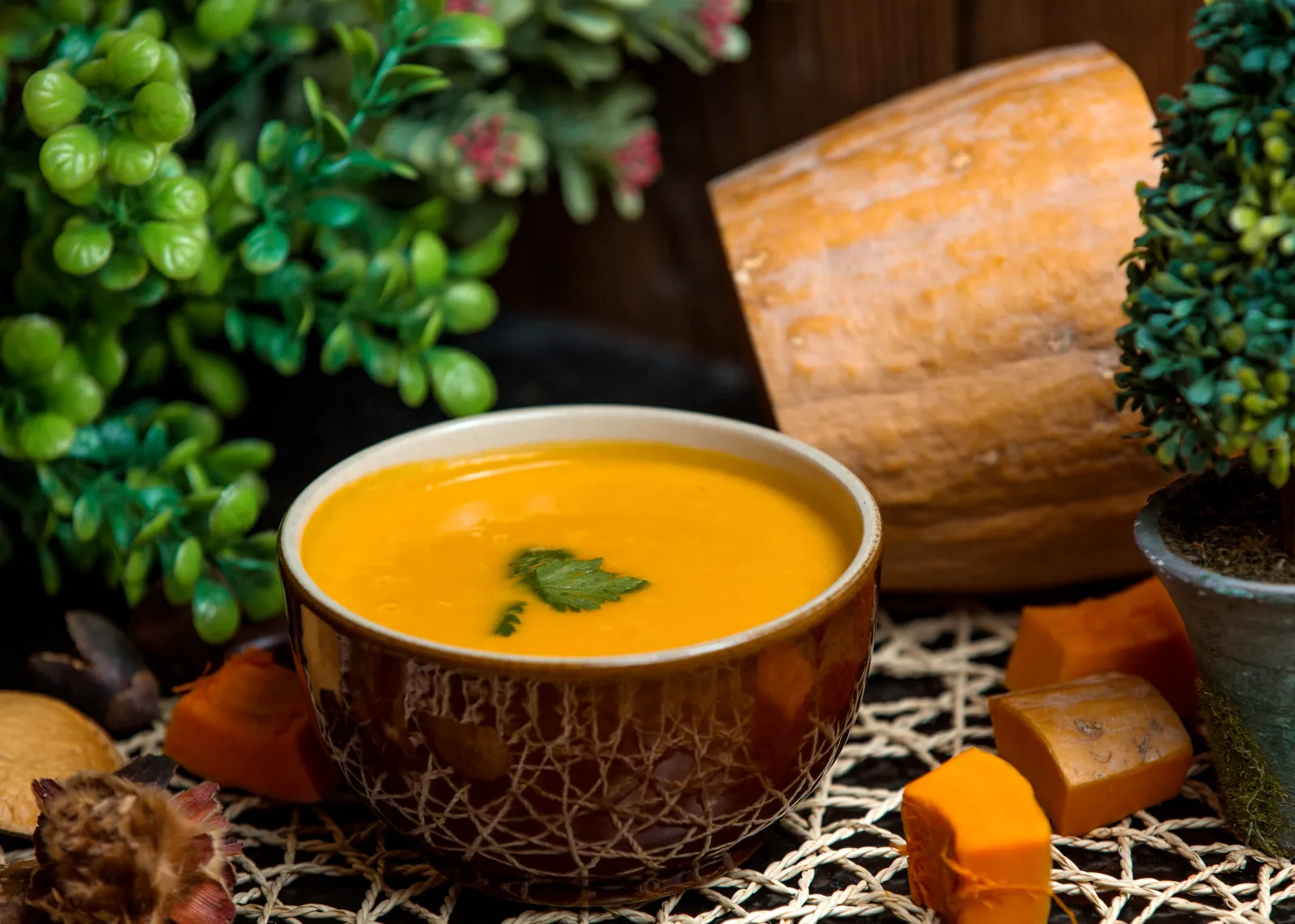

The first spoonful of Colombia’s crema de ahuyama (ah-OO-yah-mah) tastes familiar if you’ve made butternut squash soup with nutmeg and maple, and the second goes somewhere else: onion, scallion, garlic, a little cumin and chicken stock, with crumbled fresh cheese on top instead of a swirl of something sweet. It’s the everyday blended squash soup of Colombia, where ahuyama is the big, hard-skinned, orange-fleshed squash of the produce markets. You don’t need to find ahuyama to make it. Below is which US or UK squash gets closest, how to make it thick without flour, how to blend hot soup without the lid flying off, and what a pot really costs.
Is Colombian squash soup worth making?
How do you make Colombian squash soup? Soften onion, scallions, garlic and cumin in butter, then simmer 1.2 kg (2.6 lb) of cubed squash and a potato in 800 ml (3⅓ cups) of stock, covered, for 18 minutes. Rest 5 minutes, blend in batches, return to the pot with cream and thin with the reserved stock only if needed. 55 minutes for 6 servings.
Yes, especially if squash soups have let you down by turning out thin or sweet. This one is savory, and the thickness comes from the squash and one potato, not from flour or a pint of cream.
When it shines. As a starter for 6, a light supper with bread, or a batch you blend on Sunday and finish on Tuesday. It’s also one of the few soups where a plain, unsalted portion can be set aside for a baby who already eats purées.
When to skip it. If you want a meal in a bowl: 270 kcal and 7 g of protein won’t carry dinner on their own. If you have neither a blender nor an immersion blender. Or if the natural sweetness of winter squash isn’t for you; no seasoning hides it.
Real time. 55 minutes, about 28 of them hands-on. Peeling and cubing 3.3 lb (1.5 kg) of squash is the slow part, around 15 minutes.
Honest difficulty, easy. It goes wrong in only two ways: too much stock (you get a thin soup) or blending it boiling hot in a full jar.
What crema de ahuyama is, and how it differs from pumpkin soup
Ahuyama is the Colombian name for a large winter squash with orange flesh; Venezuelans and Dominicans say auyama, and Peru, Chile and Argentina say zapallo. Colombian breeding work at the National University in Palmira, published in Acta Agronómica, studies it as Cucurbita moschata, the same species as butternut.
The differences from the soups you may know are in the seasoning, not the method. America’s Test Kitchen flavors its puréed butternut soup with ginger and sherry, and the Colombian-American blog My Colombian Recipes adds cinnamon and honey to its version. Spain’s crema de calabaza usually brings leek, carrot and olive oil to the pot. The Colombian home version I make, like the ones published by Colombia.com and the newspaper El Espectador, stays savory: onion, garlic, chicken stock, cream, and cheese or cilantro at the table.
What you’ll need, and which squash to buy
Every quantity is in the recipe card: 3.3 lb (1.5 kg) of whole squash, one 9 oz (250 g) russet, 1 liter (4¼ cups) of stock and ½ cup (120 ml) of cream for 6 bowls. The squash is the one ingredient where your choice changes the result.
Butternut is the default: same species, sold year-round on both sides of the Atlantic, and slightly milder than a ripe market ahuyama. Kabocha is the closest match according to Dominican Cooking, whose cream of auyama calls for it by name; it’s drier, so I add about 100 ml (scant ½ cup) more stock. Buy a squash that feels heavy for its size with deep orange flesh; a pale one gives a yellow, watery soup. Skip carving pumpkins. USDA’s Food Buying Guide puts the usable yield of peeled, cubed butternut at 84%, which is why 3.3 lb whole gives roughly 2.6 lb (1.2 kg) of cubes.
What changes with each swap.
| Ingredient | US swap | UK swap | What changes |
|---|---|---|---|
| Ahuyama | butternut, kabocha | butternut | butternut a touch milder; kabocha drier |
| Papa pastusa | russet | Maris Piper, King Edward | nothing you’d notice |
| Cebolla larga | scallions | spring onions | nothing |
| Crema de leche | heavy cream | double cream | whole milk is lighter and can split if it boils |
| Queso campesino | queso fresco | a mild crumbly white cheese | saltier cheeses need less salt in the pot |
| Chicken stock | low-sodium carton | low-salt stock | a regular carton or a cube means cutting the added salt |
Equipment. A 4 to 5 quart (4 to 5 liter) pot, a big knife, a peeler and a blender or an immersion blender. The immersion kind is the safer one for hot soup because nothing gets sealed in a jar. A food mill or a potato masher gives a rustic soup with strands, good but not creamy.
How to plan it
55 minutes on the clock, 28 of them hands-on. Heat the stock while you peel so it comes back to a boil in about 4 minutes once the squash goes in.
Make-ahead and freezer plan.
- The day before → cook and blend the base through step 4, without the cream, and refrigerate it in shallow containers within 2 hours. On the day, reheat over low heat, adjust with stock and add the cream: about 10 minutes.
- Prep only → peel and cube the squash the night before and keep it in a sealed bag in the fridge.
- Freezer → freeze the base without cream for 2 to 3 months (quality guidance from the FoodSafety.gov cold storage chart). I add the cream when reheating, because dairy can separate after thawing. Thaw overnight in the fridge.
How to tell each stage is right.
| Stage | What you should see |
|---|---|
| Aromatics, 5 min | onion translucent, no browned edges |
| Stock | just level with the squash cubes, not 1 in (2 cm) above them |
| Simmer, 18 min | a cube crushes against the pot with no resistance; potato falls apart |
| Blending, 1 min per batch | no visible strands when you tilt the jar |
| Final texture | coats the back of a spoon; a finger drawn through leaves a clean line |
Thick without flour, the liquid ratio
The pot is thick because of how little liquid goes in: 800 ml (3⅓ cups) for 2.6 lb of squash plus a potato, which works out to under a liter per kilo once the cream is in. Push past roughly 2½ liters of liquid per kilo of squash (about 2½ quarts per 2.2 lb) and you’re making a thin soup. The potato’s starch adds body. Cook with the smaller amount, blend, then add the reserved 200 ml (¾ cup) only if it needs it.
If you’ve already gone too thin, reduce it uncovered over low heat for 10 minutes, scraping the bottom, or simmer another 7 oz (200 g) of squash in a little of the soup and blend it back in.
Blending hot soup without getting burned
Steam builds up inside a closed blender jar and can push the lid off. The technique guides from Rouxbe, Tasting Table and The Striped Spatula give the same precautions, and I follow every one.
- Rest 5 minutes off the heat before blending.
- Fill a third, never more than half. In a standard 2-liter (64 oz) jar that’s about 800 ml (3⅓ cups), so this pot takes three batches.
- Remove the center cap, lay a folded towel over the lid and hold it down.
- Start on the lowest speed and work up. Check your blender’s manual too; some list a maximum liquid temperature.
Scaling for 4, 8, 12 or 18
| Servings | Whole squash | Potato | Stock | Cream | Blending |
|---|---|---|---|---|---|
| 4 | 1 kg (2.2 lb) | 170 g (6 oz) | 650 ml (2¾ cups) | 80 ml (⅓ cup) | 2 batches |
| 6 | 1.5 kg (3.3 lb) | 250 g (9 oz) | 1 liter (4¼ cups) | 120 ml (½ cup) | 3 batches |
| 8 | 2 kg (4.4 lb) | 330 g (12 oz) | 1.35 liters (5¾ cups) | 160 ml (⅔ cup) | 4 batches |
| 12 | 3 kg (6.6 lb) | 500 g (1.1 lb) | 2 liters (8½ cups) | 240 ml (1 cup) | immersion blender |
| 18 | 4.5 kg (10 lb) | 750 g (1.7 lb) | 3 liters (12¾ cups) | 360 ml (1½ cups) | immersion blender |
Scale the onion, scallions, garlic, butter, cumin and salt the same way. For 12 or more, use a 10-quart pot or two pots; the simmer stays at 18 minutes with 1¼ in cubes, but allow about 10 more minutes to reach the boil.
Before you cook, mistakes, kids, babies and allergens
Mistakes and how to avoid them.
- Thin soup → too much stock, or a pale squash. Reduce uncovered over low heat for 10 minutes.
- Stringy texture → undercooked squash or too short a blend. A cube should crush with no effort; blend a full minute per batch.
- Tastes of fried onion → the aromatics browned. Medium heat, 5 minutes, translucent.
- Cream split → it boiled hard after the cream went in. Low heat, 3 minutes.
- Too salty → regular stock or bouillon plus the full teaspoon of salt. Taste before salting.
- Scorches when reheated → it thickens overnight. Add stock or water and stir over low heat.
Spice level, 0 out of 5. Nothing in it is hot.
Will kids eat it? Usually: it’s smooth, orange and a little sweet. Cumin is the only thing some children object to, and you can leave it out without changing the texture.
For babies. Don’t serve the finished soup to a baby under one: Clemson Extension’s guide to homemade baby food (HGIC 4259) says not to add salt, seasonings, sugar, butter or oil, and this soup has all of those plus stock and cream. Instead, set aside 7 oz (200 g) of raw squash cubes before you start, steam them or simmer them in unsalted water until they mash with a fork, about 15 minutes, and purée them with a little of the cooking water. The same guide places the gradual move to table foods between 6 and 11 months; your pediatrician has the final word. Refrigerate the purée covered and use it within 1 to 2 days, or freeze it in a covered ice cube tray and use it within a month.
Allergens. Dairy (butter, cream, cheese). Carton stock can contain celery, soy or traces of gluten: check the label if you cook for someone with celiac disease or allergies. No egg, nuts or fish.
Which version should you make?
- Short on time → two 15 oz (425 g) cans of 100% pumpkin purée (not pie filling) with the softened aromatics and 600 ml (2½ cups) of stock, 10 minutes at a gentle simmer, then blend: about 25 minutes. Less aroma, same texture.
- No blender → an immersion blender in the pot; or a food mill for a rustic soup.
- For a party → blend the base the day before without cream, and keep it on low heat on the day. Set out cheese and cilantro so everyone tops their own.
- Lighter → skip the cream, which adds 68 kcal and 7 g of fat a bowl. It drops to about 200 kcal and stays creamy thanks to the potato.
- Vegan and dairy-free → oil for the butter, vegetable stock, no cream or cheese. For a richer finish, 100 ml (scant ½ cup) of coconut milk at the end, which does taste of coconut.
- A meal in a bowl → El Espectador’s squash soup with chicken simmers a chicken breast with the vegetables, lifts it out before blending and returns it shredded; it also adds red pepper and potato.
- Dominican-style → Dominican Cooking’s crema de auyama uses evaporated milk and finishes with grated nutmeg.
- As a side, not a soup → poteca de ahuyama from Tolima, described by My Colombian Recipes as a squash mash with hogao, butter and milk.
What it costs
At US grocery prices the pot comes to $7.77, about $1.30 a bowl, before stock and the cheese garnish. The produce prices are the weighted average advertised prices in USDA AMS’s national survey of grocery ads ending between October 3 and 15, 2026: butternut at $1.09 per pound (kabocha $1.06), russets $1.19, white onions $1.22, garlic $5.99, and a bunch of cilantro or scallions $0.97 and $0.99. Butter is the BLS US city average for August 2026, $4.021 per pound, and the cream is a 16 fl oz carton of Walmart’s Great Value brand at $2.96.
Yield. About 2.5 liters (10½ cups): 6 bowls of 400 ml (1⅔ cups) as a light supper, or 10 cups of 250 ml (1 cup) as a starter.
What drives the price. The squash, at 46% of the bill. In Colombia it’s the other way round: at Bogotá wholesale prices from the DANE’s SIPSA bulletin for September 12 to 18, 2026, ahuyama was 2,273 pesos a kilo, and the squash was half the cost of the ingredients that bulletin tracks, with the cheese about a third. I don’t have a verified UK price, so I won’t guess one.
What to expect, and how to serve and store it
Taste and texture. Smooth and deep orange, with the squash’s natural sweetness held in check by onion, garlic and stock; the cumin shows up at the end without taking over. Thick enough to coat a spoon. The cheese brings salt and a cool contrast, the cilantro something fresh.
How it’s served in Colombia. Hot, in a deep bowl or a mug, usually as the starter before lunch. On top: a thread of cream, crumbled fresh cheese or cilantro, and sometimes matchstick potato chips, as Colombia.com suggests.
What to serve with it. Warm Colombian cheese arepas on the side. As a starter, it leads well into a heartier pot like Colombian sancocho, or into a bowl of caldo de costilla on a weekend morning. Among Colombia’s thick soups it shares an idea with ajiaco, which is thickened by potato, not flour, and with Boyacá’s cracked wheat soup. Across the border, Venezuelans put the same squash in chunks into beef hervido, and in Mexico it becomes dessert as calabaza en tacha.
Fridge. Per the FoodSafety.gov and USDA FSIS cold storage chart, vegetable soups keep 3 to 4 days at 40°F (4°C) or below, and shouldn’t sit out for more than 2 hours. Cool it in shallow containers.
Reheating. It thickens overnight because of the potato: add 2 to 3 tablespoons of stock or water per cup and warm over low heat, stirring, to 165°F (74°C) in the center, the FSIS figure for leftovers. In the microwave, use 1-minute bursts and stir in between.
Frequently asked questions
What is ahuyama, and what can I use instead? Ahuyama is the Colombian name for a large orange-fleshed winter squash, studied in Colombia as Cucurbita moschata, the same species as butternut. Butternut is the easy swap; kabocha is closest in flavor.
How do I make squash soup thick without flour? Use less liquid and add a potato. Cook 2.6 lb (1.2 kg) of peeled squash and a 9 oz russet in 800 ml (3⅓ cups) of stock, blend, and add more stock only if needed.
Is it safe to blend hot soup in a blender? Yes, with precautions: rest it 5 minutes, fill the jar a third and never past half, remove the center cap, cover with a towel and start on low. An immersion blender is safer.
Can you freeze squash soup with cream? Yes, for up to 3 months for best quality, as long as the cream goes in after thawing, since dairy can separate in the freezer. Thaw it in the fridge.
Can I use canned pumpkin? Yes, 100% pumpkin purée, never pie filling. Two 15 oz cans with 2½ cups of stock make a quick version in about 25 minutes, with less aroma.
Is Colombian squash soup vegan? Not as written. Use oil, vegetable stock and no cream or cheese; the potato keeps it creamy.
Can babies have it? Not the finished soup, which has salt, butter, stock and cream. Steam plain squash separately and purée it; check the age and texture with your pediatrician.
How long does it keep in the fridge? 3 to 4 days at 40°F (4°C) or below, refrigerated within 2 hours. Reheat to 165°F (74°C).
Nutrition
Per serving, about 420 g (15 oz) without cheese or cilantro, calculated ingredient by ingredient from the USDA FoodData Central database (SR Legacy) with the quantities above, using raw butternut for the squash, low-sodium chicken broth, heavy cream and the full teaspoon of salt:
- Calories: 270 kcal
- Protein: 7 g
- Carbohydrates: 37 g
- Fat: 13 g, of which 8 g saturated
- Fiber: 5 g
- Sugars: 7 g
- Sodium: 490 mg
The 20 g (¾ oz) of fresh cheese per bowl adds about 60 kcal, 5 g of fat and 150 mg of sodium. Skip the cream and fat drops to 5 g a bowl, calories to roughly 200. About 390 mg of the sodium comes from the teaspoon of salt; with half a teaspoon, it falls to about 290 mg.
My first pots of this in Colombia came out as soup, not crema, because I poured in every drop of stock before the squash had a chance. A Venezuelan habit: at home, auyama went into the broth in chunks and nobody blended anything. Now a cup of stock waits by the stove until the very end, and most nights it goes back in the fridge unused. Josnaisis.