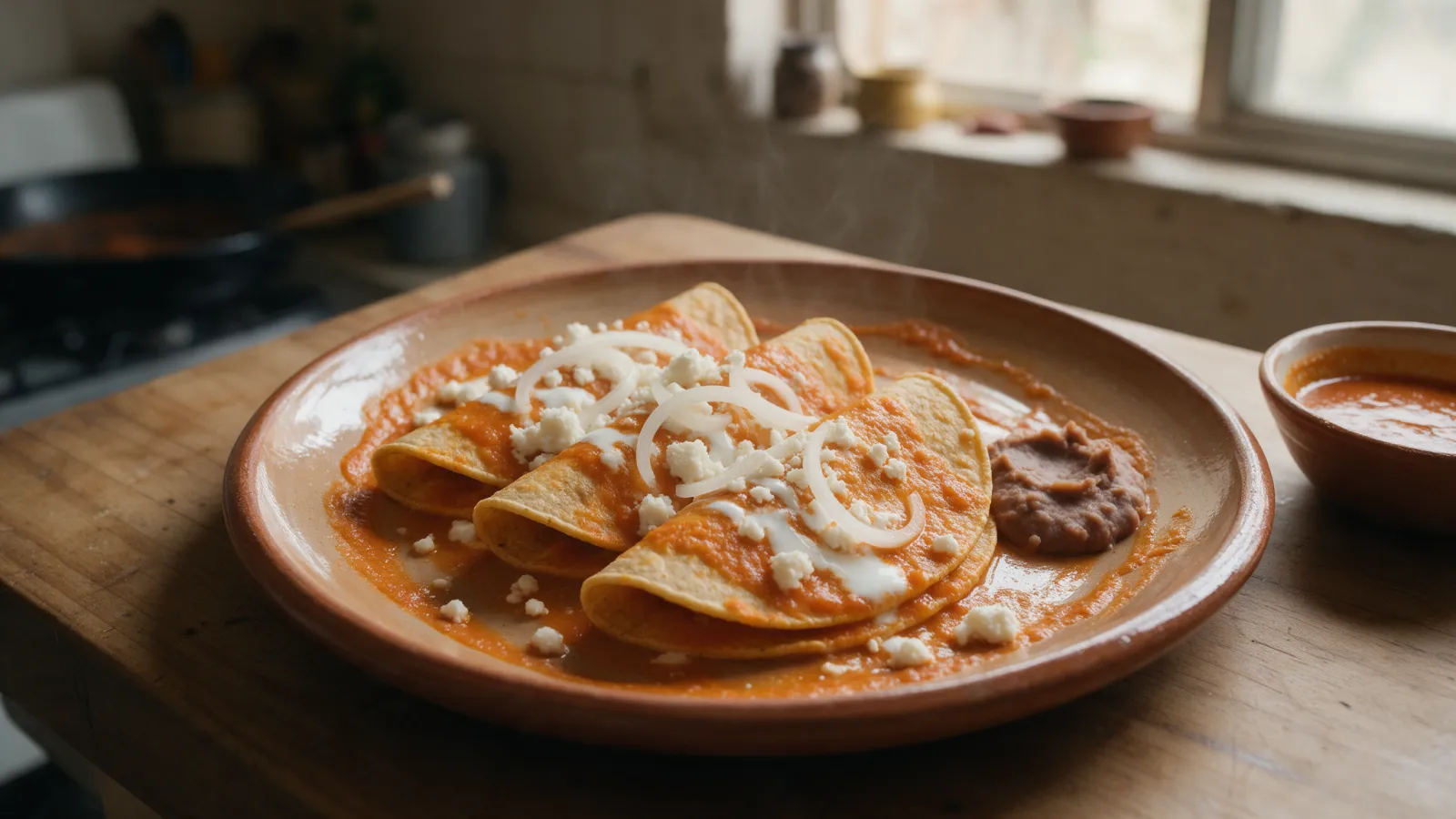

Entomatadas (en-toh-mah-TAH-dahs) need 1½ lb of ripe tomatoes, one serrano and a stack of corn tortillas, and not a single dried chile, which makes them a quicker, milder cousin of red enchiladas. Corn tortillas are flash-fried, dipped in a smooth sauce of boiled tomatoes, onion, garlic and a single serrano, then folded around crumbled queso fresco and topped with crema and raw onion. Rick Bayless also calls them enjitomatadas, because in central Mexico a red tomato is a jitomate. No dried chiles, no beans to cook, nothing you can’t find in an American or British supermarket: below you get the sauce with fresh or canned tomatoes, the one sign that tells you it’s done, the fillings and the cost per plate.
What are entomatadas, and are they worth making?
How do you make entomatadas? Boil 1½ lb (700 g) of tomatoes with onion, garlic and a serrano for 10 minutes, blend with 1 cup (240 ml) of stock, then fry the sauce for 10 minutes until it turns brick red. Flash-fry a dozen corn tortillas in hot oil, give each a 2-second dip in the sauce, fill with queso fresco, fold, and top with crema and onion. Serves 4 in 35 minutes.
They belong to a family of dishes built the same way: tortilla through hot oil, through sauce, folded. Only the sauce changes. Enfrijoladas use blended beans, red enchiladas a guajillo and ancho chile sauce, and enchiladas suizas a creamy green sauce finished under the broiler. Of the four, entomatadas have the fewest calories, about 570 a plate.
Worth it? Yes, for a weeknight. It takes 35 minutes, about 26 of them hands-on, or around 25 minutes with a can of tomatoes. The only things to learn are reading the sauce by its color and keeping the tortilla in it for just 2 seconds.
Who might skip it. Heat lovers: with one serrano the sauce is about a 1 out of 5 in my kitchen. And anyone without corn tortillas, since flour ones turn to mush in a sauce this thin.
Ingredients, and the best supermarket swaps
Everything is in the recipe card: 1½ lb (700 g) of tomatoes, 1 cup (240 ml) of stock, 12 corn tortillas, 5½ oz (160 g) of queso fresco and ½ cup (120 ml) of crema for 4 people.
| Ingredient | Best choice | US swap | UK swap | What changes |
|---|---|---|---|---|
| Tomatoes | Ripe Roma (plum) | 28-oz (794 g) can whole tomatoes | Two 400 g tins whole plum tomatoes | Canned is sweeter and darker, and already salted |
| Queso fresco | Mexican queso fresco | Most supermarkets carry it | Mild feta, rinsed under cold water | Feta is saltier and firmer |
| Crema | Mexican crema | Sour cream thinned with a splash of milk | Crème fraîche or soured cream | Sour cream is tangier and thicker |
| Serrano | 1 fresh serrano | ½ jalapeño | 1 fresh green chilli | Jalapeño is milder |
| Corn tortillas | 6 in (15 cm), about 24 g each | Any supermarket | Mexican food shops online | Flour tortillas go soggy |
Tomatoes. Roma tomatoes are meaty and less watery, which gives a thicker sauce. They should be deep red and yield slightly when pressed; pale ones make a pink, sour sauce. Out of season, a can beats pale fresh tomatoes. Skip tomato paste and passata-only versions: the sauce turns pasty and sweet. Fresh tomatoes carry 5 mg of sodium per 100 g and canned ones 115 mg, according to the USDA, so don’t salt canned tomatoes until you taste.
Equipment. A medium saucepan, a blender, a deep 10-11 in (26-28 cm) skillet so a tortilla lies flat, an 8-9 in (20-24 cm) skillet for the oil, tongs and paper towels. An immersion blender in the pan works fine. With no blender at all, grate the raw tomatoes on the coarse side of a box grater, discard the skins, and simmer the pulp with finely chopped onion and garlic for 15 minutes: a more rustic sauce, but it works.
How to plan the 35 minutes
The trick is overlapping: the tomatoes boil unattended while you chop and crumble, and the tortillas get fried while the sauce cooks. Done one step after another, the same recipe takes about 45 minutes and the sauce over-reduces.
Make-ahead. The whole sauce, blended and fried, keeps 3 to 4 days in the fridge and thickens a little; loosen it with stock 2 tablespoons at a time when reheating. Crumble the cheese and chop the onion too. Fry and fill the tortillas only at the last minute.
Reading the sauce, the step that matters most
For 12 tortillas I use 1½ lb (700 g) of tomatoes and 1 cup (240 ml) of stock. In my kitchen that blends to a little under 1 quart (1 liter) and cooks down to about 3⅓ cups (800 ml), enough to dip every tortilla and sauce the plates. Bayless uses less tomato for 4, 12 oz (340 g), with 1½ cups (360 ml) of broth and a 20 to 30 minute simmer; I prefer more tomato and a shorter cook because the sauce keeps a fresher taste.
Don’t skip the frying. When the sauce hits hot oil it sizzles, darkens and loses its raw blended-tomato taste. Watch for pink foam at first, then slow bubbles, and after 10 minutes a brick red sauce that coats a spoon with oil glistening at the edge. Too thick, like a purée? Add stock. Runny as water? Keep it on the heat a little longer. Strain it before frying only if your blender leaves skins or seeds.
Why the tortillas tear, and how to stop it
Hot oil seals the tortilla’s surface so the sauce can’t soak straight in. 10 seconds per side keeps it bendable; browned, it cracks when folded. In the sauce, 2 seconds only, one second less than for enfrijoladas, because tomato sauce is thinner than bean sauce and soaks in faster.
- Falls apart on the plate → too long in the sauce, or it skipped the oil.
- Cracks when folded → browned in the oil, or cooled before filling. Fill it right away.
- Greasy → the oil was too cool. The tortilla edge should bubble on contact.
Scaling for a crowd
Plan on 3 entomatadas per person.
| People | Tortillas | Fresh tomatoes | 28-oz (794 g) cans | Stock | Queso fresco | Crema |
|---|---|---|---|---|---|---|
| 4 | 12 | 1½ lb (700 g) | 1 | 1 cup (240 ml) | 5½ oz (160 g) | ½ cup (120 ml) |
| 6 | 18 | 2⅓ lb (1.05 kg) | 1½ | 1½ cups (360 ml) | 8½ oz (240 g) | ¾ cup (180 ml) |
| 12 | 36 | 4⅔ lb (2.1 kg) | 3 | 3 cups (720 ml) | 1 lb 1 oz (480 g) | 1½ cups (360 ml) |
| 20 | 60 | 7¾ lb (3.5 kg) | 5 | 5 cups (1.2 l) | 1¾ lb (800 g) | 2½ cups (600 ml) |
For 12 or more, fill and fold the tortillas into 9×13 in (23×33 cm) baking dishes, 12 per dish, cover with sauce and foil, and bake at 375°F (190°C) for 10 to 15 minutes. Add crema and onion as they come out. They’re softer than plated-to-order entomatadas, but everyone eats at once. For 20, cook the sauce in two batches.
Heat, kids and allergens
Heat level, 1 out of 5 with one serrano. No chile, 0; two serranos, 2.
Kids? Tortilla, tomato sauce and cheese: an easy sell. I leave out the chile for children and serve the crema on the side.
Allergens. Milk in the cheese and crema. Corn tortillas are naturally gluten-free, but some brands blend in wheat flour, so check the label, and check store-bought stock too. Without dairy and with water or vegetable stock, the dish is vegan.
Which version should you make?
Filled or not, both are entomatadas. Unfilled, folded with all the cheese on top, they’re a side dish or a light supper; as a main course I fill them.
- Cheese → the base recipe, 1 heaped tablespoon (10 g) per tortilla.
- Chicken → 10½ oz (300 g) of cooked, shredded breast, cooked to 165°F (74°C), with only 1½ oz (40 g) of cheese on top. Twice the protein for 24 kcal more per plate.
- Chicken tinga → filled with chicken tinga, smoky and a little hotter.
- Egg → 2 scrambled eggs per plate inside, or a fried egg on top.
- Beans → 1 tablespoon of refried beans per tortilla; with vegetable stock and no dairy, they’re vegan.
- Short on time → a 28-oz (794 g) can and no boiling, about 25 minutes.
- Lighter → tortillas warmed in a dry skillet instead of fried, about 434 kcal a plate. They tear more easily, so dip for 1 second.
- Deeper flavor → roast the tomatoes under the broiler or at 400°F (200°C) for 20 to 25 minutes instead of boiling them, or simmer a sprig of epazote or a handful of cilantro in the sauce, as Bayless suggests.
If you want the tortillas fried into chips and simmered in the sauce instead, that’s chilaquiles; the technique is in these chilaquiles verdes.
What entomatadas cost
In the US, using BLS and USDA average prices and an H-E-B supermarket for tortillas and crema, the batch for 4 comes to $7.34, about $1.84 a plate, before oil, garlic, stock and salt:
What pushes the price up. Fresh tomatoes, over 40 % of the bill, then the cheese and crema. That makes entomatadas pricier in the US than enfrijoladas, which come to $1.28 a plate. A 28-oz can is often the cheaper route in winter, but there’s no official average price for canned tomatoes, so I won’t give one.
Yield. A dozen entomatadas: 4 plates of three, or 6 people if you serve rice and beans alongside and give everyone two.
What to expect, how to serve them and how to store leftovers
Taste and texture. Soft, intact tortillas in a smooth tomato sauce that’s brighter and tangier than an enchilada sauce, with a little warmth from the serrano. Salty cheese, sour crema and crunchy raw onion do the contrast work.
Serving. Three per plate, folded or rolled and overlapping, sauced and topped. Mexican red rice and beans on the side, or sliced avocado.
Fridge. USDA FSIS guidance for leftovers: no more than 2 hours at room temperature and 3 to 4 days at 40°F (4°C) or below. Store the sauce separately; assembled entomatadas go soft overnight.
Freezer. The sauce freezes well for 3 to 4 months for best quality. Assembled entomatadas don’t: the tortillas fall apart when thawed. I freeze the sauce in 1⅔-cup (400 ml) bags, half a batch each.
Reheating. Warm the sauce over low heat, adding stock 2 tablespoons at a time, until it reaches 165°F (74°C), as FSIS recommends. Fry and fill fresh tortillas. Already assembled? Cover with foil and bake at 350°F (180°C) for 10 minutes; the microwave turns them soggy.
Entomatadas FAQ
What’s the difference between entomatadas and enchiladas? The sauce. Enchiladas are sauced with chile, dried or green; entomatadas with tomato, so they’re much milder. The assembly is identical.
Can I use canned tomatoes? Yes. One 28-oz (794 g) can of whole tomatoes with its juice replaces 1½ lb (700 g) of fresh and saves the boil. In the UK, use two 400 g tins. Don’t add salt until you’ve tasted it.
Can I use store-bought salsa or tomato sauce? A jarred salsa makes something closer to enchiladas, and plain tomato sauce or passata gives a flat, sweet result. A can of whole tomatoes blended with onion and garlic is almost as quick and tastes far better.
Why do my corn tortillas break? They weren’t flash-fried, they browned, or they sat in the sauce too long. Give them a quick fry, about 10 seconds a side, and pull them out of the sauce almost as soon as they go in.
What do you fill entomatadas with? Queso fresco, shredded chicken, scrambled egg or refried beans. They’re also served unfilled, with all the cheese on top.
Can I make them ahead? The sauce, yes: it keeps in the fridge for up to 4 days and in the freezer for months. Fry and assemble the tortillas just before eating.
Are entomatadas spicy? Barely. One serrano gives a 1 out of 5; leave it out for zero.
Nutrition per serving
Per serving (3 cheese entomatadas with crema), calculated ingredient by ingredient from USDA FoodData Central (SR Legacy) with this recipe’s quantities, using fresh tomatoes, home-made chicken stock, about 60 g (2 oz) of oil absorbed by the 12 tortillas (my own estimate) and sour cream as a stand-in for crema:
- Calories: 569 kcal
- Protein: 16 g
- Carbohydrates: 47 g
- Fat: 37 g, of which 11 g saturated
- Fiber: 7 g
- Sugars: 9 g
- Sodium: 826 mg
Oil is the biggest single line, about 166 kcal a plate (around 135 from what the tortillas absorb and 31 from the tablespoon in the sauce); tortillas add 157, cheese 120, crema 59 and the tomatoes just 32. Nearly half the sodium comes from the salt in the sauce and over a third from the cheese. Swap in canned tomatoes and keep the salt and you’re at about 1,045 mg; leave the salt out and it falls to about 658 mg.
The first batch I ever made, I cooked the sauce the way I cook a Venezuelan tomato sauce for pasta, low and slow until it was thick enough to stand a spoon in, and every tortilla tore the moment it went in. Entomatadas want a sauce that still pours. These days I keep a bag of it in the freezer for weeknights, and leftover sauce is just as good spooned over Colombian cheese arepas with a fried egg the next morning. Josnaisis.