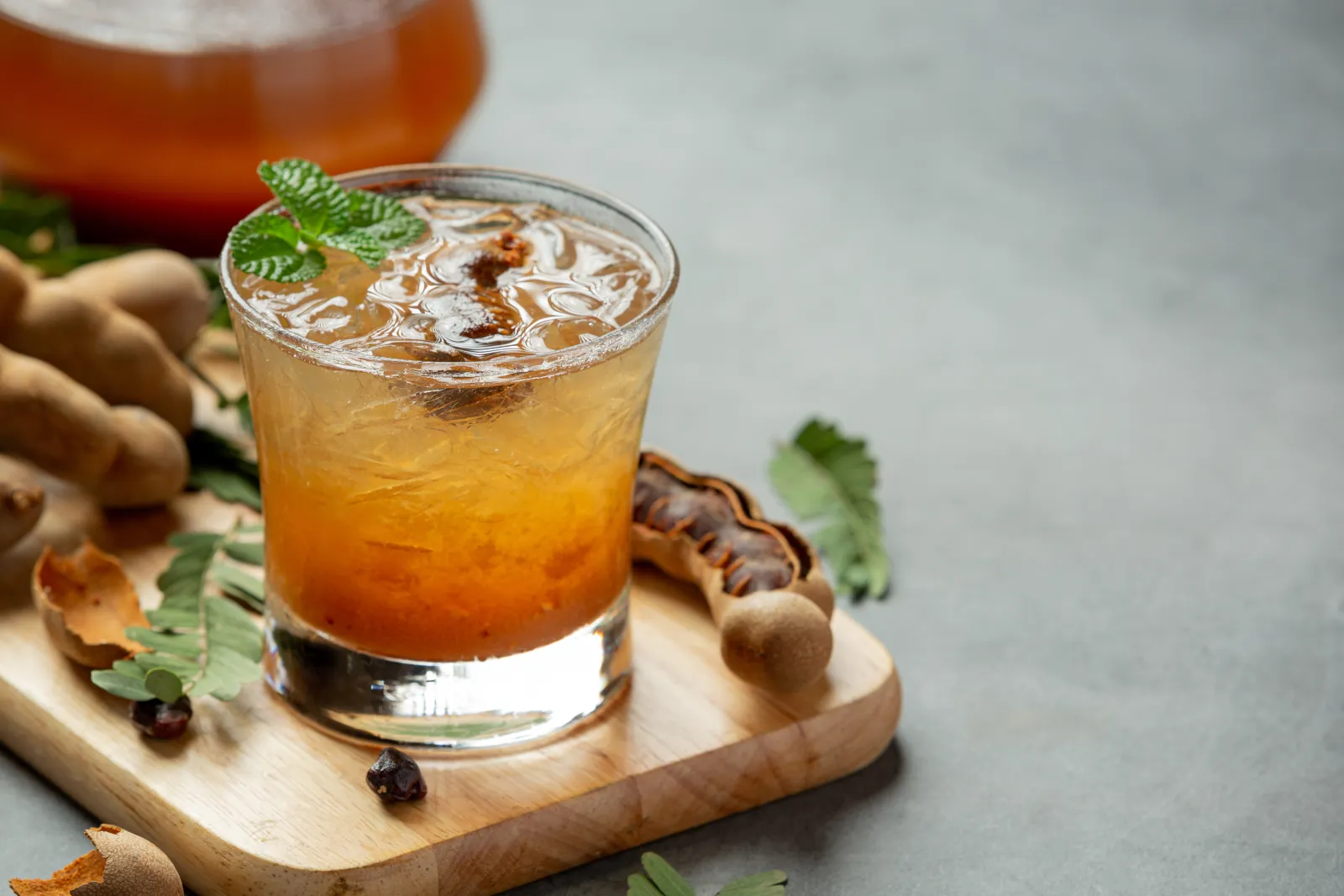

Agua de tamarindo (AH-gwah deh tah-mah-REEN-doh) is what Mexican market stalls and taquerías ladle out of big glass barrels when you want something sour, cold and brown: tamarind pulp worked loose from its seeds in hot water, strained, sweetened and stretched with plenty of cold water. It tastes like a tart cross between dates and prunes with a lemonade finish, and it’s built for food with chile and fat. Fourteen large pods, about 400 g (14 oz) with shells on, make 2 quarts. That weight matters more than anything else in the recipe, because “15 tamarinds” can mean 150 g or 600 g depending on the pods in front of you.
How do you make agua de tamarindo?
How do you make tamarind agua fresca from pods? Peel 400 g (14 oz) of tamarind pods, simmer them covered in 1 liter (4¼ cups) of water for 10 minutes and rest 20 minutes off the heat. Mash the pulp off the seeds, blend 30 seconds with 120 g (½ cup plus 1½ tbsp) of sugar, strain, and top up with cold water to 2 liters. Ready in 55 minutes for 8 servings.
Only 25 of those 55 minutes need your hands. The rest is the pot doing its job, and if you soak the pods the night before, the morning work shrinks to about 15 minutes.
Which tamarind to buy in the US and UK
Tamarind comes in four forms outside Mexico, and they are not swapped gram for gram.
Sour tamarind pods are the Mexican kind and the one this recipe is written for. Look in Mexican and Latin grocers, sold loose or in bags in the produce section. Pick pods with a dry shell that cracks when you squeeze it; Rick Bayless puts a pound (454 g) at about 16 large pods, roughly 28 g each.
Sweet tamarind pods come in cardboard boxes from Thailand at Asian grocers and some US supermarkets. They are eaten as a snack and make a much gentler drink: the Oldways tamarind agua fresca uses sweet pods and only 1 teaspoon of agave for 4 cups. If that’s what you have, halve the sugar and taste.
Seedless pressed block or slab is the easiest find in the UK, in the world food aisle (Morrisons stocks a KTC tamarind slab) and in Indian and Asian shops; in the US it’s at the same shops and online. It’s compacted pulp with a little fibre left in. Use about 150 g (5 oz), roughly the pulp you’d get from 400 g of pods, soak it 30 minutes in the liter of hot water as the packet instructions say, then carry on from the mashing step.
Concentrate in jars is already cooked and seedless, so there’s no stove at all. Strength varies a lot by brand: start with 2 tablespoons (30 ml) per quart and add more as you taste. It comes out darker and more like cooked fruit. Skip the ready-made tamarind drinks and nectars; they’re already sweetened and you lose control of the sugar.
Peeling pods without losing your afternoon
Don’t peel the shell, break it. A squeeze with your thumb cracks it, the pieces lift off, and then the trick is the stem: pull it down along the pulp and the stringy veins come away in one go. Plan on about 10 minutes for 400 g (14 oz). Camila Made cuts peeled pods into pieces with kitchen scissors so they soften faster, which is handy with very dry pods.
Leave the seeds for later. Raw, each one is glued into sticky pulp; after 30 minutes in hot water, a rub between two fingers frees it. That’s the single change that makes this recipe quick.
Soak or simmer, and how long
Every method works; they differ in time and in how “cooked” the drink tastes.
My routine is a 20 minute covered rest after just 10 minutes of simmering. Some recipes boil for half an hour, and in my kitchen that never released the seeds any better, it just pushed the taste toward stewed fruit. When I’m planning ahead, the cold soak (peeled pulp in a liter of water, 8-12 hours in the fridge) gives the freshest result with no stove at all. Rick Bayless pours boiling water over the pods and leaves them 1-2 hours off the heat, which sits neatly in between.
Sugar, and the calories tamarind already brings
The surprise is the sugar: according to USDA data, every 3½ oz (100 g) of tamarind pulp holds 38.8 g of sugars. So before you add a single spoonful, a glass already carries about 48 calories from the fruit. This recipe uses 120 g (½ cup plus 1½ tbsp) per 2 liters, 15 g per glass, which sits in the middle of the recipes I compared. Blend the sugar in with the pulp, where it dissolves without heating, and only taste once the pitcher is diluted.
Swaps. Dark brown sugar, or dark muscovado in the UK, stands in for Mexican piloncillo: the drink turns darker with a molasses note that suits tamarind. Honey or agave work too; add them to the finished pitcher. Any tabletop sweetener works for an unsweetened version, which still tastes sharper than you’d expect.
Make-ahead plan and party batches
The whole thing can be done a day early. What comes out of the sieve before you add the cold water is a base, a little over 1 liter (1 quart). Keep it covered in the fridge and dilute it 1 to 1 with cold water when you serve. It takes half the fridge space of the finished pitcher.
Count 2 glasses of 8.5 fl oz (250 ml) per person with a meal, 3 when it’s hot out and there’s nothing else to drink.
| People | Finished drink | Tamarind pods | Water to simmer | Sugar | How |
|---|---|---|---|---|---|
| 4-6 | 2 L (about 2 qt) | 400 g (14 oz) | 1 L (4¼ cups) | 120 g (scant ⅔ cup) | as written |
| 10-12 | 5 L (1⅓ gal) | 1 kg (2.2 lb) | 2.5 L (10½ cups) | 300 g (1½ cups) | 4 qt pot, blend in 2-3 batches |
| 20 | 10 L (2⅔ gal) | 2 kg (4.4 lb) | 5 L (5¼ qt) | 600 g (3 cups) | 8 qt pot or two pots, 5 batches |
Peeling is the slow part at scale, about 25 minutes per kilo (2.2 lb), so hand it out. Keep the ice in a separate bucket so it doesn’t water the pitcher down.
Mistakes that make it stewed, thin or gritty
- Tastes like jam → boiled too long. 10 minutes plus a rest, not 30 minutes on the flame.
- Thin and muddy → too little tamarind, often because the peeled weight was used as if it were whole pods. It’s 200 g (7 oz) of whole pods per liter, about 150 g (5 oz) peeled.
- Still sour after more sugar → it needs water, not sugar. Add 1 cup (250 ml) of cold water and taste again.
- Strings or grit in the glass → veins left on, or a coarse sieve. Pull the stem when peeling and strain through fine mesh.
- Separates in the pitcher → normal; the fine pulp settles. Stir before pouring.
Is tamarind water a laxative or a weight loss drink?
There’s no solid evidence for either. WebMD’s tamarind monograph says the fruit contains compounds that “might” have a laxative effect, but that there’s no good scientific evidence for most of its uses, constipation included, and advises sticking to food amounts. The fibre people point to mostly stays in the sieve: the math gives 1 g per glass at most. For weight, a glass made as written has 106 calories, the same as 8.5 fl oz of cola; with 60 g of sugar per pitcher it drops to 77. The same monograph notes tamarind might increase how much aspirin and ibuprofen the body absorbs, so if you take either daily, mention it to your doctor.
Allergens. No gluten, dairy, egg or nuts. Kids usually like it sweetened; it’s tart, so I add a little more water for them.
Versions worth making
- Fastest → 150 g (5 oz) of seedless block soaked 30 minutes, or concentrate, about 5 minutes and no cooking.
- No stove → cold soak overnight, 8-12 hours.
- Lighter → 60 g (5 tbsp) of sugar per pitcher and a squeeze of lime so it doesn’t taste flat.
- Chile rim → dip the glass rim in chamoy or chile-lime seasoning.
- Cinnamon → simmer 1 stick with the pods.
- Sparkling → half a glass of tamarind water, half chilled sparkling water.
- Spiked → for adults, a shot of mezcal or tequila per glass, added when serving.
What it costs
There’s no official retail price for tamarind in the US or UK, so check your receipt: 400 g (14 oz) of pods or 150 g (5 oz) of block per pitcher. For scale, Mexico’s SNIIM wholesale report for 9 October 2026 had first-grade tamarind at 60-80 pesos per kilo in the Guadalajara, Monterrey and Morelia markets. The sugar is trivial: 120 g costs about $0.27 at the BLS US average of $1.024 per pound for August 2026. The tamarind is nearly the whole bill. Yield is 8 glasses of 8.5 fl oz (250 ml), about 10 with ice.
How long it keeps and how to serve it
Fridge. Covered, at 40°F (4°C) or below, the temperature USDA recommends for a home refrigerator. The recipes I compared give 2 to 3 days for the pitcher and up to 3 days for the undiluted base; I drink it within 2 and pour it out if it smells fermented or fizzes.
Freezer. Freeze the base in ice cube trays or flat bags for up to 2 months (Camila Made’s guidance) and thaw it overnight in the fridge. The cubes also chill a glass without watering it down.
Serving. Tall glass, lots of ice, alongside the food. It’s made for tacos al pastor and anything rich, and in Colombia it holds its own next to a bandeja paisa. For a table of aguas frescas, set it beside a red agua de jamaica and a pale green cucumber lime agua fresca, with creamy Mexican horchata or a Colombian coconut lemonade for anyone who wants something sweet. Venezuelans will recognise the idea from papelón con limón, only sharper.
Frequently asked questions
How much tamarind do you need per liter? 200 g (7 oz) of whole pods in their shells per liter of finished drink, about 7 large pods. Peeled, about 150 g (5 oz).
Do you have to boil tamarind for agua fresca? No. An overnight cold soak in the fridge or a 1-2 hour soak in just-boiled water both work; the fastest route is a 10 minute simmer and a 20 minute rest.
How do you get the seeds out of tamarind? Soften the pulp first, then rub it between your fingers in the soaking water or mash it. Raw, the seeds cling; softened, they slip out.
Can I use tamarind paste or concentrate instead of pods? Yes. Use about 150 g (5 oz) of seedless block, soaked 30 minutes, or start concentrate at 2 tablespoons per quart and add to taste.
How many calories are in a glass of tamarind agua fresca? 106 calories per 8.5 fl oz (250 ml) glass as written, about 48 unsweetened.
How long does agua de tamarindo last in the fridge? 2 days, 3 at most, covered at 40°F (4°C). Frozen, the base lasts 2 months; in the fridge, 3 days.
Is agua de tamarindo a laxative? There’s no good scientific evidence that it is, and most of the fibre stays in the sieve.
Nutrition per glass
Per 8.5 fl oz (250 ml) glass, with 400 g (14 oz) of pods and 120 g of sugar for 2 liters, from USDA FoodData Central (SR Legacy): tamarind pulp 239 kcal and sugar 387 kcal per 100 g. The math assumes 40% pulp, 160 g (5.6 oz) per pitcher, inside the 30-55% range given by Purdue University’s fruit compendium.
- Calories: 106
- Protein: 1 g
- Carbohydrates: 28 g
- Sugars: 23 g
- Fat: 0 g
- Fiber: 1 g (at most, strained)
- Sodium: 6 mg
That counts every bit of pulp, so it’s a ceiling. Fleshy pods at 55% pulp push it to 124 calories; skinny ones at 30%, down to 94.
I used to think more boiling meant more flavor, and my first pitchers tasted like tamarind jam. Ten minutes on the stove, a lid, and a scale for the pods fixed it. Dylan gets his with an extra splash of water. Josnaisis.