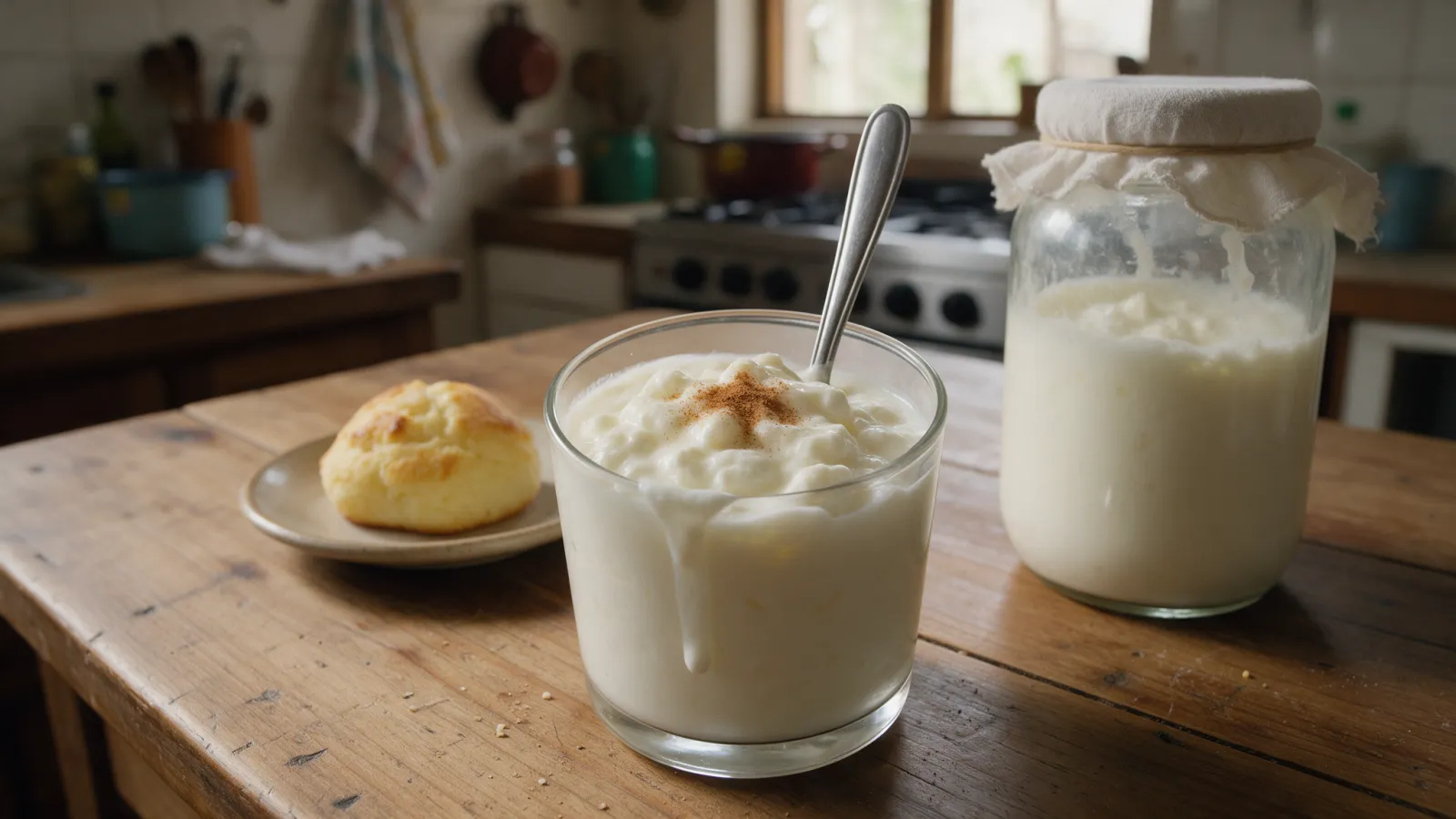

In Colombia, kumis (KOO-mees) is the drink you buy in a plastic cup at the corner bakery and drink with warm cheese bread: cow’s milk fermented until it thickens and turns tangy, then sweetened and served cold. The country’s dairy regulation, Resolution 2310 of 1986, defines it as milk set by Streptococcus lactis or cremoris, the bacteria now called Lactococcus lactis. Those are countertop bacteria, happiest at 79-82°F (26-28°C), and that single fact changes how you make it at home: no yogurt maker, no oven, no warm blanket.
What is Colombian kumis, and is it worth making?
How do you make Colombian kumis at home? Heat 2 litres (8½ cups) of pasteurized whole milk to 185°F (85°C) and hold it 10 minutes, cool it to 86°F (30°C) and stir in 100 ml (scant ½ cup) of plain kumis or cultured buttermilk. Leave the jar at 75-82°F (24-28°C) for 20 to 24 hours until set, blend with 120 g (½ cup plus 1½ tbsp) of sugar and chill 4 hours. Ready in 1520 minutes for 8 servings, with 20 minutes of hands-on work.
It’s worth it if you like tangy dairy and drink it often. Homemade, you choose the sweetness and the sourness, and it costs a fraction of store-bought.
Who it suits. Anyone who already makes yogurt or sourdough and likes a project that mostly waits. It is also a good make-ahead breakfast drink: one batch is 8 glasses for the week.
Who it doesn’t. Anyone who wants it today, since it takes about 25 hours start to finish. People with a cold kitchen in winter, below about 68°F (20°C), will wait much longer. And it isn’t lactose-free: fermentation uses up some of the lactose, not all of it.
Difficulty. Easy. About 20 minutes of actual work across two days. A kitchen thermometer makes it foolproof.
Kumis vs kefir, yogurt and koumiss
The names cause real confusion, and the clearest referee is the Codex Alimentarius, the international food standards body, in its standard for fermented milks. Yogurt is made with Streptococcus thermophilus and Lactobacillus bulgaricus, cultures that work at around 110°F (43°C), the temperature the University of Alaska Fairbanks extension gives for home yogurt. Kefir uses kefir grains, a mix of bacteria and yeasts, which is why it’s fizzy. Koumiss (also spelled kumys or kumiss) is the fermented mare’s milk of the Central Asian steppes. According to the Codex, it is made with Lactobacillus bulgaricus plus the yeast Kluyveromyces marxianus and must reach at least 0.5% alcohol. Colombian kumis shares the name and nothing else.
The starter, and why buttermilk beats yogurt outside Colombia
Use a scant ¼ cup of starter per quart of milk (50 ml per litre, about 5%). A 2015 thesis on kumis fermentation from the Universidad Laica Eloy Alfaro de Manabí in Ecuador used 3% commercial culture; the Alaska yogurt guide uses ¼ cup per quart, closer to 6%. I sit between the two because a homemade starter’s strength is unknown, and a slightly bigger dose sets faster and crowds out anything that shouldn’t be there.
Cultured buttermilk is the find for US and UK readers. Buttermilk cultures, such as New England Cheesemaking’s Buttermilk DS, are blends of Lactococcus lactis strains plus Leuconostoc, the same family Colombian law names for kumis, and they set at around 72°F (22°C) in 12 to 24 hours. Buy one labeled “cultured” with live cultures. The result is milder and slightly buttery next to Colombian kumis, and much closer to it than yogurt gets.
| What you need | Best choice | Supermarket swap | What changes |
|---|---|---|---|
| Starter, 100 ml (scant ½ cup) | Plain Colombian kumis (Latin grocers) | Cultured buttermilk with live cultures | Milder, a little buttery |
| Starter, second option | — | Plain yogurt with live cultures, 100 g | Slower on the counter, tastes like drinkable yogurt |
| Milk, 2 L (8½ cups) | Whole milk, 3.25% (US) or full-fat (UK) | Long-life whole milk | Same result; still heat it to 185°F (85°C) |
| Sugar, 120 g | Granulated (US) or caster (UK) | Panela or piloncillo, grated | Darker, molasses notes |
Equipment. A heavy 3-quart (3 L) pot, a 2½-quart (2.5 L) glass jar with a lid, a blender and ideally an instant-read thermometer. Without a thermometer, 185°F (85°C) looks like steady steam and small bubbles at the edge; 86°F (30°C) feels barely warm dripped on your wrist.
The temperatures that decide everything
Three numbers matter. 185°F (85°C) for 10 minutes, from the Alaska extension, so the milk proteins thicken rather than curdle; the Ecuadorian thesis uses 194°F (90°C) for the same time. 86°F (30°C) to add the starter. 79-82°F (26-28°C) to ferment, the range in a National University of Colombia study published in Vitae in 2011, which gives 20 to 24 hours to a final pH of 4.00 to 4.25.
A warm kitchen in summer is already in range. In a colder house, put the jar inside the switched-off oven or a cupboard, wrapped in a towel. What I avoid is a yogurt maker or a proofing setting: too hot for these bacteria, and the drink comes out tasting like thin yogurt.
Timeline, make-ahead and batch sizes
The schedule that works for me: heat the milk after dinner, let it ferment overnight and through the morning, blend in the afternoon and it’s cold by evening. Kumis is a make-ahead drink by nature; it thickens a little as it rests in the fridge.
How to tell it’s ready.
- At 8-12 hours → it starts to thicken at the bottom and smells faintly sour. If nothing has changed at 12 hours, the room is too cool or the starter was weak.
- Ready, at 20-24 hours → tilt the jar and the milk moves as one mass, like a loose custard, pulling away from the glass. It smells clean and tangy. If you own pH strips, you are looking for about 4.0 to 4.25.
- A little over → a layer of clear whey on top and a sharp sour taste. Still fine: blend it in and add a little more sugar. Next time, take it off 2-4 hours earlier.
Batch sizes. The ratio is linear: 50 ml (scant ¼ cup) starter and 60 g (5 tbsp) sugar per litre (4¼ cups), same timings.
- 1 litre, 4 glasses → 50 ml starter, 60 g sugar, in a 1.2-litre (1¼-quart) jar.
- 2 litres, 8 glasses → the recipe card.
- 5 litres (about 1⅓ gallons), 20 glasses → 250 ml (1 cup) starter and 300 g (1½ cups) sugar, split across three 2-litre jars.
Saving starter. Before sweetening, set aside 100 ml (scant ½ cup) in a small scalded jar and keep it closed in the fridge until the next batch, as the Alaska guide advises for yogurt starter. I use mine within 7 days. If a batch is slow, weak or smells off, the chain ends there: start again from bought kumis or buttermilk.
Is homemade kumis safe? When to throw it out
Yes, with pasteurized milk and clean equipment. Kumis used to be made with raw milk left to sour overnight. Raw milk can carry Salmonella, E. coli, Listeria and Campylobacter, according to the FDA, and the risk is highest for pregnant women, young children, older adults and anyone with a weakened immune system. Twenty hours on a counter at 80°F (27°C) is no place to take that chance.
Throw out the whole batch if you see or smell any of these.
- Mold of any color, even a speck. The University of Connecticut extension, following the USDA’s guidance on moldy foods, says high-moisture dairy like yogurt should be discarded at any sign of mold. Don’t scrape it off.
- Pink, orange or black spots, or a slimy surface.
- A putrid, strong cheesy, yeasty or boozy smell instead of clean tang.
- Gas that domes the lid or fizzes when you open the jar.
- No set after 36 hours. The Alaska extension says to discard batches that fail to set, since it may mean a bad culture or unwanted microorganisms.
Mistakes that ruin it.
- Thin → skim milk, not enough time at 185°F, or over-blending. Use whole milk and a 30-second blend.
- Tastes like yogurt → yogurt starter or too warm a spot.
- Lumpy with whey → fermented too long or the jar was moved. Blend and drink; shorten next time.
- Lime juice → some recipes add it. I don’t: the starter does the souring, and acid in warm milk curdles it into grains.
Kids and allergens. My son drinks it cold with cinnamon; to cut sugar, step down from 120 to 80 g over a few batches. Heat level zero. The allergen is milk.
Lighter, sugar-free and other versions
- Lighter → skim milk with 40 g (⅓ cup) nonfat dry milk whisked in before heating, and 60 g (5 tbsp) sugar: about 144 kcal a glass instead of 225. Without the milk powder, 126 kcal but noticeably thin. Several Colombian commercial brands add milk powder too, according to the Vitae study.
- Unsweetened → blend without sugar and let everyone sweeten their own glass. About 165 kcal.
- El Patía style → grated panela or piloncillo instead of sugar, plus a stick of cinnamon and two cloves, removed before serving. Colombia’s Radio Nacional describes the kumis of El Patía, in Cauca, as originally set overnight in a lidded gourd and sweetened with scraped panela.
- With fruit → at serving time, blend a glass of kumis with 50 g (⅓ cup) strawberries or blackberries for 10 seconds. Drink it straight away.
What it costs in the US
At BLS average US prices for August 2026 (whole milk $4.229 a gallon, sugar $1.024 a pound), the milk and sugar for 8 glasses cost about $2.50, roughly $0.31 a glass, plus your starter. BLS doesn’t track buttermilk or plain yogurt, so I’m not putting a number on those; you use 100 ml once and then save your own. In Colombia, by comparison, the first batch costs about 15,121 pesos with bought starter, and the same weight of kumis in single cups costs three times as much. For the UK I couldn’t find an official average-price series for these items, so no pound figure.
How it tastes, what to serve, how long it keeps
Taste and texture. Cold, thicker than milk and thinner than yogurt, tangy underneath and sweet up front, with cinnamon on the nose. It gets a little tangier each day.
What to serve it with. In Colombia, bread. Warm Colombian cheese bread (pandebono) is my default, and almojábanas or crisp pandeyuca cassava rings work just as well. If you like cold dairy drinks, Colombian cold oat drink is the other bakery classic, and Colombian masato, a fermented rice drink, is the dairy-free one. And when there’s milk left over, Colombian dulce de leche or the Colombian natas dessert turn it into something sweet.
Fridge. At 40°F (4°C) or below, in clean closed jars, I drink it within 7 days, the shelf life New England Cheesemaking gives for homemade buttermilk made with similar cultures. The Alaska extension gives home yogurt 10 to 21 days, but I’d rather be conservative with a home ferment. Don’t leave it out of the fridge for more than 2 hours.
Freezer. Not as a drink: it separates into curds and whey when thawed. Leftovers make good ice pops.
Colombian kumis FAQ
What does kumis taste like? Like a sweetened, pourable plain yogurt with a gentler, rounder tang, served very cold with cinnamon.
Is kumis the same as koumiss? No. Koumiss is Central Asian fermented mare’s milk, made with yeast, and the Codex requires it to contain alcohol (half a percent at minimum). Colombian kumis is cow’s milk fermented by lactic bacteria, with no alcohol.
Can I make kumis with yogurt? Yes: a scant ½ cup (100 g) of plain live-culture yogurt for the whole batch. It ferments slower on the counter and tastes more like drinkable yogurt; cultured buttermilk gets closer.
How long do you ferment kumis? 20 to 24 hours at 79-82°F (26-28°C). In a 68-72°F (20-22°C) kitchen, up to 36 hours.
Is kumis alcoholic? Colombian kumis isn’t. Its bacteria make lactic acid, not alcohol.
How long does homemade kumis last? I drink it within 7 days, kept at 40°F (4°C) or below. Throw it out at any sign of mold, off smells or a domed lid.
Can I use raw milk? I wouldn’t. The FDA warns raw milk can carry Listeria, Salmonella and E. coli, and a day on the counter doesn’t make it safe.
Nutrition per glass
Per glass of about 270 ml (9 fl oz), one eighth of the batch, calculated ingredient by ingredient from USDA SR Legacy data:
- Calories: 225 kcal
- Protein: 9 g
- Carbohydrates: 29 g
- Fat: 9 g, of which 5 g saturated
- Sugars: 29 g (15 g added)
- Sodium: 117 mg
The calculation doesn’t subtract the lactose the bacteria turn into lactic acid, so real sugars run a little lower. Sugar moves the number most. Leave it out and a glass drops to about 165 kcal; go up to 160 g (¾ cup) for the batch and it reaches about 244.
I’m Venezuelan, and kumis was new to me when I moved to Colombia; my first batches tasted like yogurt because I kept them somewhere warm, the way I’d always made yogurt. Once I left the jar alone on the kitchen counter, it came out right. Kumis rewards a cooler spot and more patience than you’d think. Josnaisis.