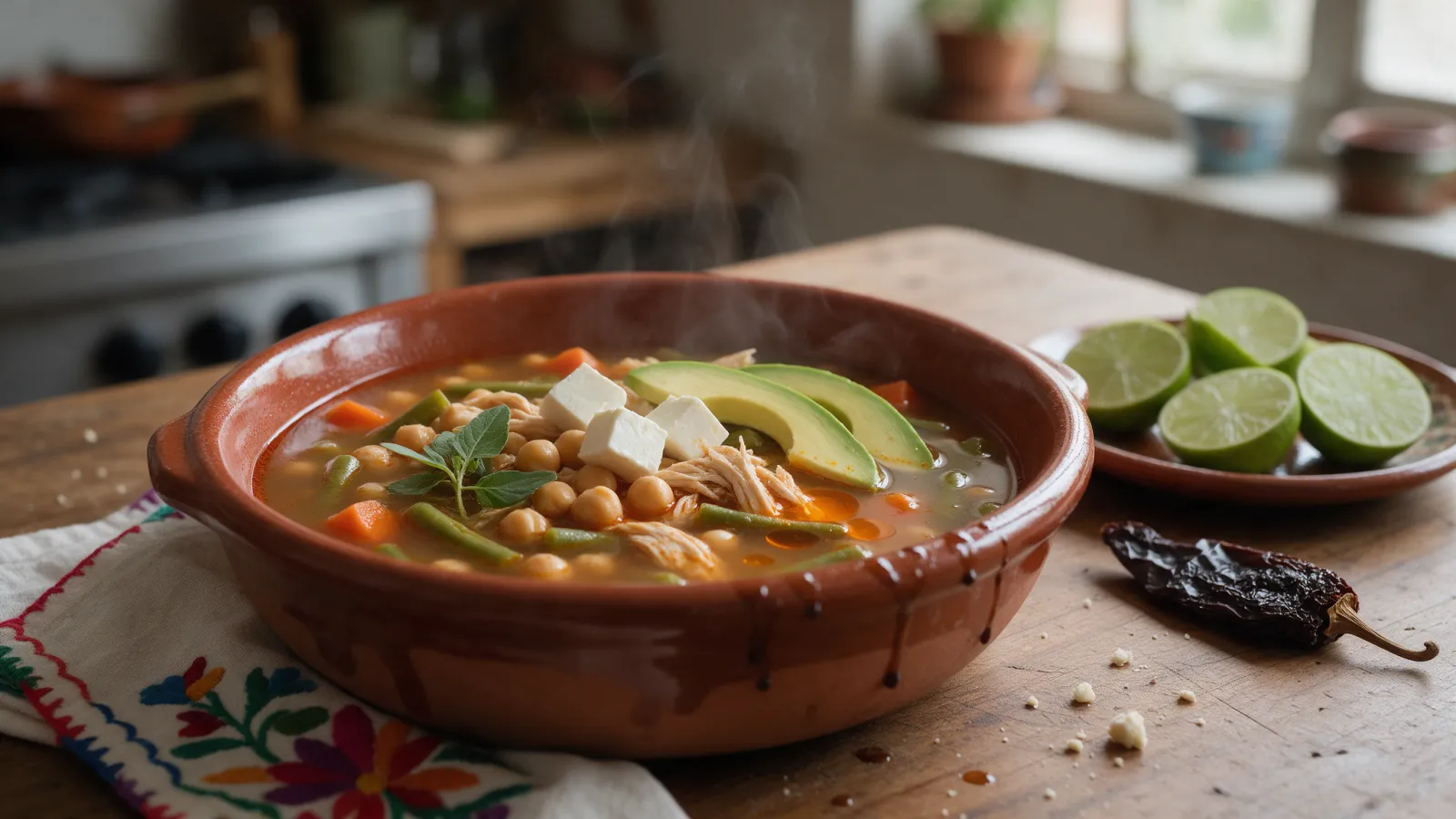

Caldo tlalpeño (cahl-doh tlahl-PEH-nyoh) is a chicken soup from Mexico City with a smoky, brick-red broth. Its name points to Tlalpan, a district on the southern edge of the city; the colorful stories about who invented it are unverified, and Spanish Wikipedia says plainly that the exact origin is unknown. What makes it different from any other chicken soup is three ingredients: chipotle peppers in adobo blended into the broth, chickpeas, and epazote, a pungent Mexican herb. A Tlalpan chef quoted by the Mexico City magazine Chilango put it bluntly: without epazote, it’s just broth with chipotle.
How do you make caldo tlalpeño?
How do you make caldo tlalpeño? Simmer bone-in chicken from cold water with onion and garlic, skim, and keep it at a bare simmer: the breast comes out at 25 minutes, the thighs at 35. Blend tomatoes with 2 chipotles in adobo, fry the sauce 8-10 minutes and strain the broth into it. Add carrots, then green beans, chickpeas and epazote, and finally the shredded chicken. 90 minutes for 6 servings.
90 minutes on the clock, about 45 of them hands-on. It’s an easy recipe; the two things people get wrong are the heat level, which you control by counting chipotles, and dry chicken breast, which you avoid by pulling it at 165°F (74°C) instead of boiling it as long as the thighs.
Is it worth making? If you like smoky heat and want a one-bowl meal, yes. It’s a good cold-weather pot for 6, it doubles without any change in technique, and leftovers keep for days. Skip it if nobody at your table tolerates any chile at all, or if you want a clear, light broth: this one is red and full-bodied.
How spicy is it, and how many chipotles should you use?
A chipotle is a ripened jalapeño that has been smoked and dried. English Wikipedia rates it at up to 8,000 Scoville heat units, with milder ones from 2,500. Canned in adobo, it comes stewed in a tangy sauce of tomato, vinegar, garlic and spices. It’s milder than a serrano, but two blended into 2 liters (8 cups) of broth are noticeable.
Published recipes range from 1 chipotle in the sauce (Mama Maggie’s Kitchen, for 4 servings) to 2 (the Mexican newspaper Excélsior), while Pamela Salzman rates 4 whole dried chipotles in her pot at about 2-3 out of 10. Here’s how I count for 2 liters (8 cups) of broth:
| Chipotles blended into the sauce | Heat | Who it’s for |
|---|---|---|
| Only 1 tbsp of adobo sauce | barely there | young kids, chile-shy guests |
| 1 chipotle | mild, 1 out of 5 | most families |
| 2 chipotles (this recipe) | medium, 2 out of 5 | anyone who eats jalapeños |
| 3 to 4 chipotles | hot, 3-4 out of 5 | chile lovers |
A whole chipotle in the bowl is hotter than a blended one, because you bite into it. For a mixed table, blend just 1 into the pot and set a dish of whole ones in the middle.
No canned chipotles? Soak a dried chipotle (morita or meco) in hot water for 15 minutes and it replaces one canned pepper; Excélsior notes it tastes smokier and less tangy. Chipotle powder works in a pinch, ½ teaspoon per pepper, though it loses the sweetness of the adobo.
What you need, with US and UK swaps
The exact amounts are in the recipe card: 2.2 lb (1 kg) of bone-in chicken, 14 oz (400 g) of tomatoes, 2 chipotles, 7 oz (200 g) of carrots, 5 oz (150 g) of green beans, one can of chickpeas and 2 sprigs of epazote for 6 bowls.
Epazote, and what to use without it
Epazote is a strong-smelling herb used across central Mexico in beans, quesadillas and soups. It goes in for the last 5 minutes only, 2 fresh sprigs (10 g) or a teaspoon dried; in my kitchen, left in longer, it turns the broth bitter. In the US, look for it dried at Mexican grocers or online, and fresh at some Latin markets. In the UK, dried epazote is an online order. Without it, a handful of cilantro (fresh coriander) with a pinch of dried oregano makes a good chicken chipotle soup, just flatter, which is also the swap Mama Maggie’s Kitchen suggests.
Canned or dried chickpeas
Canned is what most recipes use, and it’s what I reach for on a weeknight. One 15-ounce (400 g) can, drained and rinsed, gives about 250 g (9 oz) of chickpeas; USDA weighs it at 254 g. Rinsed canned chickpeas still carry 212 mg of sodium per 100 g, against 7 mg for chickpeas cooked at home without salt. From dried, 100 g (½ cup) soaked 8 to 12 hours and simmered 30 to 60 minutes gives about 230 g cooked; in an Instant Pot, soaked chickpeas take 12 minutes at high pressure plus a 10-minute natural release.
The chicken, and why there are two cuts
I use half breast, half thighs, both on the bone. Breast gives long, clean shreds; thighs give flavor and forgive extra minutes. USDA’s Food Safety and Inspection Service (FSIS) sets 165°F (74°C) as the safe internal temperature for all poultry, and the breast gets there first. That’s why it comes out 10 minutes early. One thing not to do, even though some recipes say so: FSIS advises against rinsing raw chicken, because the splashes spread bacteria around the sink.
Equipment
A 5 to 6 quart (5 to 6 liter) pot, a saucepan for frying the sauce, a blender, a strainer and an instant-read thermometer. An immersion blender in a tall jug works instead of a blender. No thermometer? Cut into the thickest part of the breast: the juices should run clear and the meat should no longer be pink.
How to plan it, and how to tell it’s going right
The sauce gets blended and fried during the chicken’s 35-minute simmer, and the shredding happens while the carrots cook. Done one step after another, the soup takes closer to two hours.
Make ahead. Strain the broth and shred the chicken the day before; refrigerate them separately and lift off the fat once it sets. The fried sauce keeps overnight too. On the day, carrots, beans, chickpeas and epazote take about 30 minutes.
| Stage | What you should see |
|---|---|
| Broth, first 5 min of boiling | gray foam rises; skim it, then keep the surface barely trembling |
| Breast, 25 min | 165°F (74°C) in the thickest part |
| Sauce, 8-10 min | goes from bright red to brick red, thickens, stops smelling of raw tomato |
| Carrots, 10 min | a knife goes in with slight resistance; they finish with the beans |
| Green beans, 8 min | bright green and tender, not limp |
| Salt | taste at the very end; the adobo and canned chickpeas are already salty |
Why the sauce gets fried first
Excélsior and the Mexican food site Gastrolab both fry the tomato sauce until it changes color before the broth goes in. Give it 8 to 10 minutes over medium heat in a tablespoon of oil, stirring: the water in the tomato cooks off, the color deepens and the chipotle spreads through it. Skip this and the soup tastes of raw tomato and comes out thin. It’s the same base as albóndigas in chipotle sauce, stretched with 2 liters (8 cups) of broth.
Scaling for 12 or 20
| Ingredient | 6 bowls | 12 bowls | 20 bowls |
|---|---|---|---|
| Bone-in chicken, half breast, half thighs | 1 kg (2.2 lb) | 2 kg (4.4 lb) | 3.3 kg (7.3 lb) |
| Water | 2.5 L (10½ cups) | 5 L (5¼ qt) | 8.5 L (9 qt) |
| Tomatoes | 400 g (14 oz) | 800 g (1¾ lb) | 1.35 kg (3 lb) |
| Chipotles in adobo | 2 | 4 | 6, plus more on the table |
| Carrots | 200 g (7 oz) | 400 g (14 oz) | 680 g (1½ lb) |
| Green beans | 150 g (5 oz) | 300 g (10½ oz) | 500 g (1.1 lb) |
| Chickpeas, drained | 1 can | 2 cans | 3½ cans |
| Fresh epazote | 2 sprigs | 4 sprigs | 6 sprigs |
| Pot | 5-6 qt | 10-12 qt | two 10 qt pots |
Doubling doesn’t change the chicken times, though a full pot of water takes about 20 minutes to boil instead of 12. For 20, split everything between two pots and fry the sauce in two batches; in one crowded pan it stews instead of frying.
Mistakes to avoid, kids and allergens
- Too spicy → more than 2 chipotles for 2 liters, or extra-large ones. Add 2 cups (500 ml) of broth or water and another carrot, and serve with more avocado and cheese.
- Dry chicken → the breast stayed in for the thighs’ 35 minutes, or the pot boiled hard. Pull it at 25 minutes and keep the shredded meat covered with a ladle of broth.
- Cloudy broth → a rolling boil, or the foam wasn’t skimmed. Gentle heat from the first bubble.
- Tastes of raw tomato → the sauce wasn’t fried long enough. 8-10 minutes, until it darkens.
- Gray, limp green beans → they went in with the carrots. They go in 10 minutes later.
- Bitter → epazote left too long. Five minutes, then out.
Kids. Two chipotles is usually too much for young children. Blend the sauce with 1 chipotle or just the tablespoon of adobo, ladle the kids’ bowls, then blend the other chipotle with a ladle of broth and stir it back in.
Allergens. The soup has no gluten, egg, nuts or fish. Dairy comes only from the cheese at the table. For anyone with celiac disease, check the label on the canned chipotles and on any store-bought broth.
Which version to make
- Weeknight shortcut → a store rotisserie chicken, shredded, and 2 liters (8 cups) of boxed chicken broth: fry the sauce, add the broth and vegetables as written. About 35 minutes. Boxed broth is saltier, so taste before adding any salt.
- Instant Pot → chicken and water at high pressure for 10 minutes, a 5-minute rest and a quick release, the timing The Bossy Kitchen uses; use all thighs so there’s no breast to dry out. Sauce and vegetables on sauté, not under pressure.
- Cheaper and more flavorful → all bone-in legs and thighs instead of half breast. At BLS prices, the pot drops from $8.96 to $7.35, and the broth tastes richer.
- Lighter → skip the cheese, which adds about 75 kcal and 188 mg of sodium a bowl, and use 1 tsp salt instead of 1½.
- Vegetarian → vegetable broth, 300 g (10 oz) of sliced mushrooms and a diced zucchini instead of chicken; chipotle, chickpeas and epazote keep the character.
- The Tlalpan version → the recipe Mexico’s consumer agency PROFECO published from Tlalpan chef Ulises García adds zucchini, chayote, cooked rice and shredded Oaxaca cheese to each bowl.
How it differs from other Mexican chicken soups
Caldo de pollo is the clear, everyday version with big vegetables and the chile on the table. Mexican tortilla soup uses pasilla chile, has no chickpeas and is ladled over fried tortilla strips with crema. Sopa de lima, from Yucatán, isn’t spicy at all and finishes with lime. Caldo tlalpeño is the one with chipotle in the pot and chickpeas.
What it costs
At the US city average prices the Bureau of Labor Statistics published for August 2026, plus USDA retail prices from October, the ingredients those agencies track come to $8.96 a pot, $1.49 a bowl.
What drives the price. Chicken, at 59 % of the tracked total. The BLS doesn’t publish bone-in breast, so the chart prices the 13 oz (375 g) of breast meat at the boneless rate. Canned chickpeas, chipotles, green beans, epazote, avocado and cheese aren’t tracked by either agency and come on top.
Yield. 6 bowls of about 600 g (21 oz) with chicken, vegetables and chickpeas, enough for a main course. As a starter, it serves 10.
What to expect, how to serve it and how to store it
Taste and texture. Red, smoky broth with a slow heat, the herbal edge of epazote and sweetness from the carrots. Chickpeas give it body; the green beans keep a little crunch. Cold avocado and fresh cheese against the hot broth are half the point.
How to serve it. In deep bowls with the shredded chicken, and on the table, diced avocado, queso fresco or panela, lime wedges and whole chipotles. Warm corn tortillas on the side, a scoop of Mexican red rice in or beside the bowl, and a cold glass of agua de jamaica.
Fridge. Per USDA FSIS: refrigerate within 2 hours, and keep 3 to 4 days at 40°F (4°C) or below. Store the shredded chicken covered with broth. Avocado and cheese go on fresh.
Freezer. The broth with chicken and chickpeas freezes well for 2 to 3 months (FSIS, soups with meat). Carrots and green beans soften when thawed, so if you know you’ll freeze some, pull them a couple of minutes early. Freeze in two-bowl containers.
Reheating. Bring it back to a boil, as FSIS recommends for soups, or at least to 165°F (74°C). Add the chicken once the broth is boiling and turn off the heat after 2 minutes so it doesn’t dry out.
Frequently asked questions
What is caldo tlalpeño? A Mexico City chicken soup named after the Tlalpan district, with chipotle in adobo, chickpeas, carrots, green beans and epazote, served with avocado, queso fresco and lime.
Is caldo tlalpeño spicy? Medium, with 2 chipotles in 2 liters (8 cups) of broth: about 2 out of 5. Use 1 chipotle for mild, or only a spoonful of adobo for kids.
What’s the difference between caldo tlalpeño and caldo de pollo? Caldo de pollo is a clear chicken and vegetable soup with chile on the side. Caldo tlalpeño has chipotle blended into the broth, plus chickpeas and epazote.
Can I use canned chipotle peppers? Yes, that’s the standard: chipotles in adobo, blended into the tomato sauce. One dried chipotle soaked 15 minutes replaces one canned.
What can I use instead of epazote? Cilantro with a pinch of dried oregano. The soup is good, but flatter.
Can I make caldo tlalpeño in an Instant Pot? Yes. Chicken and water at high pressure for 10 minutes, rest 5 minutes and quick-release, then fry the sauce and cook the vegetables on sauté, uncovered.
How long does it keep, and can I freeze it? 3 to 4 days in the fridge at 40°F (4°C) or below, and 2 to 3 months frozen, per USDA FSIS. Freeze it without avocado or cheese.
Nutrition
Per bowl, about 600 g (21 oz) without avocado, cheese or tortillas, calculated ingredient by ingredient from USDA FoodData Central (SR Legacy) with the amounts above, counting 375 g (13 oz) of meat per 500 g (1.1 lb) of bone-in chicken, rinsed canned chickpeas and the salt in the pot. The onion, garlic and bay leaf in the broth are strained out and not counted:
- Calories: 269 kcal
- Protein: 31 g
- Carbohydrates: 19 g
- Fat: 8 g, of which 1 g saturated
- Fiber: 5 g
- Sugars: 6 g
- Sodium: 864 mg
At the table, a third of a Hass avocado adds about 76 kcal and 7 g of fat, and 25 g (1 oz) of queso fresco about 75 kcal and 188 mg of sodium. About 581 mg of the soup’s sodium comes from the salt in the pot; the rest is the adobo and the canned chickpeas.
Chicken soup in my Venezuelan childhood never had chile in the pot; the hot sauce sat on the table and that was it. Caldo tlalpeño taught me to measure heat before it goes in, and my first pot, with four chipotles, was a lesson. Now I blend two, set aside a cup of plain broth for my son Dylan, and leave the whole chipotles in a little dish for the grown-ups. Josnaisis.