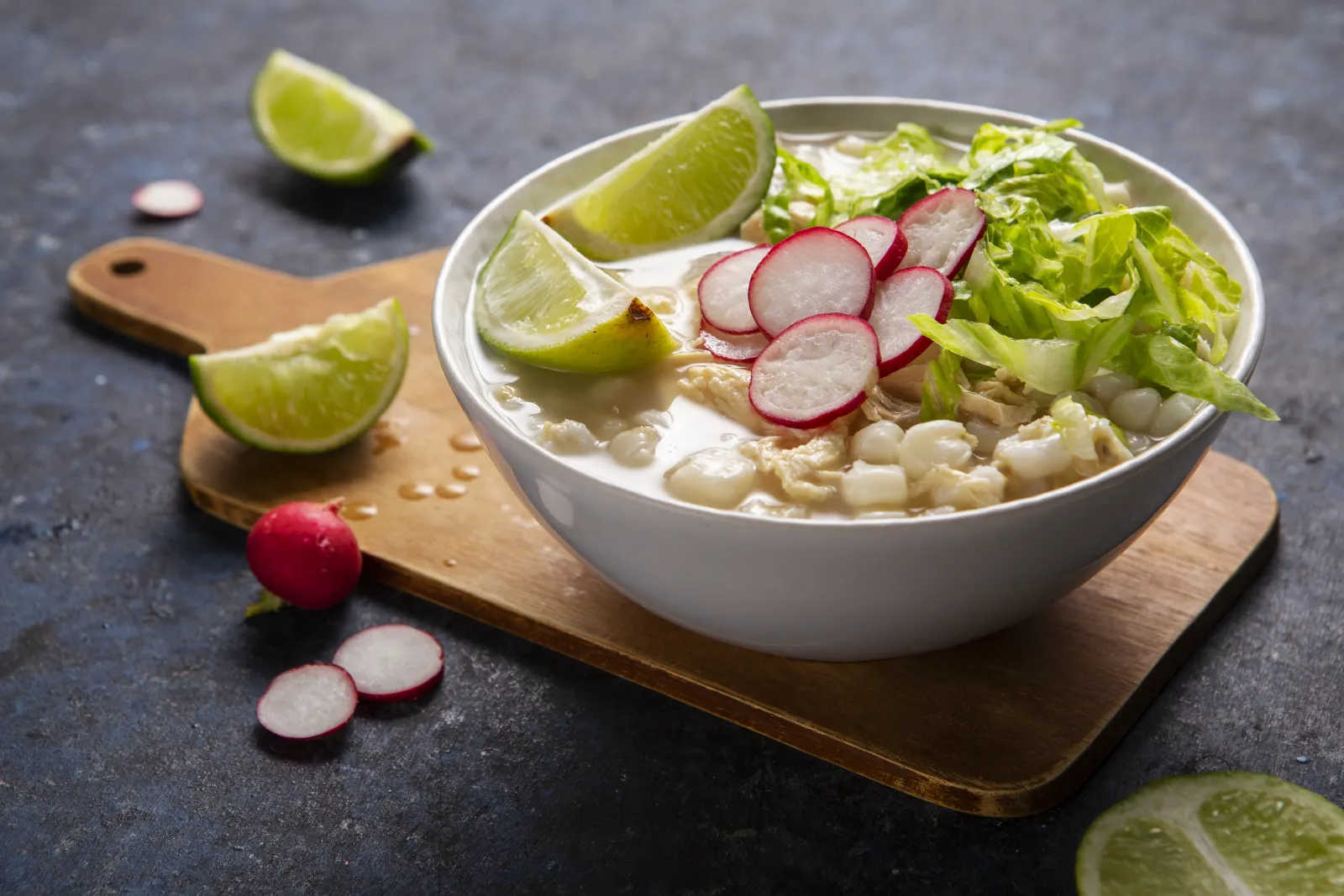

Pozole blanco (poh-SOH-leh BLAHN-koh) is the plainest member of Mexico’s hominy soup family: pork and big, chewy white corn kernels in a clear broth, with no chile at all in the pot. The heat, the crunch and the acid all come from the table, where everyone builds their own bowl with shredded lettuce, radishes, onion, lime, oregano and ground chile. That makes it the pozole I’d choose for a crowd with mixed tastes, and it also means the broth has nowhere to hide. This recipe focuses on getting that broth clean and full-bodied, and on running a big pot for a party without being stuck at the stove.
What is pozole blanco, and is it worth making?
How do you make pozole blanco? Simmer 1 kg (2.2 lb) of pork neck bones and 1.5 kg (3.3 lb) of pork shoulder in 5 liters (5¼ quarts) of cold water with onion, garlic and bay, skimming for the first 20 minutes, then 90 minutes on low without salt. Pull the shoulder apart, add 2 kg (4.4 lb) of drained canned hominy and salt, and simmer 30 minutes more. Finish with oregano and serve with lettuce, radishes, onion, lime, chile and tostadas. 165 minutes for 10 servings.
Yes, if you’re feeding a group. It’s the simplest pozole there is: no chiles to toast, no sauce to blend, and the hard part is patience rather than technique. Mexican outlet Uno TV calls it the most eaten pozole in central Mexico, and says that in the state of Guerrero it’s served white or green, with onion, chile piquín, oregano and lime but without radish or lettuce.
When it shines. Mexican Independence Day on September 15–16, a birthday, a game day, any gathering of 10 to 20 where you’d rather be at the table than the stove. The pot holds hot for hours and people serve themselves.
When it might not. If you want a broth that tastes of chile, the red pozole with guajillo and ancho is the one. And it’s not a weeknight dinner for two: allow nearly 3 hours.
Real time. 165 minutes, about 70 of them hands-on with canned hominy. Dried hominy adds an overnight soak and about 60 minutes of cooking.
Difficulty, easy. What usually goes wrong is the broth: cloudy from boiling too hard, salty from unrinsed hominy, or thin from using only boneless meat.
What you need, and what to buy in a US or UK store
Exact amounts are in the recipe card: 2 kg (4.4 lb) drained hominy, 2.5 kg (5.5 lb) of pork and 5 liters (5¼ quarts) of water for 10 big bowls.
Hominy, canned or dried
Hominy is corn treated with an alkaline solution (nixtamalized), hulled and cooked until each kernel bursts open; in Mexico the large white cacahuazintle variety is used, and cooks say it florea, it flowers. My red pozole explains the three routes to hominy in detail, including homemade nixtamal. For the white version, here’s what matters.
- Canned white hominy → already open and tender. Drain, rinse until the water runs clear, and add it for the last 30 minutes. Mexican newspaper Excélsior gives 30 to 40 minutes; 30 is enough for the kernels to take on the broth. This is what the recipe uses.
- Dried hominy → this is where the white pozole changes most, because the starch it releases over a long cook turns the broth softly milky. Soak it overnight, drain, and simmer it 60 minutes in the 5 liters (5¼ quarts) of unsalted water before the pork goes in, then follow the recipe from step 1 with the pork added to the hominy pot. Excélsior puts the whole job at about 3 hours with dried corn and 2 with canned.
If the kernels still haven’t opened when the pork is done, lift the pork out and keep the corn going. Unsalted water gets them there faster, which is why the salt waits.
The pork, and why bones matter
A white broth with body needs bone or cartilage. Without it you get pork-flavored water: fine, and flat.
- Neck bones or spine → called espinazo in Mexico. They give gelatin and depth. 1 kg (2.2 lb) for 10.
- Boneless shoulder → the meat you actually eat in chunks. 1.5 kg (3.3 lb) for 10.
- Pig’s head → the traditional choice, soft meat and lots of gelatin. A Mexican butcher will sell it cleaned and split. It needs about 3 hours for the meat to come off the bones: Uno TV’s version with Profeco’s shopping list gives 1½ hours for the meat plus 1½ more with the corn, and Hank Shaw’s pozole at Honest Food cooks half a head for 4 hours.
- Pig’s trotters (feet) → the easiest stand-in for the head in a UK butcher’s or a US supermarket. I add 2 split trotters with the neck bones; Chili Pepper Madness uses them too, for the same reason.
- Chicken → 2.5 kg (5.5 lb) of bone-in thighs and drumsticks, about 60 minutes, as in Mama Maggie’s Kitchen’s white chicken pozole. Lighter, with less body.
US and UK shopping list
| Ingredient | In the US | In the UK | What changes |
|---|---|---|---|
| Hominy | Canned white hominy, most supermarkets | Mexican grocers online, in cans | Nothing, if you rinse it |
| Espinazo | Pork neck bones | Pork bones or ribs from the butcher | Slightly less gelatin with ribs |
| Pig’s head | Mexican and Asian butchers | Ask a butcher, or use trotters | Less soft meat, same body |
| Mexican oregano | Latin aisle, in bags | Online, or regular dried oregano | Regular oregano is more minty, less citrusy |
| Chile piquín | Latin aisle, ground | Crushed red pepper flakes or cayenne | Similar heat, less fruit |
| Tostadas | Latin aisle | Tortilla chips | Chips are saltier and smaller |
Equipment
A 10 to 12 quart (10 to 12 liter) stockpot, a slotted spoon, a ladle and two forks. No skimmer? A small fine-mesh sieve works better. No big pot? Split everything between two 6-quart pots.
How to plan it, and how to tell each stage is right
165 minutes on the clock, about 70 hands-on. Toppings get prepped while the pork simmers.
Signs you’re on track.
- Foam → gray and plentiful in the first 20 minutes, then white and sparse. When it stops coming up gray, you’re done skimming.
- Simmer → a lazy bubble here and there. If the whole surface is moving, turn it down.
- Pork → at 90 minutes the shoulder breaks apart under a spoon and the neck meat slides off the bone.
- Hominy → kernels open like flowers, soft when you bite them, no chalky center.
- Broth → translucent and a little milky, with a thin layer of fat to ladle off.
How to keep the broth clear
Clear doesn’t mean consommé-clear: the hominy starch makes it slightly milky, and that’s right. What you don’t want is a murky gray broth with fat suspended in it. I do these four things every time.
- Start cold → meat and water heat together, so the proteins rise as foam in the first 20 minutes, where you can skim them.
- Simmer, don’t boil → with lazy bubbles the fat floats and comes off at the end; at a rolling boil it emulsifies into the broth for good.
- Rinse the hominy → canning liquid carries salt and loose starch.
- Degrease cold if you can → cook the pork the day before and the fat sets on top in the fridge, in one sheet you can lift off with a spoon.
Make-ahead plan for a party
- Two days before → buy the hominy and order the pork, especially if you want a head or trotters.
- The day before → cook the pork with the water, onion, garlic and bay (about 110 minutes). Remove the aromatics, pull the shoulder and cool quickly in shallow containers. Refrigerate broth and meat.
- The day of → lift off the set fat, bring the broth and meat to a boil, add hominy and salt for 30 minutes, and prep the toppings meanwhile. About 45 minutes. Keep the pot on the lowest heat through the evening.
Scaling for 6, 10, 15 or 20
Per person: 200 g (7 oz) drained hominy, 250 g (9 oz) raw pork and 500 ml (2 cups) water. Salt scales too, but always taste at the end.
| People | Drained hominy | Neck bones | Shoulder | Water | Pot |
|---|---|---|---|---|---|
| 6 | 1.2 kg (2.6 lb) | 600 g (1.3 lb) | 900 g (2 lb) | 3 L (3¼ qt) | 6-8 qt |
| 10 | 2 kg (4.4 lb) | 1 kg (2.2 lb) | 1.5 kg (3.3 lb) | 5 L (5¼ qt) | 10-12 qt |
| 15 | 3 kg (6.6 lb) | 1.5 kg (3.3 lb) | 2.25 kg (5 lb) | 7.5 L (8 qt) | 16-20 qt or two 10 qt |
| 20 | 4 kg (8.8 lb) | 2 kg (4.4 lb) | 3 kg (6.6 lb) | 10 L (10½ qt) | two 12 qt |
From 15 guests up, use two pots: a single 20-quart (19-liter) pot takes ages to come to a boil, scorches on the bottom and is hard to skim. Allow about 20 extra minutes to reach the boil with pots that full.
Pressure cooker or Instant Pot
Pork, water (cut it to 3.5 liters, about 3¾ quarts, to stay under the max line), onion, garlic and bay at high pressure for 40 minutes, Excélsior’s time for bone-in pork, then natural release. Open, skim foam and fat, then give the canned hominy a quarter to half an hour uncovered. About 80 minutes in all. A pig’s head needs longer; I give it a full hour under pressure.
Before you start, mistakes, heat level, kids and allergens
The two critical points are the first 20 minutes, which decide whether the broth comes out clean, and the salt, which goes in last.
- Cloudy, greasy broth → it boiled hard. Drop to a lazy simmer and degrease at the end, or cold.
- Thin broth → only boneless meat. Add neck bones, trotters or a head.
- Too salty → canned hominy brings salt. Rinse it and salt only after tasting.
- Hominy won’t open → dried corn without enough time, or salted from the start. Give it its full hour before the pork.
- Tough pork → 60 minutes isn’t enough. It’s 90 on low, about 3 hours for a head.
- Tastes flat → it needs salt at the end and oregano. Try a spoonful with a squeeze of lime before correcting: the toppings finish the seasoning.
Heat level, 0 out of 5 in the pot. All the heat is on the table. Chile piquín is tiny and fierce, so put out a teaspoon in a small dish, not the whole jar.
Kids? This is the pozole kids usually like best because it doesn’t burn. Give them broth, pulled pork and hominy without raw onion or radish, and let them squeeze their own lime.
Allergens. The pozole itself has no gluten, dairy, eggs, nuts or fish. Check the tostada label if you’re cooking for someone with celiac disease.
White, red or green pozole, which one to make
All three share hominy and meat; the sauce is what changes. This comparison uses the recipes on this site, so times and calories are those recipes’, not an average.
- Short on time → canned hominy and a pressure cooker, about 80 minutes.
- No pressure cooker → the recipe as written, with the pork cooked the day before: 45 minutes on the day.
- A party of 20 → two 12-quart pots and the pork cooked the day before. Keep them on the lowest heat all evening.
- Most traditional → pig’s head and neck bones, with dried hominy that blooms in the same broth.
- Lighter → leg instead of shoulder, chicken, or broth degreased cold. Every 100 g (3½ oz) of fat you lift off saves about 88 calories a bowl.
- Vegetarian → vegetable stock and 1 kg (2.2 lb) of mushrooms in big pieces, 30 minutes. You lose the gelatin; dried hominy, which thickens more, helps make up for it.
- Red or green without a second pot → the sauce goes in the bowl. A spoonful of red chile de árbol taco salsa or tomatillo salsa verde and each guest picks a color.
The green pozole with pepitas and tomatillos and the red one are the other two colors; Mexican menudo, made with beef tripe, is the cousin served at long weekend breakfasts.
What pozole blanco costs in the US
The pork is almost the whole bill. At BLS average prices for August 2026, the “all other pork” category, which covers shoulder and ribs, cost $3.74 a pound: the 5.5 lb here comes to $20.60.
With USDA’s October 9, 2026 retail averages for limes (50 cents each), white onion and garlic, and the BLS price for iceberg lettuce, everything that has an official price comes to $26.76, about $2.68 a bowl. Hominy, radishes, oregano and tostadas have no official series, so add them from your own receipt.
What drives the cost. Meat, and among the meat, the cuts with the most flesh. To spend less without losing body, use more trotters or neck bones and less shoulder: the broth gets more gelatin and the bill drops.
Real yield. 10 large bowls of about 750 g (26 oz) with meat and hominy, as a full meal. As a starter for a long dinner, it serves 14.
What to expect, how to serve it and how to store it
Flavor and texture. A gentle, well-salted broth where pork and corn lead, with oregano underneath. The kernels are soft and a little chewy; the shoulder falls into shreds. On its own it feels unfinished. With lettuce, radish, lime and chile, every spoonful changes.
How it’s served. In deep bowls with meat from both cuts and plenty of hominy, toppings in separate dishes and tostadas to bite between spoonfuls, sometimes spread with crema. For something on the side, refried beans on a tostada work well.
Fridge. USDA FSIS says no more than 2 hours at room temperature, and the FoodSafety.gov cold storage chart gives 3 to 4 days at 40°F (4°C) or below for soups and stews with meat. Some recipes say 5 days; I stick with the official number. Divide the pot into shallow containers before refrigerating, and keep the toppings separate.
Freezer. The broth with meat and hominy freezes well, 2 to 3 months for best quality per the same chart. The kernels come out a little softer but keep their shape.
Reheating. On the stove until it boils, which is FSIS’s guidance for soup (165°F (74°C) minimum). Add ½ cup (120 ml) of water per 4 bowls if it has thickened, since the gelatin sets it when cold, then taste for salt. To hold it for a party, keep it above 140°F (60°C).
Pozole blanco FAQ
What’s the difference between white, red and green pozole? The sauce. White has none, with chile on the table; red has a guajillo and ancho chile sauce; green has a pumpkin seed and tomatillo sauce. The corn and meat are the same.
Is pozole blanco spicy? Not in the pot. The heat comes from ground chile piquín or a chile de árbol salsa at the table, so everyone sets their own.
What cut of pork is best for white pozole? A mix of bone-in and boneless: neck bones for body and shoulder for meat. Pig’s head is the traditional choice; trotters are the easiest substitute.
Is it pozole or posole? Both spellings are used for the same dish. Pozole is the usual spelling in Mexico; posole is the one you’ll often see in New Mexico and on US menus.
How do I keep pozole broth clear? Start the pork in cold water, skim for the first 20 minutes, keep the simmer lazy and rinse canned hominy. Degrease at the end or, better, cold.
How much pozole do I need for 20 people? 4 kg (8.8 lb) drained hominy, 2 kg (4.4 lb) neck bones, 3 kg (6.6 lb) shoulder and 10 liters (10½ quarts) water, split between two 12-quart pots.
Can I make pozole blanco in an Instant Pot? Yes. Count about 80 minutes in all: 40 for the pork at high pressure, then the hominy simmered uncovered until it tastes of the broth.
Can you freeze pozole? Yes. Meat, broth and hominy keep their quality for 2 to 3 months (8 to 12 weeks). Lettuce, radish and onion should always be fresh.
Nutrition per serving
Per bowl (about 750 g / 26 oz, toppings not included), calculated ingredient by ingredient from USDA FoodData Central (SR Legacy) with this recipe’s amounts, counting roughly 400 g (14 oz) of meat on the neck bones, broth not degreased, and leaving out the pot onion and garlic, which are removed:
- Calories: 588 kcal
- Protein: 36 g
- Carbohydrates: 29 g
- Fat: 35 g, of which 12 g saturated
- Fiber: 5 g
- Sugars: 3 g
- Sodium: 1,131 mg
The fat is almost all from the shoulder and is the easiest thing to cut: every 100 g (3½ oz) you lift off the chilled pot removes about 88 calories and 10 g of fat per bowl. Of the sodium, 534 mg a bowl comes from the canned hominy and 465 mg from the salt, so rinsing the corn and salting at the end both help. Toppings add little: two tostadas are about 115 calories, and a handful of lettuce and radish under 20.
The first time I put a pot of this on the table, I worried it looked unfinished, just pale broth and corn. Then I watched everyone build a different bowl: Dylan with only lime, a friend with three spoonfuls of chile, someone else piling on cabbage. One pot, no second batch for the kids. White pozole doesn’t ask much of the cook except a low flame. Josnaisis.