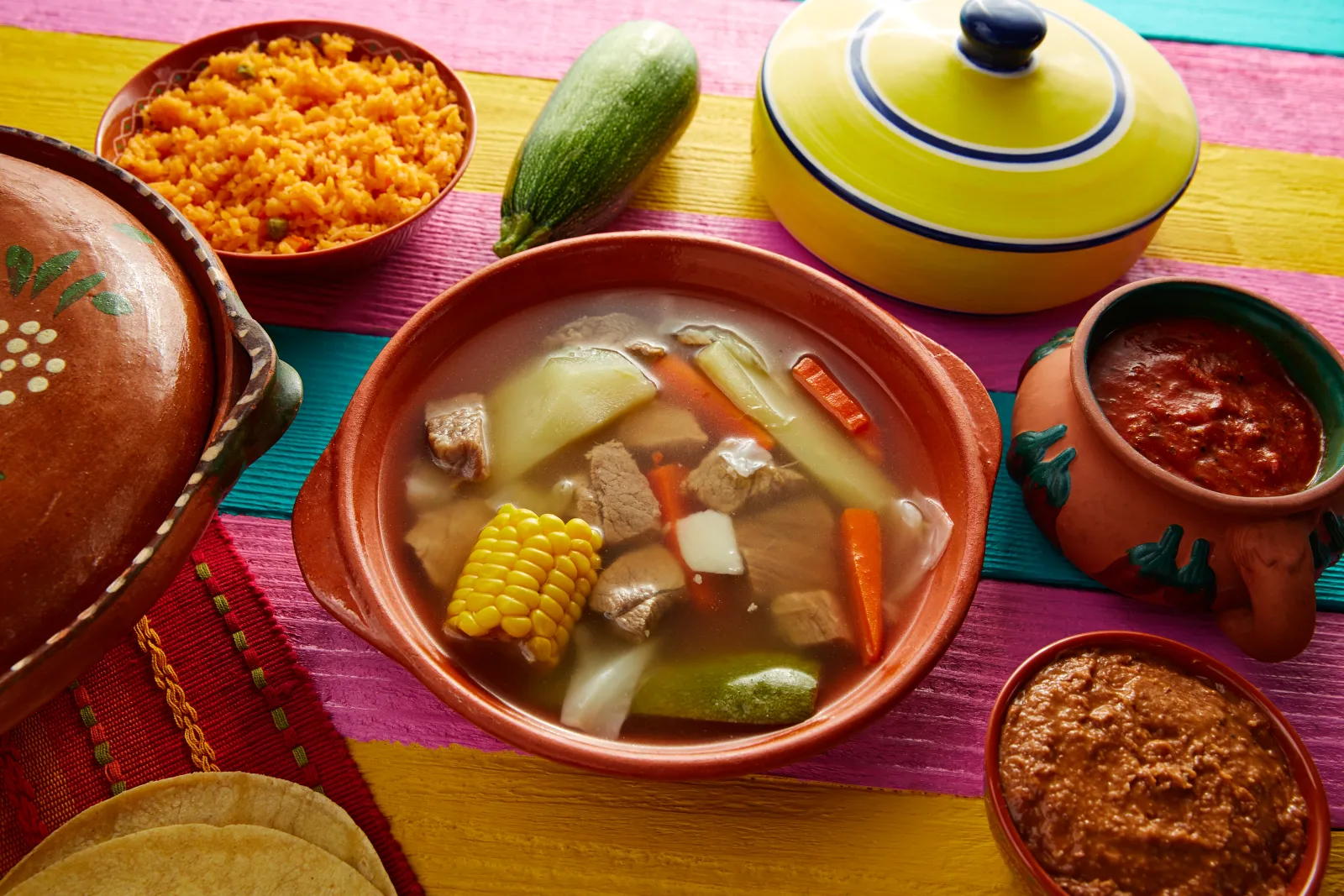

Caldo de res (KAHL-doh deh REHS) means, literally, beef broth, but in a Mexican kitchen it is a whole meal: crosscut beef shank and short ribs simmered on the bone until the meat slides off, then corn on the cob, chayote, carrots, potatoes, zucchini and cabbage added in waves, and a bowl finished at the table with lime, raw onion, cilantro and fresh chile. Think of it as Mexico’s answer to vegetable beef soup, with a clearer broth and the vegetables in big pieces.
What is caldo de res, and is it worth three hours?
How do you make Mexican caldo de res? Put bone-in beef shank and short ribs in cold water with onion, garlic and salt, skim the foam for 10 to 15 minutes as it comes to a boil, then simmer gently for 2 hours. Add the vegetables in three waves, corn and carrots for the last 30 minutes, potatoes and chayote for 20, zucchini, green beans and cabbage for 10. Serve with lime, serrano, tortillas and rice. 185 minutes for 6 servings.
Yes, if you have an afternoon at home. Only about 40 of the 185 minutes are hands-on; the rest is a pot on low heat that needs a glance every half hour. What you get is six large bowls of soup that eat like a full meal, and it tastes as good or better the next day.
It is a good fit for a Sunday lunch, a cold evening, or cooking once to eat twice. It is not a weeknight dish unless you own a pressure cooker, which cuts it to about 2 hours. And it is not spicy: the heat sits on the table as chopped serrano, so it works for kids and for guests who don’t like chile.
Difficulty, honestly easy. The two things that go wrong are a hard boil, which clouds the broth, and adding all the vegetables at once.
The beef, and which cuts to buy in the US and UK
The cut matters more than anything else in the pot. Shank is lower leg meat, sold in round slices with the bone and marrow in the middle; it is full of connective tissue that melts into gelatin over 2 hours of gentle simmering, and that gelatin is what gives the broth body. Short ribs add the fat that carries flavor. I use two parts shank to one part short ribs.
How much to buy. About 9 oz (250 g) of bone-in beef per bowl, which leaves roughly 3½ oz (100 g) of cooked meat. That is the middle of the recipes I compared, which use between 2.2 and 3 lb (1 to 1.4 kg) of bone-in beef for 4 to 6 people.
Where to find shank. In the US, Latino butchers sell it as chambarete, and supermarkets label it beef shank, cross cut or sometimes soup bones; if you only see boneless stew meat, add 1 lb (500 g) of marrow bones to get the body back. In the UK, ask a butcher for beef shin on the bone, cut across into thick slices, the same cut used for osso buco.
The vegetables, with supermarket swaps
Most of these are already in a US or UK supermarket. Two need a word.
Chayote is a pale green, pear-shaped squash with a mild, cucumber-like flavor that stays slightly crisp after cooking. It is sold in most large US chains and Latino groceries; in the UK and the Caribbean it is called christophene or cho cho. Peel it under running water or with gloves, because the skin releases a sticky sap.
Mexican grey squash (calabacita) is lighter and rounder than zucchini, with a thinner skin. Zucchini, or courgette in the UK, works just as well and releases a little more water.
| In the recipe | US swap | UK swap | What changes |
|---|---|---|---|
| Elote, Mexican white corn | sweet corn on the cob | sweet corn on the cob | sweeter, cooks in 15 min, so add it with the potatoes |
| Chayote | chayote, or a small turnip | christophene, or a small turnip | turnip tastes sharper and more peppery |
| Calabacita | zucchini | courgette | a bit more water in the broth |
| Ejotes | green beans | green beans | nothing noticeable |
| Col | green cabbage | white or green cabbage | nothing noticeable |
| Serrano chile | jalapeño | green finger chilli | jalapeño is milder |
| Mexican limes | Persian limes | limes | larger and seedless |
Frozen corn on the cob works too; it goes in straight from the freezer with the potatoes. Canned corn breaks down, so stir it in for the last 5 minutes only.
The stovetop plan, hour by hour
The first two hours belong to the beef. Use the second hour to peel and cut the vegetables, then add them in three waves.
Keeping the broth clear
Start with cold water, so the meat proteins rise slowly and gather as foam. Skim as it comes to a boil, without stirring, until the gray foam gives way to a thin white film. Then keep it at a gentle simmer: a rolling boil emulsifies the fat into the broth and clouds it for good.
Some cooks soak the beef in cold water and discard it, or blanch it briefly and drain it before starting. The broth comes out cleaner, but you lose a little flavor. I skim instead; if I want a crystal-clear broth for guests, I blanch.
The vegetable order, and why
| Wave | Goes in with | Vegetables | Cooking time |
|---|---|---|---|
| 1 | 30 min to go | corn, carrots | 30 min |
| 2 | 20 min to go | potatoes, chayote | 20 min |
| 3 | 10 min to go | zucchini, green beans, cabbage | 10 min |
The firmest go first. Zucchini and cabbage go last because they collapse, and cabbage turns bitter if it cooks much longer.
Make-ahead and freezer plan
- The day before. Cook the beef for the full 2 hours, cool it in its broth and refrigerate. The next day the fat sets in a solid layer you can lift off with a spoon, the cleanest way to de-fat the soup. On serving day, bring it back to a boil (about 20 minutes) and add the vegetables: dinner in an hour.
- To freeze. Freeze the broth with the beef, corn and carrots. Potatoes turn grainy and zucchini watery after freezing, so add them fresh when you reheat.
Pressure cooker and Instant Pot timing
A pressure cooker saves real time here, because it shortens the one long step, the beef. It saves about an hour, not two: the pot still has to come up to pressure, release it, and cook the vegetables.
- Stovetop pressure cooker. Skim with the lid off first. Then lock it and cook 35 minutes from when the valve starts to hiss, and let the pressure drop naturally for 10 minutes. Add the vegetables and cook them with the lid off, in the same three waves. About 2 hours 15 minutes in all.
- Instant Pot. Bring to a boil and skim on Sauté. Cook 40 minutes on High Pressure with a 15-minute natural release. Add all the vegetables except the zucchini, cook 3 minutes on High Pressure and quick-release, then simmer the zucchini on Sauté for about 8 minutes. About 2 hours in all.
Why those numbers: a tested pressure-cooker recipe for 1.5 to 2 in thick shank gives 30 minutes on the stovetop and 36 in an electric cooker, plus a 15-minute natural release, and Instant Pot’s own chart lists large beef chunks at 25 to 30 minutes. I go a few minutes longer because caldo wants the meat falling off the bone, not just tender.
Mistakes that ruin caldo de res
- A hard boil. Cloudy, greasy broth. Keep it barely moving after skimming.
- Pulling the beef too early. Shank goes through a firm stage before it softens. If it resists at 2 hours, give it 20 minutes more.
- All the vegetables at once. Mushy zucchini, hard corn. Three waves.
- Salting everything at the start. The broth reduces over 2 hours. Add 1 teaspoon at the start and the rest at the end.
- Skipping the de-fatting. Short ribs release a lot of fat. Ladle it off before the vegetables, or chill overnight.
- Rice in the pot. It soaks up the broth and clouds the leftovers. Cook it separately and add it to each bowl.
Before you cook, spice, kids and allergens
Spice level, 0 out of 5. Nothing in the pot is hot. The serrano goes on the table, and if your household likes more heat, a Mexican red taco salsa next to the bowls does it.
Kids. Usually a hit: mild, a little sweet from the corn and carrots, and corn on the cob they can hold. Check their bowl for bone splinters and give them the meat already off the bone.
Allergens. The soup has no gluten, dairy, egg, nuts or fish. Bouillon powder, which some cooks add, can contain gluten, so read the label. With corn tortillas, the meal is gluten-free.
Versions worth knowing
How it compares. Mexican caldo de pollo is the same idea with chicken legs and thighs, done in 90 minutes. Venezuelan beef hervido uses short ribs and shank too, but with taro, yam and pumpkin. Colombian caldo de costilla is short ribs and potatoes only, eaten at breakfast. Mexican menudo is a different soup altogether, tripe in a red chile broth. And Colombian sancocho, the Sunday pot of Colombia, is thickened with green plantain and cassava, which caldo de res never has.
- Leaner. Use shank only, no short ribs, and de-fat it cold. Each tablespoon of fat you lift off (about 13 g) is roughly 115 calories out of the pot.
- Red caldo. Some versions blend dried guajillo chiles into the broth. You get color, mild heat and something closer to a stew.
- With chickpeas. Some recipes add 7 oz (200 g) of soaked chickpeas with the beef. Heartier, less brothy.
- Faster weeknight beef soup. Carne en su jugo, Guadalajara’s beef in tomatillo broth, takes 60 minutes with thin steak strips. Different dish, same craving.
Scaling for 4, 12 or 20
| People | Bone-in beef | Water | Pot size | Vegetables |
|---|---|---|---|---|
| 4 | 2.2 lb (1 kg) | 2 L (8½ cups) | 6 qt (6 L) | 3.7 lb (1.7 kg) |
| 6 | 3.3 lb (1.5 kg) | 3 L (12½ cups) | 8 qt (8 L) | 5.5 lb (2.5 kg) |
| 12 | 6.6 lb (3 kg) | 6 L (6¼ qt) | 16 qt, or two 8 qt | 11.2 lb (5.1 kg) |
| 20 | 11 lb (5 kg) | 9 L (9½ qt) | 20 qt, or three 8 qt | 18.7 lb (8.5 kg) |
The beef time stays the same at any size. What changes is how long a big pot takes to boil, easily 40 minutes for 16 to 20 quarts, so start earlier. Water grows a little less than the beef because a big pot loses proportionally less to evaporation; the rule is to cover the meat by 2 in (5 cm).
What it costs in the US
A pot for 6 comes to about $36.94, or $6.16 a bowl, using the BLS average price for beef for stew in August 2026 and USDA retail vegetable prices for the week of October 9, 2026. The beef is 77% of the total.
About the beef price. The BLS doesn’t publish a price for bone-in shank or short ribs, so I used its boneless beef for stew series, $8.587 a pound, as the nearest stand-in. With bone-in cuts you also pay for bone, but the bone is what makes the broth. Chuck roast, at $9.448 a pound in the same month, would bring the pot to about $39.80. Cabbage and green beans aren’t in either price set, so they are left out; add a dollar or two. I don’t have a reliable official price source for the UK, so no figure there.
How to serve it, store it and reheat it
To serve. Deep bowls, one piece of beef on the bone, a piece of corn, some of each vegetable, and broth to cover. On the table: chopped onion, cilantro, lime wedges, serrano, warm corn tortillas and Mexican red rice, which each person spoons into the bowl. The marrow is for scooping onto a tortilla with a pinch of salt.
What to expect. A clear golden broth with a thin layer of fat, tasting of beef and corn, with soft meat, whole vegetables and the fresh bite of lime and raw onion on top.
Storage. Get it into the fridge within 2 hours, according to USDA FSIS, in shallow containers so it cools fast. It keeps 3 to 4 days at 40°F (4°C) or below, and 2 to 3 months in the freezer at 0°F (-18°C) for best quality. Thaw it in the fridge.
Reheating. FSIS recommends bringing soups back to a rolling boil, which takes it well past the 165°F (74°C) minimum for leftovers; then lower the heat. If the bowl already has zucchini and potatoes in it, heat it gently and stop as soon as it boils at the edges, or they will break down.
Caldo de res questions
What is the best meat for caldo de res? Bone-in beef shank for gelatin and body, with short ribs for fat and flavor, roughly two to one. Boneless stew meat works but gives a thinner broth.
What is beef shank called in the UK? Beef shin. Ask for it on the bone and cut across into slices about 1.5 in (4 cm) thick.
How long do you boil beef for caldo de res? In an Instant Pot, 40 minutes on High Pressure plus a 15-minute natural release. In a stovetop pressure cooker, 35 minutes plus 10 of natural release. On the stove, about 2 hours at a gentle simmer.
Why is my caldo de res cloudy? It boiled too hard or wasn’t skimmed. Start in cold water, skim until only white foam remains, and keep the pot barely simmering.
Is caldo de res the same as vegetable beef soup? Close, but not the same. Caldo de res keeps the meat on the bone and the vegetables in large pieces, has no tomato base, and is finished at the table with lime, onion, cilantro and chile.
Do you put rice in caldo de res? Not in the pot. Rice is cooked separately and added to each bowl, so the leftovers stay clear.
Can you freeze caldo de res? Yes. USDA FSIS gives 2 to 3 months at 0°F (-18°C) for best quality. Freeze the broth with the beef, corn and carrots, and add fresh potatoes and zucchini when you reheat.
How long does caldo de res last in the fridge? 3 to 4 days at 40°F (4°C) or below, as long as it went into the fridge within 2 hours of cooking.
Nutrition per bowl
Per bowl (1 of 6, without rice or tortillas), calculated ingredient by ingredient from USDA SR Legacy with this recipe’s quantities, counting 1.5 lb (700 g) of usable meat in the shank and 10.5 oz (300 g) in the short ribs:
- Calories: 524 kcal
- Protein: 39 g
- Carbohydrates: 41 g
- Fat: 24 g, of which 10 g saturated
- Fiber: 9 g
- Sugars: 11 g
- Sodium: 940 mg
Most of the fat comes from the short ribs, and the figure doesn’t subtract what you skim off, so yours will likely be lower. The salt in the pot accounts for 775 mg of the sodium per bowl. A cup (158 g) of cooked white rice adds about 205 calories.
I grew up in Venezuela with hervido, our own beef and vegetable pot, so the first caldo de res I made felt almost too simple: no taro, no yam, just beef on the bone, everyday vegetables and time. What took practice was holding the vegetables back. Now I set them out in three bowls by the stove, in the order they go in, and the zucchini never turns to mush. Josnaisis.