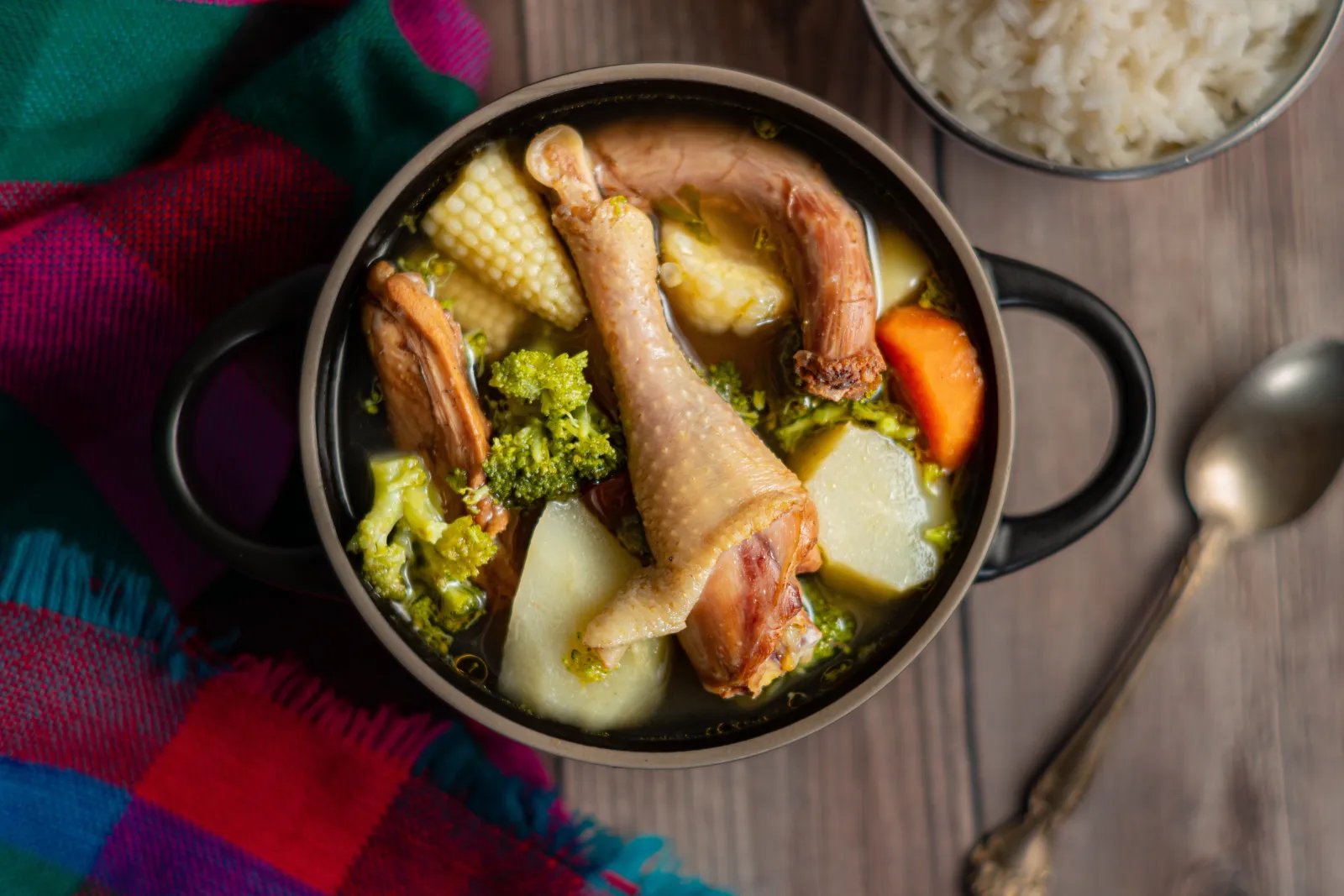

Caldo de pollo (KAHL-doh deh POH-yoh) is what most Mexican households mean by chicken soup: bone-in chicken pieces in a clear, golden broth with big chunks of corn on the cob, carrot, potato, chayote and squash. It’s eaten as a whole meal, and the finishing happens at the table, where everyone adds rice, lime, raw onion, cilantro and as much chile as they like. The recipe is simple. The part worth getting right is timing, because five vegetables that cook at five different speeds all need to land in the bowl at the same moment.
What is caldo de pollo, and is it worth making?
How do you make caldo de pollo? Start 1.5 kg (3.3 lb) of bone-in chicken legs in 3 liters (12½ cups) of cold water with onion and garlic, skim the foam for 10 minutes as it comes to a boil, then keep it at a gentle simmer. Add carrots and corn 30 minutes before the end, potatoes and chayote at 25 minutes, and zucchini for the last 10. Ready in 90 minutes for 6 servings.
Yes, if you want a soup that’s a full meal and costs little. With US prices it comes to about $14.60 for 6 big bowls, roughly $2.40 a bowl, and nothing in it needs a special skill. It also scales well and freezes well.
How it differs from the chicken soup you may know: there are no noodles and no flour, the broth stays thin and clear, and the vegetables are cut big, not diced. Compared with its Mexican cousins, it’s the gentle one. Pozole verde is built on hominy and a pumpkin seed sauce, and Mexican tortilla soup is a chile and tomato broth over fried tortilla strips. Colombian sancocho is thicker, with plantain and cassava.
Good for. A weeknight dinner that leaves lunch for tomorrow, a cold or rainy day, a crowd, or someone at home with a cold who wants something hot and easy.
Maybe not for. Anyone after big spice or deep chile flavor in the pot itself. Here, heat is a topping.
Real time. 90 minutes total, about 35 hands-on, most of it peeling and cutting.
The shopping list, with US and UK swaps
Everything is in a regular US supermarket. In the UK, two items take a little hunting.
Which chicken pieces to buy
Bone-in thighs and drumsticks, or leg quarters cut in two. Dark meat stays juicy through 70 minutes in the pot, and the bones and cartilage give the broth its body. Boneless breast gives a thinner broth and is dry by minute 40; if someone at home wants white meat, add one bone-in breast with the legs and take it out after 35 minutes.
Skin on or off? I take it off, or most of it. USDA figures show raw chicken leg with skin at 15.95 g fat per 100 g, against 4.12 g for skinless thigh meat, and nearly all of that difference ends up as a greasy layer on the broth. Leave the skin on two pieces if you like a little golden fat on top.
Chayote and Mexican squash
Chayote is a pale green, pear-shaped squash with a mild, cucumber-like taste. Cooked, it turns tender and slightly translucent. US stores sell it as chayote (and in Louisiana as mirliton); in the UK and Ireland it’s christophene, or cho cho in Jamaican shops. Peel it under running water or with gloves, because the raw skin leaves a sticky sap on your hands. No chayote? Use extra potato or a small turnip: the soup gets starchier and loses a little freshness.
Calabacita, the Mexican squash, is paler and rounder than zucchini. In the US look for Mexican grey squash; zucchini (courgette in the UK) is a fine stand-in and only releases a bit more water. Any squash left over makes a quick side of calabacitas, Mexican zucchini with corn and tomato.
Corn, herbs and celery
Mexican elote is usually white corn, and USDA data puts raw white sweet corn at 3.22 g of sugar per 100 g against 6.26 g for yellow. Either works. Frozen corn on the cob goes in straight from the freezer with the same timing; canned kernels fall apart, so add those in the last 5 minutes. Spearmint is my own finishing touch and optional. Celery is optional too, and it’s one of the 14 allergens food businesses must declare in the UK and EU.
Equipment
A 6 to 8 quart (6 to 8 liter) pot, a ladle or slotted spoon for skimming, and an instant-read thermometer if you have one.
The 90-minute plan
The cutting can happen while the pot heats if you’re short on time; it’s listed first so your hands are free to skim when the foam rises.
What you can do the day before. Cook the chicken in the broth through step 3, chill it fast and refrigerate. The next day the fat sets on top and lifts off with a spoon, so the broth ends up cleaner than on day one. Cut the vegetables fresh: with the broth made, serving day takes 35 minutes.
How to tell each stage is right.
| Stage | What you should see |
|---|---|
| Skimming, first 10 min of boil | Gray foam at first, then only a little white foam: stop there |
| Simmer | Small bubbles at one edge, surface nearly still |
| Carrots and potatoes | A knife slides in, the piece doesn’t break when lifted |
| Squash | Bright green and whole; dull and bending means overcooked |
| Chicken | 165°F (74°C) by the bone, meat pulls away with a spoon |
Why the broth turns cloudy, and how to keep it clear
Starting in cold water lets the proteins come out slowly and rise as foam, where you can lift them off. Skimming as soon as it boils, for roughly 10 minutes, catches most of it. After that, a gentle simmer: a hard boil breaks foam and fat into tiny particles that stay suspended and make the broth cloudy, and there’s no getting them out short of straining through a paper towel. Cloudy broth tastes the same. It just looks less inviting.
Mistakes that ruin caldo de pollo
- Everything in at once. Squash needs 10 minutes and carrots 30; added together, one is mush when the other is ready.
- A rolling boil. Cloudy broth, and the potatoes break up too.
- Boneless breast for 70 minutes. Dry, stringy meat and a thin broth.
- Salting only at the start. Salt in two stages and taste at the end, since the broth concentrates.
- Cooking the rice in the pot and storing it that way. It soaks up the broth overnight and turns to porridge.
- Floury potatoes. Russets dissolve and cloud the broth; waxy white or red potatoes hold.
Scaling for 12 or 20
| Serves | Chicken, bone-in | Water | Potatoes | Carrots | Squash | Corn and chayote | Pot |
|---|---|---|---|---|---|---|---|
| 6 | 1.5 kg (3.3 lb) | 3 L (12½ cups) | 450 g (1 lb) | 250 g (9 oz) | 400 g (14 oz) | 2 and 2 | 6-8 qt |
| 12 | 3 kg (6.6 lb) | 6 L (6¼ qt) | 900 g (2 lb) | 500 g (1.1 lb) | 800 g (1.75 lb) | 4 and 4 | 12 qt |
| 20 | 5 kg (11 lb) | 10 L (10½ qt) | 1.5 kg (3.3 lb) | 850 g (1.9 lb) | 1.35 kg (3 lb) | 7 and 7 | 20 qt, or two 10 qt |
Vegetable timings stay the same. The one thing that grows is the wait for the boil: plan on 25 minutes for a 10-liter pot. Start with 1 tsp salt per 1.5 liters (6 cups) of water and adjust at the end. For 20, two medium pots are easier to handle and cool faster afterwards.
Versions, from Instant Pot to sick-day soup
- Instant Pot. Published recipes use 10 to 20 minutes at high pressure with a 10-minute natural release. For bone-in legs I use 15 minutes plus 10 natural release, skim, then add the vegetables on Sauté in the same timed order. About 60 minutes start to finish.
- Stovetop pressure cooker. Chicken and aromatics 15 minutes once it’s at pressure, release, skim, then vegetables uncovered as written. Never pressure-cook the squash: it’s gone in two minutes.
- Sick-day version. Half the salt, no chile, smaller vegetable pieces, and the chicken shredded into the bowl with rice. A bowl gives about 41 g of protein and plenty of warm liquid. It isn’t medicine: the oft-quoted University of Nebraska study, published in the journal Chest in 2000, found chicken soup slowed white blood cells called neutrophils in a lab dish, and its authors noted it wasn’t tested in people.
- Lighter. Skinless chicken and 1 tsp salt instead of 2 drops sodium from 1,023 to about 635 mg a bowl.
- Rice in the pot. Some home versions fry raw rice with onion and tomato and cook it in the soup. It makes a thicker one-pot meal; eat it the same day.
- With hen. A stewing hen adds 40 to 60 minutes and a deeper broth, closer to Colombian sancocho.
- Regional. A Puebla-style version published by Saveur adds green beans and poblano chiles. Caldo tlalpeño, from Mexico City, puts chipotle, chickpeas and avocado into a chicken broth. For chipotle with meat in a thick sauce rather than a broth, make albondigas in chipotle sauce.
What caldo de pollo costs
US prices: BLS averages for August 2026 (bone-in chicken legs $1.670/lb, white potatoes $0.976/lb) and USDA AMS advertised retail prices for the week of October 9, 2026 for the produce.
Total about $14.60, or $2.43 a bowl, without rice, salt or celery. Chicken is the biggest single line at 38%, but produce adds up: two chayotes and the zucchini together cost more than half the chicken. Chicken breast instead of legs would raise the bill and lower the quality. In Mexico City the same pot costs about 97 pesos at wholesale prices, and there the chicken is two thirds of the cost.
Yield. 6 large bowls, each with one or two pieces of chicken, a piece of corn and some of every vegetable, plus broth for seconds. As a starter it serves 10.
Serving, storing and reheating
Serve it in deep bowls, each person adding a spoonful of Mexican red rice or white rice, a squeeze of lime, chopped onion and cilantro, and chile. Warm corn tortillas on the side, and for those who want real heat, a spoon of red taco salsa with chile de árbol. A glass of cold agua de jamaica goes well with it.
Fridge. The rule, according to USDA FSIS, is to refrigerate within 2 hours and eat within 3 to 4 days at 40°F (4°C) or below. A full pot takes hours to cool, so divide it into shallow containers, no more than 3 inches (7.5 cm) deep. Keep the rice separate.
Freezer. The broth and chicken keep good quality for 2 to 3 months (FSIS). Potatoes turn grainy and squash goes soft once thawed, so I freeze broth and shredded chicken and add fresh vegetables when reheating. Thaw in the fridge, not on the counter. Strained leftover broth is all you need for sopa de fideo, a toasted noodle soup in tomato broth, on the table in 30 minutes.
Reheating. Bring it to a boil on the stove, as FSIS advises for soups, or at least to 165°F (74°C). In the microwave, heat in 1-minute bursts and stir between them.
Caldo de pollo questions
What is caldo de pollo made of? Bone-in chicken, water, onion and garlic, with chunks of carrot, corn on the cob, potato, chayote and Mexican squash. Rice, lime, onion, cilantro and chile are added at the table.
What’s the difference between caldo de pollo and chicken noodle soup? Caldo de pollo has no noodles, keeps the vegetables in big chunks and the chicken on the bone, and is finished with lime, cilantro and chile at the table.
Which chicken is best for caldo de pollo? Bone-in thighs and drumsticks. They stay juicy through a long simmer and the bones give the broth body.
What can I use instead of chayote? Extra potato or a small turnip. The soup gets slightly starchier. In the UK, look for christophene in Caribbean grocers.
How long do you boil chicken for caldo de pollo? About 60 minutes at a gentle simmer after the boil, vegetables included, until it reads 165°F (74°C) next to the bone.
Can you make caldo de pollo in an Instant Pot? Yes: 15 minutes at high pressure plus 10 minutes natural release for the chicken, then the vegetables on Sauté in order.
Can you freeze caldo de pollo? Yes, for 2 to 3 months. Freeze the broth and chicken without the potatoes and squash and add fresh ones when reheating.
Why is my chicken broth cloudy? It boiled hard or wasn’t skimmed. Start with cold water, skim the gray foam as it comes to a boil, then keep it at a bare simmer.
Nutrition per bowl
Per bowl (1 of 6), without rice or tortillas, calculated ingredient by ingredient from USDA FoodData Central (SR Legacy) using this recipe’s quantities, counting 1.1 kg (2.4 lb) of meat in 1.5 kg (3.3 lb) of bone-in legs, corn as kernels, the table onion, cilantro and lime, and the full 2 tsp of salt:
- Calories: 377 kcal
- Protein: 41 g
- Carbohydrates: 36 g
- Fat: 8 g, of which 2 g saturated
- Fiber: 7 g
- Sugars: 9 g
- Sodium: 1,023 mg
A cup (158 g) of cooked white rice adds 205 kcal and 45 g of carbohydrate. Most of the sodium is the salt in the pot, about 775 mg a bowl. Mint and chiles aren’t counted.
Where I grew up in Venezuela, chicken soup was thick with pumpkin and taro, and in Colombia I learned it with plantain and cassava. Caldo de pollo taught me the opposite lesson: a clear broth with whole vegetables can fill you just as well, provided the carrots go in first and the squash goes in last. It’s now the pot I make whenever someone at home wakes up with a cold. Josnaisis.