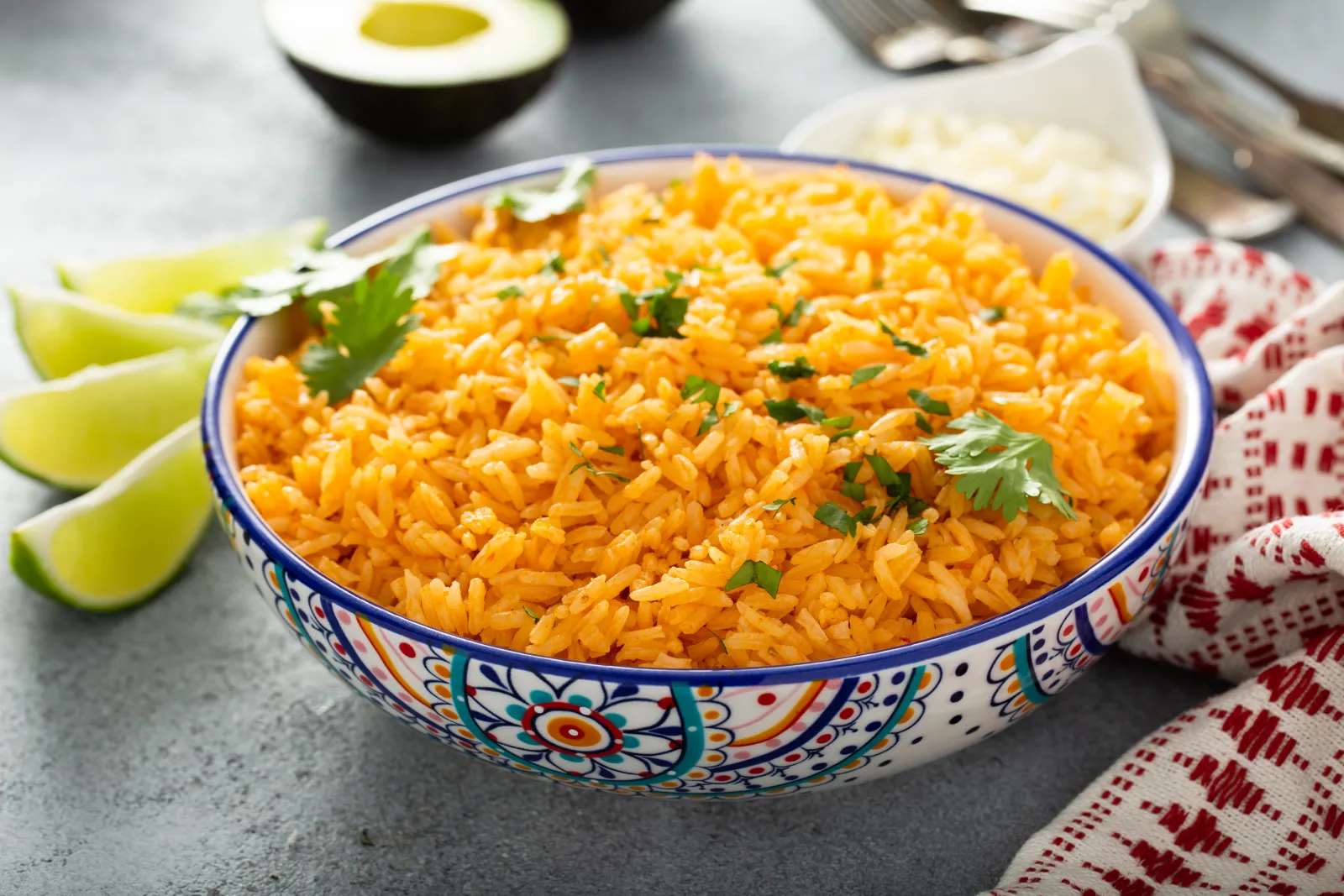

Mexican rice, arroz rojo in Mexico, is long-grain rice toasted in oil and then simmered in a puree of fresh tomato, onion and garlic topped up with chicken broth. It is the orange-red side that sits next to the beans on a Mexican plate, and the one many US restaurants call Spanish rice. The version here needs no tomato sauce from a can and no bouillon powder, and it hinges on one measurement: the tomato puree is part of the cooking liquid, not something added on top.
What is Mexican rice, and is it worth making from scratch?
How do you make Mexican rice? Rinse and drain 1 cup of long-grain rice, then toast it in 2 tablespoons of oil until the grains go milky white and then pale gold. Add a strained puree of 225 g (½ lb) tomatoes, onion and garlic and cook it down for 4 minutes, then pour in hot broth until the total liquid reaches 2 cups (480 ml). Simmer covered on the lowest heat for 15 minutes and rest 10 minutes without lifting the lid. 50 minutes for 4 servings.
It is worth it, and it costs very little. The ingredients are pantry staples, the method takes 25 minutes of actual work, and from-scratch rice tastes of tomato and toasted grain rather than of salt. In Mexico it is served with almost everything, from mole to enchiladas, and it is the rice I make when the main dish has a sauce.
Who it suits: anyone cooking a Mexican meal at home, or feeding a crowd, since it scales cleanly to 12. Who it might not: if you want rice as a meal in itself, a one-pot dish like Colombian chicken and rice does more work. And if your saucepan lid rattles, read the note on lids below before you start.
If you already make Colombian white rice, you know the toast-then-simmer method; Mexican rice toasts the grains longer, to pale gold, and swaps half the water for tomato puree.
The one number that matters, 2 cups of liquid per cup of rice
Here is the rule: 1 cup of rice takes 2 cups (480 ml) of liquid in total, and the strained tomato puree counts toward those 2 cups. Blending 225 g (½ lb) of tomatoes with the onion and garlic and straining it gives roughly 240 ml (1 cup) of puree, so the broth is usually about another cup. Pati Jinich’s arroz rojo uses the same arithmetic, puree plus broth equalling twice the rice.
If your tomatoes are watery and the puree measures 300 ml (1¼ cups), cut the broth to 180 ml (¾ cup). The total stays put. That is why this recipe asks you to measure the puree in a jug rather than trusting a fixed amount of broth: tomatoes vary, the rice doesn’t.
Shopping list, with US and UK swaps
Everything here is in a regular supermarket. The quantities above are for 4 side servings.
Which rice to buy
Long-grain white rice: American long grain in the US, “long grain” or easy-cook in the UK. Basmati works with the same liquid and comes out drier and more separate. Jasmine is softer and slightly sticky but fine. Avoid short-grain, pudding or risotto rice; it releases starch and turns creamy.
Tomatoes, fresh or canned
Roma (plum) tomatoes give more flesh and less water than big round ones, and 4 medium Romas weigh about 225 g (½ lb). Out of season, a 400 g (14 oz) can of whole plum tomatoes, blended with its juice, gives a deeper red and is just as good. Tomato paste let down with water works in a pinch but tastes flatter. Tomato bouillon powder (the Knorr kind sold in Latin aisles) colors the rice in seconds and is very salty, so drop the added salt entirely if you use it.
The chile and the broth
A whole serrano perfumes the rice without making it hot, because it is never cut. In the UK, where serranos are rare, a whole green finger chile or jalapeño does the same job. Use chicken broth (stock) from a carton or cube, or vegetable stock for a vegetarian version.
Equipment
A heavy-bottomed 8 in (20 cm) saucepan with a tight lid, a blender, a fine sieve and a measuring jug. No blender? Grate the tomatoes on the coarse side of a box grater and mince the onion and garlic very finely. If the lid is loose, lay a clean tea towel or a sheet of foil over the pan before putting the lid on.
Game plan, and how to tell each stage is right
Make ahead. The strained puree keeps for 1 day in a jar in the fridge, and you can dice the carrot the night before. Rinse the rice on the day: rice that sits wet for hours soaks up water and won’t toast properly.
Rinse, then drain for 5 minutes
Three or four rinses, rubbing the grains, remove the loose surface starch that turns into paste in the pan. The drain is the part people skip. Rice that goes into the oil dripping wet spits, drops the oil temperature and boils instead of toasting. Give it 5 minutes in the sieve.
How far to toast the rice
On medium heat, 2 tablespoons of oil and 1 cup of rice, the grains turn milky white around minute 3. That is the minimum and the point Pati Jinich gives. I keep going to about minute 6, until some grains are pale gold and the pan smells like toasted nuts. The toasted grains take up liquid more slowly and evenly, so they stay whole, and the color carries flavor. Brown is too far: the rice turns bitter and brittle, and brittle grains break and go starchy. The same toast-first move, taken to amber with thin noodles, is what makes sopa de fideo, Mexican toasted noodle soup.
Why the lid stays on
After the boil, the rice gets a quarter of an hour on the lowest heat and then a 10-minute rest off the heat, 25 minutes in all, covered the whole time. By then the liquid is gone from the top layer and the steam does the cooking. Lift the lid and that steam escapes, the bottom keeps cooking and the top stays chalky. Don’t stir either; soft grains break when you stir them.
Cues at each stage
| Stage | What you should see |
|---|---|
| Rinsing | last rinse water almost clear |
| Toasting, 6-7 min | opaque white with pale gold grains, sounds like dry sand when stirred |
| Puree, 3-4 min | darker red, thick, almost no loose liquid |
| Before the lid, 2-3 min | boiling across the whole surface, liquid tastes slightly over-salted |
| After the rest, 10 min | no liquid, small steam holes on top, grains separate |
Stovetop, rice cooker or shortcut
Rice cooker method. Do the toasting and the puree in a skillet exactly as above, then tip everything into the rice cooker with the broth up to 2 cups (480 ml) total per cup of rice, the vegetables and the salt. Run the white rice cycle and leave it 10 minutes on keep-warm before opening. It is the most forgiving method if you have burned rice on the stove before.
Bouillon shortcut. Toast the rice, then add 2 cups (480 ml) of hot water with tomato bouillon dissolved in it, no puree and no salt. You save about 8 minutes of blending and reducing. It is brighter and saltier, with less real tomato flavor.
Vegetarian or vegan. Vegetable stock, or water with an extra ½ teaspoon of salt. Nothing else changes.
Scaling Mexican rice for 12
| People | Rice | Tomatoes | Onion | Garlic | Oil | Total liquid | Pan |
|---|---|---|---|---|---|---|---|
| 4 | 1 cup (185 g) | 225 g (½ lb) | 40 g (1½ oz) | 2 cloves | 2 tbsp (30 ml) | 2 cups (480 ml) | 8 in (20 cm) |
| 12 | 3 cups (555 g) | 675 g (1½ lb) | 120 g (4 oz) | 6 cloves | 6 tbsp (90 ml) | 6 cups (1.44 l) | 11 in (28 cm), wide |
The ratio holds at 2 to 1, puree included. The timings stretch: toasting takes about 10 minutes, and in my kitchen the covered simmer needs 18 to 20 minutes for 3 cups. Use a wide pan so the rice is no deeper than 2 in (5 cm); in a tall narrow pot the bottom goes soft before the top cooks. For 12, use 180 g (6 oz) carrot, 210 g (1½ cups) peas and 1½ teaspoons of salt.
Mistakes, heat level and allergens
- Mushy rice → too much liquid, nearly always 2 cups of broth plus the puree, or stirring after the boil. Measure the total.
- Hard on top → the lid was lifted or doesn’t seal. If it is still firm after the rest, sprinkle ¼ cup (60 ml) hot broth over it, cover and give it 5 minutes on the lowest heat.
- Scorched bottom → heat above the lowest setting or a thin pan. Don’t scrape it into the serving dish.
- Tastes of raw tomato → the broth went in straight after the puree. Cook the puree down for 3 to 4 minutes first.
- Broken grains → toasted to brown, or fluffed with a spoon. Use a fork and lift from the bottom.
Heat level, 1 out of 5. The whole chile flavors the rice without heat. Slit it lengthwise if you want some kick; leave it out and the rice has none. Children usually like it.
Allergens. Mexican rice is naturally free of gluten, dairy, egg, nuts and fish. Check the label on boxed broth and bouillon powder, which can contain wheat, celery or milk.
What it costs
Using the US Bureau of Labor Statistics average prices for August 2026, long-grain rice was $1.11 a pound and tomatoes $1.98 a pound, so the 185 g of rice and 225 g of tomatoes for 4 servings come to about $1.43, roughly 36 cents a serving before oil, broth, onion, peas and salt, which the BLS series don’t cover in a way I can match to this recipe. The tomatoes cost more than the rice. 1 cup of raw rice makes about 3 cups cooked, 4 side servings, or 3 if it is the main carbohydrate on the plate.
Serving, storing and reheating safely
Serve it on the same plate as the main dish and the beans: next to Mexican refried beans, under mole poblano, alongside green chicken enchiladas or with chicken tinga and warm tortillas. It is also the usual side for cheese-stuffed chiles rellenos in tomato broth. A jug of agua de jamaica goes well with all of them.
Cool it fast. Cooked rice is the textbook food for Bacillus cereus, whose spores survive cooking and, if the rice sits warm for hours, produce a toxin that reheating does not destroy. So I follow the USDA FSIS leftovers rule strictly: into the fridge within 2 hours of cooking, within 1 hour if the room is above 90°F (32°C), spread in shallow containers so it chills quickly. Don’t leave the covered pot on the stove all afternoon; the middle stays warm for hours.
Fridge. At 40°F (4°C) or below, 3 to 4 days, according to the USDA FSIS.
Freezer. Flat in freezer bags, 3 to 4 months for best quality (FSIS). The peas wrinkle a little; the rice holds up well.
Reheating. Add 1 to 2 tablespoons of water per cup of rice, cover, and microwave for 1 minute, stir, then another minute; or warm it in a covered skillet over low heat. It should reach 165°F (74°C) in the center. Frozen rice can go straight into the microwave.
Frequently asked questions
What is the ratio of rice to liquid for Mexican rice? 1 cup of rice to 2 cups (480 ml) of liquid in total, counting the strained tomato puree as part of the 2 cups.
Why is my Mexican rice mushy? Usually too much liquid, from adding 2 cups of broth on top of the tomato puree, or from stirring once it boils. Short-grain rice also turns mushy.
Should you rinse rice for Mexican rice? Yes. Three or four rinses until the water runs almost clear, then 5 minutes draining so the rice toasts instead of steaming.
Is Mexican rice the same as Spanish rice? In much of the US the two names are used for the same tomato rice. Rice dishes from Spain, like paella, are a different thing, made with short-grain rice.
Can I make Mexican rice in a rice cooker? Yes. Do the toasting and the puree in a skillet first, transfer to the cooker with broth up to 480 ml (2 cups) per cup of rice, run the white rice cycle and leave it on keep-warm for a while before opening.
Can I use canned tomatoes or tomato sauce? Canned whole tomatoes, blended, are an excellent swap, 400 g (14 oz) for 1 cup of rice. Tomato sauce or paste works but tastes flatter; measure it as part of the liquid.
How long does Mexican rice last in the fridge? 3 to 4 days at 40°F (4°C) or below, provided it went into the fridge within 2 hours of cooking.
Can you freeze Mexican rice? Yes, flat in freezer bags for up to 4 months of best quality. Reheat from frozen with a splash of water until it reaches 165°F (74°C).
Nutrition
Per serving (a quarter of the recipe, about ¾ cup cooked), calculated ingredient by ingredient from USDA FoodData Central (SR Legacy), counting all the oil, 240 ml (1 cup) of store-bought chicken broth and the ½ teaspoon of salt:
- Calories: 269 kcal
- Protein: 5 g
- Carbohydrates: 45 g
- Fat: 7 g, of which 1 g saturated
- Fiber: 3 g
- Sugars: 4 g
- Sodium: 557 mg
About 290 mg of the sodium comes from the salt and 230 mg from the boxed broth; with unsalted homemade stock it drops to around 330 mg. The oil accounts for about 60 kcal a serving.
For years my everyday rice was plain white rice, and Mexican rice made me break two habits at once: pulling the rice off the oil after a minute, and peeking under the lid. The puree was the last thing I worked out. Now I pour it into a measuring jug every time before I reach for the broth, and the rice comes out loose. Josnaisis.