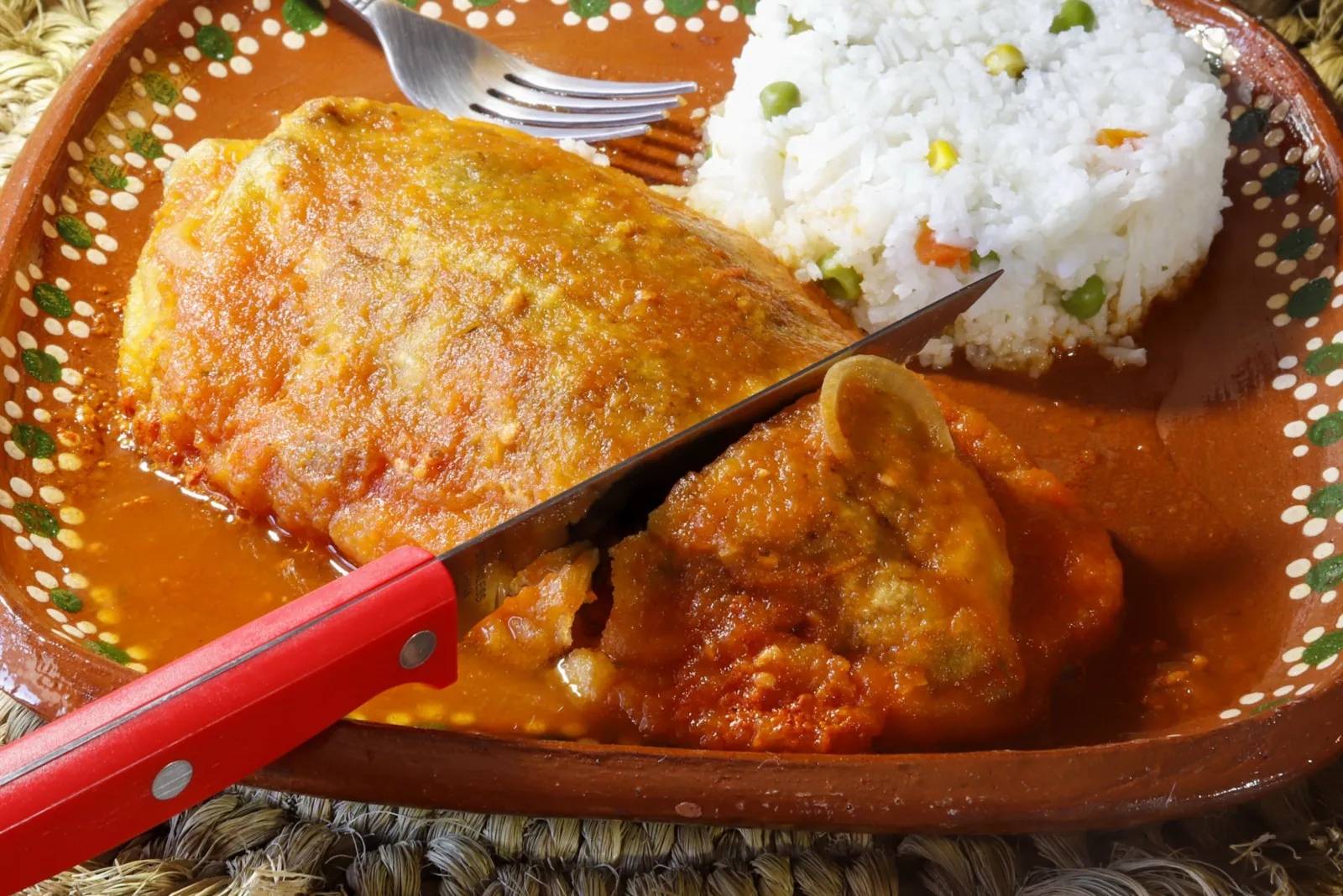

A chile relleno (CHEE-leh reh-YEH-noh), “stuffed chile” in Spanish, is a roasted poblano pepper filled with cheese, wrapped in a soufflé-like coat of whipped egg, fried and served in a thin tomato broth. In the US it’s a Tex-Mex restaurant staple, often made with Anaheim peppers and smothered in sauce; in Mexico it’s everyday home and lunch-counter food, and the poblano is the default. Getting the puffy coat to stay on comes down to three variables, none of which is the eggs, and I’ll give you the numbers for each.
What a chile relleno is, and is it worth making at home?
How do you make chiles rellenos? Char poblano peppers over a flame for 12 to 15 minutes, steam them for 10, peel, and remove the seeds through a side slit. Stuff each with 50 g (1¾ oz) of melting cheese, dredge in flour, dip in stiffly whipped egg whites folded with the yolks, and fry at 350-355°F (175-180°C) for 1½ to 2 minutes per side. Serve in tomato broth. Ready in 90 minutes for 4 servings.
Yes, if you have a free afternoon or can do half of it the day before. What you get is a contrast nothing else on a Mexican menu gives you: a smoky, barely hot pepper, molten cheese, a soft eggy coat and a light, slightly sharp broth soaking into its edge.
Real time. 90 minutes from start to table, about 80 of them hands-on. Roast, peel and stuff the day before and serving day takes around 40.
Honest difficulty, medium. Peeling without tearing takes a couple of tries, and frying needs the oil at the right heat. There’s nothing else to master.
Skip it if you don’t want to shallow-fry at home, or you’re cooking for someone who can’t eat eggs. The baked version further down solves both.
Not to be confused with chiles en nogada, the late-summer dish from Puebla. Same roasted poblano, but filled with a fruit-studded meat picadillo, covered in cold walnut sauce and pomegranate, and often served without batter. Chiles rellenos are a year-round, hot, cheese-and-tomato dish.
Why the batter falls off, and the three fixes
The batter itself is just eggs. When it slides off or turns greasy, one of these went wrong.
- A wet pepper. Peeled peppers hold steam. Pat them dry with paper towels inside and out, and if they’ve been in the fridge, give them 30 minutes on the counter: a cold pepper sweats in the oil and the coat lifts.
- No flour. Egg foam won’t cling to smooth, damp skin. Roll each stuffed pepper in flour and shake off the excess, so only a thin dusting stays on.
- Cool oil. Below 340°F (170°C) the batter sits there and soaks up fat. Above 375°F (190°C) it browns before the cheese melts.
No thermometer? Drop a teaspoon of batter in the oil. It should float and sizzle at once and turn golden in about a minute. Fry 2 or 3 peppers per batch, seam side down first, so the opening seals before anything leaks, and spoon oil over the top so you can flip without the raw foam running off.
Whip the whites only when the oil is almost hot. In my kitchen, batter that waits 10 minutes is already half the height and fries flat.
What you need, with US and UK swaps
Amounts are in the recipe card: 8 poblanos, 400 g (14 oz) of cheese, 5 eggs, 60 g (½ cup) of flour and 800 g (1¾ lb) of tomatoes for 4 people, two peppers each.
Poblanos, and what to use if you can’t find them
Poblanos are dark green, wide-shouldered fresh chiles; dried, they’re sold as ancho. They measure 1,000 to 1,500 Scoville heat units according to Wikipedia, mild enough that most people don’t notice the heat. US supermarkets carry them year-round, sometimes labelled “pasilla.” In the UK, look for them at Mexican grocers and online fresh-chile growers; supermarkets rarely stock them.
| Pepper | Heat (Scoville) | Charring time | Cheese per pepper | What changes |
|---|---|---|---|---|
| Poblano | 1,000-1,500 | 12-15 min | 50 g (1¾ oz) | the reference |
| Anaheim / New Mexico green | 500-2,500 | 6-8 min | 30 g (1 oz) | longer and thinner-walled, tears more easily, similar flavor |
| Romano or long sweet pepper (UK) | 0 | 6-8 min | 30 g (1 oz) | sweet, no chile flavor |
| Green bell pepper | 0 | 10-12 min | up to 70 g (2½ oz) | holds the most filling, tastes of bell pepper |
The Anaheim is a mild strain of the New Mexico No. 9 cultivar and the usual choice in the US Southwest. It’s the closest swap for flavor; buy the widest ones you can find.
Which cheese melts properly
You want a cheese that melts and pulls into strings. In Mexico that’s Oaxaca (a stretched-curd cheese wound into a ball) or Chihuahua. Good stand-ins are Monterey Jack in the US and low-moisture mozzarella in a block on both sides of the Atlantic. Avoid fresh mozzarella in water, which leaks whey into the pepper, and queso fresco or paneer, which soften but never melt.
A meat filling instead
For 8 peppers, brown 200 g (7 oz) each of ground beef and ground pork for 8 minutes with 40 g (1½ oz) of chopped onion and a garlic clove, add 150 g (5 oz) of potato and 100 g (3½ oz) of carrot in ¼ in (5 mm) dice plus 1 blended tomato, and cook 15 minutes until the potato is tender and the pan is dry. Use about 80 g (3 oz) per pepper, cold and dry: a wet filling soaks the pepper from inside and the batter lifts. A leftover batch of Mexican picadillo with potato and carrot works too, cooked down until dry. Well-drained chicken tinga works too.
Equipment
Tongs, a 10 to 11 in (26 to 28 cm) high-sided skillet, a hand or stand mixer and an instant-read thermometer. Electric stove? Use the broiler, 6 in (15 cm) from the element, 4 to 6 minutes on one side and 3 to 5 on the other, the timing America’s Test Kitchen gives for poblanos.
Charring and peeling without tearing
Two habits tear peppers. Leaving them on one side too long, which cooks the flesh soft instead of just blackening the skin, and peeling them under the tap, which also washes off the roasted flavor. Turn every 2 to 3 minutes and rub the skin off with a damp towel after 10 minutes in a sealed bag. A few black flecks left behind don’t matter; the batter covers them.
Make the slit after peeling, 2½ in (6 to 7 cm) long, stopping short of the stem and the tip. The heat sits mostly in the white veins, where capsaicin concentrates, so scrape those out completely along with the seeds. If one tears anyway, stuff it and fry it tear-side down; the batter seals it. Badly torn peppers aren’t wasted either: slice them into rajas con crema, poblano strips simmered in cream.
A make-ahead plan for a relaxed serving day
Up to 2 days ahead. Char, peel, seed and stuff the peppers; keep them covered in the fridge.
Up to 3-4 days ahead. The tomato broth, refrigerated.
On the day. Take the peppers out 30 minutes before frying. Reheat the broth, heat the oil, flour the peppers, whip the eggs, fry in three batches, and serve.
For 10 people, scale to 20 peppers (2.5 kg / 5½ lb), 1 kg (2.2 lb) of cheese, 12 eggs, 150 g (1¼ cups) of flour, 2 kg (4½ lb) of tomatoes and 1.25 liters (5 cups) of stock. Frying grows from about 20 to about 50 minutes, so batter and fry up to an hour ahead, hold them on a rack, and slide them into the hot broth when you serve; the coat softens in the broth anyway.
Fried, baked or air-fried, which should you make?
- Baked, no batter → stuff the peppers, lay them in an oiled dish and bake at 400°F (200°C) for 15 to 20 minutes, until the cheese melts and the edges brown. Serve on the broth the same way. You lose the puffy coat and about 216 calories per serving.
- Air fryer, no batter → 375°F (190°C) for 8 to 10 minutes, in two batches of 4. Egg-foam batter doesn’t work in an air fryer: it’s a liquid foam and drips through the basket before it sets.
- Meat filling → heartier, about 700 calories per serving.
- Vegetarian → the cheese version already is, with water or vegetable stock in the broth.
- Gluten-free → dredge in rice flour or cornstarch instead of wheat flour; it grips just as well. Check the stock label.
What it costs to make in the US
With BLS average prices for August 2026, the cheese (priced as cheddar), eggs, tomatoes and flour come to about $9.80, or $2.45 a serving. The BLS doesn’t track poblanos or frying oil, so add those at your store’s price. Swap the cheese for a meat filling and it’s about $10.90.
Yield. 8 medium peppers, 2 per person as a main with rice and beans, or one each as part of a bigger spread for 8.
How to serve chiles rellenos, and how to store them
Taste and texture. A soft, eggy coat rather than a crisp one, soaking up broth at the edge; underneath, a smoky, slightly bitter pepper and salty melted cheese. The broth is thin and a little tart, and that’s what balances the frying.
Serving. In a shallow bowl, on about 1 cup (250 ml) of broth, with Mexican red rice, refried beans and warm tortillas. A jug of agua de jamaica is the drink, and a bowl of pico de gallo cuts through the richness.
Fridge. According to USDA FSIS, refrigerate within 2 hours and eat within 3 to 4 days. Store peppers and broth separately; left in the broth overnight, the coat dissolves.
Freezer. FSIS gives 3 to 4 months for best quality. Stuffed, unbattered peppers and the broth freeze best; battered ones turn rubbery when thawed.
Reheating. Oven at 350°F (180°C) on a rack for 10 to 15 minutes, to 165°F (74°C) in the center, with the broth heated separately on the stove. The microwave makes the coat soggy.
Frequently asked questions
Why does my chile relleno batter fall off? The pepper was wet, wasn’t floured, or the oil was below 340°F (170°C). Pat it dry, dredge in flour, shake off the excess, and fry at 350-355°F (175-180°C).
What’s the best cheese for chiles rellenos? A melting, stringy cheese: Oaxaca or Chihuahua in Mexico, Monterey Jack or low-moisture mozzarella elsewhere. About 50 g (1¾ oz) per medium poblano.
Can I use Anaheim peppers instead of poblanos? Yes. They taste similar and range from 500 to 2,500 Scoville units, but they’re thinner-walled, char in 6 to 8 minutes and hold about 30 g (1 oz) of cheese.
Can I make chiles rellenos ahead? Roast, peel and stuff them up to 2 days ahead and keep them in the fridge. Batter and fry on the day, after 30 minutes at room temperature.
Can you bake chiles rellenos instead of frying? Yes, without batter: 400°F (200°C) for 15 to 20 minutes, or 375°F (190°C) for 8 to 10 in an air fryer. It’s lighter, 467 calories a serving, but not puffy.
Are chiles rellenos spicy? Usually not. Poblanos are mild, though the odd one runs hot. Taste a scrap of each while you clean them, and scrape out all the white veins.
Are chiles rellenos gluten-free? Not as written, because of the flour dredge. Rice flour or cornstarch works in its place, and the batter itself is only eggs.
Nutrition
Per serving (2 cheese chiles rellenos with about 1 cup / 250 ml of broth), calculated ingredient by ingredient from USDA SR Legacy with this recipe’s amounts: 850 g of trimmed peppers, Oaxaca cheese calculated as whole-milk mozzarella, 30 g of flour that stays on the peppers, and 45 g of oil absorbed, which is what I measure missing from the pan after frying 8 peppers.
- Calories: 683 kcal
- Protein: 38 g
- Carbohydrates: 39 g
- Fat: 44 g (17 g saturated)
- Fiber: 6 g
- Sugars: 18 g
- Sodium: 1,355 mg
Baked without batter, the same recipe drops to 467 calories and 27 g of fat. Most of the sodium comes from the cheese and stock; made with water, it falls to about 890 mg. Allergens: egg, milk and wheat.
I’m Venezuelan and live in Colombia, where poblanos turn up only now and then, so I learned this dish as often on green bell peppers as on the real thing. The recipe never changed what came out of my pan; the thermometer did. The day I started measuring the oil, I stopped throwing away greasy, half-naked peppers. Josnaisis.