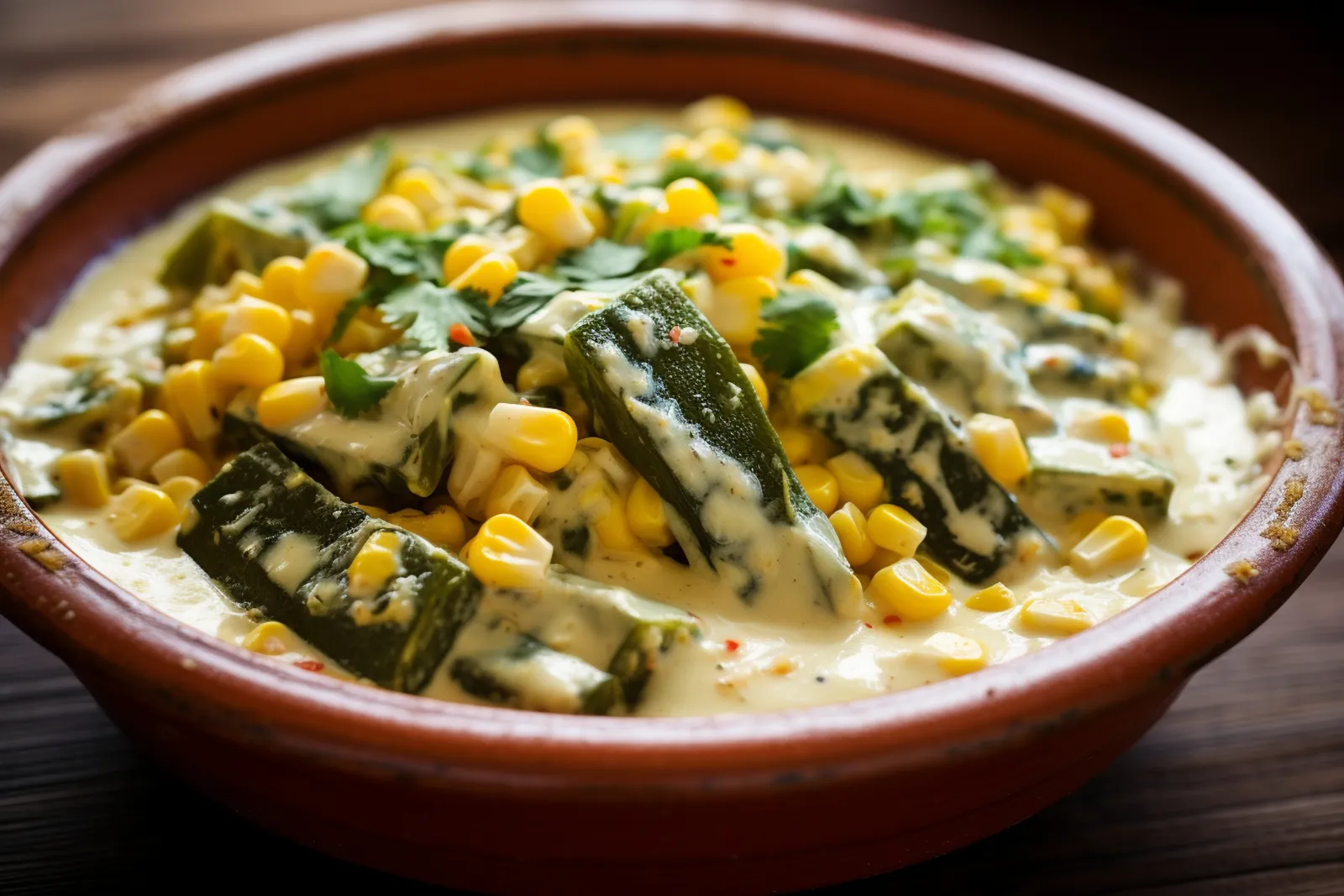

Rajas (RAH-hahs) means “strips” in Spanish, and in Mexican kitchens the word almost always means roasted, peeled poblano peppers cut into ribbons. Simmered with onion, sweet corn and Mexican crema, sometimes with melting cheese stirred in, they become rajas con crema: a mild, smoky, creamy vegetable dish that fills tacos, tamales and quesadillas or sits next to grilled steak. If you’ve never cooked with poblanos, picture a green bell pepper with a deeper, grassier flavor and a whisper of heat. Below you’ll find three ways to char them (including one that needs no gas burner), how spicy the dish really is, which supermarket cream won’t curdle, and a make-ahead plan for a crowd.
What is rajas con crema, and is it worth making on a weeknight?
How do you make rajas con crema? Char 6 poblano peppers over a flame for 12 to 15 minutes until black, steam them in a bag for 10 minutes, then peel, seed and slice them into strips. Soften a sliced onion for 8 minutes, add garlic, corn and the strips, and finish with 200 ml (¾ cup) of Mexican crema over low heat for 2 to 3 minutes, without boiling. 45 minutes for 4 servings.
Yes, it’s a good weeknight dish, with one caveat: half of the 45 minutes goes into charring and peeling the peppers. Do that part on a Sunday and the dish itself takes 20 minutes on a Tuesday.
Who it’s for. Anyone looking for a meatless taco night that still feels substantial, hosts who need a vegetarian option at a taco bar, and cooks who like a side that works with grilled meat or fish.
Who might skip it. People avoiding dairy, since crema makes up much of the sauce. And chili-heads: with the ribs removed, poblanos are mild enough that some guests won’t notice any heat at all.
Effort. Easy. Two things take a little practice: knowing when the skin is charred but the flesh is still firm, and keeping the crema below a boil.
How hot are poblano peppers?
Mild. The University of Florida’s IFAS extension puts poblanos at 1,000 to 2,000 Scoville heat units, against 2,000 to 8,000 for a jalapeño. Most of that heat lives in the white ribs (the placenta), not the seeds: researchers at New Mexico State University’s Chile Pepper Institute found that capsaicin is produced in tiny vesicles on the placenta, and the seeds only pick it up by contact. Scrape out the ribs and you’ve removed most of the heat; scrape out only the seeds and you haven’t.
Now and then a poblano runs hotter than the label suggests. Taste a strip before you add the crema; if it bites, the cream will soften it, and so will an extra handful of corn.
Three ways to roast and peel poblanos
For rajas the pepper doesn’t have to survive in one piece, which is the opposite of what you need for chiles rellenos. That opens up the easiest method of all: split, seed and flatten the raw peppers, then broil them skin side up.
- Gas flame, 12-15 minutes. The smokiest result. Set the peppers right on the grate over high heat and turn every 2 to 3 minutes. Good for 2 to 4 peppers at a time.
- Broiler, 5-10 minutes. America’s Test Kitchen’s method: halved and seeded, skin side up, 3 to 4 in (8-10 cm) below the element, rotating the pan halfway. One sheet pan fits a dozen peppers, which makes this the method for a crowd.
- Hot oven or grill, 6-8 minutes. New Mexico State University Extension recommends 400-450°F (205-230°C), peppers in a single layer and turned often, with a small slit in each so steam can escape.
Whichever you use, seal the hot peppers in a bag or covered bowl for 10 minutes, then rub the skins off with your fingers. Skip the running tap: it rinses off the charred flavor along with the skin. NMSU also suggests rubber gloves, or a thin coat of oil on your hands, if your skin is sensitive; a splash of vinegar helps if your fingers start to burn. A microwave won’t blister the skin and leaves it tougher, so I don’t use one here.
Signs you got it right. The skin is black and puffed over most of the pepper, but the flesh still feels firm when you squeeze it with tongs. If it slumps like a wet cloth, it went too long.
Ingredients, and what to buy in a US or UK supermarket
Amounts are in the recipe card: 6 poblanos, a large white onion, 1 cup of corn and 200 ml (¾ cup) of crema for 4 servings.
Poblanos. Dark green, wide-shouldered and about 4-5 in (10-12 cm) long. Most US supermarkets carry them year-round, sometimes mislabeled as “pasilla”. In the UK they turn up at Mexican grocers and with online fresh-chilli growers more often than in supermarkets.
| If you can’t find poblanos | Use for this recipe | What changes |
|---|---|---|
| Anaheim (US) | 6-7 peppers | closest flavor, thinner walls, chars in about half the time, can be a little hotter (up to 5,000 SHU) |
| Green bell pepper + jalapeño | 4 bell peppers + 1 seeded jalapeño | sweeter and less grassy; the jalapeño supplies the chile note |
| Romano or long green peppers (UK) | 5-6 peppers + 1 green chilli | thin skin tears when peeled, which doesn’t matter for strips |
| Jarred fire-roasted poblanos | about 525 g (1 lb 2 oz) drained | saves 25 minutes; softer, less smoky |
Corn. Fresh, frozen (straight from the bag) or canned and drained. Same weight, same result.
Cheese. Optional, and it turns a side dish into a filling. You want one that melts into strings: Oaxaca or asadero from a Latin grocer, Monterey Jack in the US, or a block of low-moisture mozzarella in the UK. Queso fresco and paneer-like cheeses soften but don’t melt.
Which cream won’t curdle, crema vs sour cream vs crème fraîche
Cream sauces split when heat makes the whey proteins unfold and clump with the casein. Butterfat protects against that. In America’s Test Kitchen’s tests, yogurt (about 4 % fat) and sour cream (18-20 %) curdled quickly when heated, while crème fraîche, at 30-40 %, stayed smooth.
- Mexican crema (Cacique, in the dairy aisle of most US stores) lists 2.5 g of fat per 15 g tablespoon, about 17 %, plus guar gum and carrageenan that keep it stable over low heat.
- Crème fraîche is the best UK option: similar tang, and it won’t split.
- Heavy cream (US) or double cream (UK) won’t split either. Add 1 tsp of lime juice to 200 ml so the sauce doesn’t taste flat.
- Sour cream or Greek yogurt work only with the heat off. Take the pan off the burner, wait a minute, then stir.
A make-ahead plan, from one batch to a taco bar for 20
45 minutes on the clock for 4 servings. The trick is to cook the onion while the peppers steam; done one after the other, it stretches to an hour.
The day before. Char, peel and slice the strips and refrigerate them covered. On the day, it’s onion, corn and crema: 20 minutes.
For a crowd. Count 3 oz (80 g) of rajas per taco and 3 tacos per person. For 12 people, triple the recipe: 18 poblanos and 600 ml (2½ cups) of crema. For 20, multiply by 5: 30 poblanos and 1 liter (4¼ cups) of crema. Broil the peppers in sheet-pan batches, peel them the day before, and cook the sauce in two wide skillets; in a deep pot the onion steams instead of softening.
For the freezer. Freeze the roasted strips, not the finished dish. NMSU’s guide to freezing green chile says roasted chiles can be frozen peeled or unpeeled (they peel more easily after freezing), cooled below 40°F (4°C) first, and kept for up to a year. With crema already in, the sauce turns grainy when thawed.
Mistakes that ruin rajas con crema
- The sauce split. It boiled, or you used sour cream on the heat. Pull the pan off the burner and stir in 2 tbsp of cold crema; it looks better, the flavor was never the problem.
- Too spicy. The ribs stayed in, or you drew a hot pepper. Add 50 ml (3 tbsp) more crema and some extra corn.
- Skins won’t come off. Not enough char or not enough time in the bag. Scrape with the back of a knife rather than rinsing.
- Watery strips. You peeled them under the tap, or frozen corn released ice. Cook 2 minutes more over medium heat before the crema goes in.
- Bitter, burnt taste. The flesh charred, not just the skin. Turn every 2 to 3 minutes.
Ways to serve it and variations
- Tacos → warm corn tortillas, rajas, a few crumbles of cotija if you have it, with Mexican refried beans on the side.
- Side dish → next to carne asada or grilled chicken, with Mexican red rice.
- Quesadillas → rajas with cheese and only a little crema, well drained, folded into Mexican quesadillas.
- Tamales de rajas → make the strips with half the crema or none, since cream tends to separate in the steamer, and tuck a strip of cheese into each. One batch fills about 24; the dough and folding are the same as for green chicken tamales.
- With chicken → add 300 g (10 oz) of shredded cooked chicken breast and it’s a main course for 4.
- Lighter → skip the cheese (265 kcal and 17 g fat per serving) or use half the crema.
- Vegan → cashew or oat cooking cream, no cheese, a squeeze of lime.
Many Mexican home cooks add cubed boiled potato or zucchini to the pan, and some leave out the corn. For another dish where corn meets crema, esquites take the idea in a different direction.
What it costs to make in the US
About $6.68 for 4, or $1.67 a serving. The USDA’s weekly retail ad survey doesn’t track poblanos, so the peppers are priced at the Anaheim figure, which is in a similar range.
Peppers and crema are two-thirds of the bill. Leaving out the cheese saves about 20 %. The batch makes roughly 1 kg (2¼ lb), enough for 12 tacos.
Storage and reheating
Fridge. USDA FSIS guidance: refrigerate within 2 hours and eat within 3 to 4 days at 40°F (4°C) or below.
Reheating. In a skillet over low heat with 1 to 2 tbsp of milk or crema to loosen the sauce, stirring until it reaches 165°F (74°C). High heat splits the crema. In the microwave, use half power in 1-minute bursts and stir between them.
Rajas con crema FAQ
Are rajas con crema spicy? Usually only slightly. With the ribs removed most people find them mild; poblanos top out around 2,000 Scoville units. Keep the ribs of one pepper, or add a seeded jalapeño, for more kick.
Can I use sour cream instead of Mexican crema? Yes, but stir it in with the heat off. It has much less fat than crème fraîche and curdles if it boils. Crème fraîche or heavy cream can go in over low heat.
What’s the best substitute for poblano peppers? Anaheim peppers, which taste the most similar. Otherwise, a seeded jalapeño with four green bell peppers for this recipe.
Do I have to peel poblano peppers? For rajas, yes. The charred skin is papery and tough, and it separates from the strips in the sauce.
Can you freeze rajas con crema? The finished dish freezes poorly because the cream turns grainy. Freeze the roasted strips without crema for up to a year, and add the crema when you reheat.
What do you eat rajas con crema with? Corn tortillas as tacos, inside tamales or quesadillas, or as a side for grilled steak, chicken or fish with rice and beans.
How many poblanos per person? One and a half as a main with tortillas, or roughly 1 pepper for every 2 tacos.
Nutrition per serving
Per serving (about 250 g / 9 oz, with cheese), calculated ingredient by ingredient from USDA FoodData Central (SR Legacy) with this recipe’s quantities. SR Legacy has no poblano entry, so raw green chile stands in, and sour cream stands in for Mexican crema, which has a similar fat content.
- Calories: 354 kcal
- Protein: 11 g
- Carbohydrates: 29 g
- Fat: 23 g (11 g saturated)
- Fiber: 4 g
- Sugars: 12 g
- Sodium: 590 mg
Leave out the cheese and each serving drops to 440 mg sodium, 17 g fat and 265 kcal.
Poblanos are hard to find where I live in Colombia, so most weeks my rajas start with green bell peppers and a single jalapeño, and when real poblanos show up I buy a dozen, broil them on one tray and freeze them in bags of six. The habit that made the biggest difference was splitting and seeding them raw. Ribs out before the heat goes on, and the dish is exactly as mild as you meant it to be. Josnaisis.