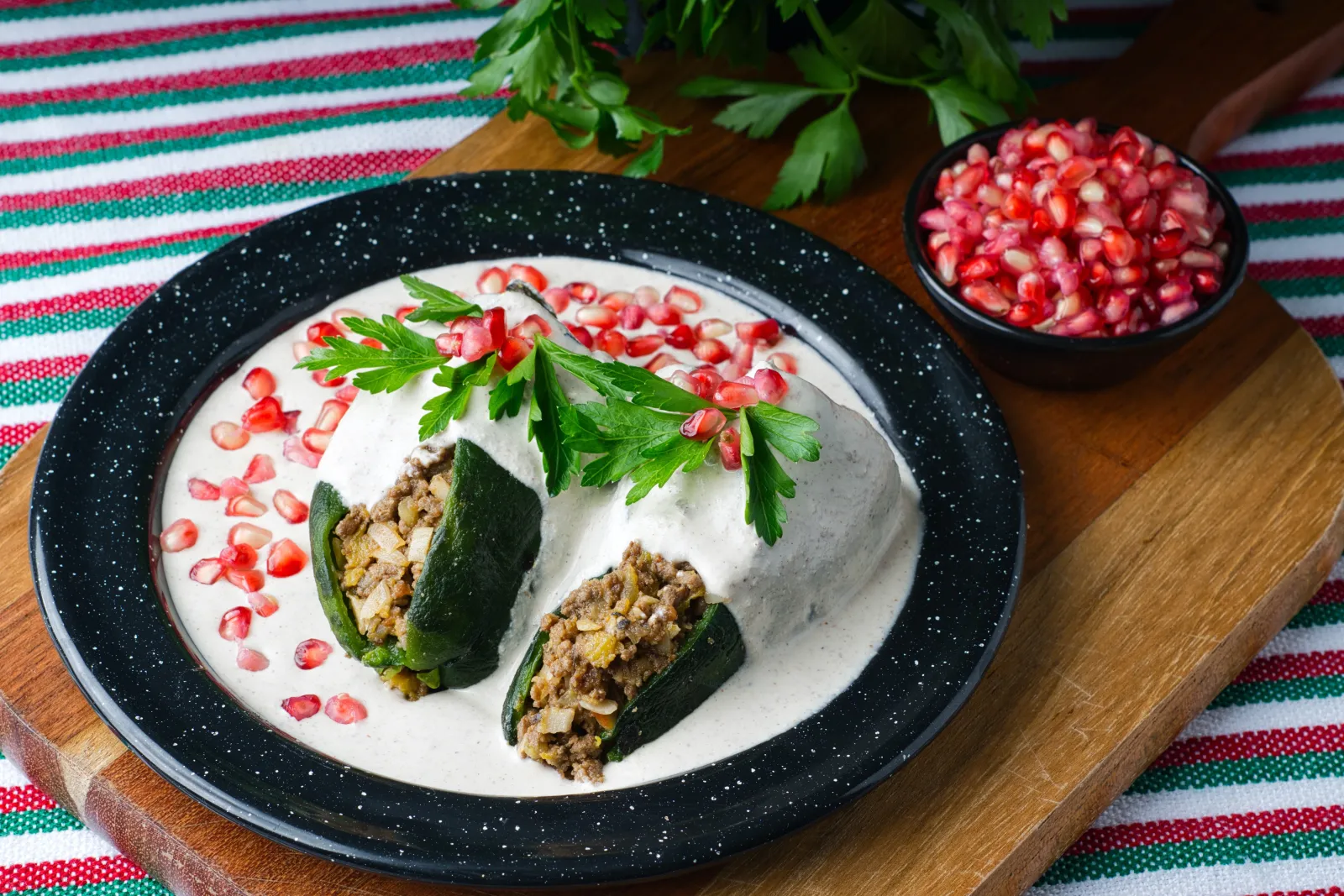

Chiles en nogada (CHEE-lehs en noh-GAH-dah) are Puebla’s late-summer dish: 6 roasted poblano peppers filled with ground meat cooked with apple, pear, peach and plantain, then covered in a cold white walnut sauce and scattered with pomegranate and parsley. Puebla is in central Mexico, and the dish is seasonal: green chile, white sauce and red pomegranate match the Mexican flag, and they turn up in late summer around Independence Day on September 16. If you have never eaten one, think sweet and savory stuffed pepper under a cool, nutty cream. The work is real, about 90 hands-on minutes, so below is what to buy in a US or UK store, how to split it across two days, and the one step that decides whether the sauce comes out white or bitter.
What chiles en nogada are, and whether they’re worth the effort
How do you make chiles en nogada? Char, peel and seed 6 poblano chiles, then stuff them with pork and beef cooked with diced apple, pear, peach, plantain, raisins and almonds. Cover them with a sauce of peeled walnuts blended with goat cheese, milk and a little sherry, and finish with pomegranate seeds and parsley. 120 minutes for 6 servings.
They are worth it for an occasion, and only if you’re happy to spend about 40 minutes peeling walnuts. Nothing else on the plate is hard. What makes the dish is the contrast: a warm, smoky chile with very little heat, a filling that is half meat and half fruit, and a cold sauce that tastes of fresh walnut and tangy cheese. The pomegranate adds the sour pop that stops the whole thing from being too sweet.
When to make them. A late-summer lunch or dinner for 6, a September 16 party, or any table where you want something people can’t buy ready-made. One chile is a full main course.
When to skip them. A weeknight, because it’s 2 hours on the clock and about 90 minutes of that hands-on. Anyone allergic to tree nuts: the sauce is walnuts, and there’s no swap that makes the same dish.
Difficulty, honestly. Hard, though no single step is. There are five separate jobs, and two go wrong easily: a chile that tears while you peel it, and walnut skins left on.
Fresh or dried walnuts, the choice that changes the sauce
In Puebla the sauce is made with fresh Castilla walnuts, harvested in summer, soft and moist, with a skin you can lift with a fingernail. The 2026 season in Puebla ran July 1 to September 16, according to the state tourism secretary as reported by Publimetro. Outside those weeks, and outside Mexico almost always, you’ll be working with ordinary dried walnut halves.
Dried walnuts make a good sauce with two compromises. The skin is stuck to the nut, so even after soaking you’ll only get part of it off, and what stays turns the sauce beige and slightly bitter. I soak them 8 hours in milk in the fridge, blanch them 1 minute, rub them in a towel, and add 1 extra teaspoon of sugar to the sauce. Pecans are also used in Mexico, alone or mixed in. In my kitchen they give a toastier, more buttery sauce; good, but different.
How to peel walnuts, and why skins make the sauce bitter
The papery skin is rich in tannins, which react with the proteins in saliva and taste bitter and astringent; a 2024 review in Food & Medicine Homology notes that food processors throw the skin away for exactly that reason. That’s also why the soaking milk goes down the drain and never into the blender.
With fresh walnuts, split the halves, slide a nail or knife tip under the edge of the skin and pull toward the center; it comes away in strips. It takes me about 40 minutes for 200 g (7 oz). If a fold won’t let go, 10 seconds under hot water loosens it.
Ingredients and US and UK substitutes
The recipe card has exact amounts: 6 poblanos of about 5 oz (140 g), 500 g (1.1 lb) of ground meat split between pork and beef, 570 g (1¼ lb) of fruit, 200 g (7 oz) of walnuts and 100 g (3.5 oz) of goat cheese.
Poblanos, and what to use in the UK
Poblanos are dark green, wide-shouldered chiles with thick walls and mild heat, 1,000 to 1,500 Scoville units according to Wikipedia. Most US supermarkets stock them. In the UK they’re harder: look at Mexican online grocers. Failing that, large green bell peppers work. They have no heat and thinner walls, so they char in about 8 minutes and tear more easily; the dish will taste of pepper rather than chile.
The fruit, the cheese and the sherry
In Puebla the fruit is panochera apple, milk pear and criollo peach. A Golden Delicious apple, a firm Bosc or Conference pear and a firm yellow peach do the same job. Canned peaches work out of season: drain them, add them for the last 3 minutes, and halve the sugar in the filling. The plantain must be ripe, yellow going black; a green one stays starchy.
For the sauce, fresh soft goat cheese gives a tang that balances the sugar. Queso fresco in the US or ricotta in the UK makes it milder. The sherry should be dry, a fino or amontillado; without it the sauce is a little sweeter and nothing else changes.
Make-ahead plan, two days to a 35-minute serving day
Done in one go, the dish takes 120 minutes. Split over two days, serving day drops to 35 minutes, and that’s the way I recommend for a first time.
The day before, about 95 minutes. Peel the walnuts and keep them covered in milk in the fridge, or start the dried ones soaking. Char, peel and seed the chiles and refrigerate them covered. Cook the picadillo, cool it and refrigerate it.
Serving day, 35 minutes.
Charring poblanos without tearing them
Chiles tear for two reasons: a side left too long on the flame goes soft, and peeling under running water weakens the flesh and washes off the roasted flavor. High flame, a turn every 2 or 3 minutes, 12 to 15 minutes in total, then into a bag for 10 minutes. Make the slit only after peeling. If one tears anyway, put it seam-side down on the plate; the sauce hides it.
Walnut sauce ratio and texture
My ratio by weight is 2 parts walnut, 1 part goat cheese, 2 parts milk: 200 g (7 oz) walnuts, 100 g (3.5 oz) cheese and 200 ml (¾ cup + 1 tbsp) milk for 6 chiles, about 3 oz (90 g) of sauce each. Blend 1 to 2 minutes until there’s no grain at all. It should coat a spoon and fall in a ribbon. Some cooks add Mexican crema or heavy cream (double cream in the UK); it makes the sauce richer and thicker and mutes the walnut.
Mistakes that ruin chiles en nogada, plus heat level and allergens
- Bitter sauce → skins left on, or soaking milk used. Peel better and discard that milk. To rescue a batch, blend in 50 g (1¾ oz) more cheese and 1 tsp sugar.
- Gray sauce → walnuts oxidized, or the sauce was blended too far ahead. Blend on the day and keep peeled walnuts under milk.
- Watery filling → fruit went in before the tomato reduced. Give the tomato 5 minutes on its own.
- Mushy fruit → dice smaller than ½ in (1 cm), or cooked 25 minutes. 12 to 15 is enough.
- Torn chiles → too long on one side, or peeled under the tap.
- Too hot → veins left in. Scrape them all out; the seeds carry less heat than you’d think.
Heat, 1 out of 5. Poblanos are mild and the sauce cools them further. Taste a strip of each chile as you clean it; the odd one is hotter.
Kids. Most like the sweet filling. Many eat the inside and leave the green skin. The sherry isn’t cooked, so the alcohol stays in the sauce: blend a portion without it.
Allergens. Tree nuts (walnuts and almonds) and milk. A battered version adds egg and wheat. Sherry contains sulfites.
Battered or not, and other versions
Both styles are traditional. Unbattered is the usual home version: peeled, stuffed and sauced. Battered (capeado) chiles are dipped in whipped egg and fried before saucing; UnoTV, reporting on the Puebla culture ministry’s guidelines, says only the battered version can be called the “original.” I make them plain for family and battered for guests.
To batter 6 chiles. Whip 4 egg whites to stiff peaks, fold in the 4 yolks and a pinch of salt. Dust the stuffed chiles with 40 g (⅓ cup) flour, dip them in the egg and fry in 2 cm (¾ in) of oil at 350°F (175-180°C), 1 to 2 minutes a side. Drain on paper. That’s about 30 more minutes, at the last moment, and about 72 kcal more per chile before the oil it absorbs.
- Short on time → unbattered, with everything prepped the day before.
- For 12 → double everything and skip the batter, or you’ll spend half an hour at the stove while everyone eats.
- Out of season → dried walnuts, drained canned peaches and tubs of pomegranate seeds.
- Vegetarian → swap the meat for 500 g (1.1 lb) chopped mushrooms and 150 g (1 cup) mashed cooked chickpeas; cook the mushrooms 10 minutes until dry before the fruit goes in.
- Chicken → 500 g (1.1 lb) poached, shredded chicken breast instead of ground meat, added with the fruit.
| Ingredient | 6 chiles | 12 chiles |
|---|---|---|
| Poblanos | 6 (850 g / 1.9 lb) | 12 (1.7 kg / 3.75 lb) |
| Ground pork and beef | 500 g / 1.1 lb | 1 kg / 2.2 lb |
| Diced fruit | 570 g / 1¼ lb | 1.14 kg / 2½ lb |
| Shelled walnuts | 200 g / 7 oz | 400 g / 14 oz |
| Goat cheese | 100 g / 3.5 oz | 200 g / 7 oz |
| Milk | 200 ml / ¾ cup + 1 tbsp | 400 ml / 1⅔ cups |
| Pomegranates | 1 | 2 |
| Hands-on time | 90 min | about 140 min |
What chiles en nogada cost to make
Walnuts are the expensive part wherever you cook. In Mexico, fresh Castilla walnuts reached 900 pesos a kilo in Calpan, Puebla, in July 2026, according to the town’s mayor, so the 200 g (7 oz) for this sauce alone cost about 180 pesos. On October 10, 2026, Costco Mexico sold dried walnut halves at 279 pesos for 1.36 kg, about 205 pesos a kilo, a quarter of the price. All the produce in the recipe that the Mexican government’s SNIIM wholesale survey priced on September 2, 2026 at Mexico City’s Central de Abasto came to 43.31 pesos.
In the US, the BLS average price for 100% ground beef in August 2026 was $6.923 per lb, so the 9 oz (250 g) of beef costs about $3.82. The BLS doesn’t track walnuts, poblanos, pomegranates or goat cheese, so I can’t give you a reliable total; check your store’s walnut price, because it will decide the bill. In Puebla restaurants, the state expected 2026 prices of 250 to 600 pesos per chile, which is a good argument for making them at home.
How to serve, store and reheat chiles en nogada
Serve one chile per plate with the chile warm or at room temperature and the sauce cold. That temperature contrast is the point, so never heat the sauce. A light soup beforehand is plenty. For a longer Mexican meal, start with pozole rojo or chicken tinga tostadas, and finish with café de olla rather than a sweet dessert. Puebla’s other celebration dish is mole poblano, the one for winter, and in December the pomegranate comes back in the Mexican Christmas Eve salad. If you enjoy projects like this one, Venezuelan hallacas are the dish from my own country that asks for the same kind of afternoon.
Fridge. USDA FSIS guidance for leftovers: no more than 2 hours at room temperature, and cooked picadillo keeps 3 to 4 days at 40°F (4°C) or below. I keep the walnut sauce 2 days at most in a sealed jar, my own limit because it sours and darkens, and roasted peeled chiles 2 days covered. Store the parts separately.
Freezer. The picadillo freezes well for 2 to 6 months. The sauce doesn’t: the cheese and milk split when thawed.
Reheating. Only the picadillo: in a skillet over medium with 2 tbsp water, to 165°F (74°C) in the center (FSIS), then cool to warm before stuffing. An assembled chile isn’t reheated; eat leftovers cold the next day.
Chiles en nogada FAQ
Are chiles en nogada served hot or cold? The chile and filling warm or at room temperature, the walnut sauce cold. The sauce is never heated.
Why is my walnut sauce bitter? Walnut skins, which are full of tannins, or the soaking milk went into the blender. Peel more carefully and discard that milk; to fix a batch, blend in more cheese and a teaspoon of sugar.
Can I use regular walnuts for chiles en nogada? Yes. Soak dried walnut halves 8 hours in milk, blanch, and rub off what skin you can. Expect a beige, slightly bitter sauce.
What can I use instead of poblano peppers? In the UK, large green bell peppers: no heat, thinner walls, about 8 minutes to char. Anaheim chiles work in the US but are narrower and harder to stuff.
Can I make chiles en nogada ahead? Yes. Cook the filling, peel the walnuts and roast the chiles the day before; blend the sauce and assemble on the day, 35 minutes.
Do you have to batter (capear) the chiles? No. Both styles are traditional; battered adds about 30 minutes of frying at the last moment.
What does nogada taste like? Like fresh walnuts and mild, tangy cheese, lightly sweet, with a hint of sherry. Cold and pourable, closer to a sauce than a dip.
Nutrition per chile
Per chile (about 1.1 lb / 500 g with filling, sauce, pomegranate and parsley, unbattered), calculated ingredient by ingredient from USDA SR Legacy using this recipe’s amounts:
- Calories: 735 kcal
- Protein: 30 g
- Carbohydrates: 55 g, including 34 g sugars, mostly from the fruit
- Fat: 47 g, of which 11 g saturated
- Fiber: 9 g
- Sodium: 680 mg
Walnuts supply almost half the fat, 130 g of the 284 g in the whole recipe, mostly unsaturated. Battering adds about 72 kcal per chile plus absorbed oil.
Where I live in Colombia, fresh Castilla walnuts never reach the shops, so my nogada is the beige, dried-walnut kind, and I’ve stopped apologizing for it. Soak overnight, peel what will come off, add that extra spoonful of sugar. The plate still goes quiet when it lands on the table. Josnaisis.