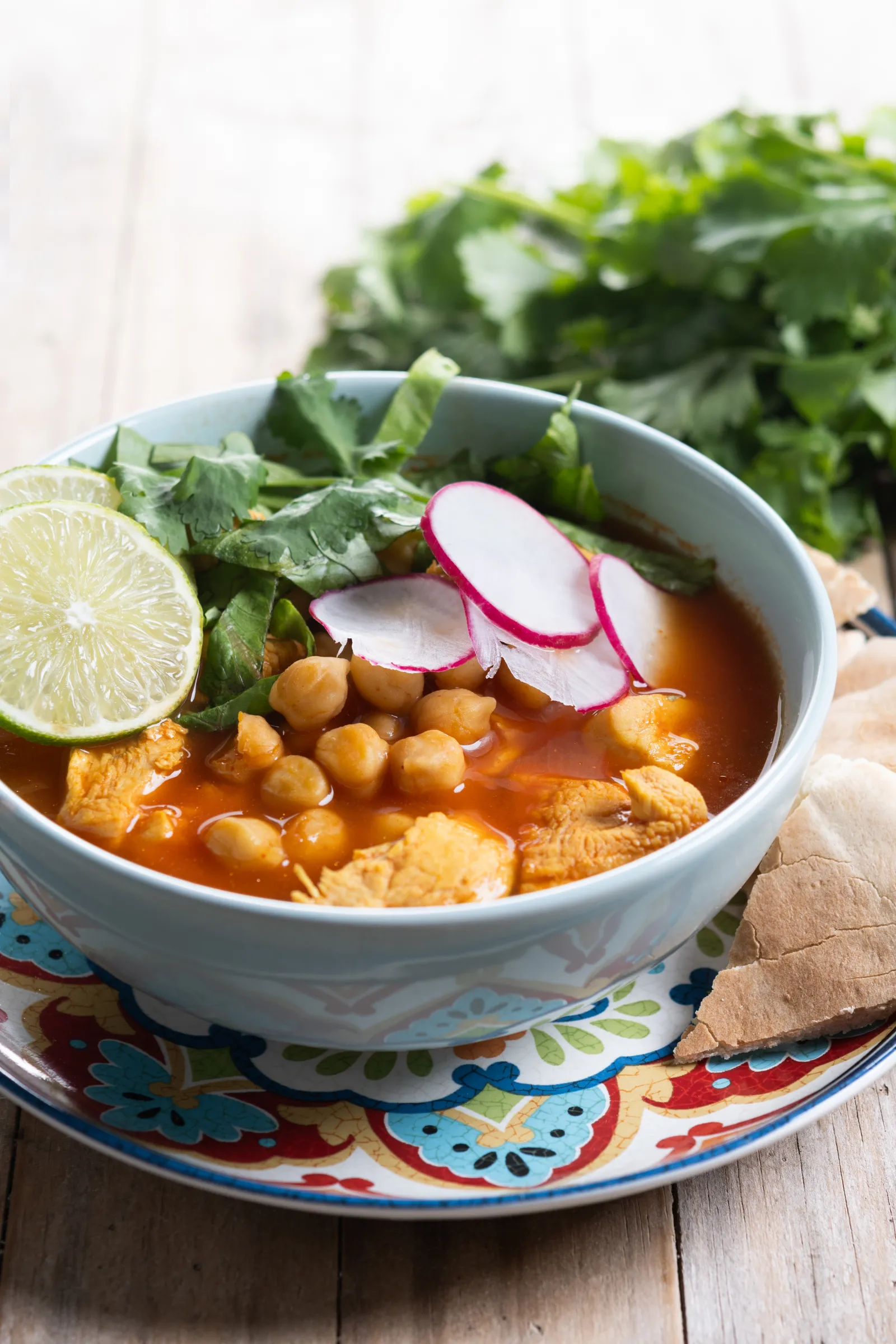

Pozole (poh-SOH-leh) is a Mexican soup built on hominy: big white corn kernels that have been soaked in an alkaline solution, hulled and cooked until they burst open like popcorn that stayed soft. In pozole rojo, the red version, those kernels sit in a pork broth colored with dried guajillo and ancho chiles, and the bowl gets finished at the table with crunchy radishes, shredded cabbage, onion, lime and oregano. It’s a big-pot dish for posadas, Christmas Eve and New Year’s, and one of the easiest ways I know to feed 25 people without being stuck at the stove. Below: canned or dried hominy, what to buy in a US or UK store, quantities from 6 to 25, and a plan that leaves 50 minutes of work for the party itself.
What is pozole rojo, and is it worth making?
How do you make pozole rojo? Simmer 2.5 kg (5.5 lb) of pork shoulder and neck bones for 90 minutes in 4 liters (17 cups) of water with onion, garlic and bay. Meanwhile toast, soak and blend 12 guajillo and 3 ancho chiles with broth, and fry the sauce for 10 minutes. Add the sauce and rinsed hominy for the last 25 minutes and serve with radishes, cabbage, onion, oregano, lime and tostadas. 150 minutes for 10 servings.
It is, if you’re cooking for a crowd. The work barely grows between 10 and 25 bowls, the pot does most of it unattended, and guests build their own bowl, so nobody’s plate is wrong.
Who it’s for. A holiday party, a game-day crowd, anyone who likes a brothy, mildly spicy soup with real chew from the corn. Each bowl is a full meal.
Who might skip it. A weeknight dinner for two: it’s 150 minutes and a 10-liter (10-quart) pot. Anyone avoiding pork, though chicken works (see below). And anyone after something light.
Time and difficulty. 150 minutes, about 80 of them hands-on, with canned hominy. Medium difficulty: nothing is technically hard, but scorching the chiles makes the whole pot bitter.
What it tastes like. Pork broth with body from the bones, gentle heat, a raisiny sweetness from the ancho. The hominy is soft and slightly springy, more like a dumpling than like sweetcorn.
Hominy, canned or dried, and the one ingredient you can’t swap
Hominy is corn that has been nixtamalized, cooked with calcium hydroxide (cal, or pickling lime), which loosens the skin and changes the texture. For pozole, cooks in Mexico use cacahuazintle, a white corn with large, soft kernels. The tip where each kernel joined the cob is removed so it can open as it cooks; in Spanish they say the corn florea, it flowers.
- Canned hominy is already nixtamalized and bloomed. Drain, rinse off the salty, starchy liquid and add it for the last 25 minutes. Weigh it drained: the label weight includes the liquid. US supermarkets carry it in the Hispanic or canned-vegetable aisle (Juanita’s and La Preferida sell 29 oz cans, for example). This is what I use for parties.
- Dried hominy (dried pozole corn) needs an overnight soak and then a long simmer: Rick Bayless allows about 5 hours for dried corn, 2 to 3 hours for fresh or frozen nixtamal. For 10 people you need 570 g to 1 kg; Bayless uses 1½ lb for 12. I use 750 g (1.65 lb).
- From-scratch nixtamal means simmering dried field corn with cal for 15 to 30 minutes, steeping at least an hour, rubbing off the skins, pinching off each tip, then 4 to 6 hours of simmering with the pork, as in the Cooks Without Borders recipe. Worth it once, for the corn flavor. Not the week of a party.
There is no real substitute for hominy. Chickpeas or sweetcorn make a pleasant soup, but not pozole. In the UK, buy canned hominy from online Mexican grocers well before the holidays.
The chiles. Guajillos bring the brick-red color and most of the heat, about 5,000 Scoville units on the Food.com chart, close to a jalapeño. Anchos, which are dried poblanos, rate around 1,000 and add sweetness. An ancho weighs about 17 g (0.6 oz) according to USDA data, a medium guajillo about 7 g. Remove the stems, seeds and pale veins, and the pot lands at a 2 out of 5 on heat.
The pork. Neck bones give the broth gelatin and body; shoulder gives meat that falls apart after 90 minutes. Pig’s head is the most traditional cut, and a Mexican butcher will sell it cleaned and split; swap in 500 g (1.1 lb) per 10 people for the same weight of shoulder.
Equipment. A 10-liter (10-quart) stockpot, a blender, a fine sieve, a heavy skillet and a skimmer. No big pot? Two 6-liter (6-quart) pots, with half of everything in each.
Mistakes that ruin pozole
- A bitter broth → chiles toasted until they smoked, or blended with the soaking water. Toast 15 to 30 seconds per side and blend with broth; Mexican Please warns about the soaking water too.
- Hominy that never opens → dried corn cooked too briefly, or with the tips left on. Canned hominy avoids the problem entirely.
- Too salty → canned hominy liquid carries salt. Rinse it and salt only at the end.
- A thin, watery broth → no bones in the pot. Neck bones or pig’s head are what give it body.
- Tough pork → pulled after an hour. Give it the full 90 minutes at a gentle simmer.
- A raw chile taste → sauce added without frying. Ten minutes in hot oil fixes it.
How to plan it for Christmas Eve or New Year’s
The trick on a normal day is to fit the chiles and toppings inside the 90 minutes the pork simmers. For a party, split it over two days and the serving day shrinks to 50 minutes.
- Two days before (Dec 22 or 29) → shop, then stem and seed the chiles and keep them in a sealed bag. If you’re making your own nixtamal, this is the cal-and-steep day.
- The day before (Dec 23 or 30) → simmer the pork, fry the sauce, cool everything quickly in shallow containers and refrigerate the broth with the pork and the sauce separately. Overnight, the fat sets on top and lifts off in one piece.
- Party day (Dec 24 or 31) → reheat to a boil, add sauce and hominy for 25 minutes, and slice the toppings while it simmers.
Pressure cooker or Instant Pot
Pork with the water, onion, garlic and bay at high pressure for 35 minutes, natural release. With neck bones I settle on 35 minutes, somewhere between the 50 Jamil Ghar gives pork shoulder and the 20 in Texas Monthly’s canned-hominy version. Then, lid off, the sauce and canned hominy for 25 minutes. Soaked dried hominy can go in with the pork: America’s Test Kitchen pressure-cooks it 25 minutes with boneless pork. If the kernels haven’t opened, 15 minutes more uncovered. About 90 minutes in total.
Scaling pozole for 6, 10, 20 or 25 people
Per person: 200 g (7 oz) drained hominy, 250 g (9 oz) pork, 400 ml (1⅔ cups) water, and the chiles in proportion.
| Guests | Drained hominy | Pork | Guajillo / ancho | Water | Pot |
|---|---|---|---|---|---|
| 6 | 1.2 kg (2.6 lb) | 1.5 kg (3.3 lb) | 7 / 2 | 2.4 L (10 cups) | 6-8 L (6-8 qt) |
| 10 | 2 kg (4.4 lb) | 2.5 kg (5.5 lb) | 12 / 3 | 4 L (17 cups) | 10 L (10 qt) |
| 20 | 4 kg (8.8 lb) | 5 kg (11 lb) | 24 / 6 | 8 L (8.5 qt) | 20 L (20 qt) or two 10 L |
| 25 | 5 kg (11 lb) | 6.25 kg (13.8 lb) | 30 / 8 | 10 L (10.5 qt) | two 12 L (12 qt) |
For 25, blend the sauce in three or four batches, and expect the pork to need about 20 minutes longer because a full pot takes a while to come to the boil. Keep the pot on the lowest flame during the party.
Versions to choose from
- Short on time → canned hominy and a pressure cooker, about 90 minutes.
- With chicken → 2.5 kg (5.5 lb) bone-in thighs and drumsticks, simmered about 45 minutes, until the meat pulls off the bone. Lighter, with less body.
- Lighter → leaner pork leg instead of shoulder and broth defatted cold. Every 100 g (3.5 oz) of fat you lift off the pot takes about 88 kcal off each bowl.
- Vegetarian → vegetable stock and 1 kg (2.2 lb) of large mushroom chunks for 30 minutes. You lose the gelatin, not the corn and chile.
- Mild for kids → 8 guajillos and 5 anchos.
- Other colors → pozole blanco has no chile sauce and puts the heat on the table; pozole verde uses pumpkin seeds and tomatillos.
Toppings and what to serve with pozole
Set the table with separate bowls of sliced radishes, finely shredded cabbage or lettuce, chopped white onion, lime wedges, dried oregano to crush between your fingers and corn tostadas to bite between spoonfuls. Cabbage stays crisp longer in hot broth; Rick Bayless lists either. Crushed chile de árbol, at about 25,000 Scoville, is the topping for anyone who wants real heat.
For a Mexican holiday menu, pozole can open the night and a mole poblano with turkey or chicken or romeritos with dried shrimp cakes can follow. A mug of thick champurrado is the classic warm drink in December, and in January the pozole pot shares the table with a Mexican Three Kings bread. If big party pots are your thing, Colombia’s three-meat sancocho and Colombian mondongo tripe soup are planned exactly the same way, bones and broth the day before; and for feeding 20 with pork, there’s the Colombian lechona. For beef instead of pork, beef birria with consommé for quesabirria tacos is built on the same guajillo and ancho adobo and is just as happy made a day ahead.
What it costs in the US and in Mexico
With August 2026 BLS average prices, the “all other pork” category (roasts, shoulder, ribs) cost $3.74 a pound: the 2.5 kg (5.5 lb) of pork here comes to $20.60, about $2.06 a bowl, and it’s most of the bill. Iceberg lettuce averaged $1.47 a pound. In Mexico City’s wholesale market, the Ministry of Economy’s SNIIM listed guajillo at 130 pesos and ancho at 140 pesos a kilo on October 9, 2026, so the chiles for 10 bowls cost about 18 pesos. Hominy wasn’t in either dataset, so I’m not giving a total I can’t check.
Storing, freezing and reheating leftovers
USDA FSIS guidance: no more than 2 hours at room temperature, and the FoodSafety.gov cold-storage chart gives soups and stews with meat 3 to 4 days in the fridge at 40°F (4°C) or below and 2 to 3 months in the freezer for best quality. A 10-liter pot of hot soup won’t cool fast enough in the fridge, so divide it into shallow containers first. Keep the toppings separate.
Pozole freezes well with the pork and hominy together; the kernels come out slightly softer but hold their shape. I freeze it in two-bowl containers that thaw overnight in the fridge. Reheat on the stove to a rolling boil, add ½ cup (120 ml) of water per 4 bowls if it has thickened, and taste for salt afterwards.
Pozole rojo questions
What is hominy, and is it the same as corn? It’s dried corn treated with an alkaline solution, hulled and cooked until the kernels swell and burst open. It’s chewier and less sweet than sweetcorn, with a faint tortilla flavor.
What’s the difference between pozole and posole? The same dish, two spellings; “posole” is the one you’ll often see on US labels and menus.
Can I use canned hominy for pozole? Yes. Drain, rinse and add it for the last 25 minutes; it’s already cooked and bloomed.
What can I use instead of guajillo chiles? Dried New Mexico or California chiles give the color with less heat and fruit. Or simply use more ancho, for a darker, sweeter and milder pot.
How spicy is pozole rojo? Mild to medium, about a 2 out of 5 with the chiles well deveined. The real heat goes on the table with chile de árbol.
How much pozole do I need for 25 people? 5 kg (11 lb) drained hominy, 6.25 kg (13.8 lb) pork, 30 guajillos, 8 anchos and 10 liters of water, split between two 12-liter pots.
Can you freeze pozole? Yes, 2 to 3 months with the pork and hominy. Never freeze the toppings.
Nutrition per bowl
Per serving (about 700 g / 25 oz, toppings not included), calculated from USDA FoodData Central (SR Legacy) using this recipe’s amounts, counting about 400 g of meat on the 1 kg of neck bones, guajillo entered as dried ancho (the closest entry in the database) and the broth not defatted:
- Calories: 671 kcal
- Protein: 39 g
- Carbohydrates: 40 g
- Fat: 39 g, 12 g of it saturated
- Fiber: 9 g
- Sodium: 1,139 mg
Most of the fat is from the shoulder, so skimming makes the biggest difference. Of the 1,139 mg of sodium, 534 come from the canned hominy liquid and 465 from the added salt, so rinsing the hominy well is the easy fix. Two tostadas add about 115 kcal; a handful of cabbage and radishes, under 20.
I grew up in Venezuela and live in Colombia, so pozole came to me through cookbooks and trial runs, not family. My first pot used dried corn I hadn’t soaked, and after two hours the kernels were still closed; since then canned hominy for parties, homemade nixtamal only on a quiet Sunday. The bowl only becomes pozole once the radishes, lime and oregano go on. Josnaisis.