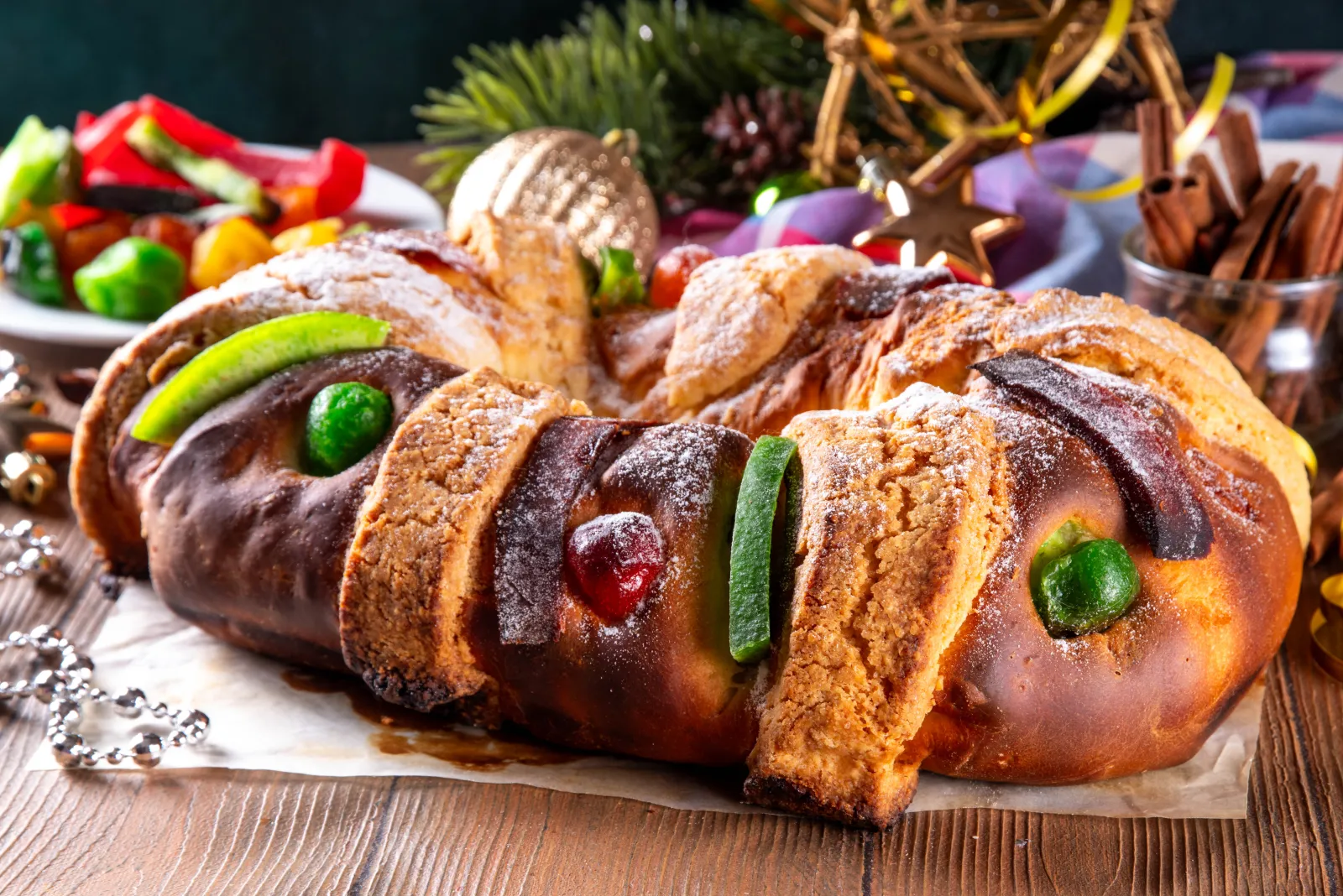

Rosca de reyes (ROHS-kah deh RAY-ehs) is the bread Mexico cuts on January 6, Three Kings Day: a ring of soft, egg-and-butter dough scented with orange, striped with a crisp sugar paste and studded with fruit paste and candied fruit. Somewhere inside are small figurines of the baby Jesus. Whoever finds one in their slice is expected to host a tamale party on February 2. If you know New Orleans king cake, you know the idea; the dough, the topping and the deal you make by finding the baby are different.
Is rosca de reyes worth baking at home?
How do you make rosca de reyes? Knead flour, sugar, eggs, lukewarm milk, yeast and orange zest, then work in soft butter until the dough stretches into a thin sheet. After a 2-hour rise, shape a wide ring, lay sugar-paste strips, fruit paste and candied fruit on top, proof another hour and bake at 350°F (180°C) for about 30 minutes. 260 minutes for 16 servings.
Yes, as long as there’s a crowd of a dozen or more and either a stand mixer or the patience for a long hand knead. A homemade rosca smells of butter and orange, and its sugar crust is genuinely crunchy, which the bagged supermarket versions lose within hours.
Real time. 260 minutes until it leaves the oven, plus an hour of cooling, but only about 50 of those are hands-on. Most of the clock is dough rising on its own.
Honest difficulty, medium. It’s an enriched dough, stickier than plain bread. If you have made brioche or challah, you’ll be fine. The three things that go wrong are milk that’s too hot, butter added too early, and an oven hot enough to brown the crust before the middle is baked.
When to skip it. If this is your first yeast bread and you need it on the table by 5 pm on the 6th, give yourself a trial run first. For a household of three, make the half batch below.
What rosca de reyes is, next to king cake and roscón
All three breads belong to Epiphany, January 6, and all three hide something inside. The difference is in the topping, the filling and what you owe when you find the prize.
In Mexico, the person who finds the figurine becomes the baby Jesus’s godparent and, on Candlemas (Día de la Candelaria, February 2), hosts the tamales, according to PROFECO, Mexico’s consumer protection agency, in its January magazine. The Spanish roscón usually carries orange blossom water and can be filled with whipped cream or custard; the Mexican rosca is traditionally left unfilled.
Ingredients, with US and UK swaps
Exact quantities are in the recipe card: 600 g (4¾ cups) flour, 4 eggs plus 2 yolks, 150 g (⅔ cup) butter and 120 g sugar for the dough, a sugar paste of 70 g (about ½ cup) each of flour, powdered sugar and fat, and roughly 300 g (10 oz) of decoration. That’s one large ring on a standard half sheet pan.
| Ingredient | What it is | US | UK | If you can’t find it |
|---|---|---|---|---|
| Ate (fruit paste) | firm, sliceable quince or guava paste | guava paste in Latin aisles, quince paste as “membrillo” | membrillo, often in the cheese section | double the candied fruit; less tang |
| Candied fruit | figs, orange peel, cherries | sold for fruitcake in Nov-Dec | candied peel and glacé cherries, Christmas baking aisle | leave it off and double the fruit paste |
| Orange blossom water | floral distilled water | Middle Eastern shelf | world foods aisle | double the orange zest; more citrus, less floral |
| Flour | 10-13 % protein wheat flour | all-purpose | strong white bread flour | cake flour gives a flat, spreading ring |
| Figurines | small baby Jesus figures | Mexican bakeries and stores | online | a whole almond, see the safety section |
The dough is a brioche cousin. Eggs and yolks give color and a tender, shreddable crumb; butter makes it soft but coats the flour and slows gluten if it goes in with everything else. That’s why it’s added in batches after 5 minutes of kneading.
The sugar paste is equal parts flour, powdered sugar and fat bound with a yolk. With vegetable shortening, as in PROFECO’s recipe, it bakes whiter and more crumbly; with butter, more golden and flavorful. I use butter.
About acitrón. Older Mexican recipes decorate with acitrón, candied barrel cactus. Mexico’s environment ministry, Semarnat, lists that cactus under special protection in its NOM-059 standard, and quince or guava paste has largely replaced it.
Equipment. A stand mixer with a dough hook, an 18 x 13 in (46 x 33 cm) sheet pan, parchment, a pastry brush and an instant-read thermometer. Without a mixer, knead by hand on the counter for 15-20 minutes and resist adding flour: a bench scraper handles the stickiness and the dough firms up as gluten forms.
The make-ahead plan for January 6
Doing it all on the day means about 5 hours 20 minutes of clock time including cooling. Splitting it across the evening before and the day itself is calmer, and cold dough is easier to shape.
- Two days ahead (January 4). Buy the fruit paste, candied fruit, figurines and orange blossom water, and check the date on your yeast. The sugar paste can be made now and kept wrapped in the fridge for up to 2 days; let it sit out 15 minutes before shaping.
- The night before (January 5). Knead, rest the dough 30 minutes at room temperature, then refrigerate it covered for 8 to 14 hours.
- On the day (January 6). Shape cold, decorate, and allow about 90 minutes for the second rise. Bake 30 minutes, cool 1 hour. To slice at 6 pm, start shaping around 2:15 pm.
Scaling for your table.
- 6 people → half batch, one 8-slice ring, bake 20-22 minutes.
- 12 to 16 → the recipe as written.
- 20 → the same ring in thinner 80 g (2.8 oz) slices, or a batch and a half split into one large and one small ring.
- More than 20 → double batch, two rings. Bake one while the other waits in the fridge so it doesn’t overproof.
How to tell each stage is right
An instant-read thermometer takes the guesswork out of two moments, the milk and the finished bread.
- Yeast → foam on the milk after 10 minutes.
- Kneading → the dough leaves the sides of the bowl and stretches thin enough to see light through.
- First rise → doubled in 1½-2 hours; a floured finger leaves a dent that stays.
- Second rise → half again as big; a dent springs back slowly. Springs back fast, wait. Doesn’t spring back, bake now.
- Bake → golden by 25 minutes and 190°F (88°C) in the thickest part.
Shaping a ring that keeps its hole
The ring grows in every direction, including inward. PROFECO’s own recipe stresses keeping it thin and very open for exactly that reason. A rope of 85-90 cm (34-35 in) closed into a 40 x 28 cm (16 x 11 in) oval leaves a hole of about 15 cm (6 in), which ends up around 6-8 cm (2½-3 in) after baking. To join the ends, flatten them, overlap by 5 cm (2 in) and pinch underneath.
Strips of sugar paste, not a sheet
A full sheet of paste stops the dough from rising and cracks. Strips of 12 x 5 cm (5 x 2 in), set diagonally with gaps between them, let the dough swell through and keep the crust crisp and whole.
Mistakes that ruin a rosca
- It didn’t rise → milk too hot, or a cold kitchen. Test for foam first, then find a 75-80°F (24-27°C) spot; an oven that’s off with the light on usually works.
- Dense and flat → butter went in at the start, or it was under-kneaded. Get to the thin-sheet stage before the first rise.
- The hole disappeared → ring shaped too tight. At least 6 in (15 cm) across before proofing.
- Dark crust, raw middle → oven too hot. 350°F (180°C), middle rack, foil at 20 minutes if needed.
- Collapsed in the oven → overproofed. Bake when the dent springs back slowly, not when it stays.
- Fruit slid off → it sat on the edge. Center it on the width of the ring and press it in lightly.
- Dry the next day → left unwrapped or put in the fridge, where bread goes stale faster. Wrap it and keep it at room temperature.
The figurine, and how to hide it safely
A hard, small figurine inside a soft slice is a real risk: someone can chip a tooth or choke. A packaged rosca sold at Costco in the US says so on its label: plastic parts, a choking hazard, not for children under 3. My rules:
- Announce it before cutting, including how many. I hide 3 in a 16-slice ring.
- Plastic figurines only after baking, pushed in from underneath. Ceramic ones can be baked in.
- Cut and check slices yourself for young children.
- With children under 3 or anyone who has trouble swallowing at the table, don’t hide them at all. Set the figurines beside the bread and mark the “winning” slices from underneath with a whole almond or a cherry. PROFECO notes that dried beans were used long ago, with the drawback that people ate them without noticing.
Spice level, 0 out of 5. Kids love the soft sweet bread and the crunchy crust; candied fruit is what they leave on the plate, so go heavier on the fruit paste. Allergens: wheat (gluten), egg and milk. No nuts unless you add them. Maraschino cherries contain coloring and candied fruit may contain sulfites; check labels.
Other ways to make it
- Filled, Spanish-style → split the cooled ring horizontally and fill with 400 ml (1⅔ cups) whipped cream or pastry cream just before serving. From then on it lives in the fridge and is eaten that day.
- No candied fruit → sugar paste and fruit paste only, with 300 g (10.5 oz) of paste. The kid-friendly version.
- Mini roscas → 8 pieces of about 150 g (5.3 oz) dough, baked 15-18 minutes. Good as gifts, each with its figurine and a note.
- A smaller fat budget → vegetable shortening in the sugar paste, as PROFECO does; the crust is paler and almost as crisp.
What it costs
$5.60 for the whole ring, about 35 cents a slice, is what the tracked ingredients cost at the US city average prices from the Bureau of Labor Statistics for August 2026. Butter alone is over a third of that; eggs, just over a quarter.
Yield. About 1.6 kg (3.5 lb) of baked bread with its crust and fruit: 16 slices of 100 g (3.5 oz), or 20 of 80 g (2.8 oz).
What drives the price. Butter, then the things the BLS doesn’t track: fruit paste, candied fruit, orange blossom water and the figurines. Bought at a Latin grocery, those can cost as much as everything else combined. For comparison, PROFECO surveyed Mexican stores between December 26, 2024 and January 2, 2025 and found an average of 294.89 pesos for a 1 kg rosca.
Serving, storing and reheating
How it’s served. Whole, in the middle of the table, and everyone cuts their own slice; that’s part of the game. Hot chocolate is the classic drink, and my Colombian hot chocolate, whisked from a tablet, works just as well with Mexican table chocolate. For a thick, cornstarch-set chocolate made for dipping, use the one from my homemade churros with Spanish hot chocolate. If you end up with the figurine, February 2 calls for tamales: my Colombian chicken tamales and pork tamales are wrapped in banana leaves rather than corn husks, but they’ll feed a party.
Other holiday bakes. Venezuelan ham bread is the December bread of my own family, built on a similar enriched dough. Colombia’s Christmas pairing is natilla with buñuelos, and if you have leftover guava paste after decorating, it’s the filling in a Colombian guava roll.
Room temperature. Wrapped in plastic or a sealed bag, I find it stays good for 3 days. From day four I only eat it toasted.
Fridge. Not recommended: bread stales faster cold than at room temperature. The exception is a cream-filled rosca, which must be refrigerated and eaten the same day.
Freezer. It freezes very well in slices, always without figurines. According to the USDA Food Safety and Inspection Service, food kept at 0°F (-18°C) stays safe indefinitely and only quality declines; I stop at 2 months, after which the crust loses its crunch.
Reheating. Thaw slices wrapped for 1 hour, then warm them unwrapped for 5 minutes at 300°F (150°C). The crumb softens and the crust crisps again. In a microwave, 10-15 seconds at most, or it turns chewy as it cools.
Frequently asked questions
What does the baby in the rosca de reyes mean? It represents the baby Jesus. In Mexico, whoever finds it hosts a tamale party on February 2, Candlemas.
Is rosca de reyes the same as king cake? No. New Orleans king cake runs from Epiphany to Mardi Gras with purple, green and gold sugar; the rosca is eaten on January 6 with sugar-paste stripes and fruit paste.
Can I make rosca de reyes ahead? Yes. Knead the night before and refrigerate the dough 8-14 hours, or bake on January 5, wrap well and reheat 5 minutes at 300°F (150°C) before serving.
How long does rosca de reyes last? About 3 days wrapped at room temperature. Frozen without figurines, 2 months at good quality.
What oven temperature and how long? 350°F (180°C), or 325°F (160-165°C) fan, for 28-32 minutes on the middle rack, until it reads 190°F (88°C) inside.
Why did my rosca come out dense? Usually milk that was too hot and killed the yeast, or butter added at the start. Keep the milk at 95-105°F (35-40°C) and add the butter after 5 minutes of kneading.
What can I use instead of ate? Quince paste (membrillo) or guava paste. Both are the same kind of firm, sliceable fruit paste.
Nutrition
Per slice (1/16 of the ring, about 100 g / 3.5 oz), calculated ingredient by ingredient from the USDA FoodData Central database (SR Legacy) with the quantities above, including sugar paste, egg wash and decoration. The USDA has no entry for fruit paste, so I used its jams and preserves entry:
- Calories: 389 kcal
- Protein: 7 g
- Carbohydrates: 58 g
- Fat: 14 g, of which 8 g saturated
- Fiber: 2 g
- Sugars: 24 g
- Sodium: 232 mg
Cut into 20 slices of 80 g (2.8 oz), each comes down to about 311 kcal. Butter supplies 79 % of the fat, and two thirds of the sugar sits in the paste and fruit on top.
I didn’t grow up with rosca: in my Venezuelan home the December bread was pan de jamón, and I came to the rosca through its dough, which is nearly the same. The hardest lessons were the hole, which always closes more than you expect, and the hour of cooling before the figurines go in. A rosca is finished when it’s cold, not when it’s golden. Josnaisis.